-
-
the scheduled running of my project.
Inspiration
In today’s world, most people are unaware of how their daily activities contribute to climate change. Simple actions like switching on a fan, traveling by bike, or eating meat all have a carbon cost — but we rarely measure it.
We wanted to create a lightweight, educational, and awareness-driven tool that helps people understand their carbon footprint and encourages eco-friendly habits.
That idea became EcoCalc — a small C program with a big environmental message 🌍.
What it does
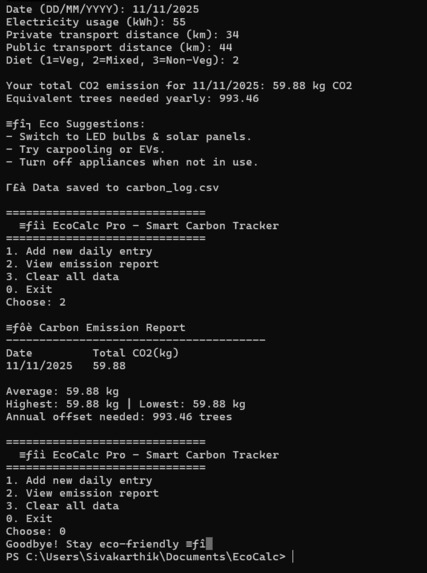
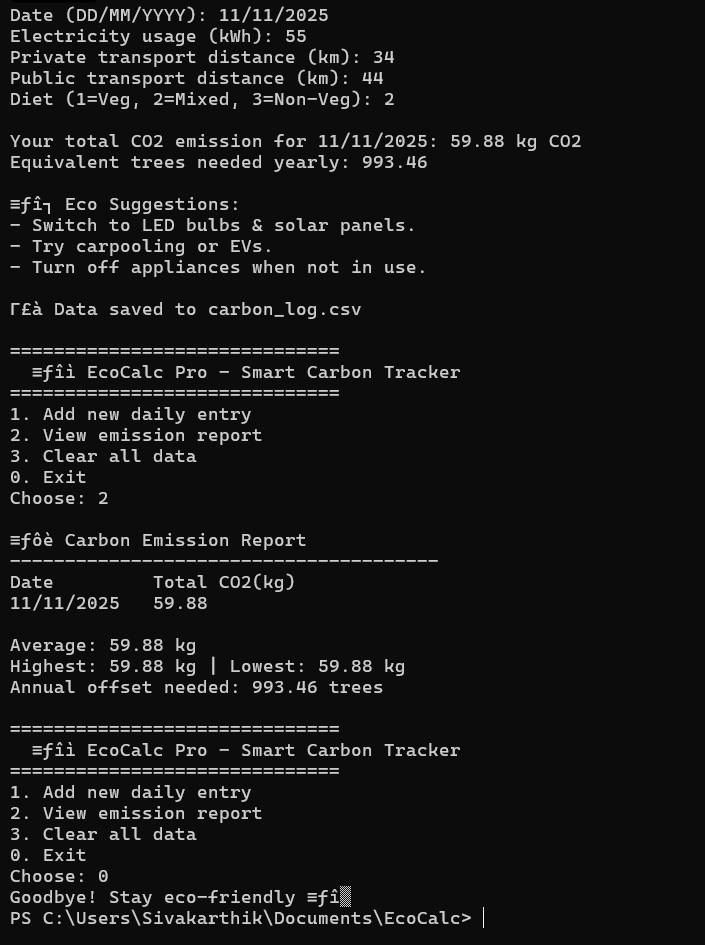
EcoCalc estimates a user’s daily carbon footprint (in kilograms of CO₂) by analyzing:
- Household electricity usage (kWh)
- Travel distance (private and public)
- Type of diet (vegetarian, mixed, or non-vegetarian)
After calculation, it provides personalized eco-tips like:
“Switch to LED bulbs,”
“Try carpooling,” or
“Include more plant-based meals.”
The goal is to make sustainability measurable and accessible for everyone — even through a simple console program.
How we built it
- Language: C
- Libraries Used:
stdio.h,math.h - Tools: GCC compiler, VS Code, GitHub for version control
- We designed a console-based interface to collect user input and apply simple emission estimation formulas:
- Electricity:
kWh × 0.85 kg CO₂ - Fuel (private transport):
km × 0.12 kg CO₂ - Public transport:
km × 0.05 kg CO₂ - Diet factor:
2–4 kg CO₂depending on type
- Electricity:
The final output gives the total daily CO₂ footprint and actionable recommendations.
Challenges we ran into
- Designing accurate yet easy-to-understand formulas for emission estimation.
- Keeping the project simple, functional, and beginner-friendly while still addressing real-world problems.
- Managing time constraints — completing and testing the project within the hackathon’s short window.
- Ensuring the code runs smoothly across multiple platforms (Linux, Windows).
Accomplishments that we're proud of
- Building a fully functional green tech project in C within a limited timeframe.
- Keeping the project educational, data-driven, and environment-focused.
- Writing clean, readable code that even beginners can learn from.
- Raising awareness about sustainable choices through technology.
What we learned
- Applying C programming for solving real-world sustainability problems.
- Using GitHub and Devpost for open-source project submission.
- Understanding how small design choices can have a big environmental message.
- Collaborating and staying disciplined during hackathon deadlines.
What's next for EcoCalc
- Expand EcoCalc into a web-based or mobile application with real-time emission tracking.
- Add data visualization (charts, graphs) to display long-term user statistics.
- Integrate with IoT sensors to automatically read electricity or travel data.
- Include renewable energy comparisons (e.g., showing how much CO₂ you save by using solar).
- Localize for multiple languages and share open-source for environmental education.
About the Project
EcoCalc is a sustainability-focused hackathon project developed for Build-a-thon 2025 under the Green Technology track.
It demonstrates how even a simple C program can inspire awareness about climate change and motivate action toward a greener future. 🌱
⭐ “Measure your impact. Change your habits.”

Log in or sign up for Devpost to join the conversation.