-
-
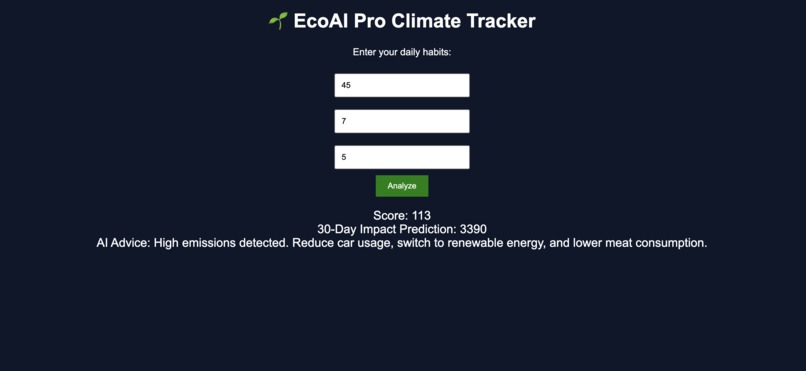
Example 2
-
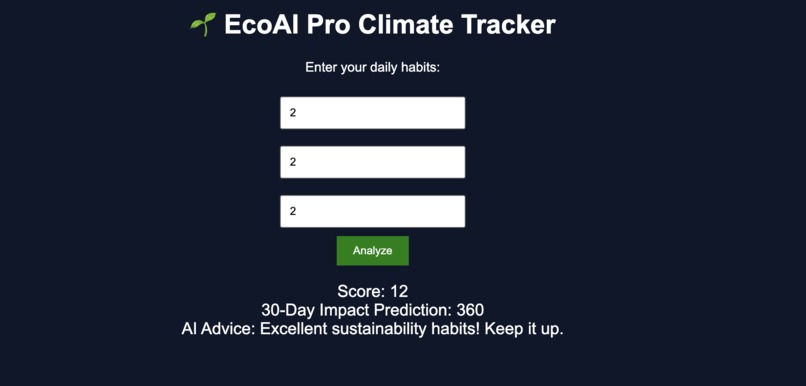
Example 1
-
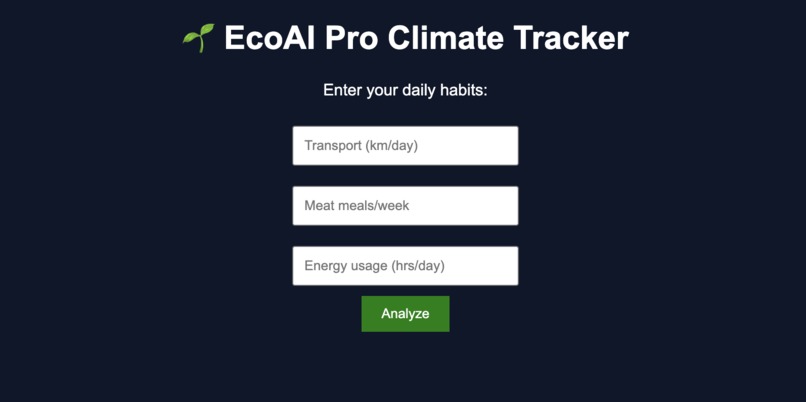
Starting Screen
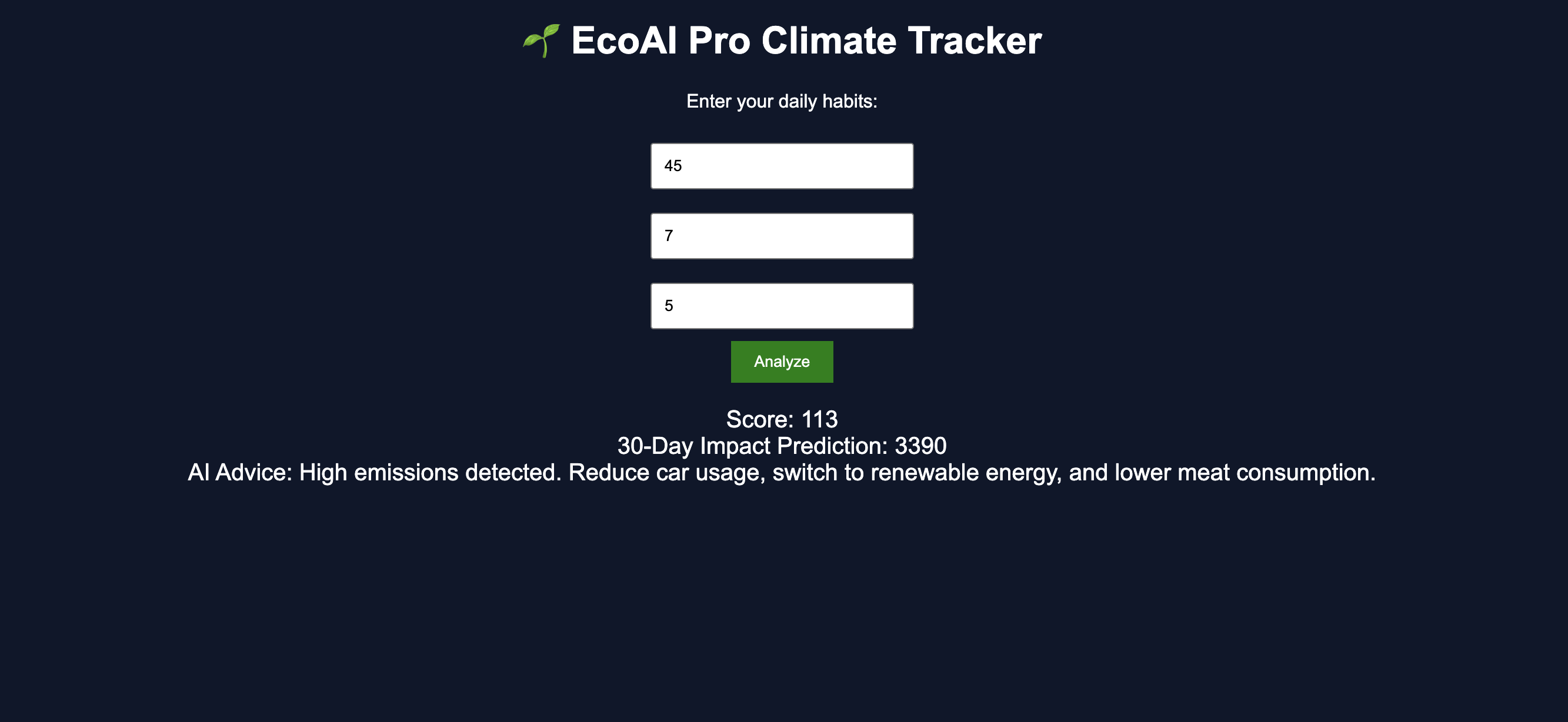
Inspiration
Climate change is one of the most urgent global challenges, directly impacting ecosystems, economies, and communities worldwide. Despite this, many individuals do not fully understand how their everyday actions contribute to carbon emissions.
I was inspired by the idea that small behavioural changes, when scaled globally, can create a significant impact by 2030. However, there is a gap between awareness and action — people need simple, personalised, and intelligent tools to guide them.
This led me to create EcoAI Pro, an AI-powered assistant that helps individuals understand and reduce their environmental impact.
What it does
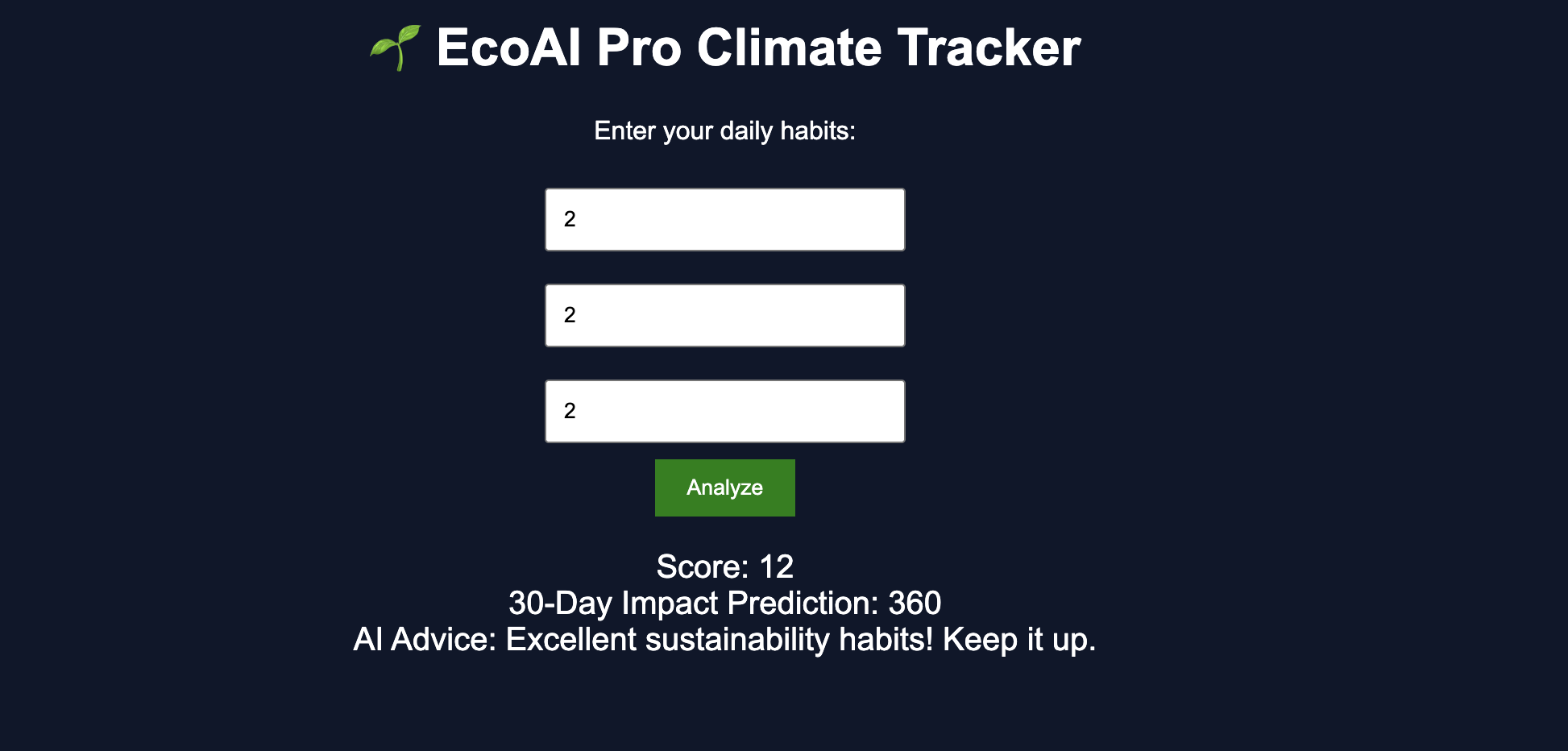
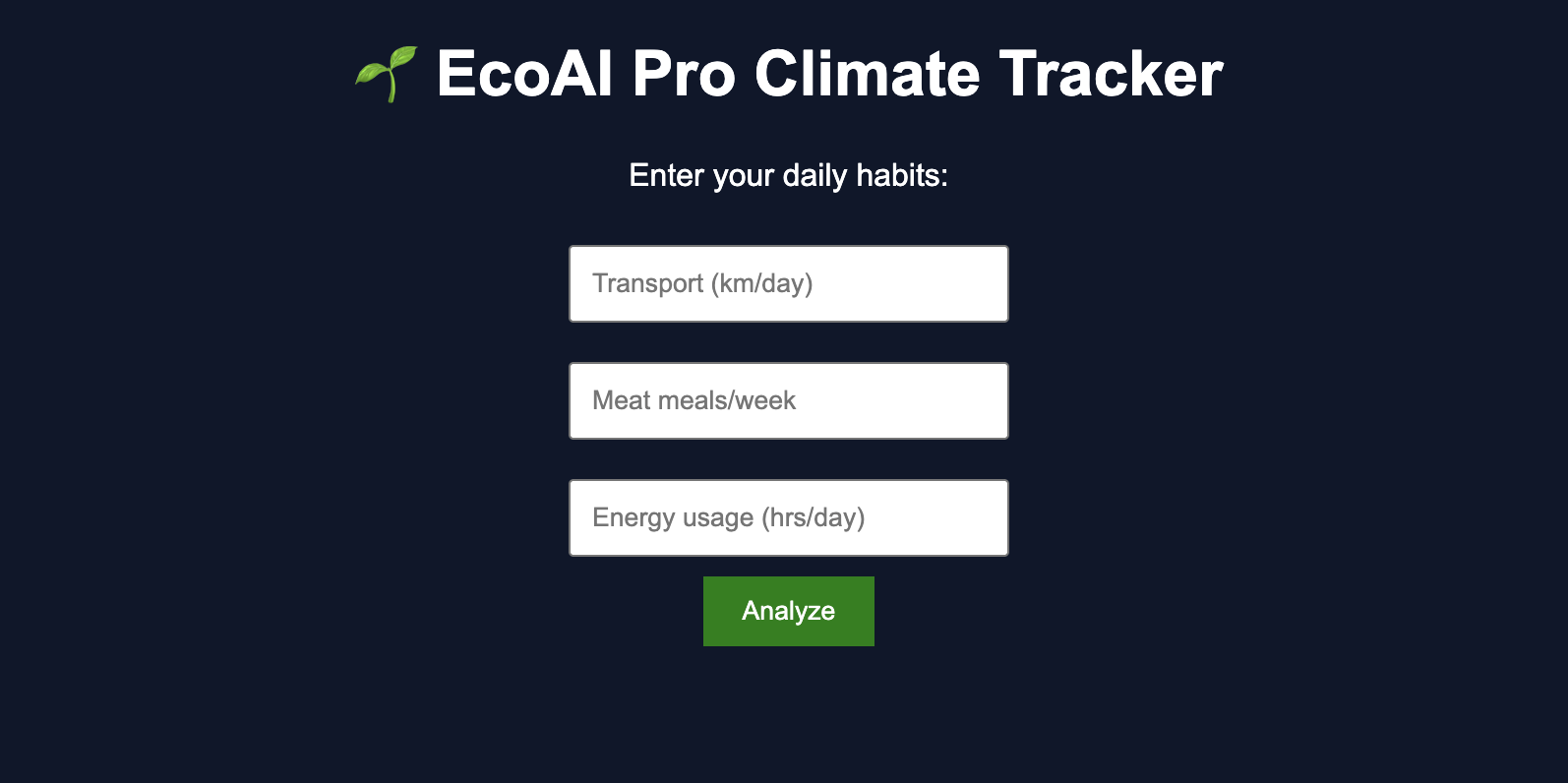
EcoAI Pro is an interactive web application that:
- Calculates a user’s personal carbon footprint
- Predicts their future environmental impact over 30 days
- Provides AI-driven personalised recommendations
Users input simple lifestyle data such as:
- Transport usage
- Dietary habits
- Energy consumption
The system then generates a carbon score, impact level, and actionable advice.
How I built it
The application was built using:
- Python + Flask for the backend server
- HTML, CSS, JavaScript for the frontend interface
- A lightweight AI-style scoring and recommendation system
The carbon footprint is calculated using a weighted model:
$$ \text{Score} = 2(\text{transport}) + 1.5(\text{food}) + 2.5(\text{energy}) $$
This model simulates how different lifestyle factors contribute to emissions.
The app also includes a prediction feature, estimating future impact:
$$ \text{30-day impact} = \text{daily score} \times 30 $$
How AI is used
While lightweight, EcoAI Pro incorporates AI-driven logic through:
- Behaviour-based analysis of user inputs
- Intelligent classification of impact levels (low, moderate, high)
- Personalised recommendations based on emission patterns
- Predictive modelling of future environmental impact
This creates a system that adapts to user behaviour and provides meaningful insights, simulating real-world AI applications.
Challenges I ran into
- Designing a model that is simple yet meaningful
- Balancing accuracy and usability for non-technical users
- Ensuring the app remained fast and interactive
- Creating a system that feels like AI without heavy datasets
What I learned
Through this project, I learned:
- How to design and build a full-stack AI-powered application
- How to translate real-world problems into technical solutions
- The importance of user experience and clarity
- How AI can be used not just for automation, but for impact and decision-making
Impact
EcoAI Pro supports the United Nations Sustainable Development Goal 13: Climate Action.
By helping individuals understand and reduce their carbon footprint, the app encourages:
- More sustainable daily habits
- Increased environmental awareness
- Data-driven decision making
By 2030, tools like EcoAI could empower millions of people to take meaningful climate action — proving that small changes can lead to global impact.
What's next
Future improvements could include:
- Real-time data integration (e.g., energy usage APIs)
- More advanced machine learning models
- A mobile app version
- Community tracking and global impact visualisation
Conclusion
EcoAI Pro demonstrates how AI can be used for social good — transforming awareness into action, and empowering individuals to be part of the solution to climate change.

Log in or sign up for Devpost to join the conversation.