-
-
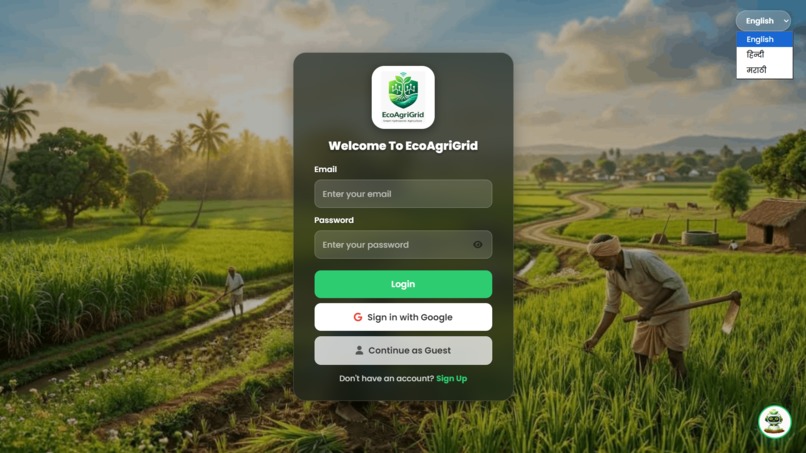
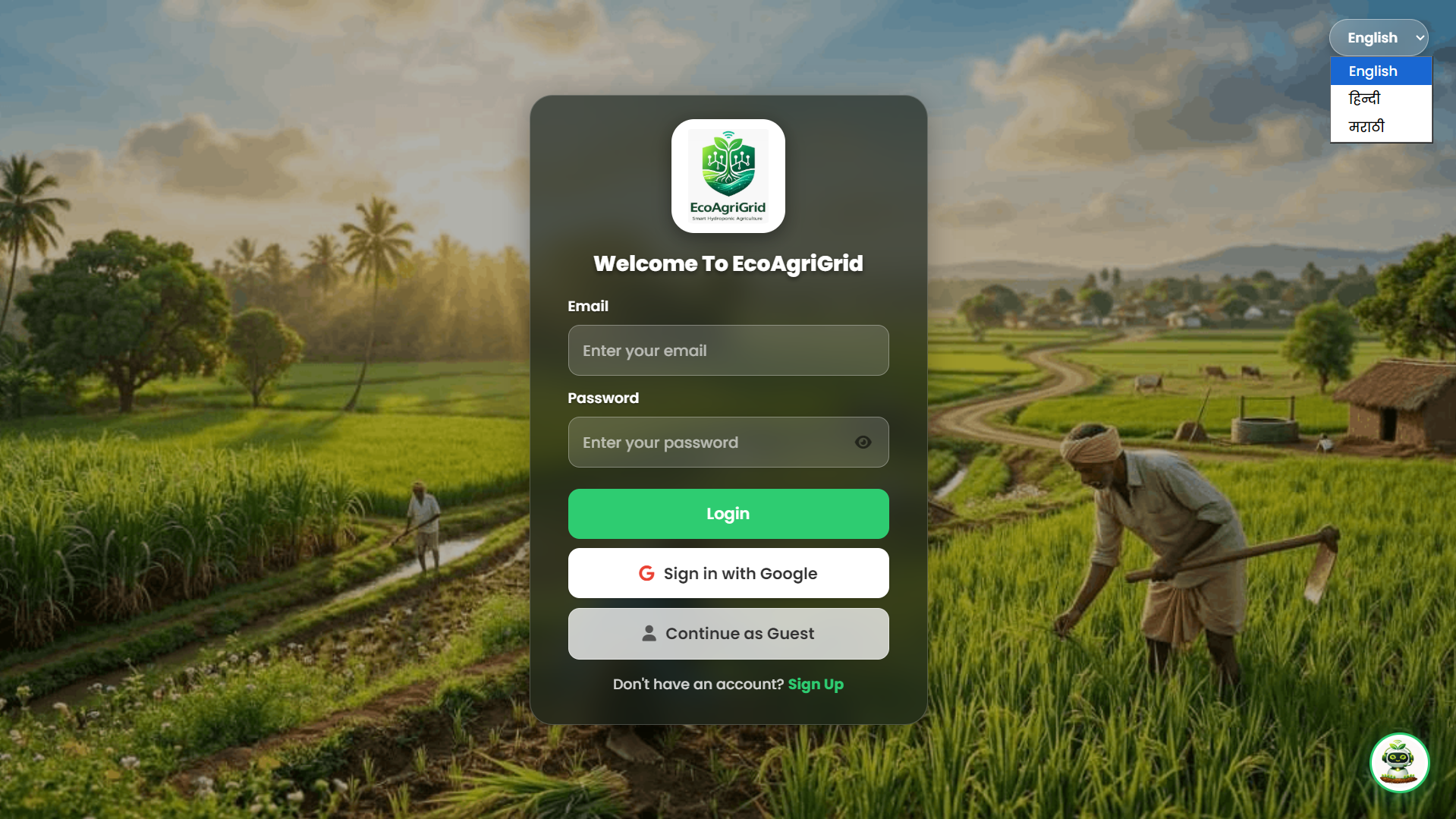
EcoAgriGrid Login Page — Supports Email, Google OAuth, and Guest Mode with English/Hindi/Marathi language switcher.
-
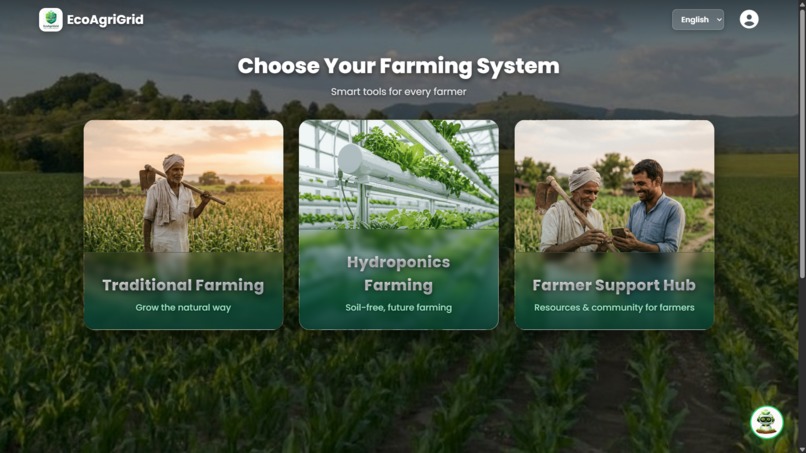
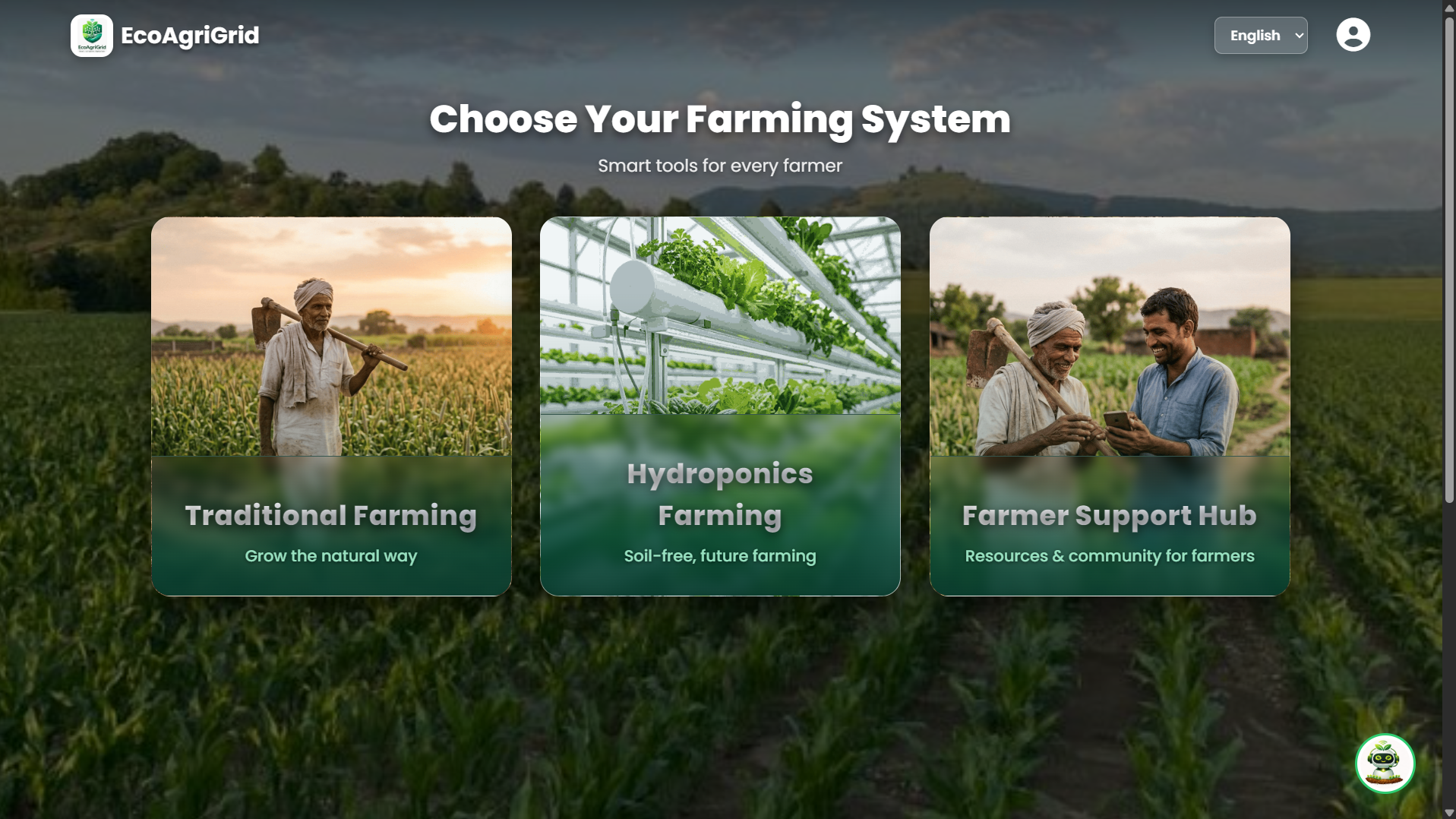
Central Hub — Choose between Traditional Farming AI, Autonomous Hydroponics Dashboard, or Farmer Support Hub
-
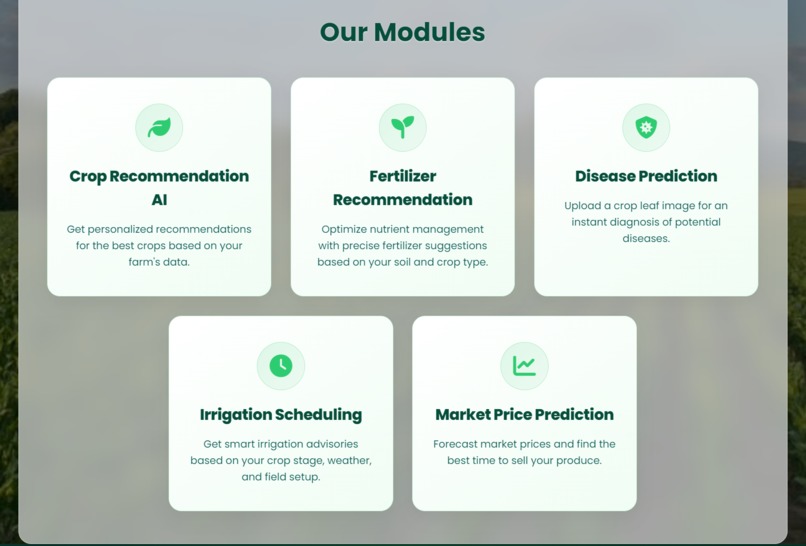
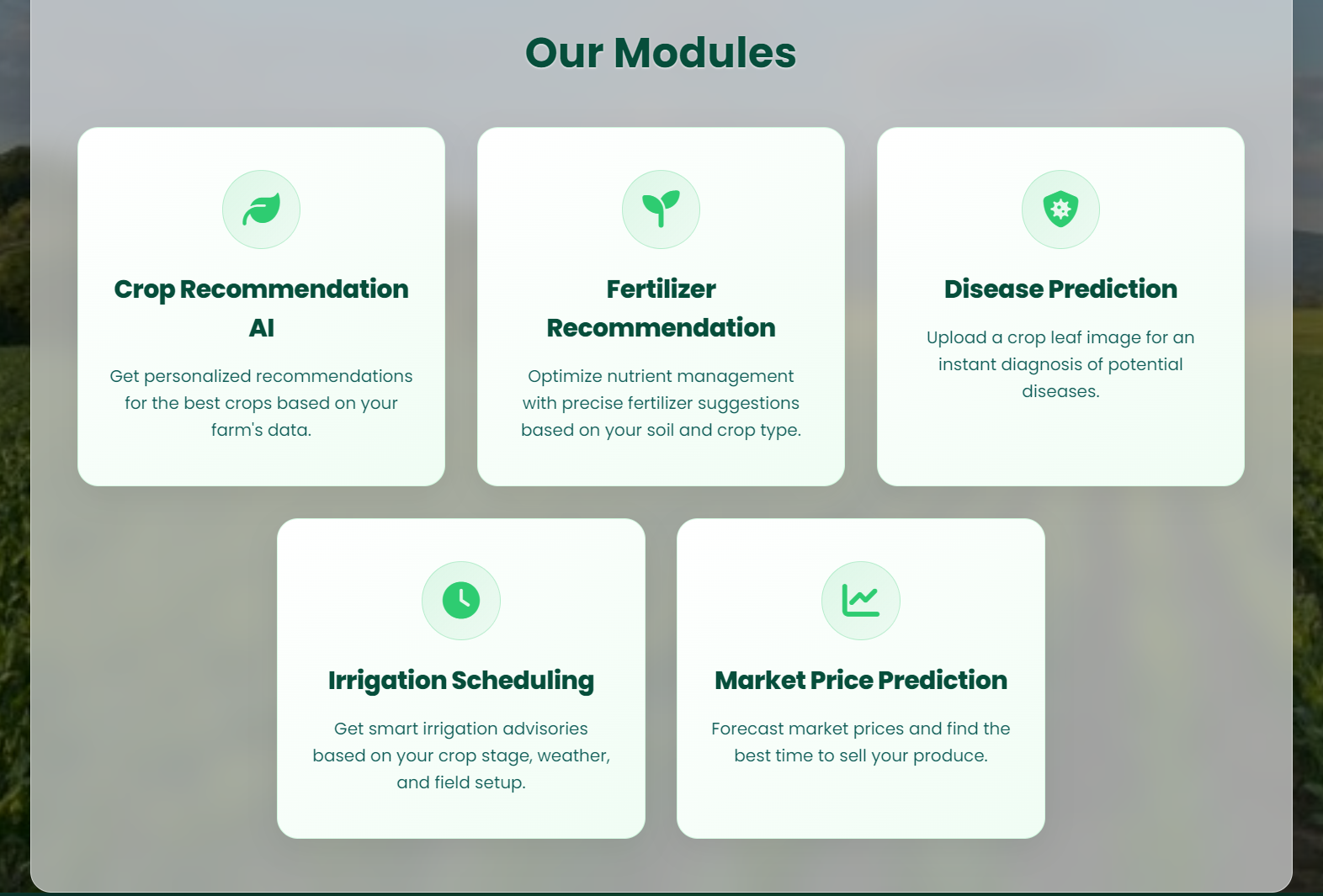
5 AI Modules: Crop Recommendation (LightGBM), Fertilizer Optimizer, Disease Detection (CNN), Irrigation Advisory & Market Prediction
-
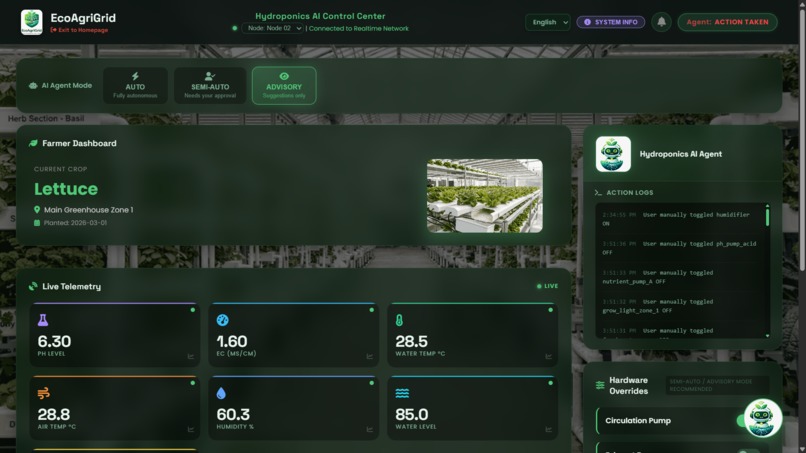
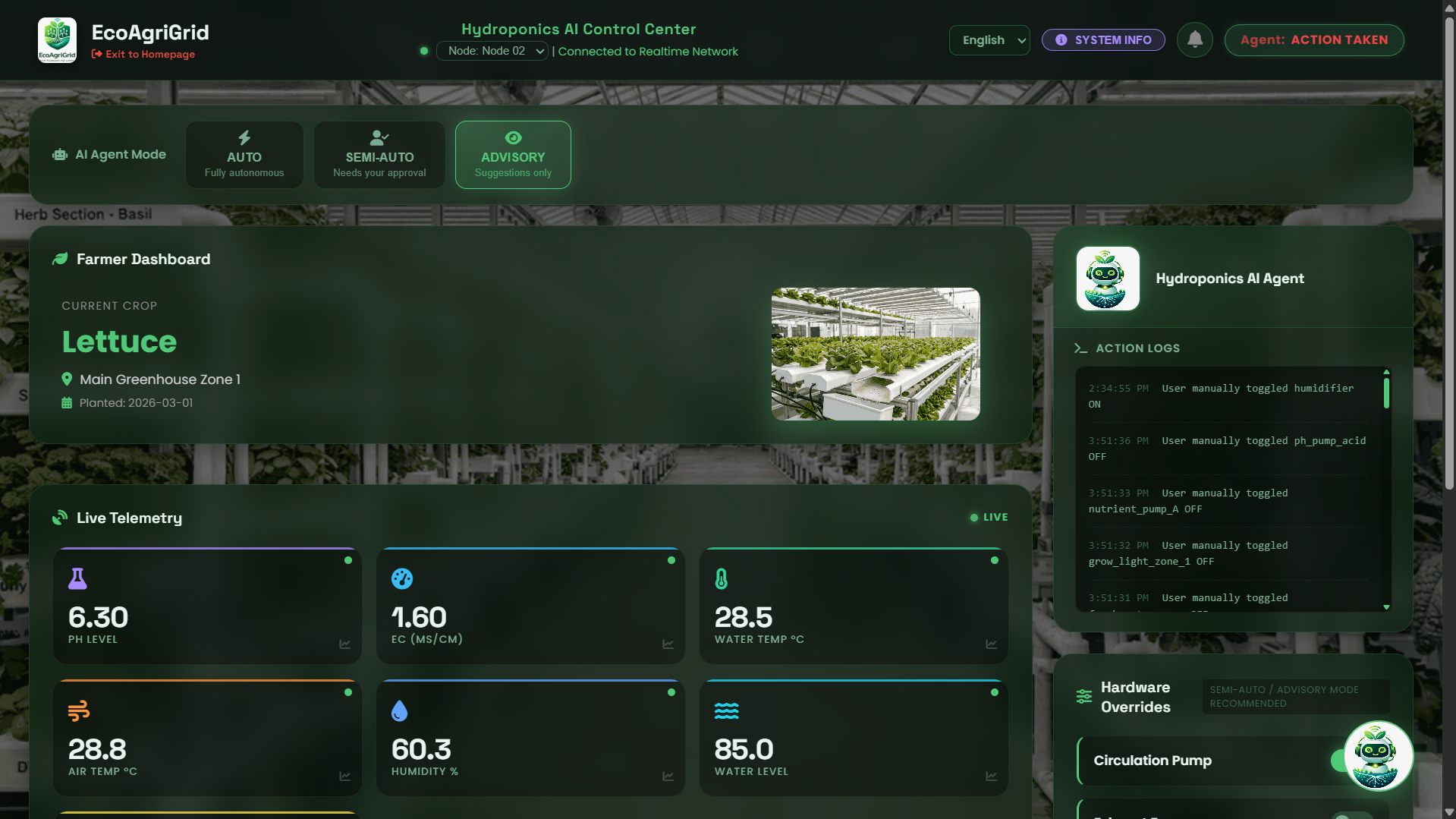
LangGraph AI Agent live dashboard — real-time pH, EC, temperature & humidity from ESP32 sensors with autonomous action logs
-
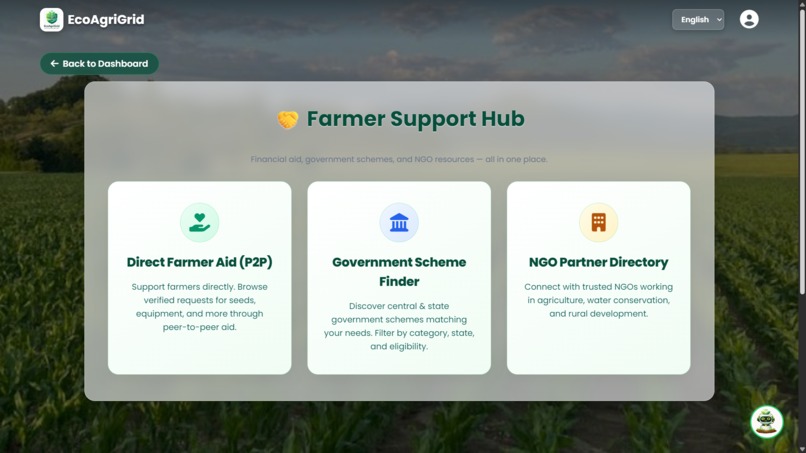
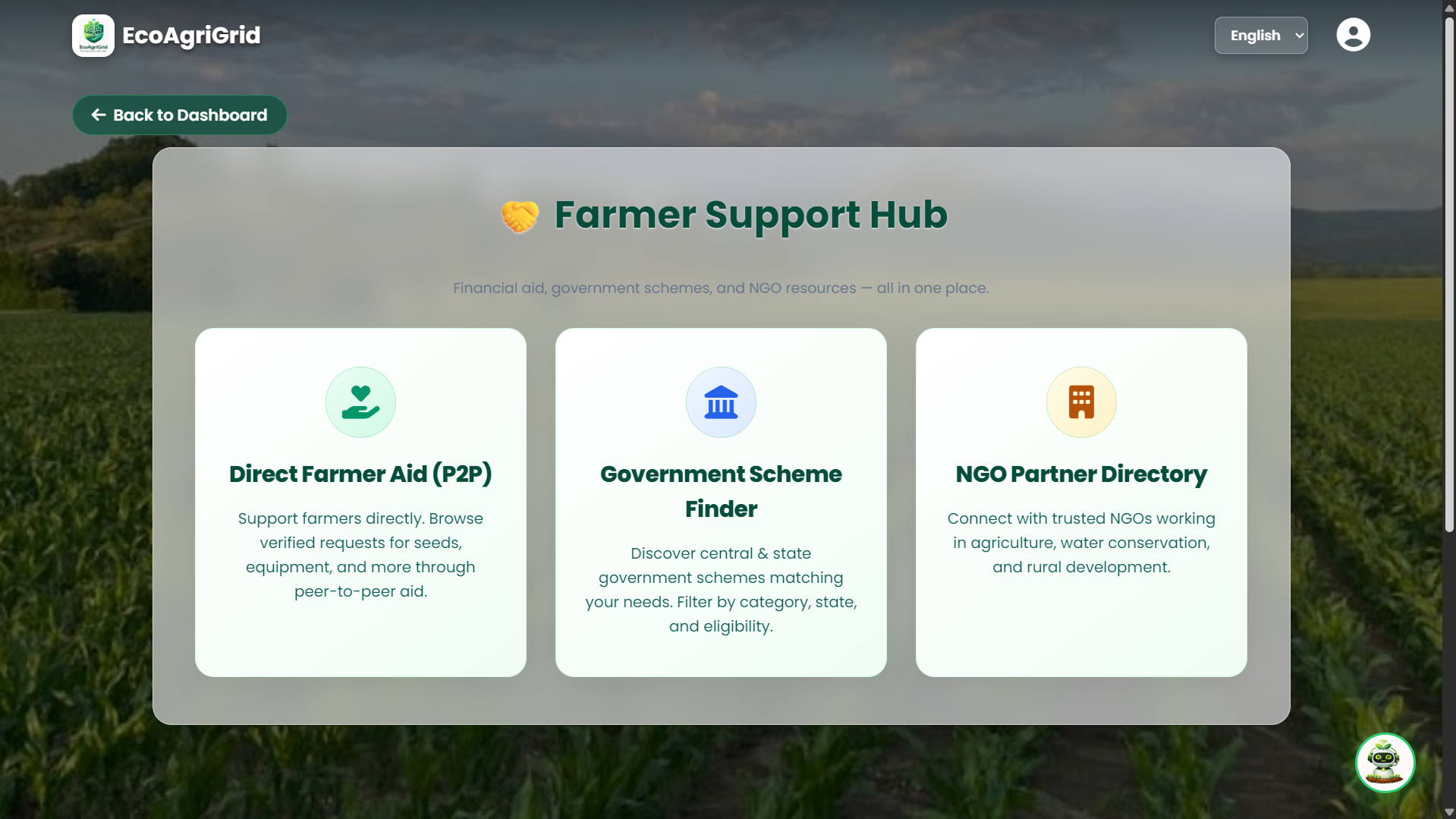
Farmer Support Hub — P2P Direct Aid, 1000+ Government Scheme Finder, and NGO Partner Directory in one place
Inspiration
India has 140 million farmers, but less than 30% have access to expert agricultural guidance. We watched farmers lose crops to preventable diseases, wrong fertilizers, and poor market timing — not because solutions don't exist, but because they're inaccessible. Hydroponics farmers face an even harder challenge: one missed pH reading can destroy an entire crop overnight. We built EcoAgriGrid to change that — putting expert-level AI in every farmer's pocket, and autonomous AI agents on every farm.
What It Does
EcoAgriGrid is a full-stack, production-deployed AI smart farming platform with three pillars:
1) Autonomous Hydroponics AI (LangGraph Multi-Agent System) : A fully autonomous IoT farm management system powered by LangGraph. ESP32 sensors stream pH, EC, temperature, and humidity to Firebase every 60 seconds. A Zero-LLM supervisor node routes to specialist AI agents only when a violation is detected — Climate Agent, pH/Nutrient Agent, Irrigation Agent, or Safety Agent. The AI writes hardware commands back to Firebase; the ESP32 executes them physically (pump on/off, fan speed, valve control) and acknowledges back. The system runs 24/7 with no human intervention.
2) AI Decision Suite for Traditional Farmers (5 ML Models) :
- Crop Recommendation : LightGBM model with GPS-based agro-climatic zone detection → Top 3 crops with confidence %.
- Disease Detection : TensorFlow MobileNet CNN → 38 disease conditions across 14 crop species in <2 seconds.
- Fertilizer Optimizer : Cosine similarity + NPK deficit engine → exact kg/hectare dosage and cost in ₹.
- Smart Irrigation Advisory : Groq LLaMA-3.3-70B (→ GPT-4o fallback) → multilingual, weather-integrated scheduling.
- Market Intelligence : Statistical seasonal model → 12-month price history + 30-day predictions + MSP comparison.
3) Farmer Support Hub :
- P2P verified crowdfunding
- 100+ government scheme finder
- NGO directory
How We Built It
- Frontend : Vanilla HTML/JS SPA deployed on Firebase Hosting with full EN/HI/MR localization.
- Backend : Python 3.10 + Flask 3.1.2 on Azure Container Apps (Docker/Gunicorn).
- ML Pipeline : LightGBM + scikit-learn (crop), TensorFlow 2.17.0 MobileNet (disease), cosine similarity (fertilizer).
- AI Agents : LangGraph orchestrator + LangChain tools + Groq LLaMA-3.3-70B + gpt-4o.
- IoT : ESP32 microcontrollers ↔ Firebase Realtime Database ↔ LangGraph agent loop.
- Database : Firebase Firestore (users, P2P), Firebase Realtime DB (IoT), Firebase Auth.
Challenges We Ran Into
- Token efficiency at scale : Designing the LangGraph supervisor to use pure Python routing (zero LLM cost) while still triggering specialist LLM agents only when needed.
- ESP32 ↔ Firebase ↔ AI synchronization : Ensuring hardware commands are acknowledged and failures are safely handled without race conditions.
- Multi-language ML output : Making LLMs generate advisories directly in the farmer's selected language (not translate after the fact).
- Cold-start latency : Solved with background-thread model pre-loading so the first API request is instant.
Accomplishments We're Proud Of
- Real IoT hardware - not simulated. Physical ESP32 nodes with real sensors controlling real actuators
- Production deployed - ecoagrigrid.web.app is live today
- 38 disease classes across 14 crop species with <2s inference
- Zero-LLM supervisor - intelligent automation without burning API tokens on every cycle
- Multi-tier AI fallback - Groq → OpenAI → Static. Farmers always get a response, even if APIs are down
What We Learned
Building a truly autonomous AI system — not just a chatbot — requires engineering discipline: knowing when NOT to call an LLM is as important as knowing when to. We also learned that real-world impact requires accessibility: multilingual support and a zero-install browser-based approach were non-negotiable for Indian farmers.
What's Next
- WhatsApp Bot integration (no browser required)
- Soil health trend tracker with NPK history
- 7-day weather-based disease risk forecast
- PWA with offline-cached advisories for low-connectivity areas
Built With
- azure
- css3
- docker
- esp32
- firebase
- flask
- groq
- gunicorn
- html5
- javascript
- langchain
- langgraph
- lightgbm
- openai
- openweathermap
- platformio
- python
- scikit-learn
- tensorflow


Log in or sign up for Devpost to join the conversation.