-
-

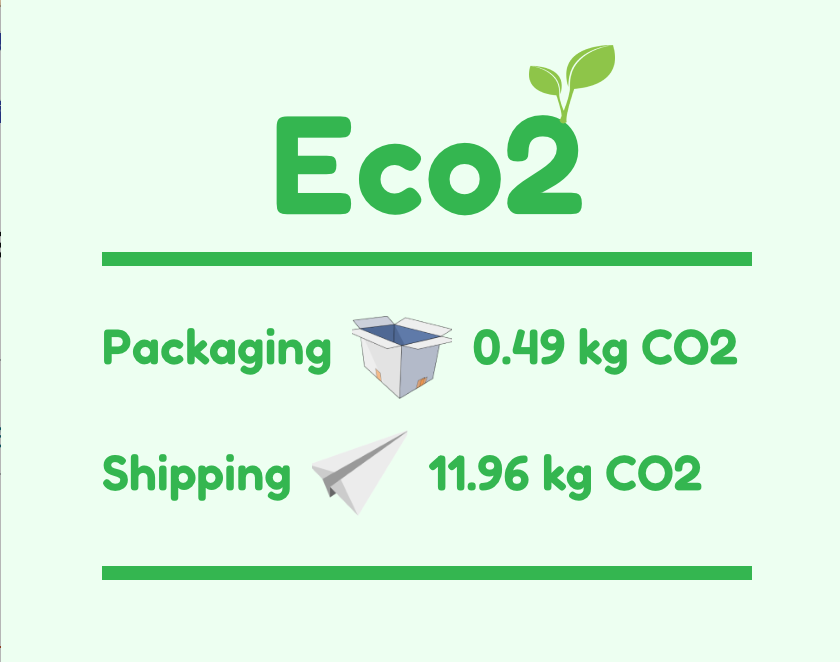
Our extension UI
-
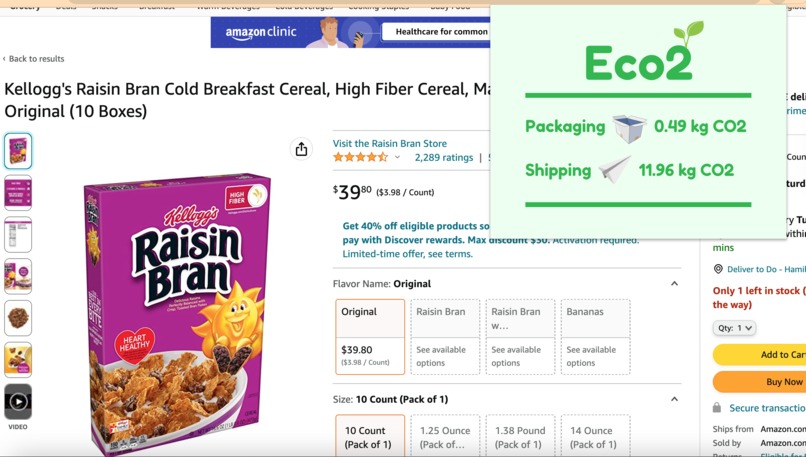
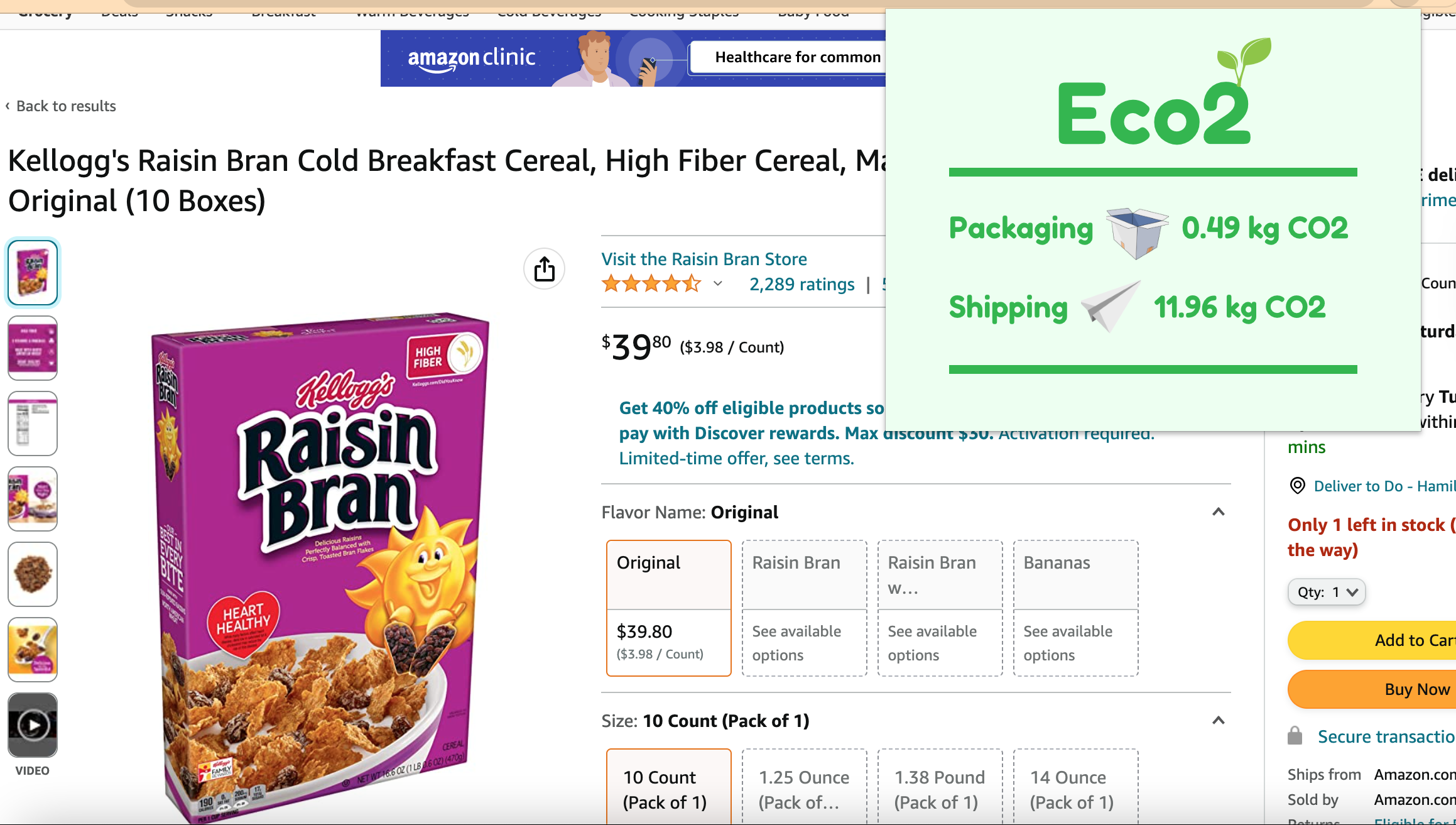
How it looks on Amazon website
-
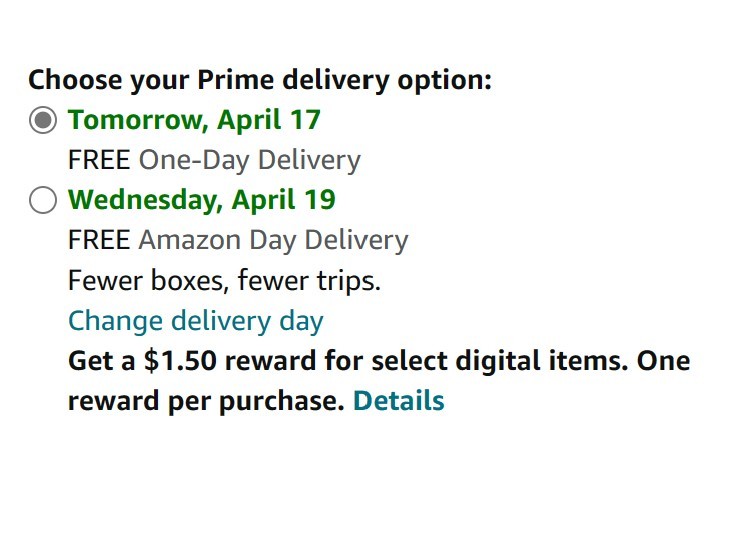
We want to help people make informed decision on their shipping method with regards to carbon footprint
Inspiration
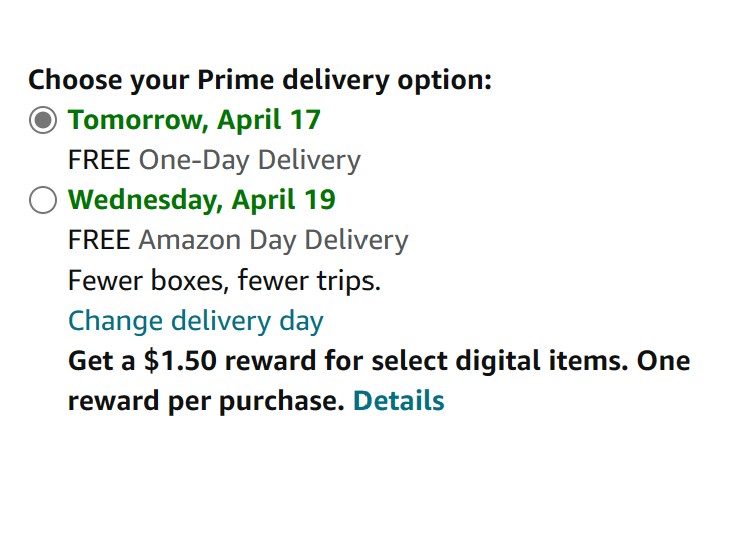
Amazon typically offers two delivery options at checkout: free One-Day Delivery for delivery by the following day, or free Amazon Day Delivery for delivery in three days, which results in fewer boxes and fewer trips. However, despite the option for a more sustainable delivery method, only 7.5% of surveyed consumers indicated that shipping dates do not influence their purchasing decisions, and a large majority (79.3%) consider free two-day shipping as the norm for online retail (source: RetailWire). To address this, we aim to create a product that encourages consumers to choose a more environmentally friendly delivery option without sacrificing the convenience of quick delivery. Our goal is to raise awareness about the impact of shipping choices on the environment and inspire consumers to make more sustainable decisions when shopping online.
What it does
When a user opens the Eco2 extension, it will parse the currently open browser for information related to the packaging of the product and get the current location of the user. Then Eco2 will calculate the carbon footprint of the packaging of the product based on our packaging algorithm, which takes into account the packaging material and the dimensions of the package. It then enables the user to view the emissions of the chosen product, as a result providing the user with an option to make an informed decision. In addition to the packaging carbon emission, we also estimate the carbon footprint of shipping based on the user’s current location. In later versions, we hope to accommodate different shipping locations based on the user’s Amazon shipping address.
Packaging Algorithm: We looked at a table showing different dimensions of boxes and their weights. We also found that for 1kg of cardboard, you produce 0.94kg of CO2. So we used the dimensions of the boxes to see what 1in^3 of cardboard weighed. We did this by multiplying all the dimensions (L*W*H) and getting the volume of the boxes in inches. We then divided both the volume and weight of the boxes. The issue was that as the volume of the boxes increased, the weight of 1in^3 of cardboard box decreased. So instead we graphed the volumes of the boxes in in^3 and their weights in kg to get an equation. This equation is y = (0.004x^0.6473) with x being the volume of the box and y being the weight of the box. We also know that for every kg of cardboard, you produce 0.94kg of CO2. This made us multiply our equation by 0.94 to give us a final equation of y = (0.004x^0.6473) * 0.94 where x is the volume of the box and y gives us the carbon emissions of the box.
Shipping Algorithm: We get all current Amazon warehouse locations and match them with their longitude and latitude and store them in our database. Then, when our customers use Eco2, we ask for the customer’s location (longitude and latitude). Our shipping algorithm finds the nearest Amazon warehouse based on the customer's current location and calculates the distance in miles between the customers and the warehouse using the Haversine formula to calculate the distance between two points on the earth's surface. Then, according to a study by the Union of Concerned Scientists, the average CO2 emissions from a diesel-powered delivery truck are approximately 161.8 grams per mile. Therefore, we multiply the distance by 161.8 grams and divided it by 1000 to get the amount of CO2 in kg for shipping.
How we built it
To develop the Chrome extension, we utilized React as the frontend technology. Additionally, we stored the Amazon location database as a JSON file, allowing us to avoid the need for a backend for the extension. Nevertheless, as our emission database continues to grow, we plan to transition to a hosted database and backend.
Challenges we ran into
During the development process, we encountered several challenges. Firstly, we faced difficulties in acquiring product data from Amazon. Furthermore, different packaging materials have varying emission rates, and accurately determining the precise location of the shipping route from the warehouse to the customer address posed another challenge. Moreover, the majority of our team members had no prior experience with React, resulting in a learning curve for them. Additionally, building a Chrome extension was a new experience for all of us, and navigating between manifest.json, the content-script, the background script, and the actual popup frontend required extensive research and a thorough understanding of the inner workings of the Chrome browser.
Accomplishments that we're proud of
We are proud that we can present a minimum viable product while learning a new tech stack under a very strict time constraint. We are also proud of making an initiative towards a social issue that can have widespread physical impacts, especially given how mainstream Amazon is.
What we learned
We learned that most companies, even corporations as big as Amazon are not liable to inform their customers of how their products are being delivered, thereby preventing the users from making an informed choice, even if they wanted to. The lack of information on the emission rates was extremely unexpected and we learned how to navigate through this difficulty. We learned how to use data to create approximate models to estimate the amount of kg of CO2 produced whether it be for packaging or shipping.
What's next for Eco2
The next step for Eco2 is to find specific product information on what materials it was made of to calculate the carbon footprint of the product itself. This includes materials like bubble wrap or styrofoam which is generally included with a lot of packaging. We also want to access the product’s data on where exactly it was produced before shipping to the warehouse/distribution centre because this can increase the total carbon footprint of the product. Finally, we will develop Eco2 to handle more online shopping platforms besides Amazon.

Log in or sign up for Devpost to join the conversation.