-
-
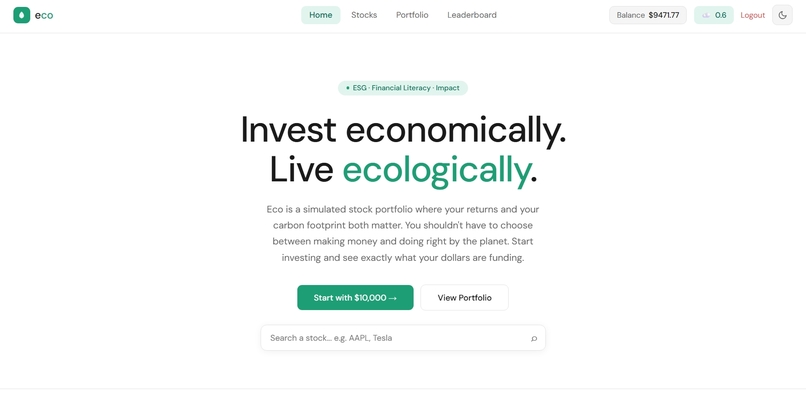
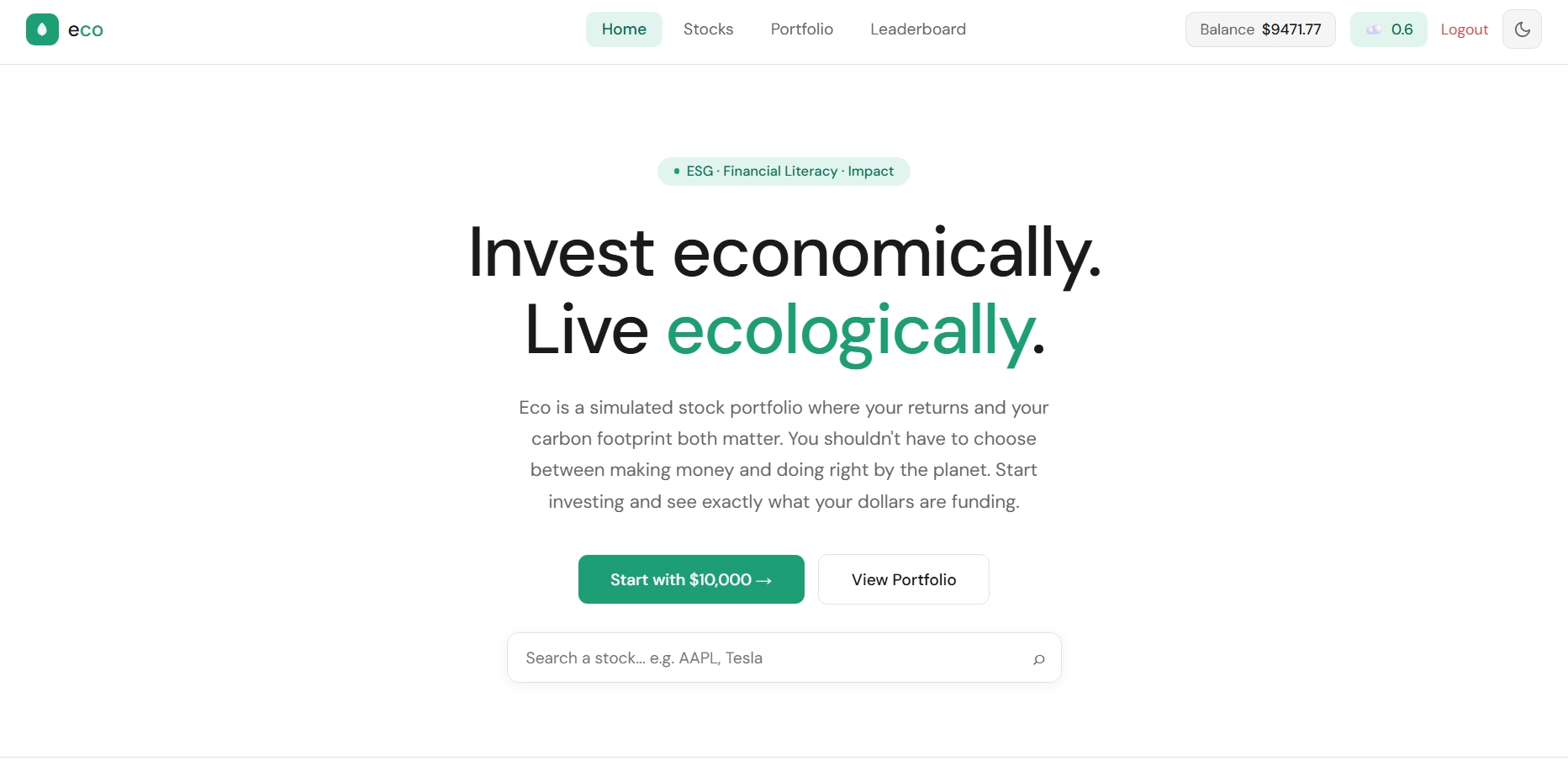
Light mode - homepage
-
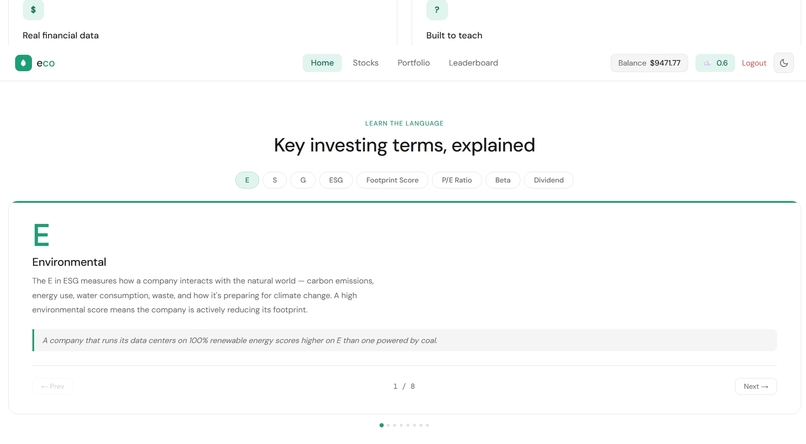
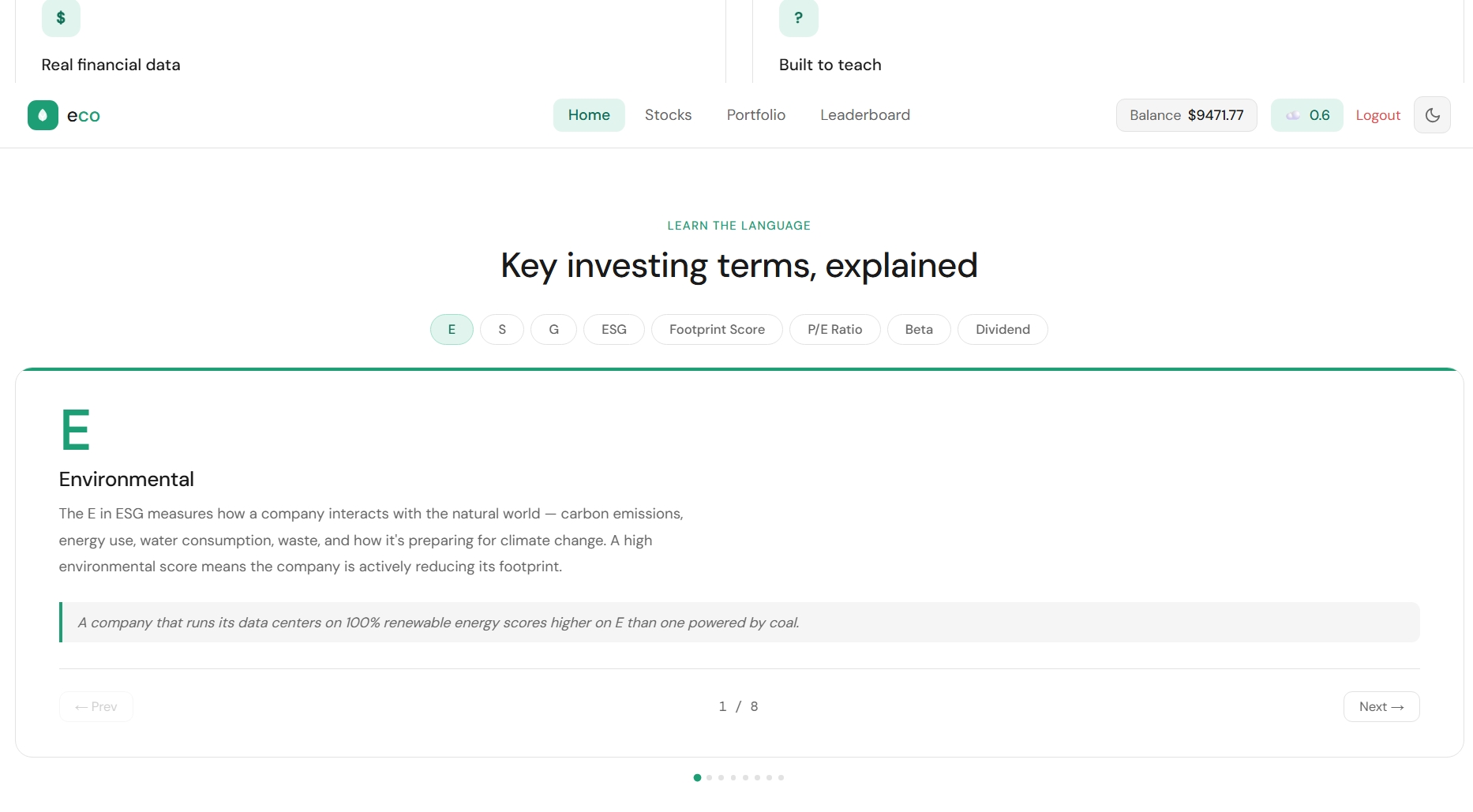
Light mode - homepage (key terms)
-
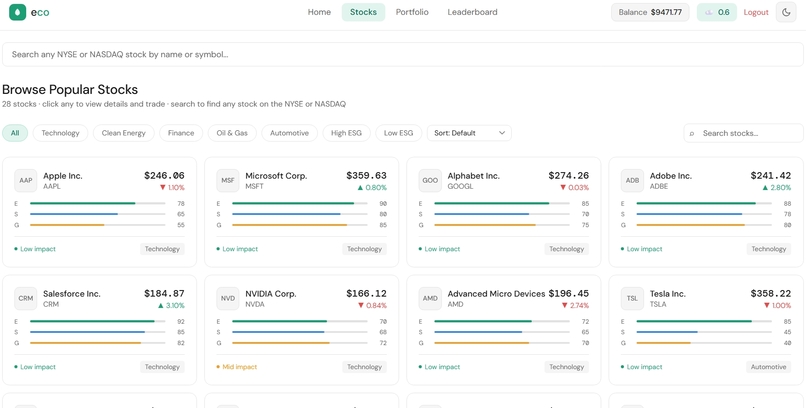
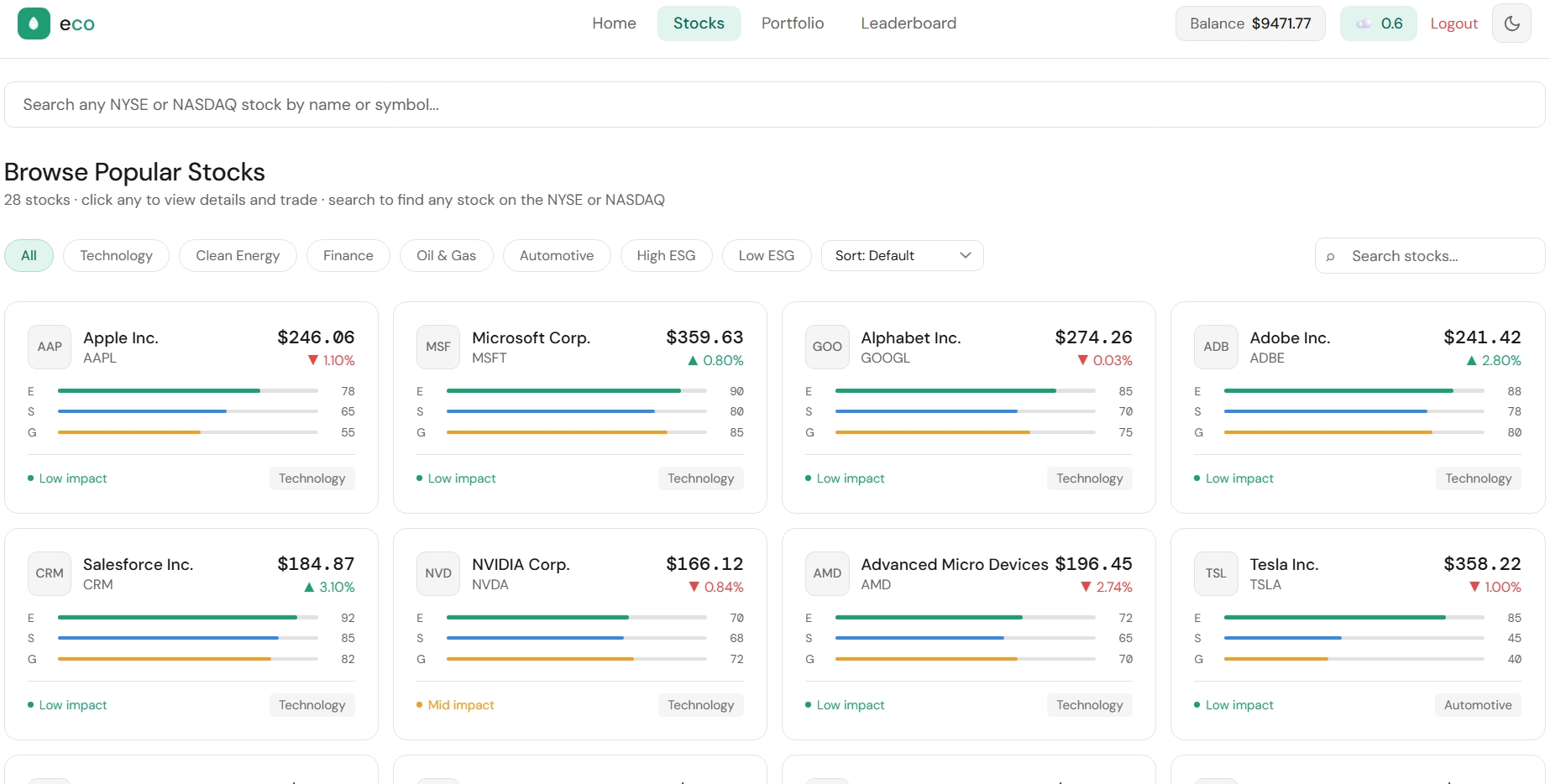
Light mode - stocks page
-
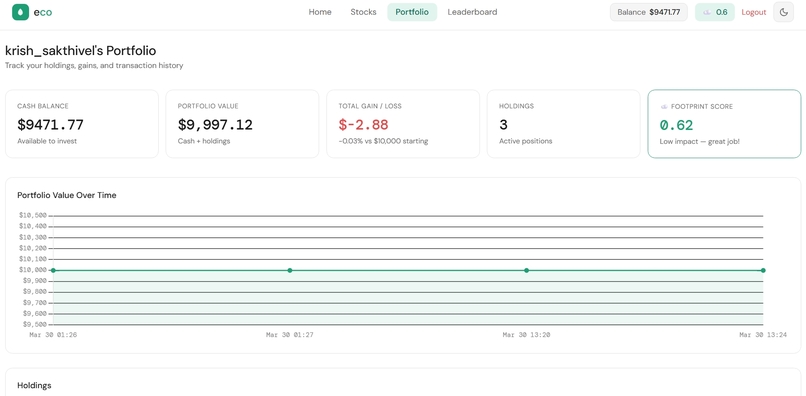
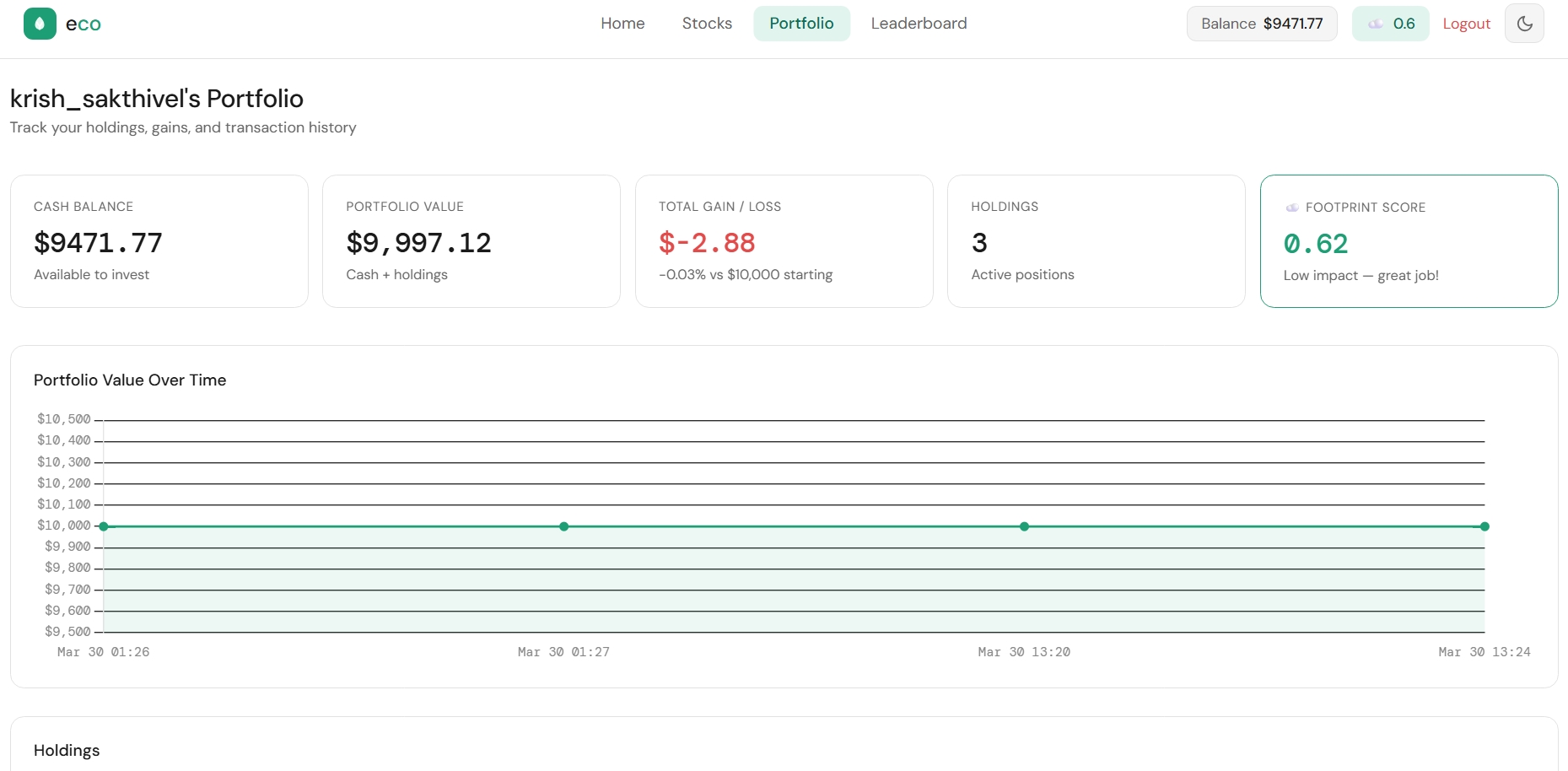
Light mode - portfolio page
-
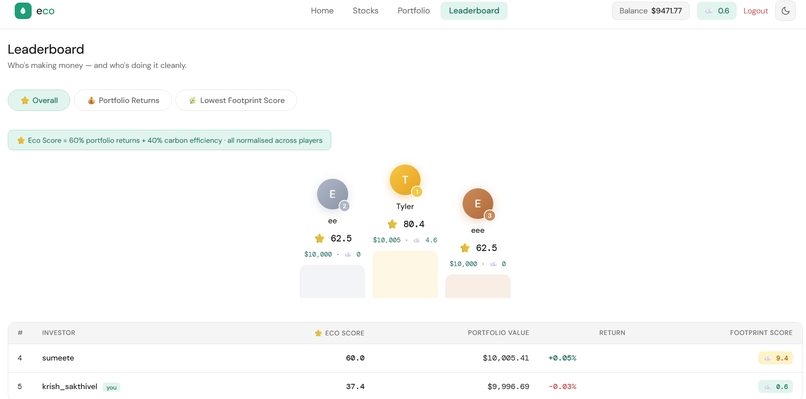
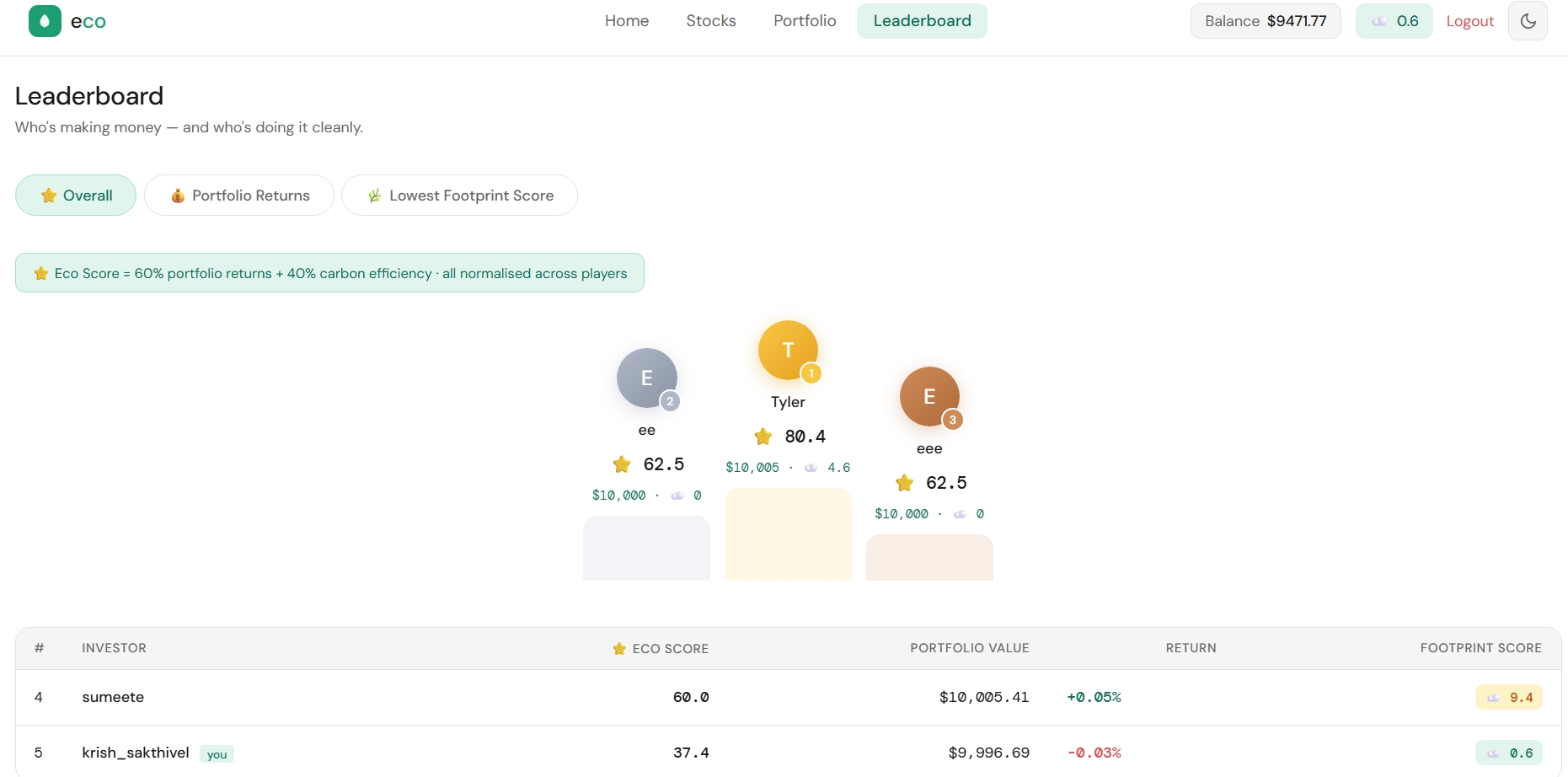
Light mode - leaderboard page
-
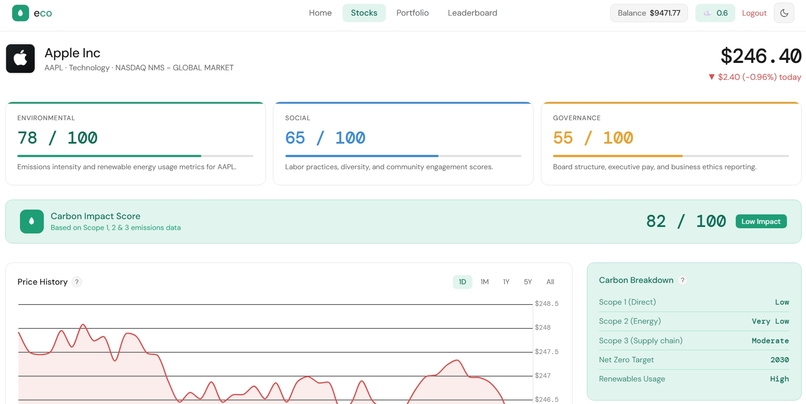
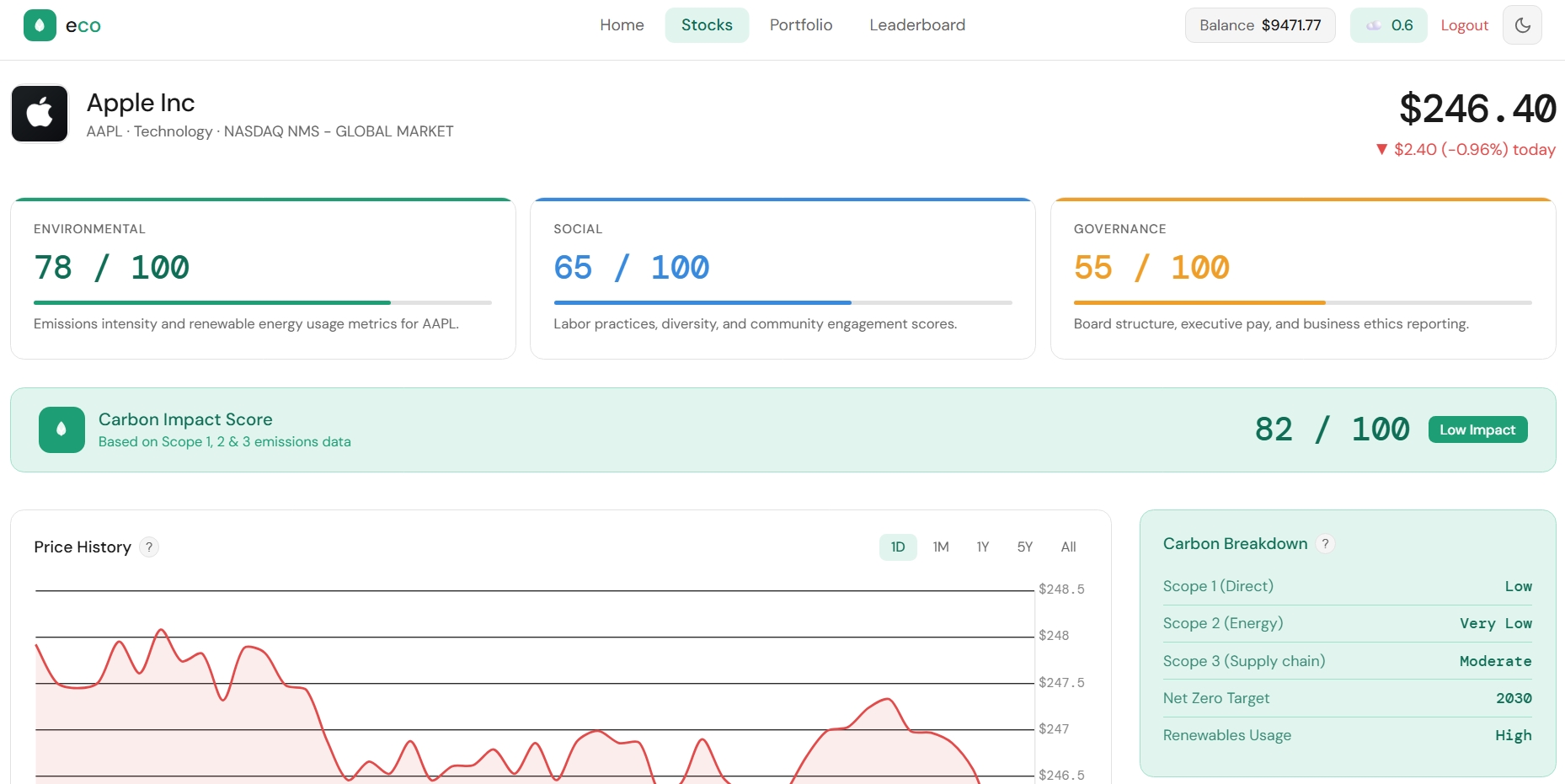
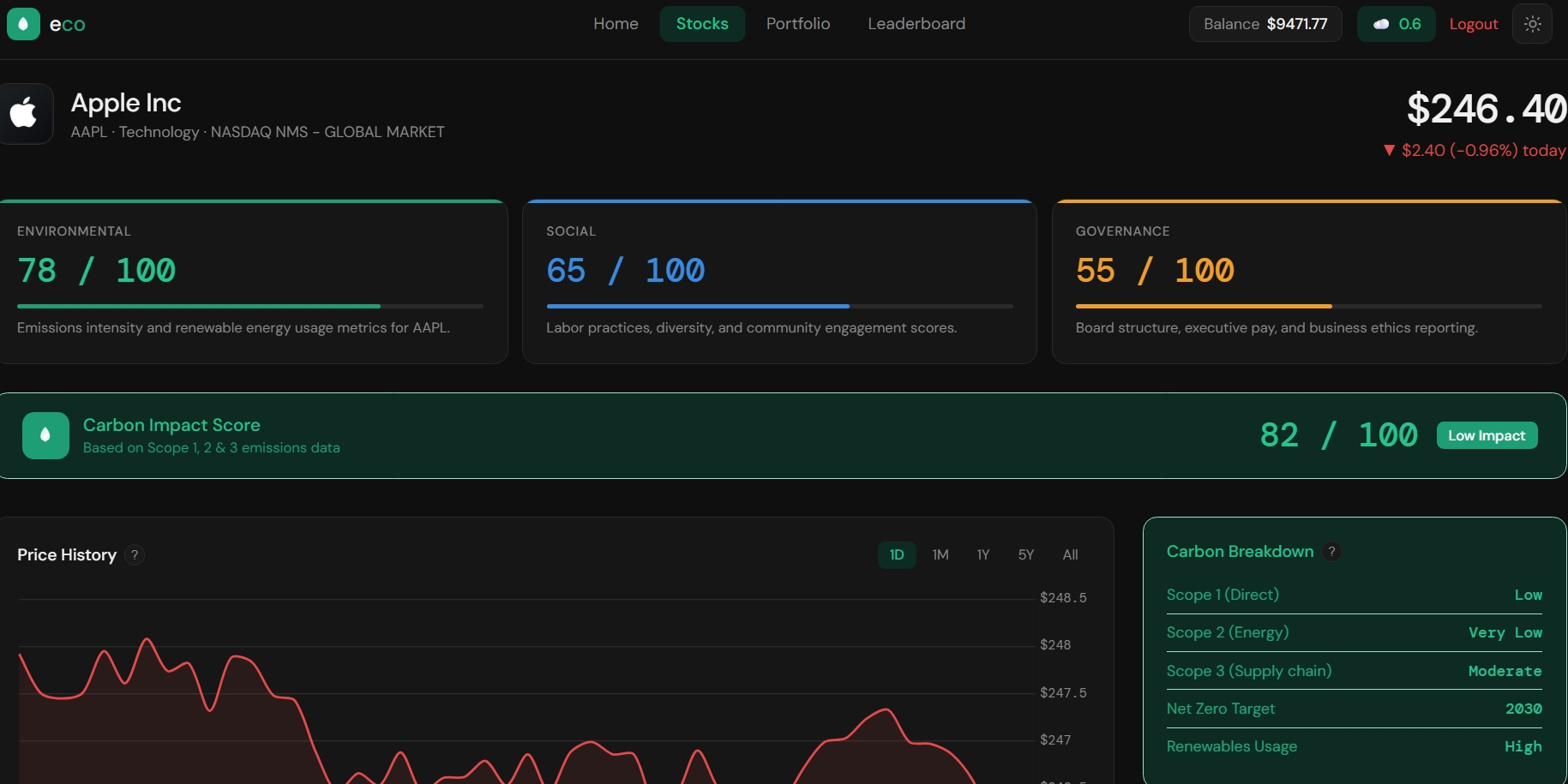
Light mode - individual stock page
-
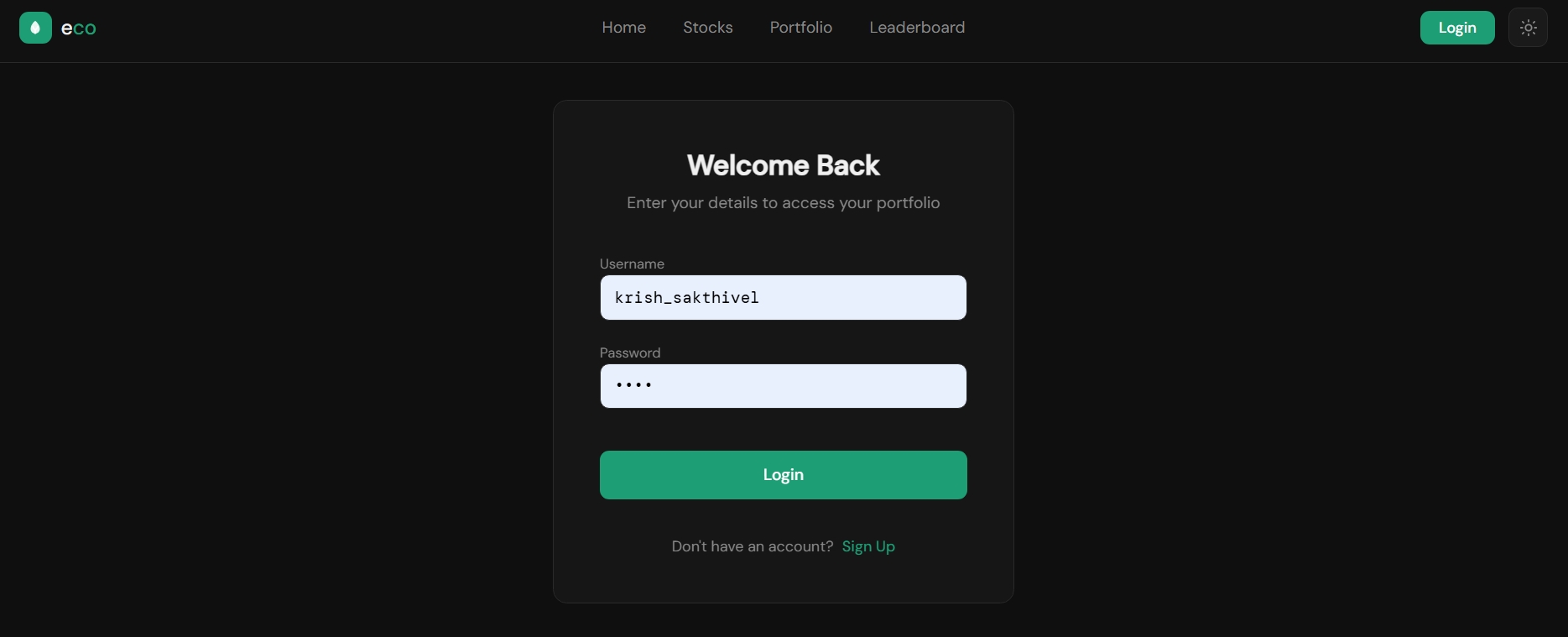
Light mode - login page
-
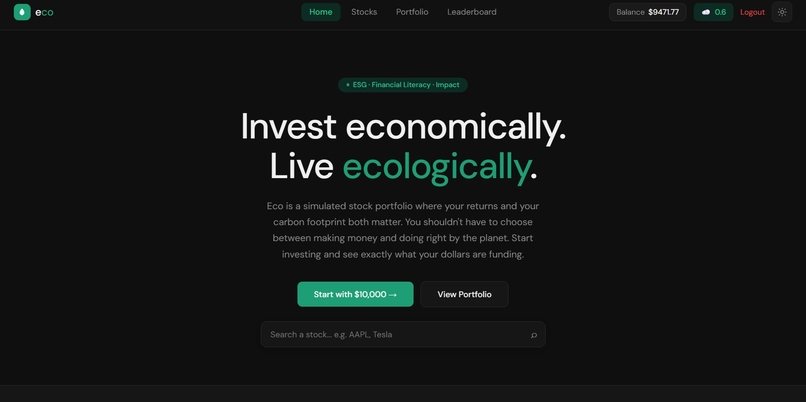
Dark mode - homepage
-
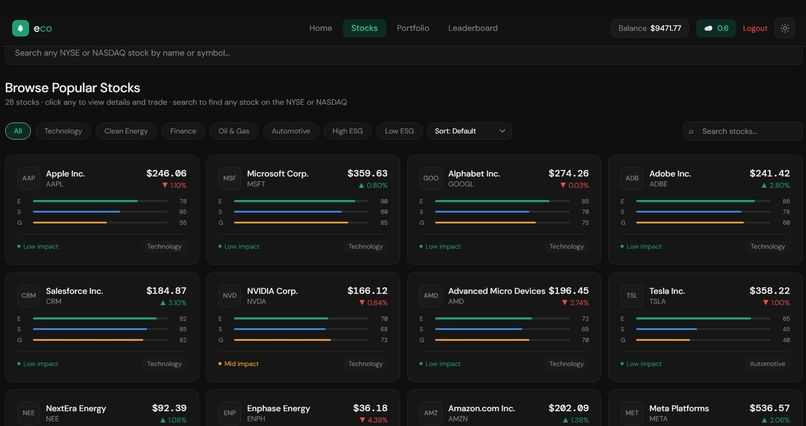
Dark mode - stocks page
-
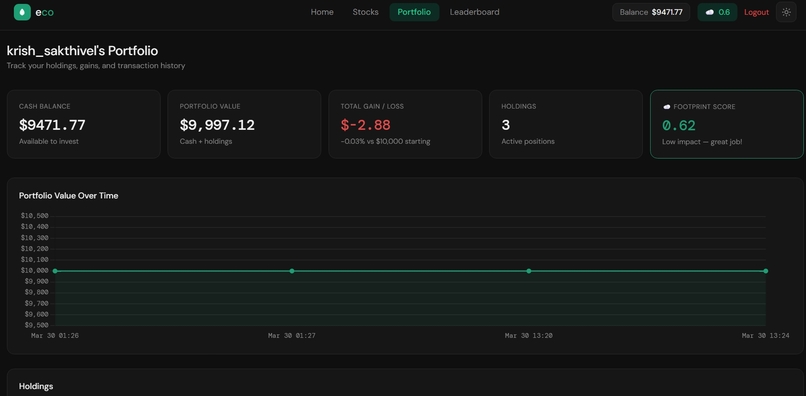
Dark mode - portfolio page
-
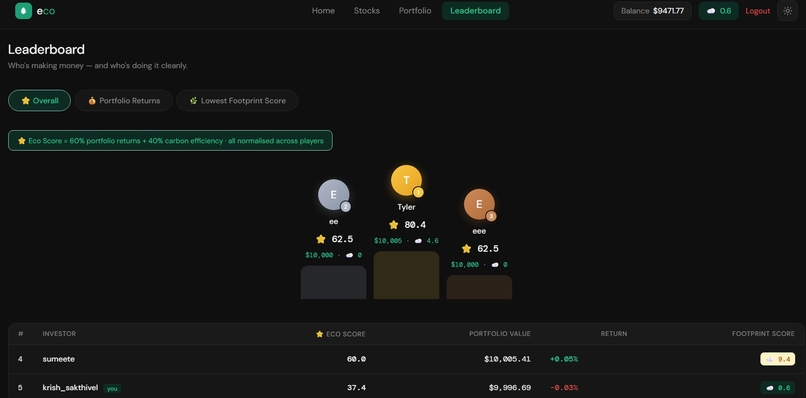
Dark mode - leaderboard page
-
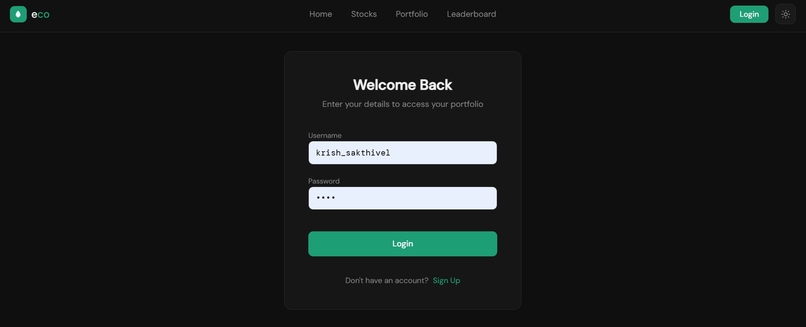
Dark mode - login page
-
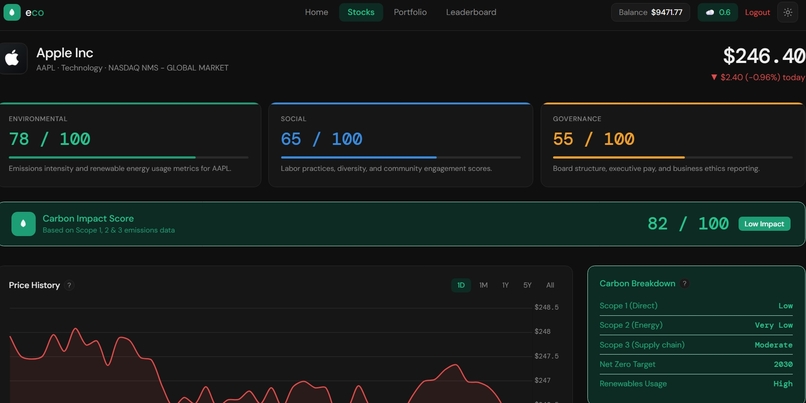
Dark mode - individual stock page
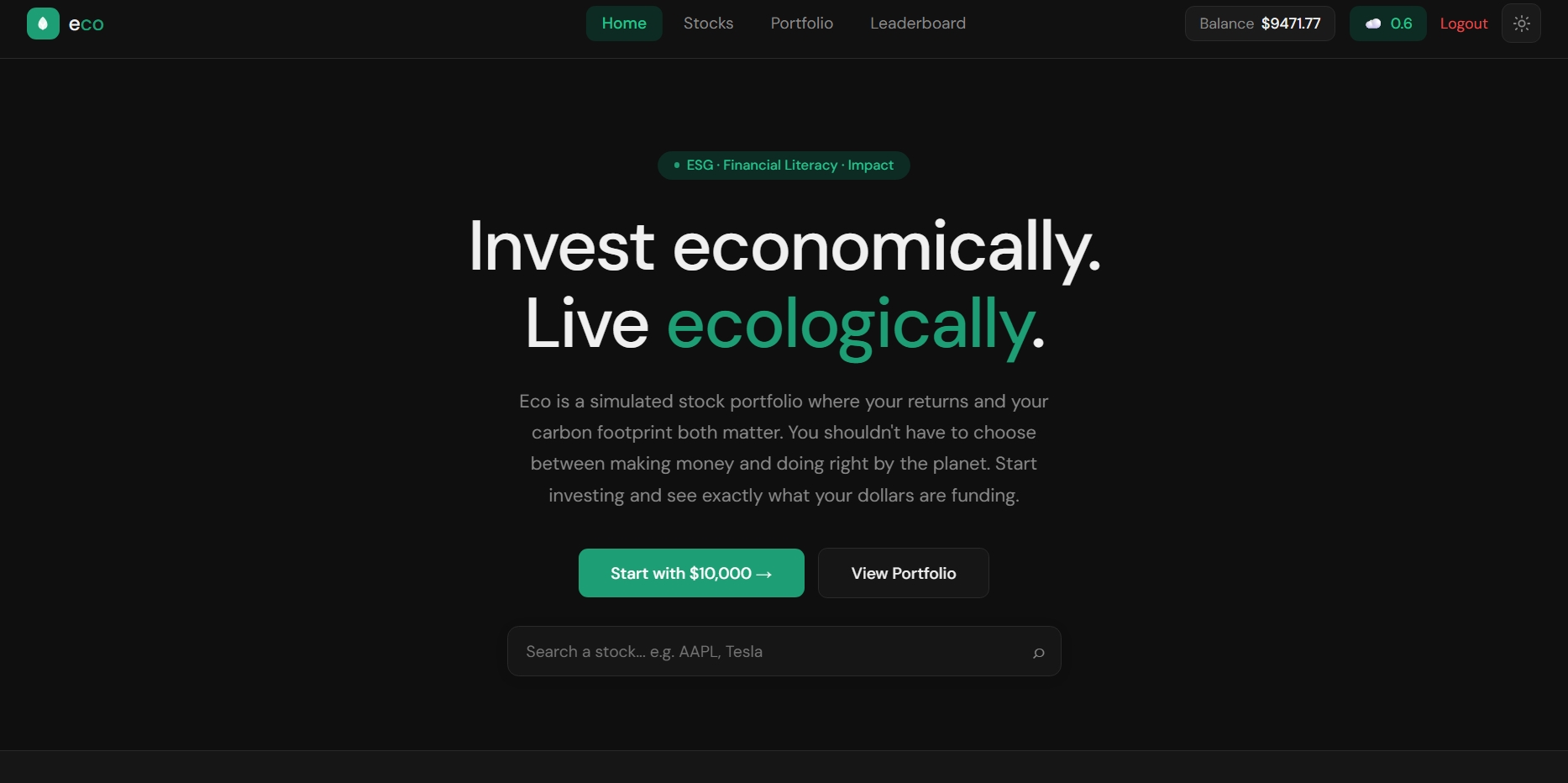
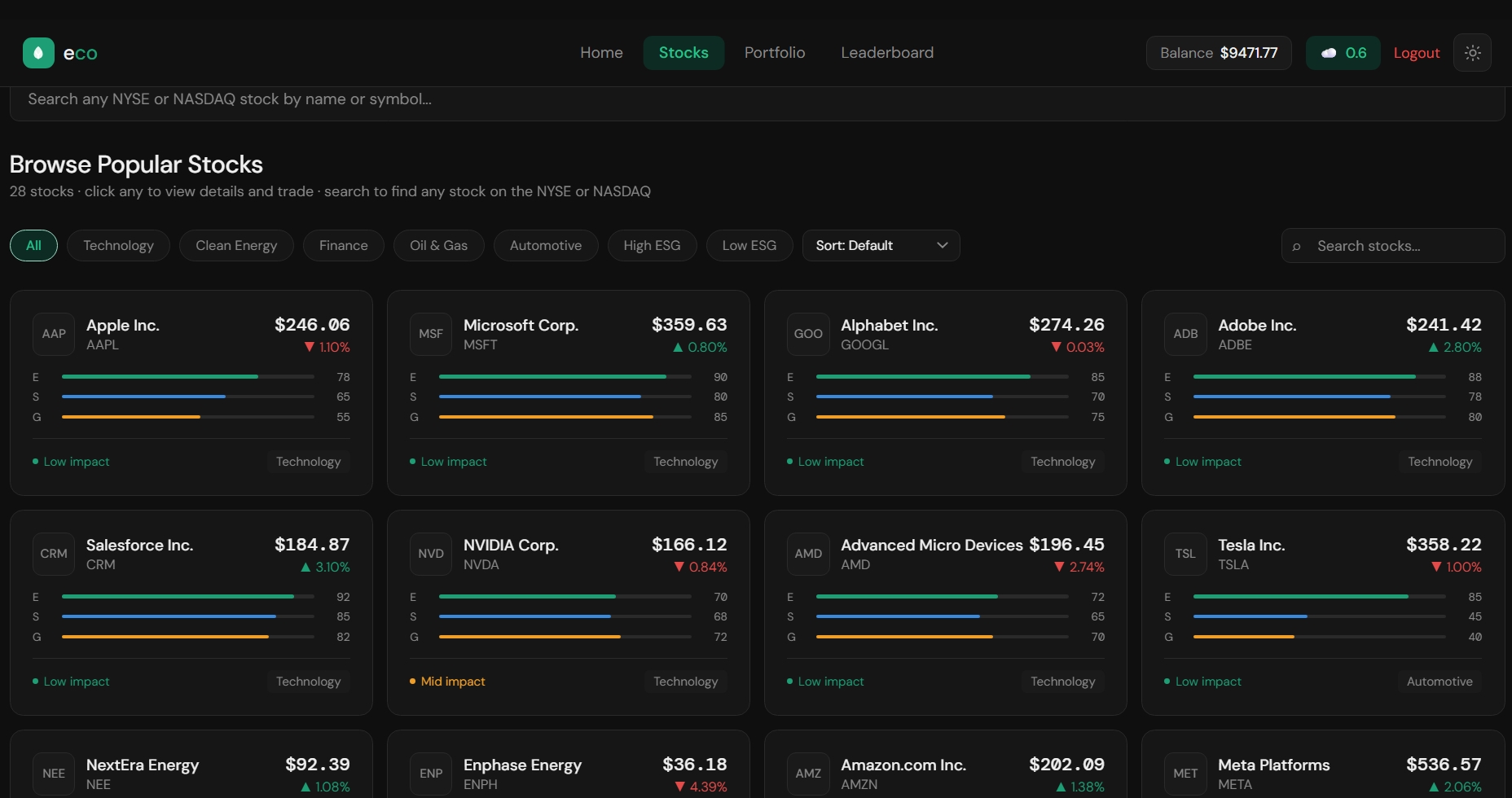
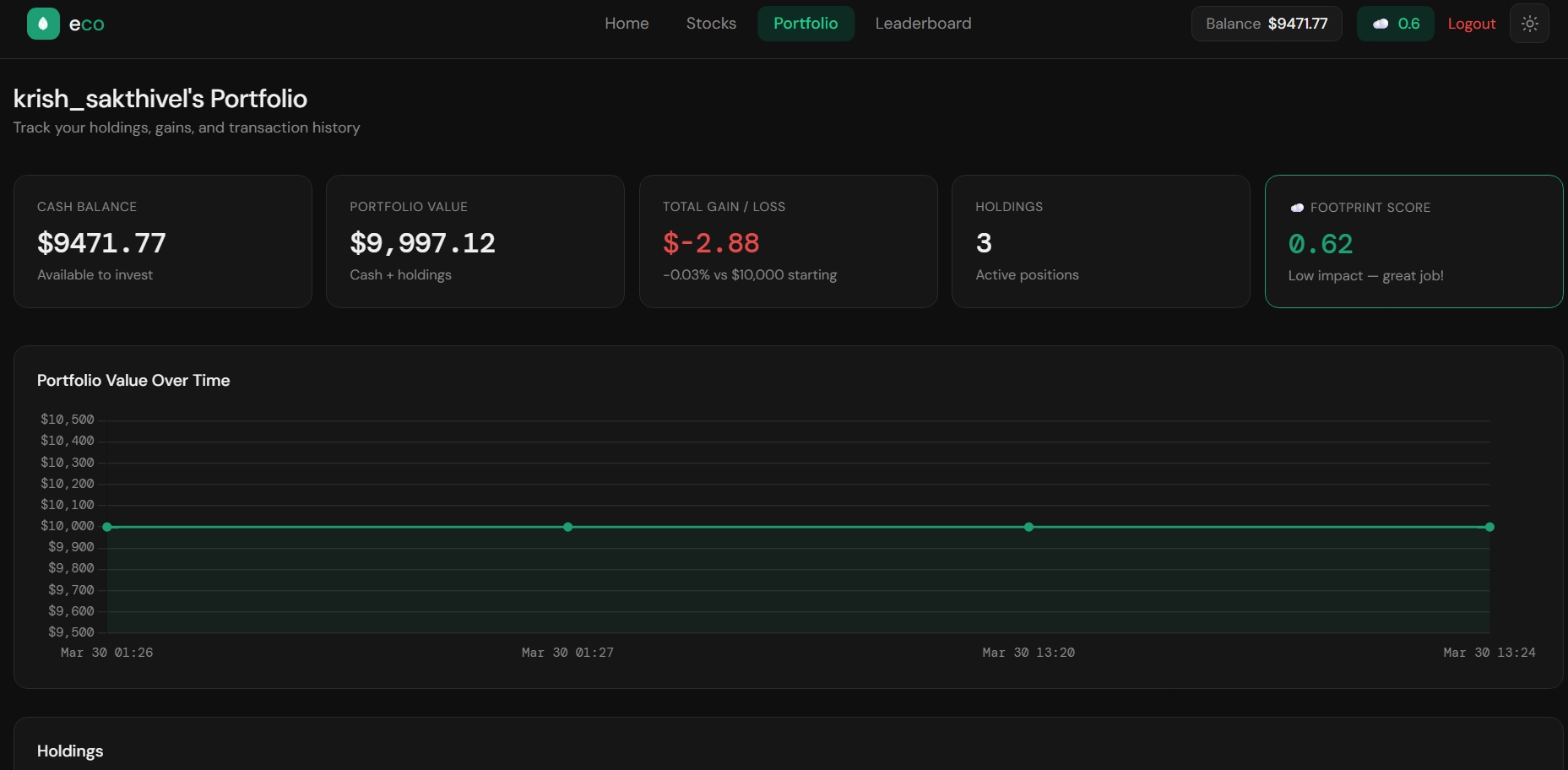
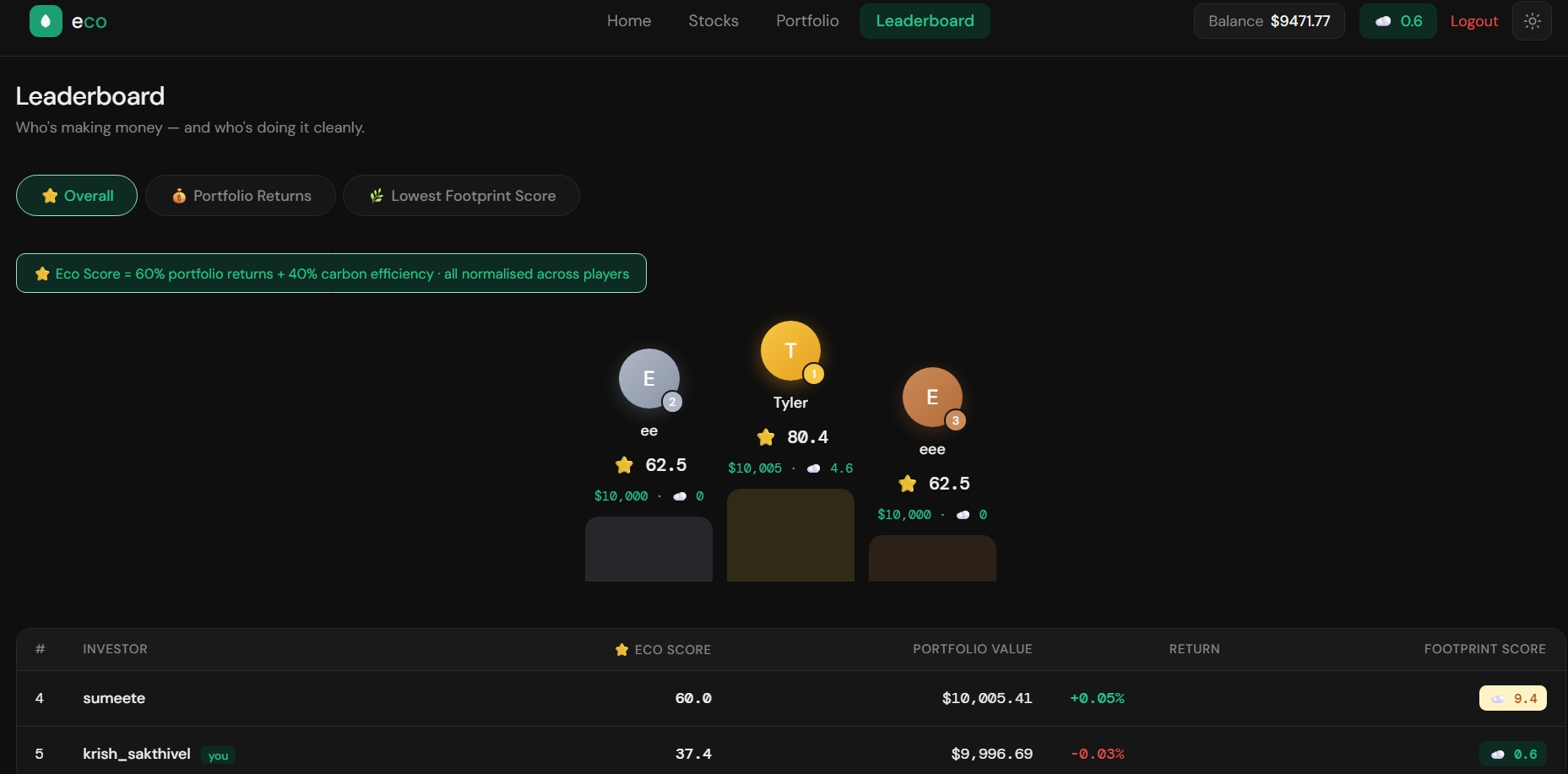
Inspiration
Many people don't know the effects companies have on our environment.
People put blind faith in companies that they believe will help their financial status in the long run, but don't consider their environmental impacts.
As an example, BA (Boeing) is a widely held stock. Yet its carbon emissions are massive. We are indirectly funding that without condemning their environmental impact.
Our team was shocked when we found out that these companies had such a huge impact on the environment and that we were indirectly contributing to it, and we wanted to make a platform in which our next generation could learn about these injustices to the environment, while also having an opportunity to learn about the stock market in general.
This is why we made Eco. So students could learn to invest without blurring the line between money and ethics.
What it does
Eco is more than just a tool; it's a platform students can use to learn how to invest hands-on while keeping the environmental aspect in mind. People can:
- view stocks and learn different aspects of that stock.
- build simulated portfolios with $10,000.
- invest and try to keep their carbon impact as low as possible while earning as much money as possible.
- analyze stocks with summaries, charts, and more.
- compete against other users to try to earn as much as possible while keeping their carbon impact as low as possible.
Our core mission is to teach people how to invest ethically and have minimal part in the destruction of our environment.
How did we build this?
Eco was built with the following:
- Flask - used to seamlessly integrate our backend and frontend.
- Finnhub & YFinance APIs - give real-time, accurate data on stocks.
- Chart.js - used to cleanly visualize graphs and charts on the website.
- Supabase - Used for authentication and databasing
- Gradient Boosting Regressor Machine Learning Models - used to predict Environmental, Social, and Governmental scores of stocks.
This is talked about more in our Challenges we faced section!
We use a formula to calculate placement for the investors on the leaderboard too!
Challenges we faced and how we solved them.
Finance is a world where many of the resources developers need are unfortunately locked behind a paywall. Being a high school team, we didn't really have a bank account to begin with, so we had to pivot to find innovative solutions.
- Problem: ESG Scores being locked behind a paywall
- Context: We spent almost two days looking for a free API that would give us ESG scores of a stock. We couldn't find any, and without it, our app would fall apart quickly.
- Solution: We built three Gradient Boosting Regressor Machine Learning models and combined them in a .joblib file to predict ESG scores. One model for Environmental, one model for Social, and one model for Governmental.
- The E model takes in the industry sector, industry type, capex ratio, and operating margin
- The S model takes in the industry sector, industry type, gross margin, and R&D ratio
- The G model takes in the industry sector, industry type, operating margin, and gross margin
Though each model only took in four values, it was the best we could do to accurately predict ESG values with the resources we had.
- Problem: API Rate Limiting
- Context: Due to Finnhub's rate limiting, sometimes our code would throw us an error if there were too many requests to the API.
- Solution: We decided that we would make a try and except and give the user a pop-up if we hit our rate limit. In the future, we want to put in place a solid API plan so that rate limiting won't be a significant issue.
You might have noticed that we didn't limit the user but rather limited ourselves. This was intentional, as since our website fetches many things from the API, it would be a nightmare to figure out how to rate limit.
Accomplishments we're proud of
We are proud of:
- making a proof-of-concept and a scalable application that can teach people worldwide how to invest and how to invest ethically.
- creating a platform that can encourage competitive learning
- developing innovative solutions to problems such as a lack of resources.
- building a clean, smooth UI that users can view on desktop.
- attempting to solve real-world problems and teaching people about a growing focus in the industry.
What we learned
We learned:
- how to use APIs and other resources such as models to make financial literacy accessible.
- how companies in the market impact our environment.
- how gamifying learning can make learning easier and more accessible.
- how hours of using the design cycle can help us make a product suiting everyone.
What's next for Eco?
We plan to expand Eco on many fronts.
- Implementing this in schools around our local area.
- Getting rid of our rate limit and making a platform where everyone can use it at one time, not just one or two people.
- Making many more gamified features that help people dive deeper into finance and their environment alike.
- Release Eco as a mobile app.
Acknowledgements
From the bottom of our hearts, we would like to thank the teams at every hackathon we submitted to for hosting their hackathons. Without these hackathons, we would never have come up with the idea for Eco or made this project.
Note
Render may take an upwards of 5 minutes to load Eco. Due to rate limiting, Eco can support only one user on the application at a time for maximum performance. We plan to fix this in the future :)
Eco is a proof-of-concept that we can have a platform that can spread financial literacy and how to not blur the line between money and ethics. We want to stop people from blindly investing in and funding companies that aren't ethical with respect to the environment, and also teach them about variables in stocks that can help them make money beyond investing in those companies. We want to help play a part in ethical investing, and that starts now.


Log in or sign up for Devpost to join the conversation.