Inspiration## 🌱 EcoAction Agent
Inspiration
Small businesses such as restaurants generate significant amounts of food waste, plastic waste, and consume large amounts of energy and water. Many businesses know they should become more sustainable, but they often lack the time, expertise, and tools to identify the most important problems and turn them into practical actions.
We wanted to build an autonomous AI system that does more than simply provide recommendations. EcoAction Agent analyzes a business's environmental data, identifies the most important sustainability problems, prioritizes them, creates an action plan, assigns operational tasks, and adapts the plan when task progress changes.
What the project does
EcoAction Agent is an autonomous sustainability workflow for small businesses.
The system:
- Receives business environmental data.
- Calculates a baseline carbon footprint.
- Identifies environmental hotspots and root causes.
- Prioritizes problems using a multi-criteria decision model.
- Generates a multi-horizon sustainability action plan.
- Converts the plan into operational tasks.
- Saves workflow state and results.
- Re-plans when task progress changes.
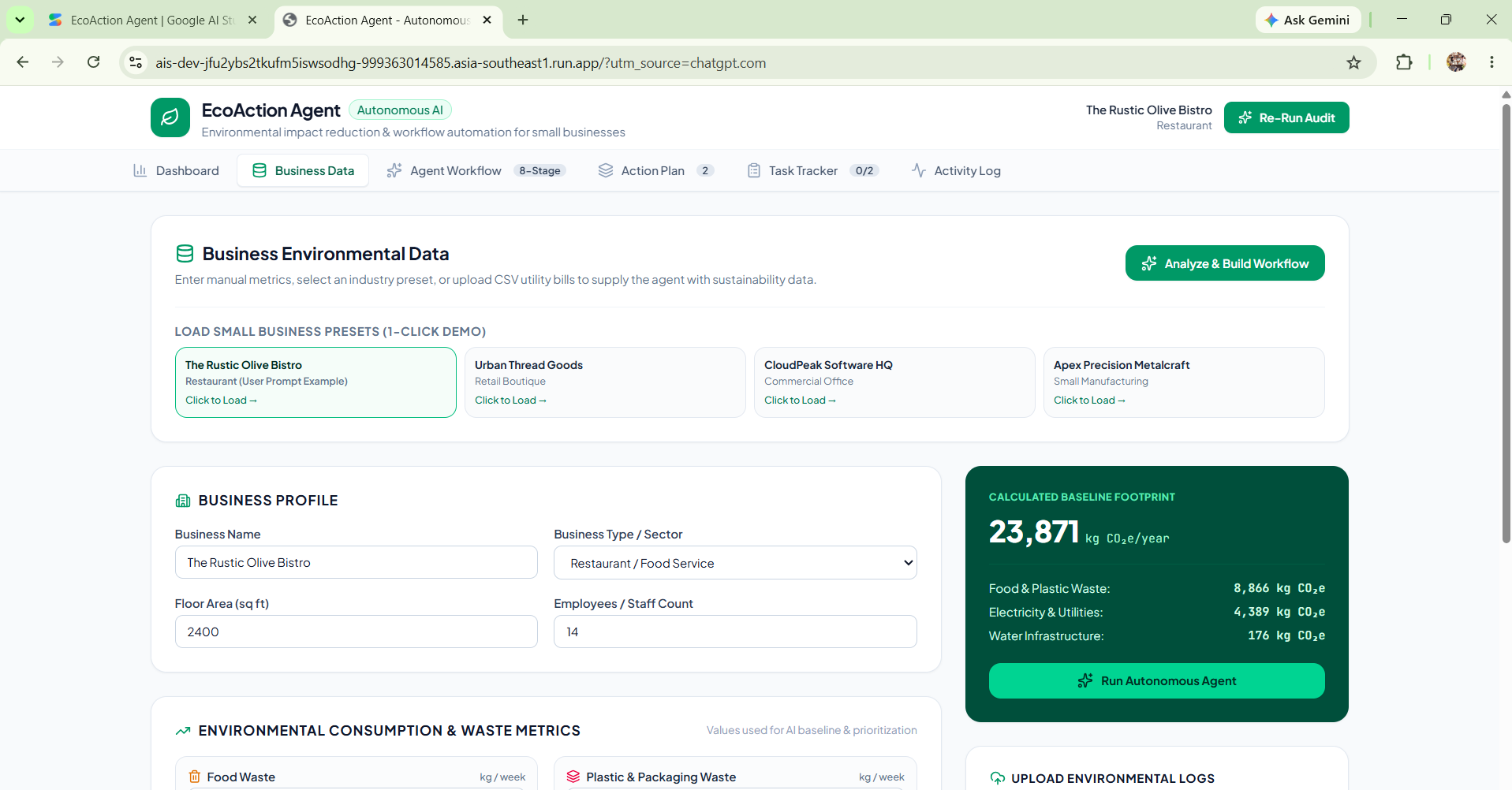
For our demonstration, we used a restaurant called The Rustic Olive Bistro.
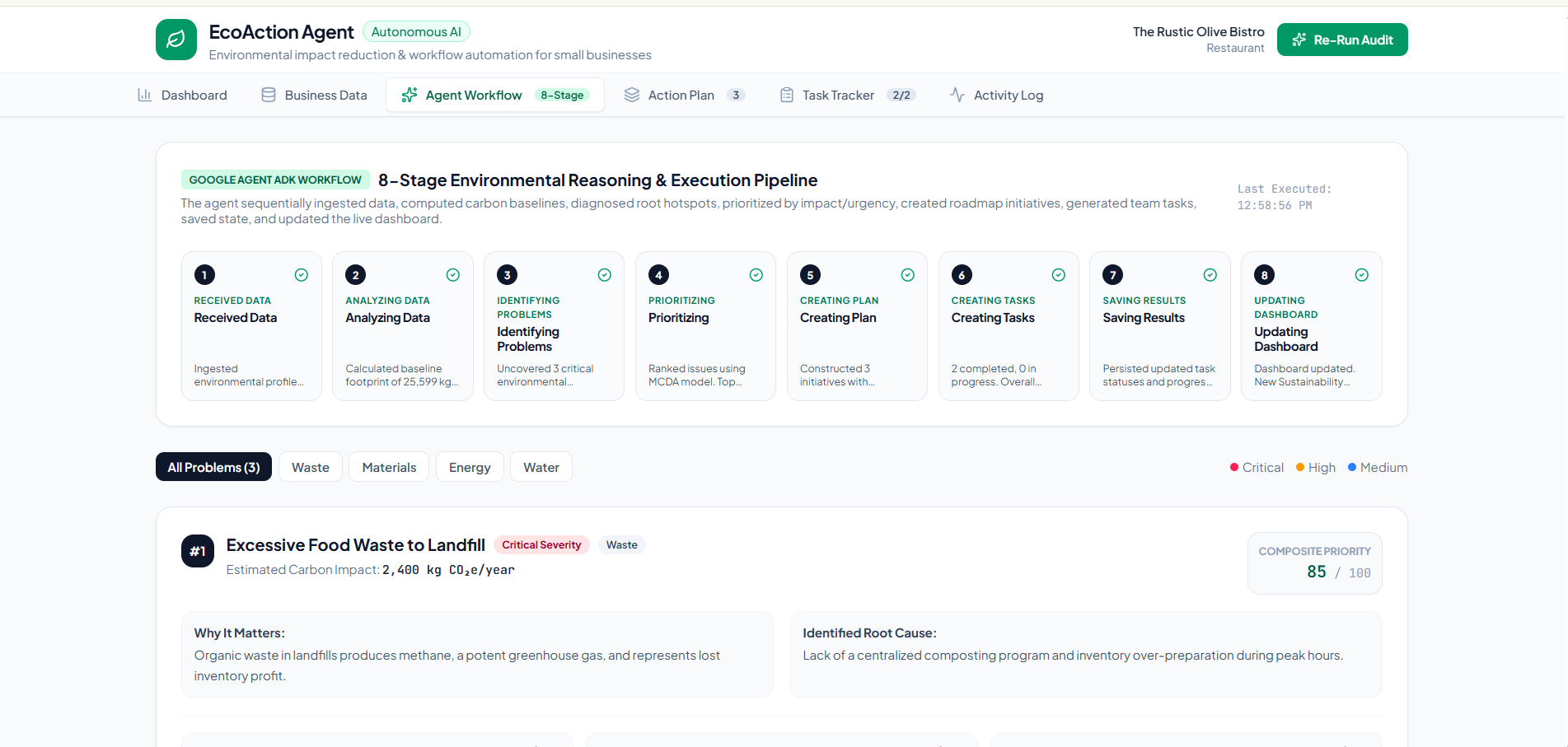
The agent calculated a baseline footprint of approximately 25,599 kg CO₂e/year, identified three major environmental problems, and generated three sustainability initiatives.
The system also demonstrated autonomous re-planning. After task progress changed, the agent triggered a REPLAN workflow and recalculated the sustainability score from 42/100 to 57/100.
How we built it
The project combines a web-based dashboard with an autonomous AI workflow. The application processes environmental metrics such as food waste, plastic waste, electricity consumption, and water usage.
The workflow is organized into eight stages:
Received Data → Analyzing Data → Identifying Problems → Prioritizing → Creating Plan → Creating Tasks → Saving Results → Updating Dashboard
A multi-criteria decision analysis (MCDA) model is used to prioritize sustainability problems based on environmental impact, urgency, and ease of improvement.
The generated tasks include assigned roles, deadlines, verification methods, and measurable goals.
Challenges
One of the main challenges was making the system behave like an actual agentic workflow rather than a simple chatbot. We needed the application to maintain workflow state, generate actionable tasks, and react to changes in task completion.
We also handled temporary AI model availability issues using a fallback mechanism so that the application could continue operating transparently.
What we learned
Through this project, we learned how agentic AI can be connected to real-world business workflows. We learned about structured data processing, multi-stage AI reasoning, task generation, state persistence, dashboard integration, and autonomous re-planning.
The key lesson was that an effective AI agent should not stop at generating an answer — it should be able to reason, execute, observe changes, and adapt.
Future improvements
We plan to add more business sectors, richer sustainability benchmarks, historical trend analysis, automatic progress verification, and additional integrations for real-world task execution.
Our goal is to make sustainability management more accessible and actionable for small businesses.
What it does
How we built it
Challenges we ran into
Accomplishments that we're proud of
What we learned
What's next for Eco
Built With
- agent
- autonomous
- climate-tech
- earth-observing-system
- eco
- environmental-life-cycle-impact-assessment
- futurelytics
- gemini
- generative-ai
- goal
- google-directions
- green-tech
- market-intelligence-network
- react
- sustain
- typescript
- workflow-automation
- world-bank-climate

Log in or sign up for Devpost to join the conversation.