Project Story — EcoScan
About the Project
Food waste is one of the biggest environmental challenges faced by schools. Every day, large amounts of food are wasted because there is no simple way to track where waste happens, understand the reasons behind it, or encourage students to take action.
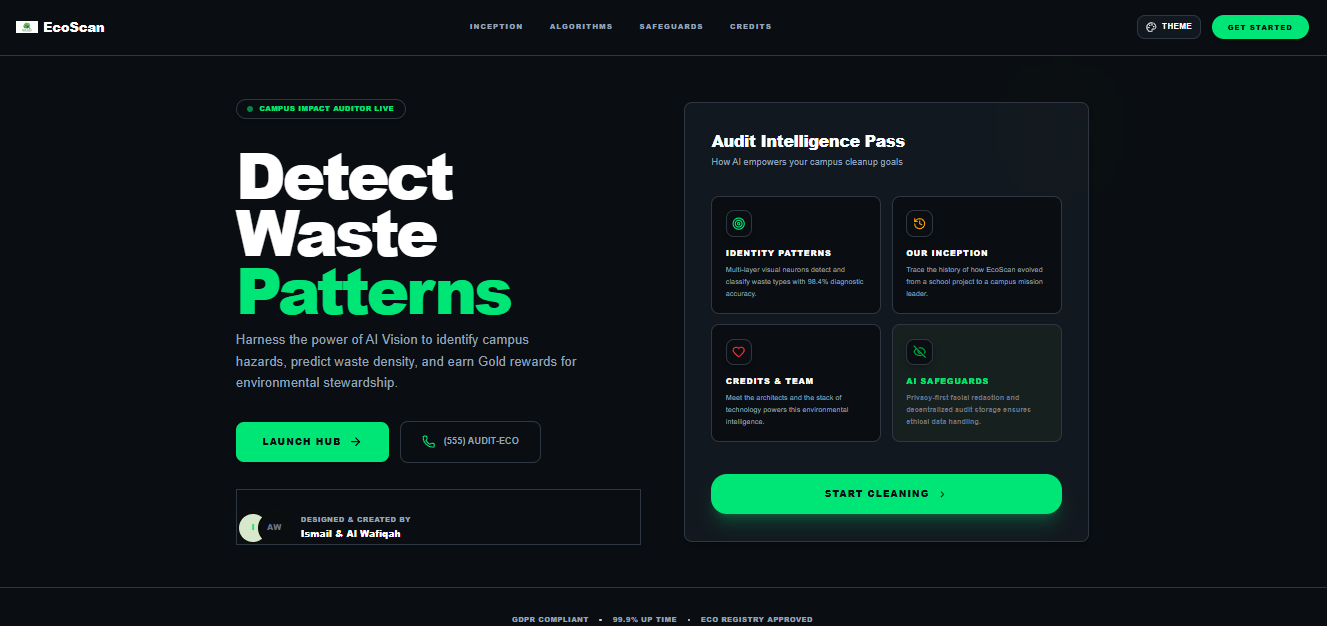
This inspired us to create EcoScan, an AI-powered food waste detection and management system that helps schools:
- Detect waste
- Predict future waste patterns
- Take action through student participation
Our mission is to transform waste management from a reactive process into a proactive solution.
Inspiration
The idea behind EcoScan came from noticing that food waste is often visible, but the reason behind it is not.
Schools may know that waste exists, but they often do not know:
- Where waste happens
- When it happens most
- Why it happens
We wanted to solve this by combining:
- Artificial Intelligence
- Data analysis
- Student involvement
- Sustainability challenges
Instead of making sustainability only a rule, we wanted to make it an engaging community activity.
How We Built It
EcoScan was built as a platform connecting students, teachers, and administrators.
AI Waste Detection
Users can upload an image of waste, and AI analyzes it to identify categories such as:
- Food waste
- Plastic waste
- Paper waste
- Other waste
This reduces manual tracking and makes reporting faster.
EcoMap
EcoScan includes EcoMap, a visual waste monitoring system.
It tracks waste across the entire school, not only the cafeteria.
The system helps identify:
- Clean areas
- Moderate waste areas
- High waste hotspots
This allows schools to focus their efforts where they matter most.
Eco Bounty System
We wanted students to become active contributors.
With the Eco Bounty System, students can:
- Report a waste problem
- Create a cleanup task
- Allow other students to participate
- Reward completed actions with EcoCoins
This creates teamwork and encourages positive environmental habits.
AI Predictions
EcoScan uses information such as:
- Waste images
- Location data
- Time of reports
- Previous activity
The AI identifies patterns and generates insights.
Example:
"Food waste increases every Wednesday after lunch."
This helps schools make better decisions and prevent future waste.
Challenges We Faced
Making AI Useful
One challenge was ensuring AI was not just a feature but a practical solution.
We focused on creating simple, understandable AI results that users can act on.
Responsible AI
AI predictions are not always perfect.
To solve this, EcoScan uses:
- Confidence scores
- User verification
- Human review
If a student finds an incorrect result or has an issue, they can report it through a dedicated support tab.
Students can contact teachers or administrators directly through the platform for review.
This creates a human-in-the-loop system where AI supports decisions, but humans remain responsible.
Encouraging Participation
Another challenge was making students stay involved.
To solve this, we added:
- EcoCoins
- Sustainability challenges
- Community updates
- Eco Bounty tasks
This transforms sustainability into an interactive experience.
What We Learned
Building EcoScan taught us that technology can create real impact when it solves real problems.
We learned:
- How AI can support environmental solutions
- The importance of responsible AI
- How to design for real users
- How teamwork can turn ideas into working solutions
A small action can create a big impact.
The idea can be represented as:
$$ Small\ Actions + Smart\ Technology = Sustainable\ Future $$
Future Vision
In the future, EcoScan can expand with:
- Mobile applications
- Real-time notifications
- Sustainability competitions
- Advanced AI recommendations
- Expansion into communities
Our vision is to help create a future where every person can contribute to reducing waste.
EcoScan — Detect. Predict. Act.


Log in or sign up for Devpost to join the conversation.