-

The homepage for Eco-Score makes a powerful statement on how together, and with technology, sustainability can be measured.
-
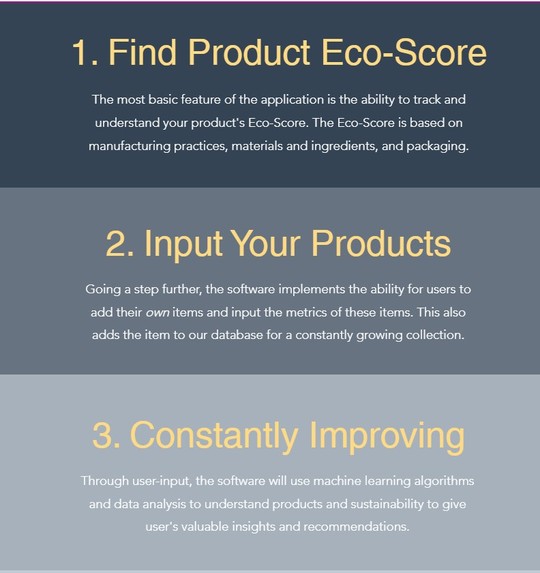
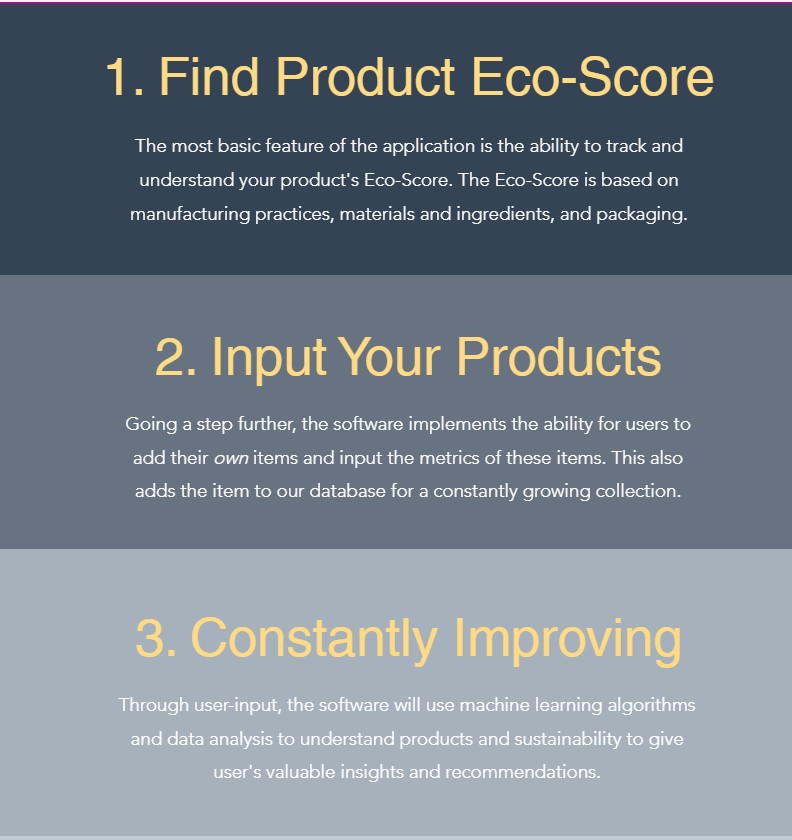
When scrolling down on the homepage, a summarization of Eco-Score's fundamentals is given to understand the software at a glance.
-
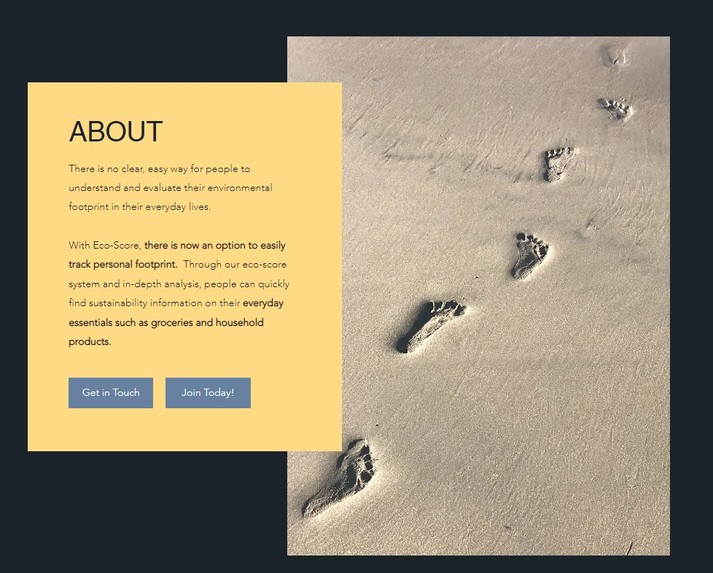
An about section gives the 'why' to Eco-Score's existence and links to contact and join now, both potential options a consumer may have.
-
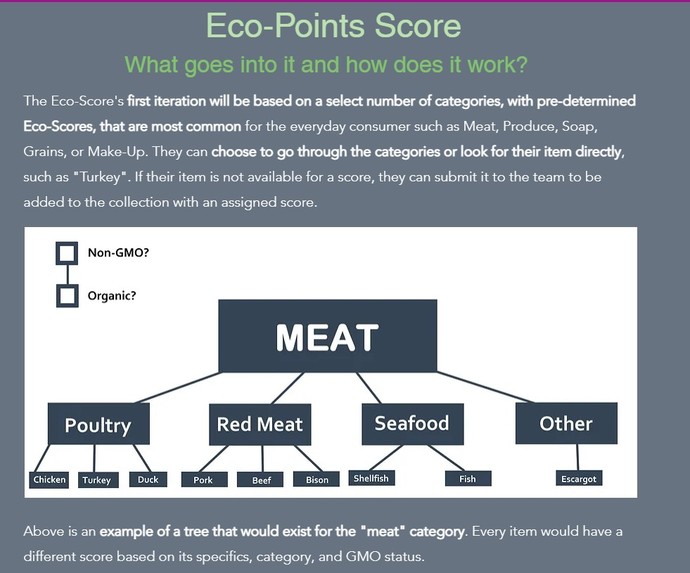
For those seeking a more full understanding of the app, there is an in depth analysis given on everything that goes into Eco-Score.
-
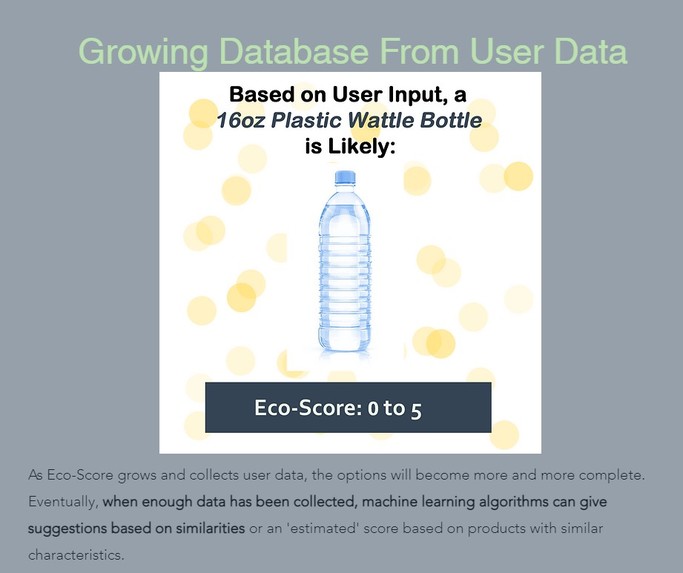
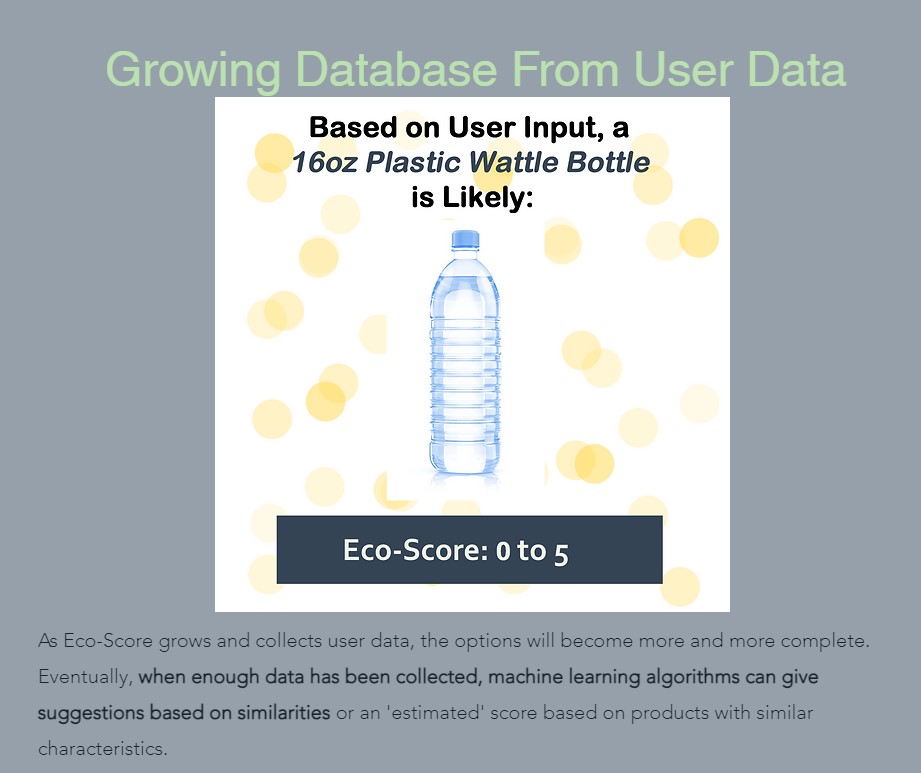
Lastly, for the future of Eco-Score, a hint of machine learning algorithms is given for the growing potential of the app.
-
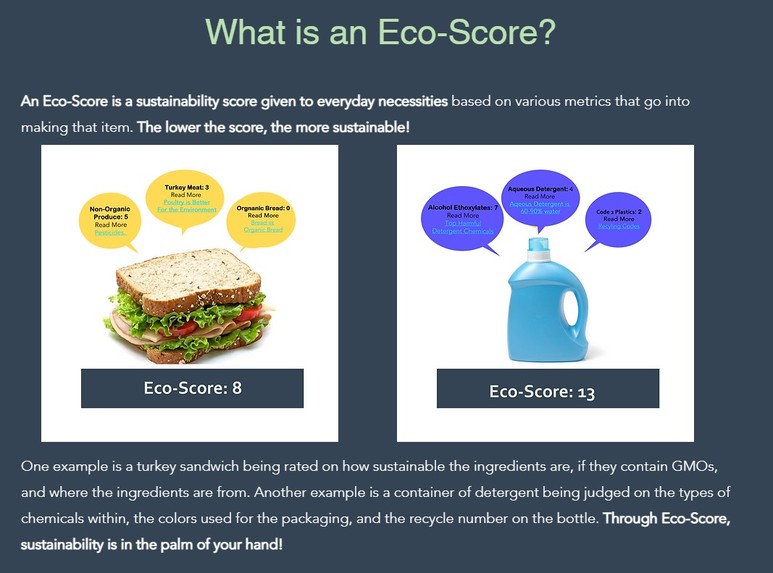
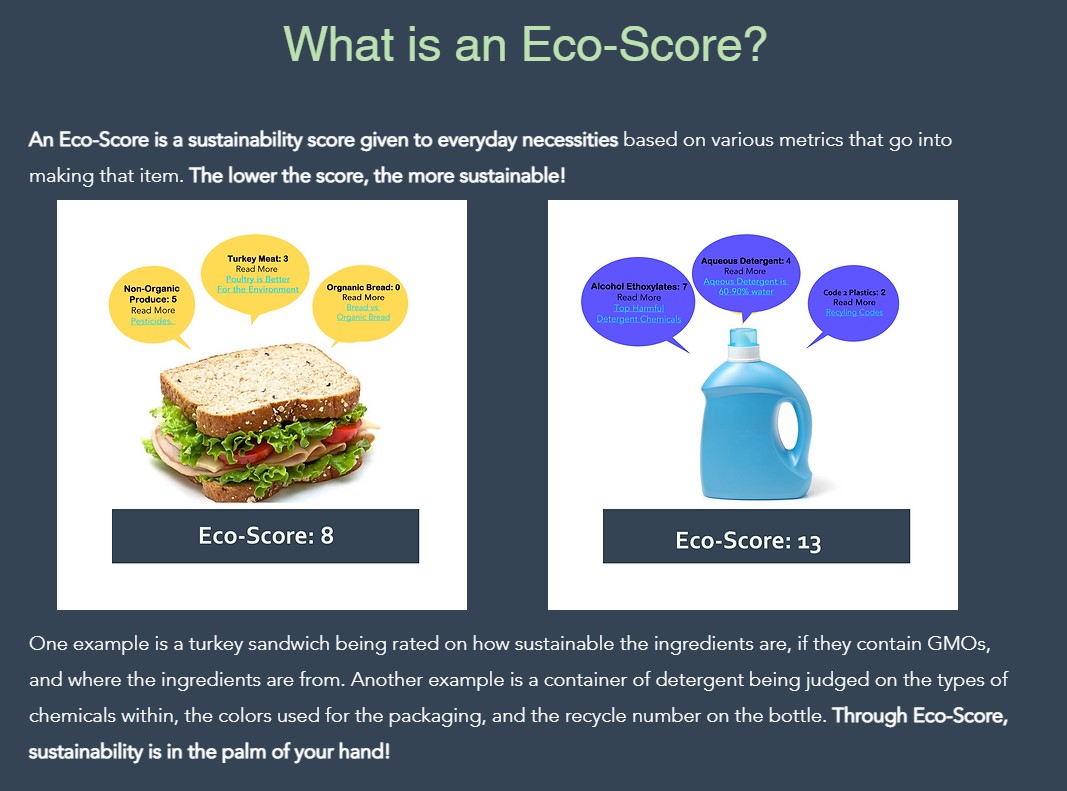
A mock-up of Eco-Score's metrics was given in a easy-to-understand graphic format for those wondering exactly what this is based on.



Inspiration
Since I was a very young child, I have cared about sustainable efforts - I even led a recycling club as a child. Within my research lab at college, I have been the team leader of the energy efficiency team and analyze manufacturers' energy output. From both of these experiences, I realized there is a disconnect from what people understand is sustainable and people need an easy and quick way to understand what goes into their everyday products - and how sustainable it truly is.
What it does
Eco-Score is a point system that analyzes ingredients, materials, and manufacturing in a product to give a score on how sustainable it is. The software would begin with roughly 500+ options to choose from ranging from meat, soap, processed foods, grains, produce, makeup, and more. Then, the software would also allow user input - meaning that users could submit an item and its metrics to the team to be given a score. With enough data and user inputs, machine learning algorithms would analyze the patterns and give better recommendations and Eco-Scores to more consumers' products.
There are also a multitude of beta features in development such as a reward system for those who frequently use and submit items, a news and resource sections, and an incentive for companies to partner with Eco-Score, to feature their products as sustainable and have their entire inventory analyzed by our team.
How I built it
I used Velo by Wix, as apart of the MLH track, to build the Eco-Score website. I used JavaScript to integrate Twilio into my contact page and also a multitude of other features within the site. Furthermore, there were touches of CSS and html to make the formatting clean. I personally designed the palette and graphics in Photoshop and built the business plan for the company and its details by hand. As a whole, Eco-Score was created to be a true startup.
*The domain for the Domain.com track was not added due to plan limitations of Velo - the domain chosen, but not implemented, was link.
Challenges I ran into
When I went to make the Eco-Score Beta, a simple JavaScript and CSS in-line calculator, I realized just how many steps go into hand making a calculator for as many unique and custom factors as Eco-Score would have. I made a tree, of just 'Meat', and how its Eco-Score would breakdown; with 14 different meat options and 2 different factors - GMO and Organic - there would be 42 different Eco-Scores for these items. As a calculator, this would be 14 unique meat options, designed in a tree-like format as shown, along with 2 modifiers. Not to mention how many different components go into other categories - making there a minimum of 200-500 inputs for an Eco-Score Beta.
For now, the Eco-Score calculator is going to have to remain a to-be-designed feature as I was a team of 1 and I would rather have a good, solid solution for people who want to understand their sustainability efforts as opposed to a makeshift one in the meantime.
Accomplishments that we're proud of
In other ways, Eco-Score is fully ready to pilot and start putting itself out their for investors. With the help from investors and funding, the Eco-Score team could grow from a team of 1 and have a team with all the skill sets necessary to make a powerful, revolutionary sustainability web app for the everyday person. Furthermore, Eco-Score lacks competition - while there are apps to monitor ecological footprint, they are often designed for corporations (Greenly) or designed to analyze carbon emissions and nothing else (LiveGreen).
What we learned
This is my first Hackathon and I learned a breadth of skills ranging from brainstorming, my first time using javascript, incorporating different DubHacks/MLH tracks into my plan, and overall project planning. I also learned that building a project from scratch can be one of the most enriching, fruitful efforts I could spend a weekend doing.
What's next for Eco-Score
Eco-Score is going to continue development! While seeking investors, Eco-Score will design and pilot its first Beta with 500+ items sometime within 6 months. Ideally, investors would invest a portion of their time, and money, to have their products analyzed and incorporated in the next batch update of Eco-Score within 12 months. For the duration of this 1 year period, the team will be expanded to have those who are knowledgeable in building Progressive Web Apps and User-Interface to have a fully fleshed and consumer ready app at the end of the 1 year mark. I am excited to see what is in store for Eco-Score!

Log in or sign up for Devpost to join the conversation.