About EcoPulse
Inspiration
Climate change and environmental degradation are realities we face daily, yet many people struggle to connect their personal choices to their real-world impact. We were inspired to create EcoPulse to make sustainability tangible, interactive, and personal. Our goal was to let users experience the consequences of their actions in a gamified, yet scientifically accurate, way — turning abstract climate data into a lived experience.
What it does
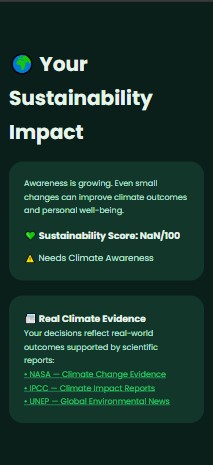
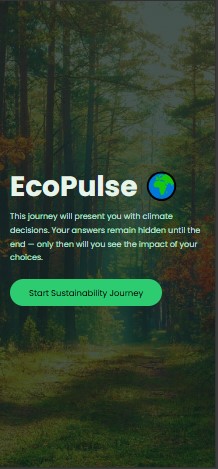
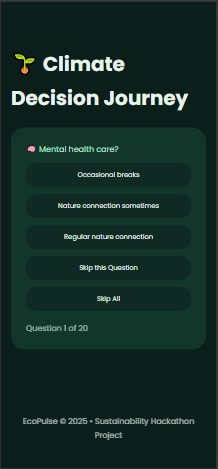
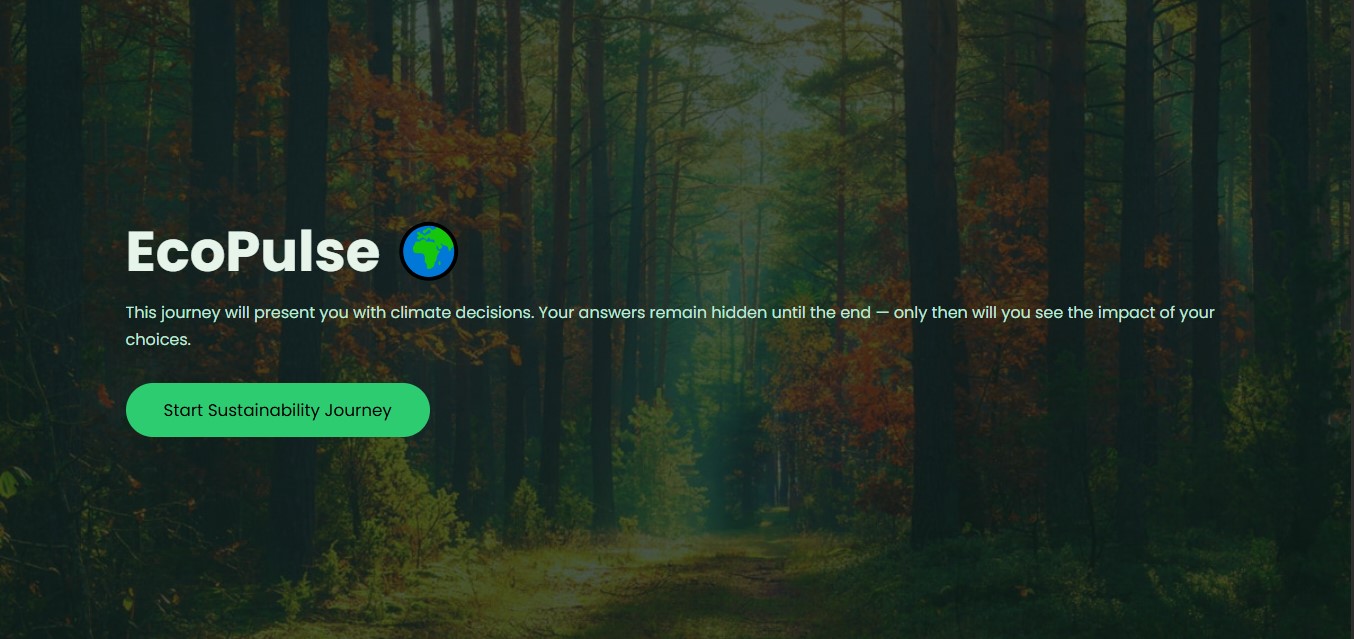
EcoPulse is an interactive web app that presents users with real-life environmental decisions through a series of multiple-choice questions. Each choice affects their planet health, mental wellness, and climate impact score, though the results are hidden until the end. Users receive a personal sustainability score and feedback on how their decisions align with environmental best practices, alongside links to real scientific reports from NASA, IPCC, and UNEP.
This allows users to understand that even small personal decisions can accumulate to make a big global impact.
How we built it
We built EcoPulse using HTML, CSS, and JavaScript, focusing on a clean, modern, and responsive design. Key features include:
- Randomized MCQ sequence with 20 climate-related scenarios.
- Skip question / Skip all functionality for user flexibility.
- Cumulative scoring system: \( \text{Score} = \frac{\text{Correct Choices}}{\text{Attempted Choices}} \times 100 \).
- Dynamic result page showing sustainability score and level.
- Integration of real-world news links to support each user’s learning journey.
We focused on UX/UI with gradients, eco-themed colors, emojis for visual cues, and responsive layouts to make the experience engaging for all ages.
Challenges we ran into
- Balancing difficulty: Early versions were too hard; users could easily score zero. We adjusted scoring to reward sustainable choices fairly.
- Randomization: Ensuring each user sees a unique sequence while keeping the experience consistent.
- Result timing: Initially, feedback was shown after each question, which reduced realism. We moved all results to the end to simulate real-life consequences.
- Data representation: We wanted to include meaningful real-world impact without overwhelming the user with numbers.
Accomplishments that we're proud of
- Creating a gamified sustainability experience that educates while entertaining.
- Successfully integrating real scientific references to back user decisions.
- Implementing dynamic scoring that balances challenge and encouragement.
- Designing a beautiful, responsive interface suitable for mobile and desktop devices.
What we learned
- The power of interactive learning: People internalize sustainability lessons better when they see their own impact.
- How UX/UI design affects engagement, especially for environmental education.
- JavaScript logic for randomized content delivery and cumulative scoring.
- The importance of balancing realism and playability in gamified educational apps.
What's next for EcoPulse
- Add interactive maps showing regional climate impacts in real-time.
- AI-driven simulations for disaster scenarios like floods, heatwaves, and deforestation.
- Leaderboard or community mode to encourage competition and collaboration.
- Offline PWA version for accessibility without internet.
- Expand question bank with 50+ scenarios covering global and local sustainability challenges.
EcoPulse aims to empower users with knowledge and action, making climate-conscious choices an intuitive part of daily life.

Log in or sign up for Devpost to join the conversation.