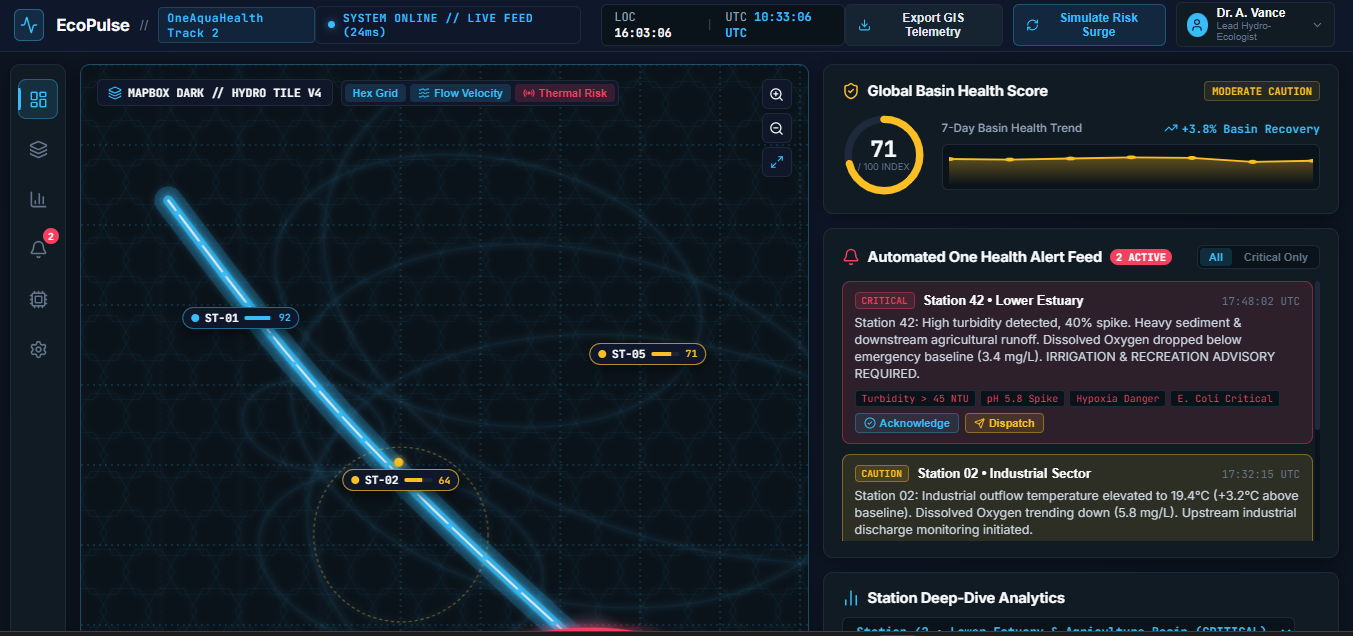
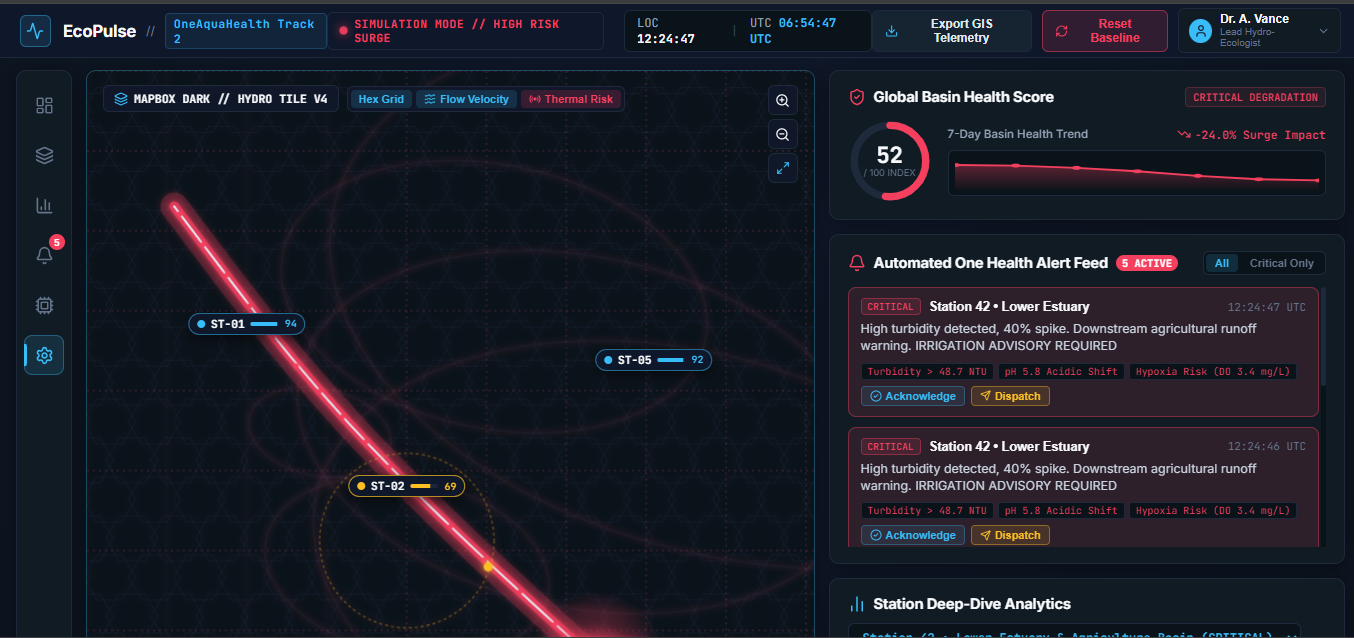
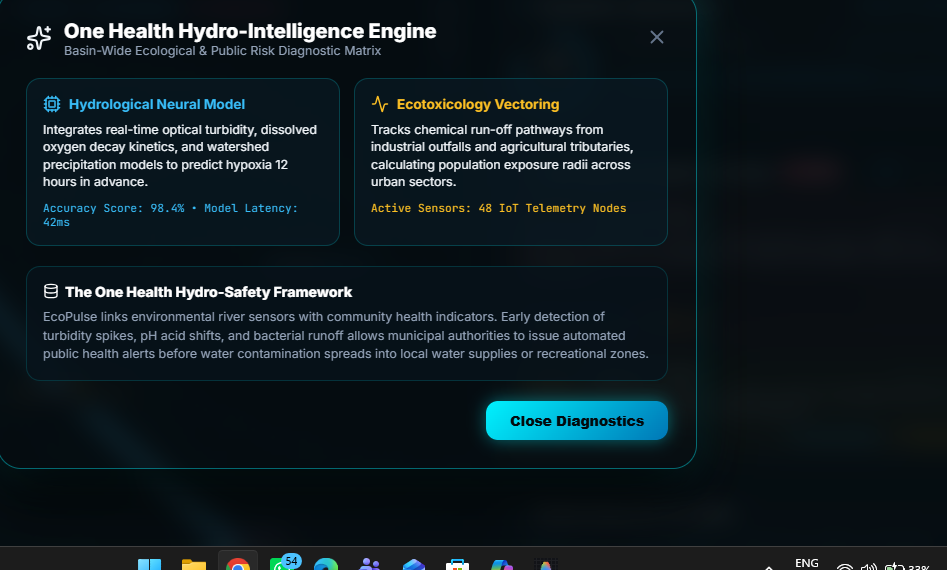
Freshwater ecosystems are the lifeblood of urban communities, yet they face severe threats from industrial discharges, agricultural runoff, and climate-induced thermal stress. While monitoring stations collect vast amounts of water quality data, non-expert citizens and municipal authorities are often left struggling to understand what isolated parameters—such as a pH of 5.8 or a turbidity reading of 48 NTU—mean for their community. Inspired by the One Health framework, we created Eco-Pulse to bridge the gap between raw telemetry and real-world environmental action by converting complex observations into immediate, human-readable risk briefings. Architecture & Mathematical Engine Eco-Pulse pairs a high-performance Python Fast-API backend with a modern React 19, TypeScript, and Vite command center. The engine normalizes physical metrics onto a 0–100 Water Quality Index scale using a weighted formulation producing plain-language advisories—such as downstream agricultural runoff warnings—and rendering them on a custom HTML5 Canvas map complete with hydrographic vector flows, thermal risk heatmaps, crowdsourced submission forms, and tactical field unit dispatch controls. Achievements & Vision Overcoming key challenges in multi-metric normalization and 60 FPS canvas performance, we built a fully integrated platform supported by a 100% passing backend test suite. Eco-Pulse demonstrates how crowdsourced data can instantly empower communities, protect aquatic biodiversity, and safeguard municipal water supplies, laying the groundwork for future expansions into autonomous hydro-drone sampling and satellite-driven predictive analytics.
Built With
- api
- python
- typescript
- vite
- watermanagement

Log in or sign up for Devpost to join the conversation.