-
-
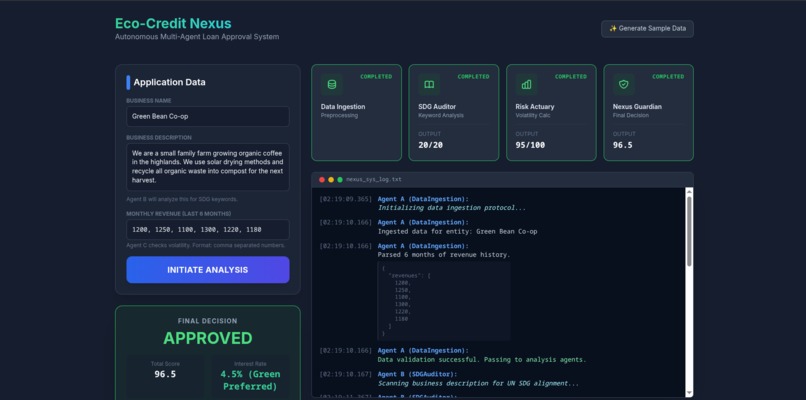
After Analysis Screen
-
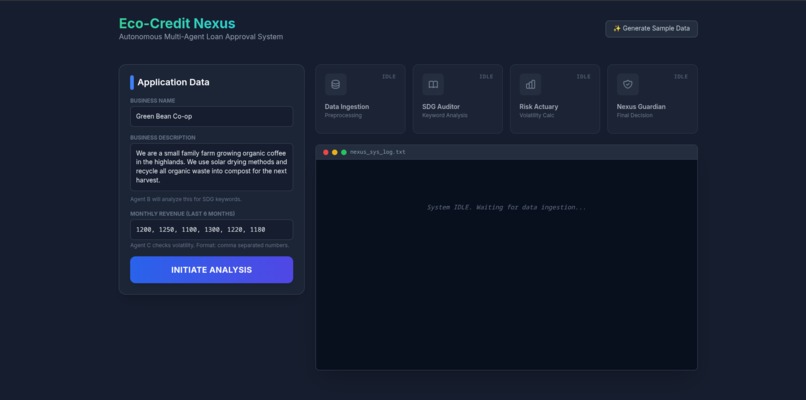
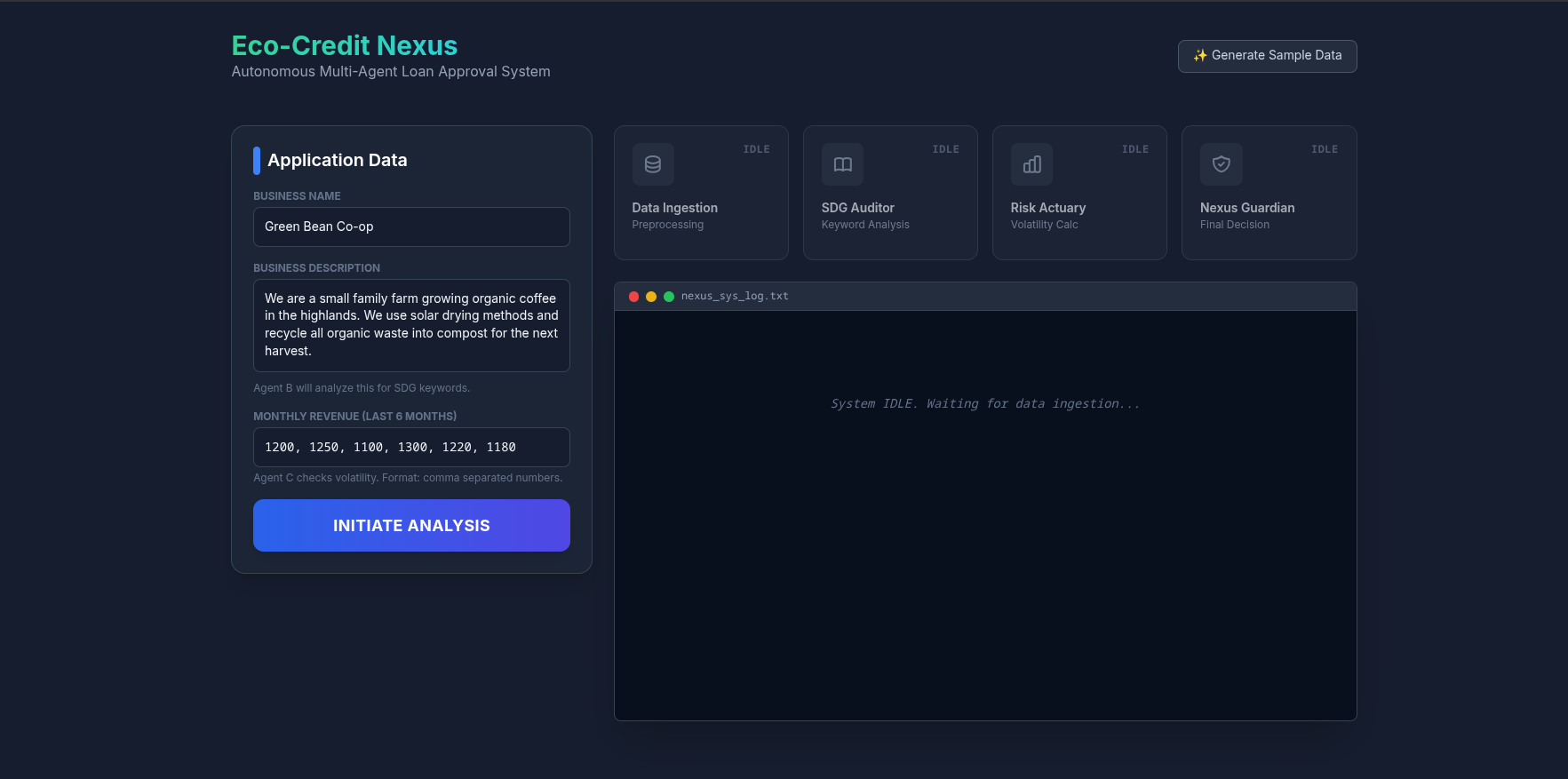
Dashboard
Inspiration The inspiration for Eco-Credit Nexus came from a glaring gap in the traditional banking sector. While the world is moving towards sustainability, financial models often struggle to quantify the long-term value of "green" practices. We wanted to ask: What if a bank had a dedicated team of experts an auditor, an actuary, and a guardian who could instantly collaborate to evaluate a business holistically? We were driven by the potential of Agentic AI to solve complex, multi-dimensional problems that require negotiation and consensus, rather than just simple prediction.
What it does Eco-Credit Nexus is an autonomous Multi-Agent System (MAS) simulator that automates the loan approval process for sustainable businesses. It employs a team of four specialized AI agents:
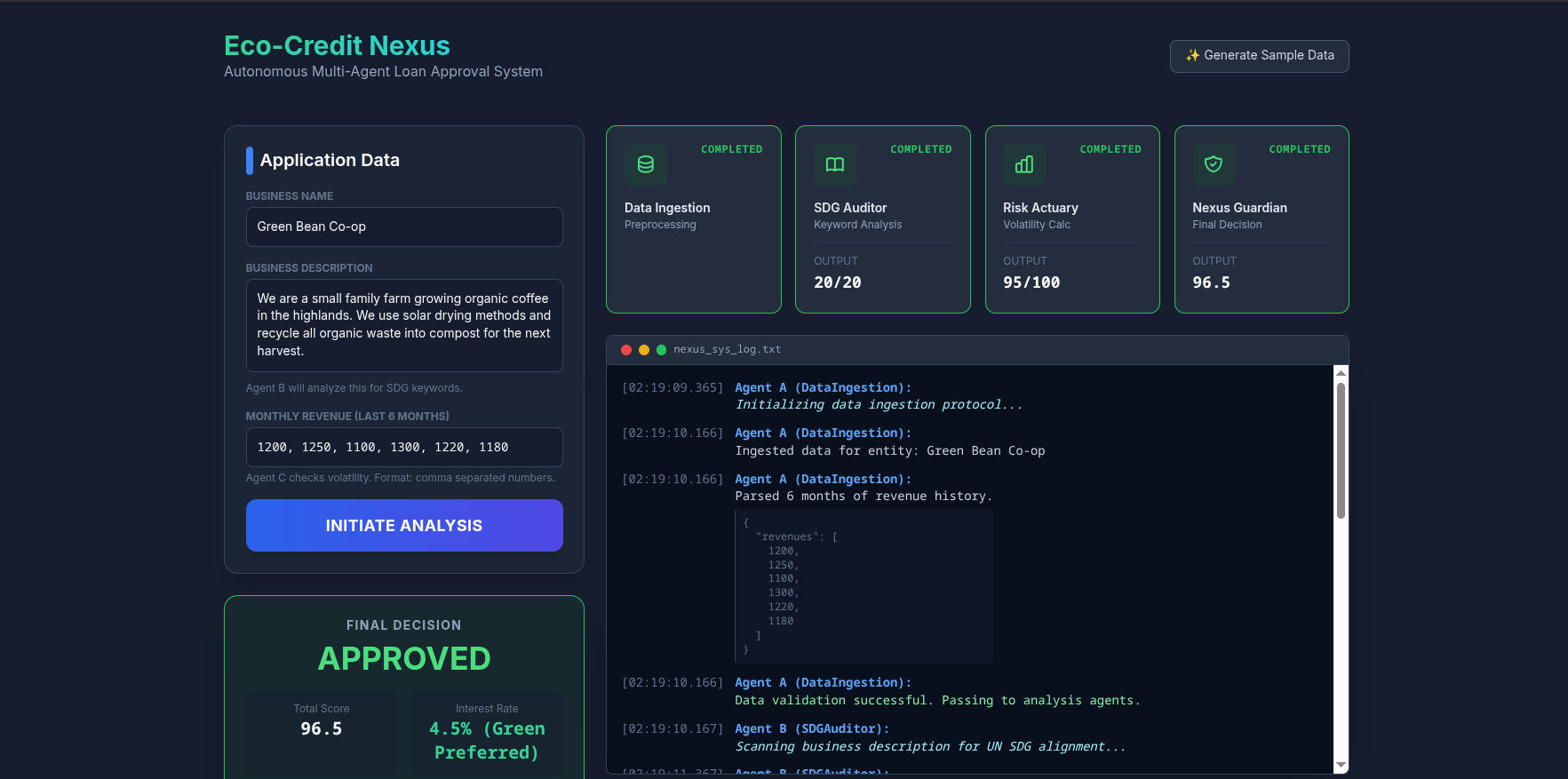
Data Ingestion Agent: Acts as the "senses," parsing raw business data. SDG Auditor Agent: Acts as the "conscience," analyzing business descriptions for alignment with UN Sustainable Development Goals. Risk Actuary Agent: Acts as the "calculator," evaluating financial stability and revenue volatility. Nexus Guardian Agent: Acts as the "judge," synthesizing the opposing views of risk and sustainability to make a final, balanced lending decision. How we built it We built the project using a modern web stack designed for speed and interactivity:
Frontend: Built with React and Vite for a responsive, real-time user interface. AI Engine: Powered by Google's Gemini API (via the Google GenAI SDK). Styling: Used Tailwind CSS for a clean, futuristic aesthetic. Architecture: We designed a modular multi-agent architecture where each agent is an independent class with specific prompts and responsibilities. The communication layer uses asynchronous hand-offs to visualize the "thought process" of the system in real-time via a terminal-like interface. Challenges we ran into Agent Orchestration: Ensuring that the Nexus Guardian didn't just blindly accept the outputs of the other agents but actually "weighed" them was tricky. We had to fine-tune the prompts to ensure the Guardian could handle edge cases like a highly profitable but environmentally damaging company. Determinism vs. Creativity: We wanted the simulation to feel alive and varied (using high temperature for generation) but the scoring logic needed to be consistent enough to be meaningful. Balancing these parameters took several iterations. Accomplishments that we're proud of Visualizing Thought: We are particularly proud of the "Terminal Log" feature, which demystifies the AI's decision-making process by showing the user exactly what each agent is thinking and doing in real-time. Seamless Integration: Successfully integrating the Gemini API to not just generate text, but to act as distinct functional components (Auditor, Actuary) within a structured software workflow. Aesthetic Polish: Creating a UI that feels like a futuristic dashboard, making the complex concept of multi-agent systems accessible and engaging. What we learned Building Eco-Credit Nexus taught us that AI agents are most powerful when they have specialized roles. Instead of asking one large model to "do everything," breaking the task into an Auditor and an Actuary resulted in much deeper, more nuanced evaluations. We also learned the importance of transparent AI, showing the user why a decision was made is just as important as the decision itself.
What's next for Eco-Credit Nexus More Agents: Adding a "Market Analyst" agent to evaluate external market trends and competitors. Real Data Integration: Connecting the system to live financial APIs or document uploaders (PDF parsing) for real-world loan applications. Negotiation Mode: Implementing a phase where the agents can debate with each other before the Guardian makes a final ruling, rather than just passing reports.
Built With
- google-gemini
- heroicons
- react
- tailwindcss
- typescript
- vite

Log in or sign up for Devpost to join the conversation.