-
-
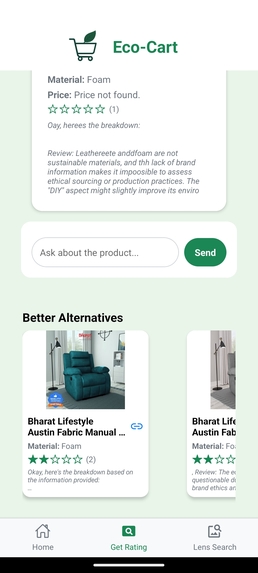
Recommendation system
-
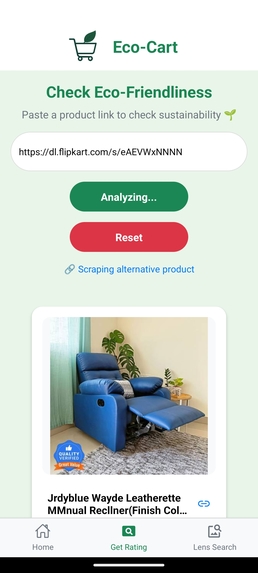
Eco-rating provider
-
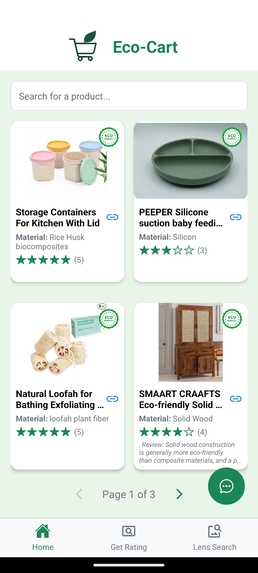
Homepage
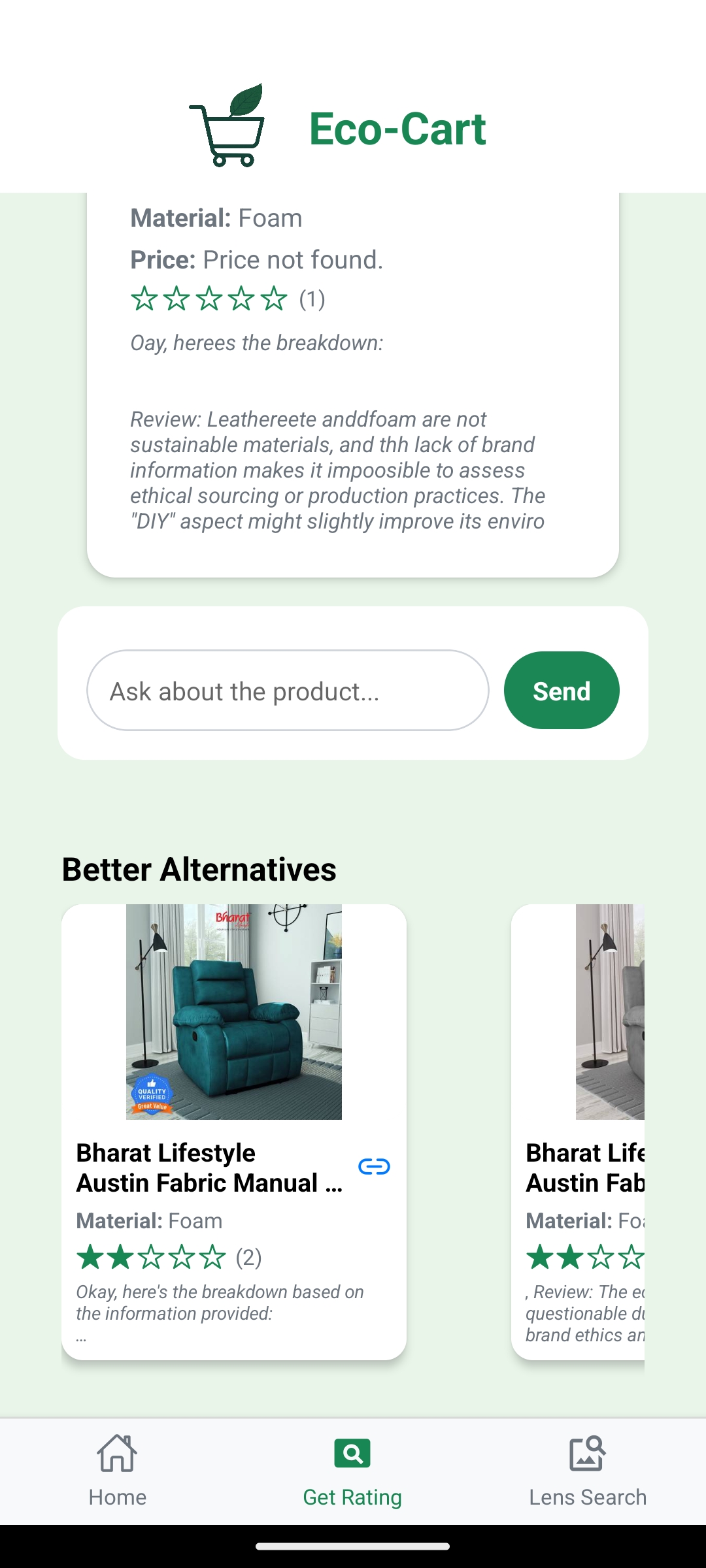
Inspiration
The inspiration behind \textbf{Eco-Cart} came from the need to make environmentally responsible shopping easier for everyone. With the growing availability of eco-friendly products, users often struggle to verify which items are genuinely sustainable. Eco-Cart aims to bridge this gap by offering a smart, simplified system that identifies eco-friendly products and helps users make greener choices effortlessly.
What it does
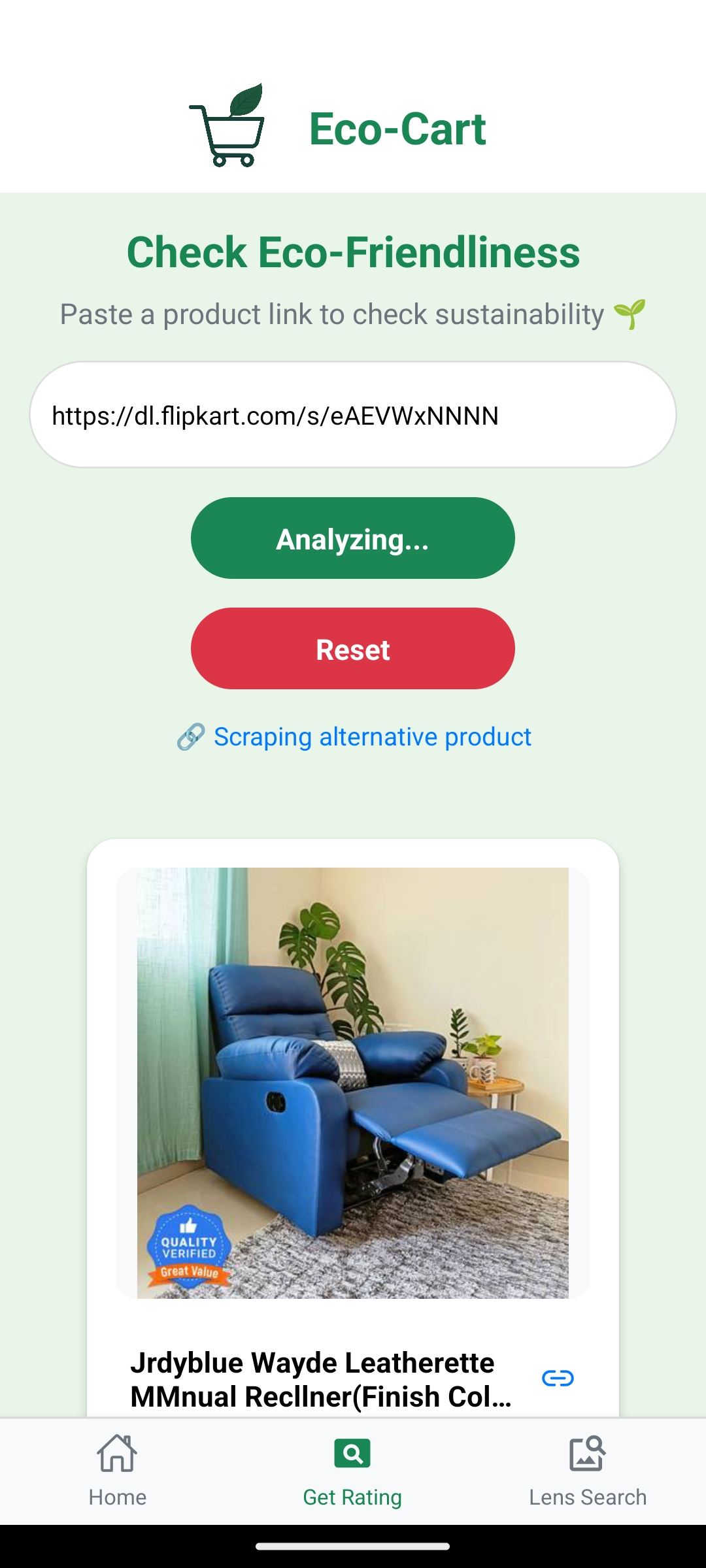
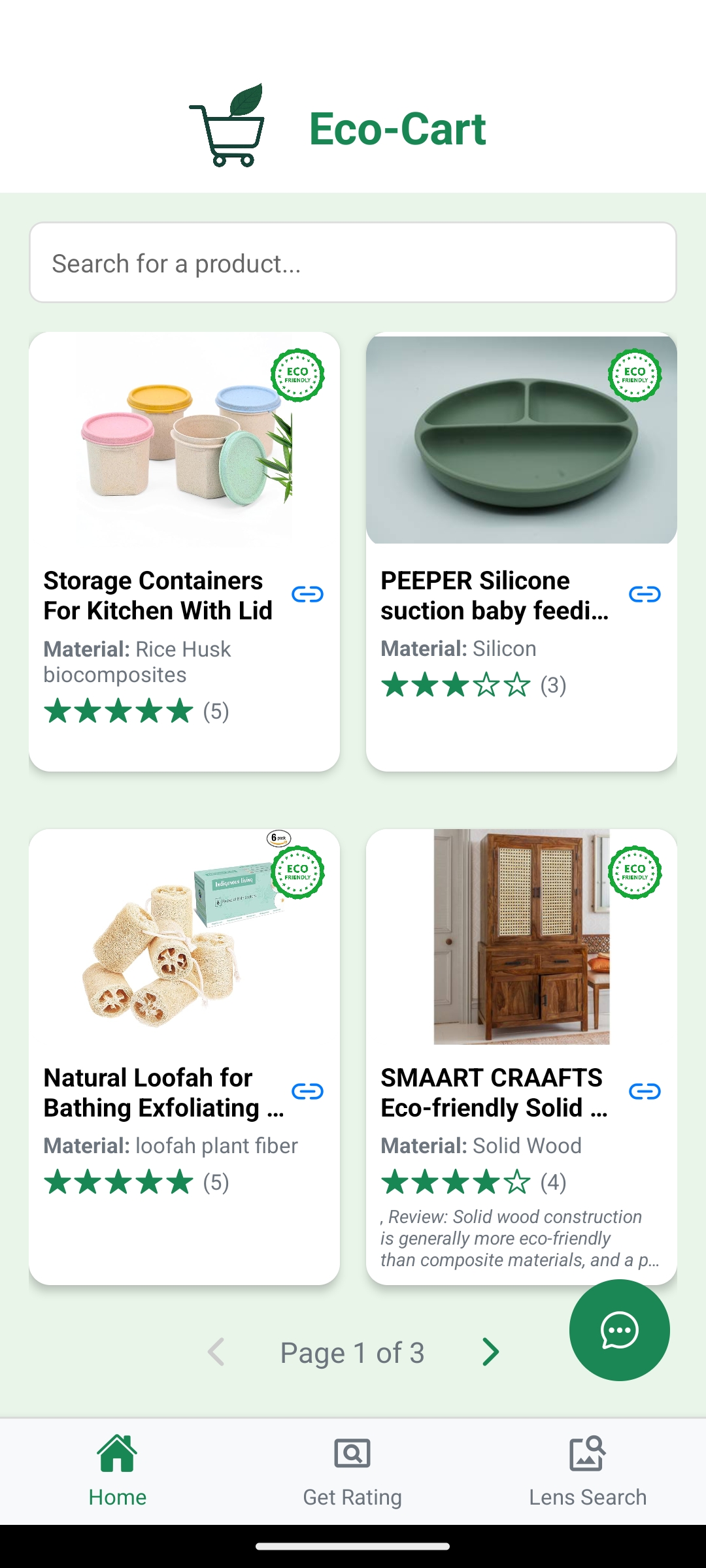
Eco-Cart serves as a digital cart and recommendation platform that displays products based on their eco-friendliness. It analyzes attributes such as material, sustainability rating, environmental impact, and customer feedback. The user can browse products, compare their eco score, and build a cart containing only environment-friendly alternatives. This ensures smarter, more conscious shopping decisions.
How we built it
Eco-Cart was developed using a combination of: \begin{itemize} \item React for the frontend UI and smooth user experience, \item Firebase for real-time data storage and product management, \item A structured dataset consisting of product details like ID, name, image, rating, material, and description, \item Custom logic to categorize and highlight sustainable products, \item Responsive design principles to ensure usability across devices. \end{itemize}
Challenges we ran into
\section*{Challenges We Ran Into} While building Eco-Cart, we faced several key challenges: \begin{itemize} \item Ensuring accurate and reliable representation of eco-friendly product data, \item Designing a clean and intuitive interface that avoids clutter, \item Structuring the dataset in a scalable way to support future expansion, \item Integrating Firebase smoothly with dynamic rendering in React, \item Deployment, cause of web-scrapping so deployed on local computer(hence it will show server offline unless local pc in running) \end{itemize}
Accomplishments that we're proud of
\begin{itemize} \item Successfully creating a functional and visually appealing eco-focused shopping tool, \item Building a clean and structured dataset for sustainable products, \item Achieving fast load times and smooth navigation despite image-heavy content, \item Designing a system that truly encourages greener choices, \item Creating a foundation that can be extended into a full e-commerce platform. \end{itemize}
What we learned
\begin{itemize} \item Work efficiently with React state management and component structuring, \item Store and retrieve structured product data in Firebase, \item Optimize UI/UX for sustainability-focused applications, \item Evaluate sustainability metrics and convert them into user-friendly formats, \item Build a scalable architecture suitable for future add-ons. \end{itemize}
What's next for Eco-Cart
\begin{itemize} \item Integrating price comparison and live offers for eco-friendly alternatives, \item Adding machine learning–based recommendations, \item Introducing a carbon footprint calculator for individual carts, \item Expanding the product database with verified sustainable brands, \item Allowing users to create accounts, track their eco-impact, and earn rewards, \item Launching a mobile app for on-the-go sustainability. \end{itemize}

Log in or sign up for Devpost to join the conversation.