Inspiration
2024 was the hottest year on record — the first to breach 1.5°C. The IPCC AR6 explicitly identifies Indigenous knowledge as critical for climate adaptation, yet most adaptation platforms exclude it. Over 476 million Indigenous people globally hold knowledge systems proven across centuries, and their lands contain approximately 80% of remaining biodiversity. But these practices are invisible: not in apps, not in searchable databases, not accessible to the youth, educators, and local leaders who need them most. We built Eco-Ancestry to close that access gap.
What it does
Eco-Ancestry is a mobile-first web platform that documents, maps, and explains Indigenous and community-led climate adaptation practices. Users can:
- Find — Browse or search 16 documented practices across 6 continents, filtered by category (Water, Soil, Food, Biodiversity, Community) with impact scores (0–100)
- Understand — Each practice has standardized data cards (CO₂ sequestration, global adoption, years documented), a radar chart across 5 ecological dimensions, and an AI-generated plain-language explainer covering how it works, why it builds resilience, and how a community can start a local pilot
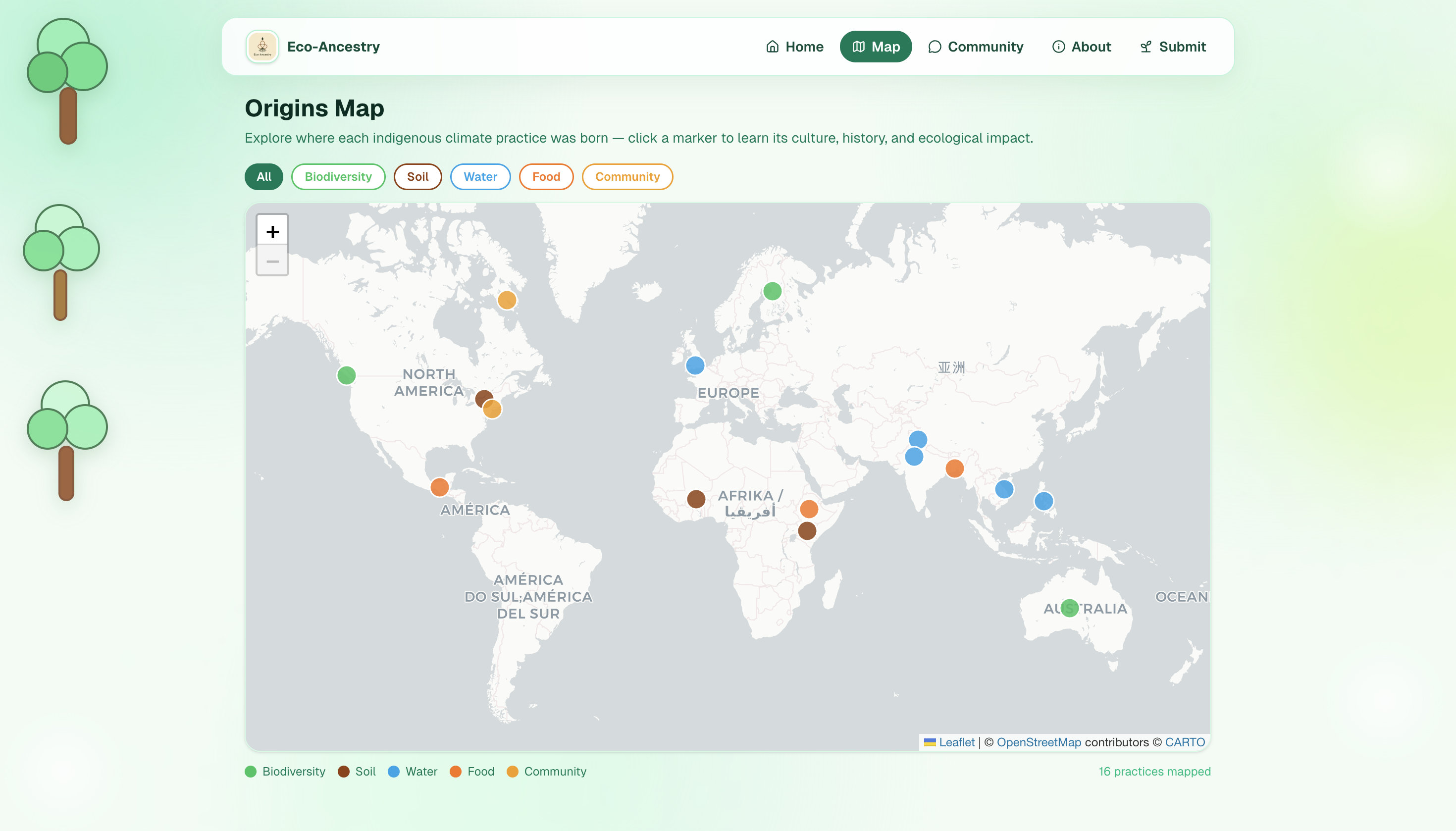
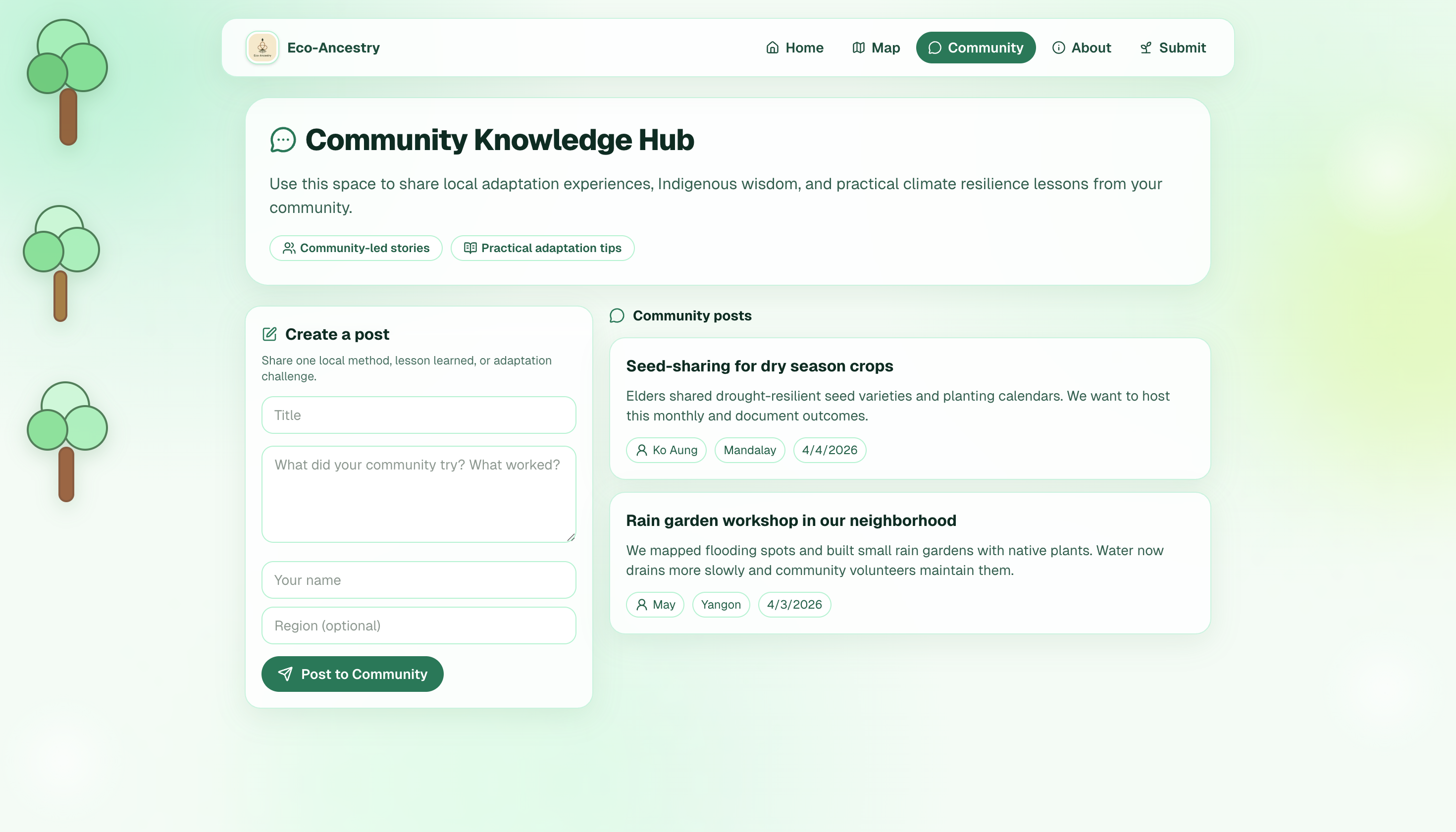
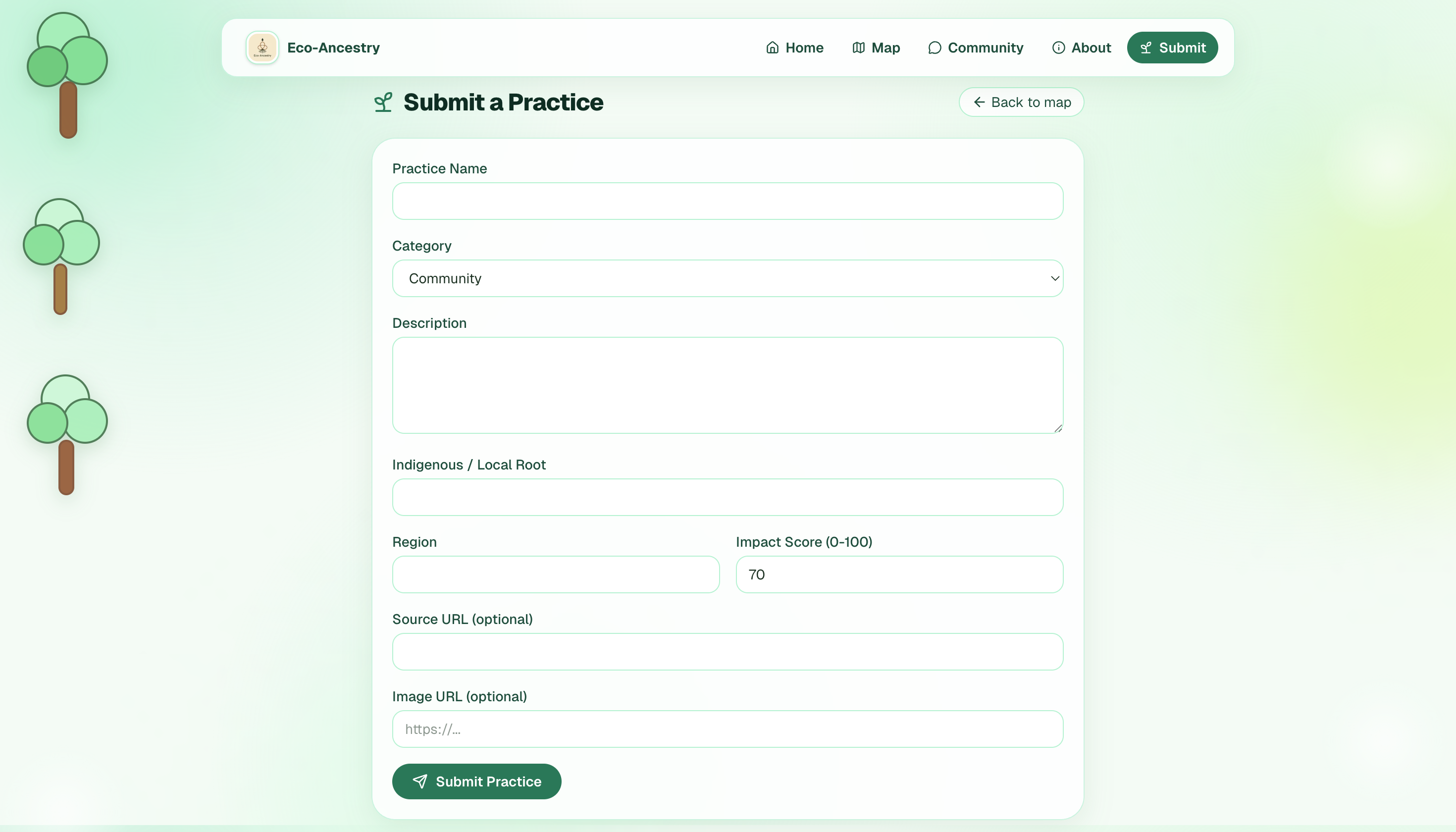
- Locate and Contribute — An interactive Origins Map pins every practice geographically; a Community Hub and Submit-a-Practice form let community leaders, elders, and youth expand the platform
How we built it
- Next.js 16 (App Router) — server components for performance, client components only where interactivity is required
- Supabase (PostgreSQL) — structured data model for practices, categories, dimension scores, community posts, and source citations; full seed fallback so the app functions without a live DB connection
- Recharts — radar charts and impact bar charts
- Vercel — deployed on free tier, global CDN, zero-config deploys
- Built in approximately 3 hours during the hackathon weekend
Challenges we ran into
- Data validation — Impact scores are researcher-estimated, not community-verified. Getting accurate, sourced data for 16 practices across 6 continents in a few hours was the hardest research constraint.
- Risk of knowledge extraction — A platform surfacing Indigenous knowledge could be used to appropriate it without consent or attribution. We mitigated this with full source attribution on every practice, "validate with local experts" disclaimers in AI explainers, and community-controlled contribution via the Submit form.
- Language access — The platform is English-only, which directly contradicts the equity goals. Multilingual support is a named gap we didn't have time to address.
- Team composition — We don't include Indigenous community members. Formal partnerships are essential before scaling.
Accomplishments that we're proud of
- 16 fully documented practices, each with sourced, verifiable data linking to UNDP, UNFCCC, WWF Arctic, indigenous-led organizations, and peer-reviewed papers — built in a weekend
- A working, navigable platform (not a mockup) deployed live on Vercel
- Honest gap acknowledgment baked into the product itself (attribution, disclaimers, community submission)
- A scalable data model that allows any community to contribute their own practices
What we learned
- Scoping matters: focusing on the knowledge-access problem (not climate change in general) made every design decision cleaner
- Indigenous knowledge equity requires more than good intentions — attribution, consent, and community ownership structures need to be designed in from the start, not added later
- A seed fallback in the database is worth the extra hour; it made the demo resilient
What's next for Eco Ancestry
- Partnerships — Partner with 2–3 Indigenous-led organizations to validate and expand the dataset
- Multilingual support — Spanish, French, Swahili, and Bahasa are the highest priority given community distribution
- Community-verified impact scores — Replace estimated scores with community-reported figures as partnerships grow
- Open-source — Release the codebase so regional organizations can fork and localize their own version
- Sustainability model — Grant funding (UNDP SIDS, Wellcome Trust, Global Innovation Fund) near-term; institutional licensing to schools and municipal governments medium-term; open-source core with paid localization services long-term
Built With
- markdown
- next
- rechart
- supabase
- three.js
- typescript
- vercel


Log in or sign up for Devpost to join the conversation.