-
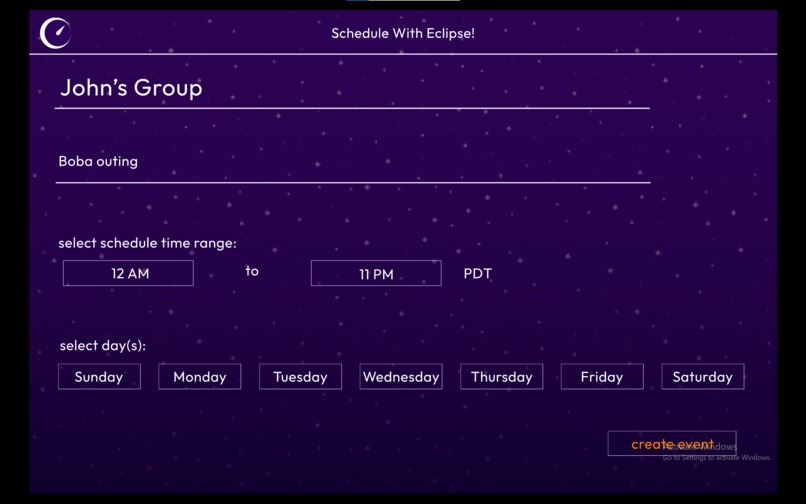
front page
-
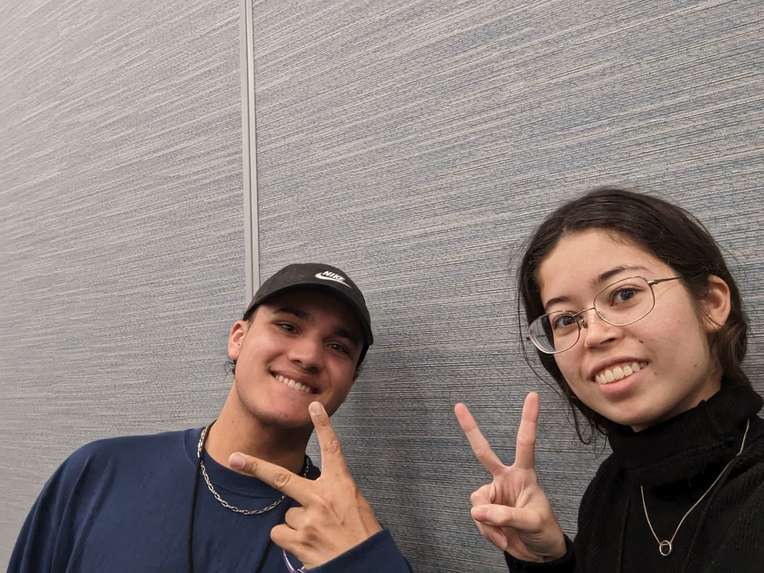
Group Photo (minus bobby and bryan)
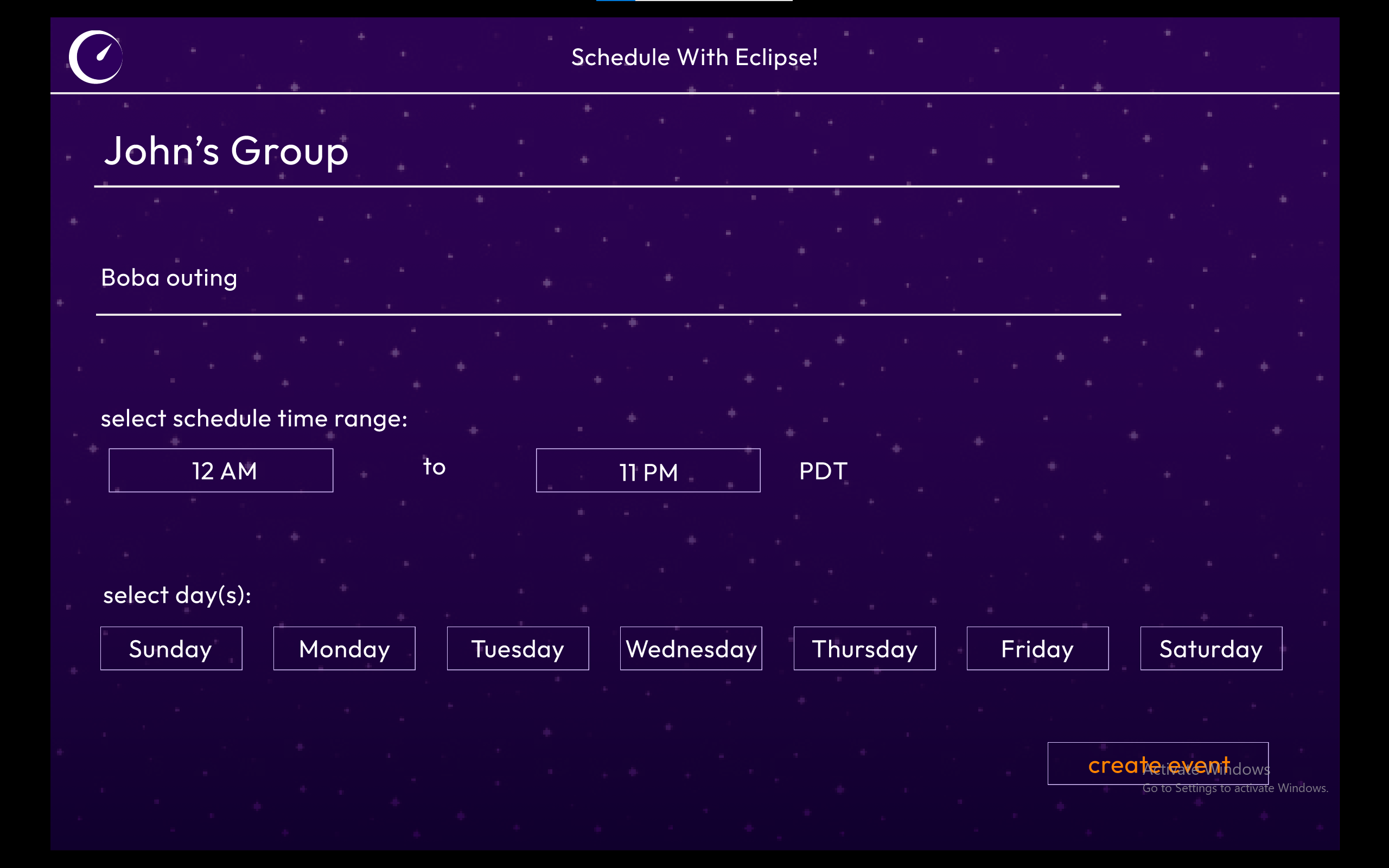
Inspiration
College is time-consuming. Whether it be for extracurriculars, classes, or assignments, the schedule of a typical college student is packed. This busy lifestyle presents problems for those who want to spend time with their friends or just need to find time to meet with teammates for a group assignment. Having to constantly compare availability with peers and stay on top of any schedule changes is difficult--unreasonably difficult. This is where Eclipse comes in.
What it does
Eclipse is a web-app calendar made by busy college students for busy college students. When landing on Eclipse's homepage, users can immediately create a new event to share to their group members. In order to finish creating an event, users will have to enter an event name, a list of members, and time slots (including time and dates). After the creation of an event, users may share a link to their group members so they can start adding in the times they're occupied. After everyone has added their schedules, comparing and finding the best free time slot is easy as the interface allows for direct comparison between the group's schedule and an individual's schedule.
How we built it
Eclipse was developed using React JSX on VS Code with a focus on HTML and CSS and designed using Figma. We decided to use the framework React JSX because it allowed for general applications throughout the webapp, which meant that the CSS and HTML code will be less redundant and cluttered. This also made our coding time more efficient as we didn't have to include the same slice of code in multiple places. In our team, everyone used VS Code as their text editor of choice because of the options of useful extensions, such as Live Share. With the use of Live Share, our team was able to collaborate on Eclipse in real time without having to push and pull from Git constantly as Live Share enables live code editting throughout the whole project for all collaborators. We decided to make Eclipse a webapp using HTML, CSS, and JavaScript because webapps are widely accessible through mobile devices and desktops. Our choice of design software was Figma because of the live collaboration and various features that helped us put together a design quickly.
Challenges we ran into
In our team, many of us were unfamiliar to the React framework and HTML/CSS/JavaScript. Thus, we had to take time to familiarize ourselves with the tools we were using. Halfway through the initial development, our team became discouraged about Eclipse--some of the concerns was the feasibility and uniqueness of the project. After careful consideration of our options, we decided to stick with Eclipse and do our best to give Eclipse our all. We cut some of the features we were planning to implement, such as a live calendar and dynamic routing, for the sake of feasibility and put emphasis on our target audience.
Accomplishments that we're proud of
Despite being largely unfamiliar with React, HTML, and CSS, we did our best to learn the basics of these tools to create Eclipse. VenusHacks 2023 was also a majority's first hackathon--our team did a great job on coordination and communication.
What we learned
- React (and what frameworks are used for and how they work)
- HTML
- CSS
- feasibility check and cutting losses while we can
What's next for Eclipse
Our current released version as of May 28th, 2023 is a demo version of Eclipse--this means that Eclipse can only support one general event and cannot save any event information configured in the event creation page. In Eclipse's future version, we aim to implement dynamic routing so that events will have their own link that groups can share amongst themselves. Another feature we are thinking about is a live calendar so that users have the option to select specific days of the year to create plans for rather than general days of the week, which Eclipse currently has.
Why Eclipse?
e·clipse
noun
an obscuring of the light from one celestial body by the passage of another between it and the observer or between it and its source of illumination (Oxford Dictionary) When two celestial bodies perfectly align, it creates an uncommon phenomena called an "eclipse". We took this idea and related it to the idea of aligning students' schedules with each other to find openings in their busy times to come together and hang out. Eclipses are hard to come across, but we want to make it easy for students to find the "eclipse"--the alignment--in their schedules and find time for each other. Finding open time slots can be difficult for college students, but with Eclipse, it doesn't have to be. As a student-focused webapp, Eclipse's number one priority is to put emphasis on student's busy times so they can find the free times together.

Log in or sign up for Devpost to join the conversation.