-
-
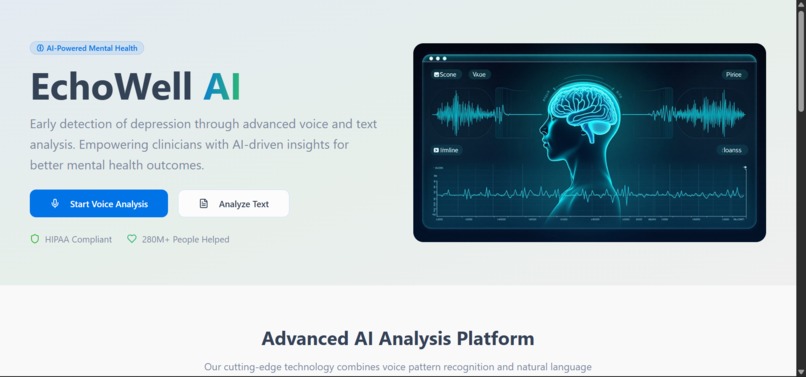
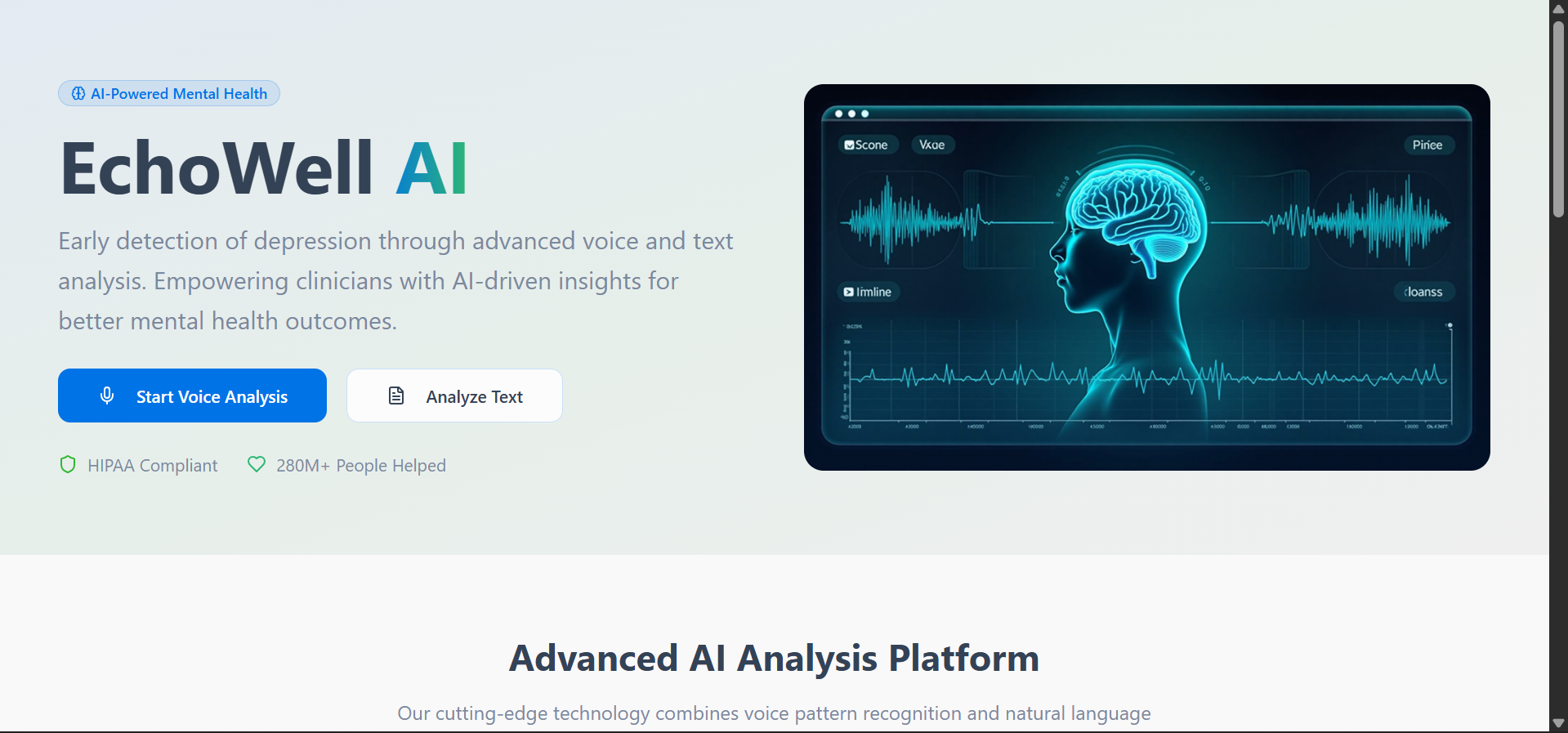
Home Page
Inspiration
Depression is one of the leading causes of disability worldwide, yet it often goes undetected until it becomes severe. Traditional diagnostic methods rely heavily on self-reporting, which can be biased or stigmatized. We wanted to create a solution that uses everyday signals—speech and text—to provide an early, accessible, and non-invasive screening tool for mental health.
What it does
EchoWell AI is an AI-powered system that analyzes speech patterns and text inputs to detect early signs of depression. It identifies subtle markers such as tone, rhythm, pauses, and linguistic sentiment. The system then generates a mental wellness risk score and offers insights that can help both clinicians and individuals take timely action.
How we built it
- NLP Models: We used transformer-based models (like BERT) for text sentiment and linguistic analysis.
- Speech Emotion Recognition: Implemented CNNs with spectrogram feature extraction to analyze voice recordings.
- Backend: Developed with FastAPI to handle real-time input and processing.
- Dashboard: Built an interactive interface using Streamlit, allowing clinicians or users to view results.
- Privacy: Designed a pipeline that anonymizes data and ensures compliance with healthcare data security standards.
Challenges we ran into
- Ensuring the model’s predictions are explainable and not a “black box.”
- Balancing accuracy with data privacy and ethical concerns.
- Limited access to clinically validated mental health datasets.
- Designing a user interface that feels supportive, not stigmatizing.
Accomplishments that we're proud of
- Built a prototype that combines speech + text analysis into a single wellness score.
- Created a system that prioritizes ethical AI design and user privacy.
- Developed an intuitive dashboard that can be easily integrated into telehealth systems.
- Sparked conversations with mentors about real-world deployment in mental healthcare.
What we learned
- The importance of designing AI that is transparent, interpretable, and ethical.
- How multimodal inputs (voice + text) improve diagnostic accuracy compared to single-source models.
- The critical role of UX design in healthcare tools, ensuring sensitivity in how results are displayed.
- Collaboration across tech and medical domains is essential for building impactful health solutions.
What's next for EchoWell AI
- Expand datasets with clinically validated and diverse samples for improved accuracy.
- Develop a mobile-friendly version for self-assessment in remote or underserved communities.
- Partner with healthcare providers to run clinical pilot studies.
- Add multilingual support to reach a global audience.
- Integrate with wearable devices for continuous, passive monitoring of mental wellness.


Log in or sign up for Devpost to join the conversation.