-
-
First Screen
-
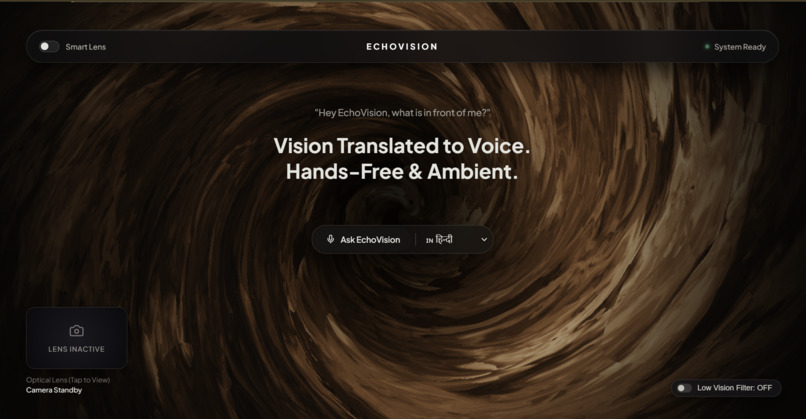
Home Screen
Inspiration
Close your eyes for ten seconds. Now try to pour yourself a glass of water.
That is not a theoretical thought experiment — that is daily life for over \( 2.2 \times 10^9 \) (2.2 billion) people living with vision impairment worldwide. The smartphone in their pocket has a 48-megapixel camera, high-speed 5G, and advanced compute, yet remains largely useless when they need to know what is directly in front of them: a medication dosage, an obstacle on the floor, or an item on a desk.
Existing visual assistance tools either produce slow, robotic labels or take 15 to 30 seconds to respond.
EchoVision was built on a single, stubborn question: What if you could turn any smartphone camera and voice interface into a real-time, sub-second spatial guide powered by world-class open vision models?
Not robotic object classification tags. Real, human, spatially anchored descriptions:
"There is a ceramic coffee mug on your desk, about 6 inches to the left of your keyboard. The path ahead is clear."
What it does
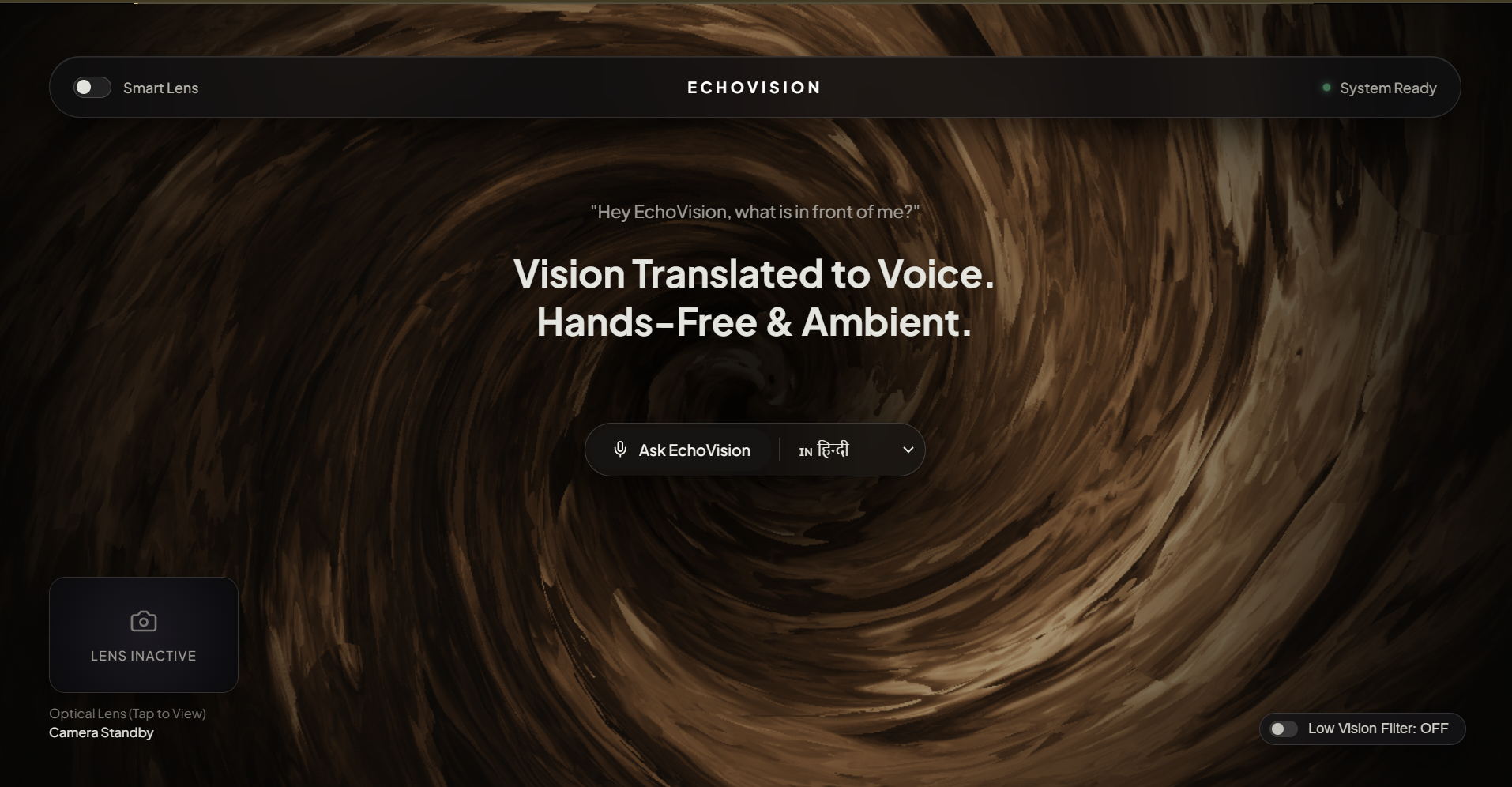
EchoVision turns any standard browser and voice interface into an instant, hands-free multimodal vision assistant:
- Zero-Install Web Experience: Open https://echovision45.vercel.app on any mobile or desktop browser. The camera immediately streams live 1080p video over native WebRTC.
- Sub-Second Spatial Intelligence: Powered by NVIDIA Nemotron-3.5-Super-VL and Llama-3.2-Vision, the engine interprets spatial orientation, clock-face positioning, and environmental hazards.
- True Native Multilingual Voice: Generates native Hindi (हिन्दी in Devanagari script), Spanish, French, and English descriptions directly from visual tokens — not machine-translated afterthoughts.
- Intelligent 2-Tier Cost and Latency Router: Pure text reading (OCR) runs on-device in milliseconds at zero cost; complex spatial queries route asynchronously to the cloud brain.
- Model Context Protocol (MCP): Built-in streaming HTTP MCP server (spec 2025-11-25) at
/api/v1/mcpallowing external autonomous agents to query the camera feed.
How we built it
Every architectural decision in EchoVision was designed backward from one strict latency wall: natural conversational audio navigation collapses if total system latency exceeds 3 seconds:
$$ T_{\text{total}} = t_{\text{capture}} + t_{\text{triage}} + t_{\text{inference}} + t_{\text{TTS}} < 3.0\text{ s} $$

Log in or sign up for Devpost to join the conversation.