-
-
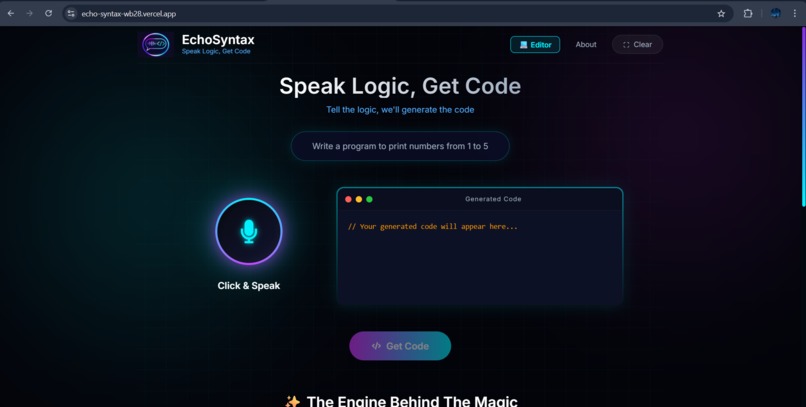
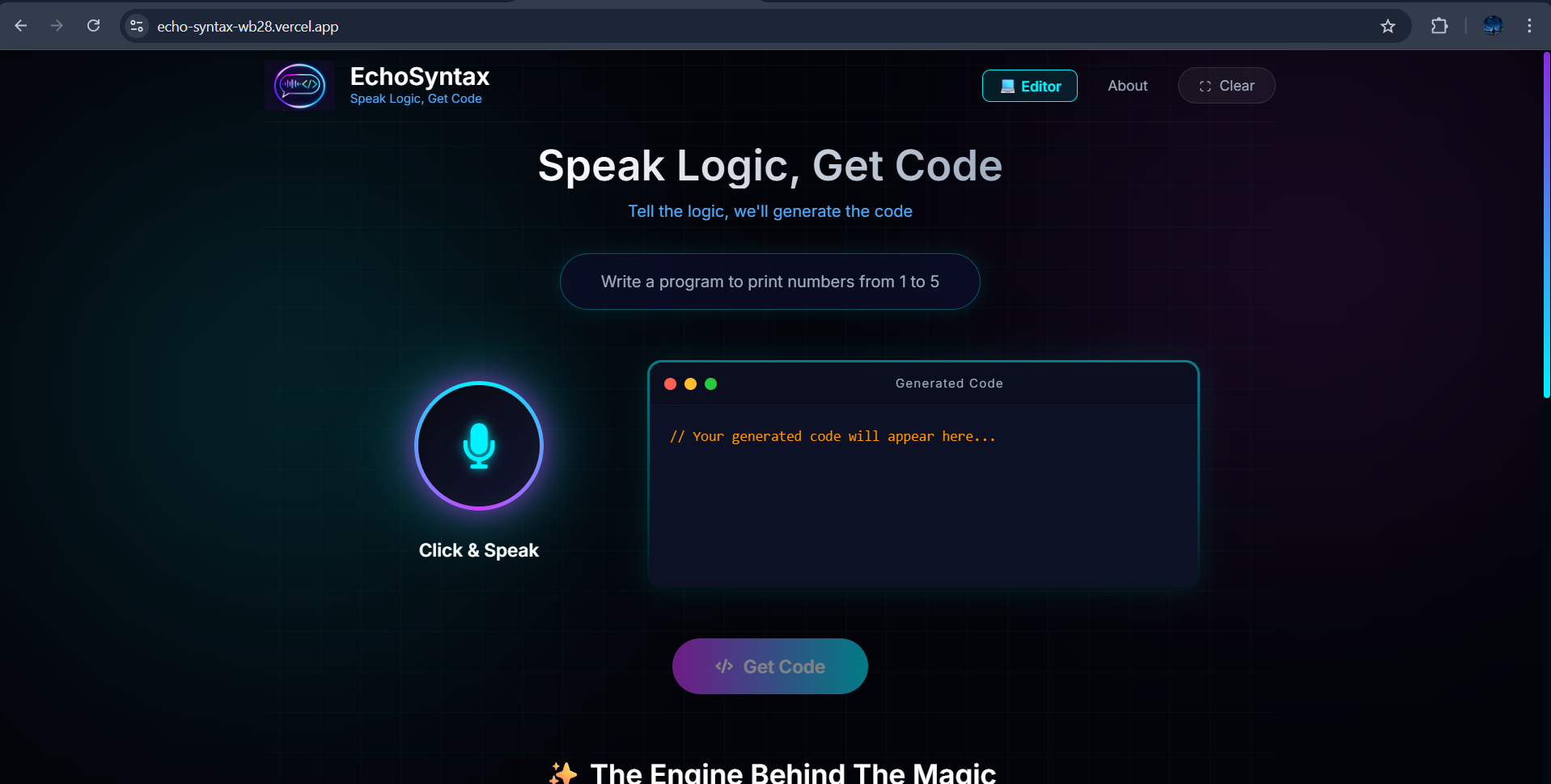
Voice Input in Action: Just click the mic and speak your algorithm naturally. EchoSyntax listens to your logic.
-
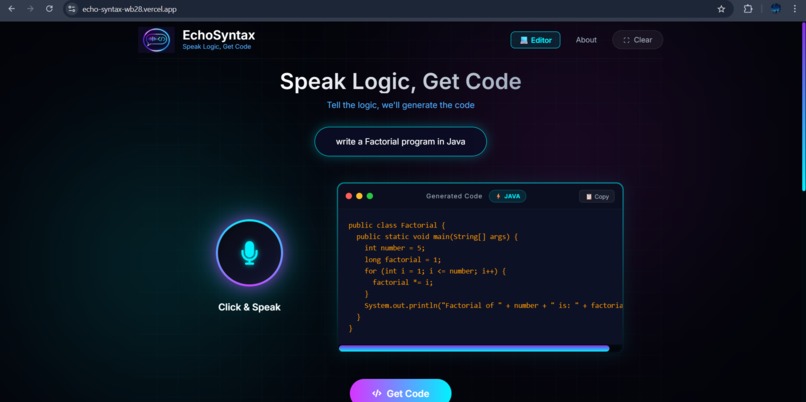
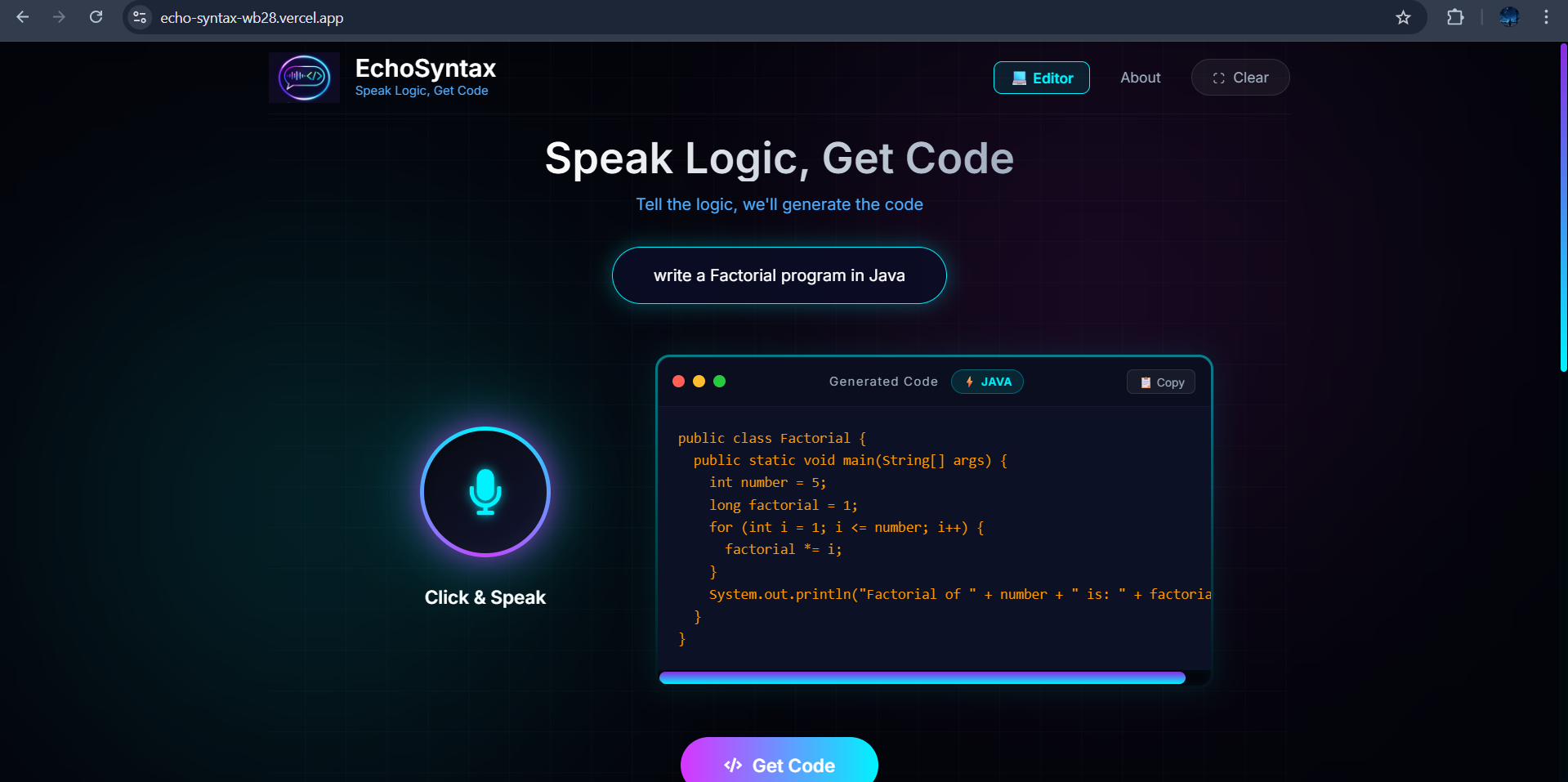
Instant Code Generation: Watch our AI (Llama 3.3) instantly translate your spoken logic into precise, working code.
-
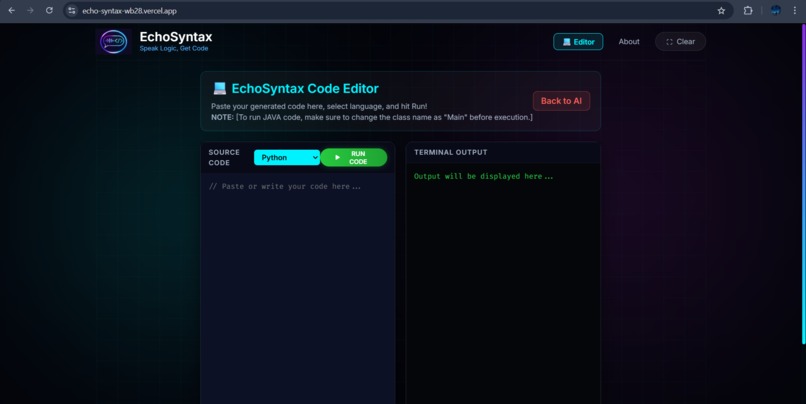
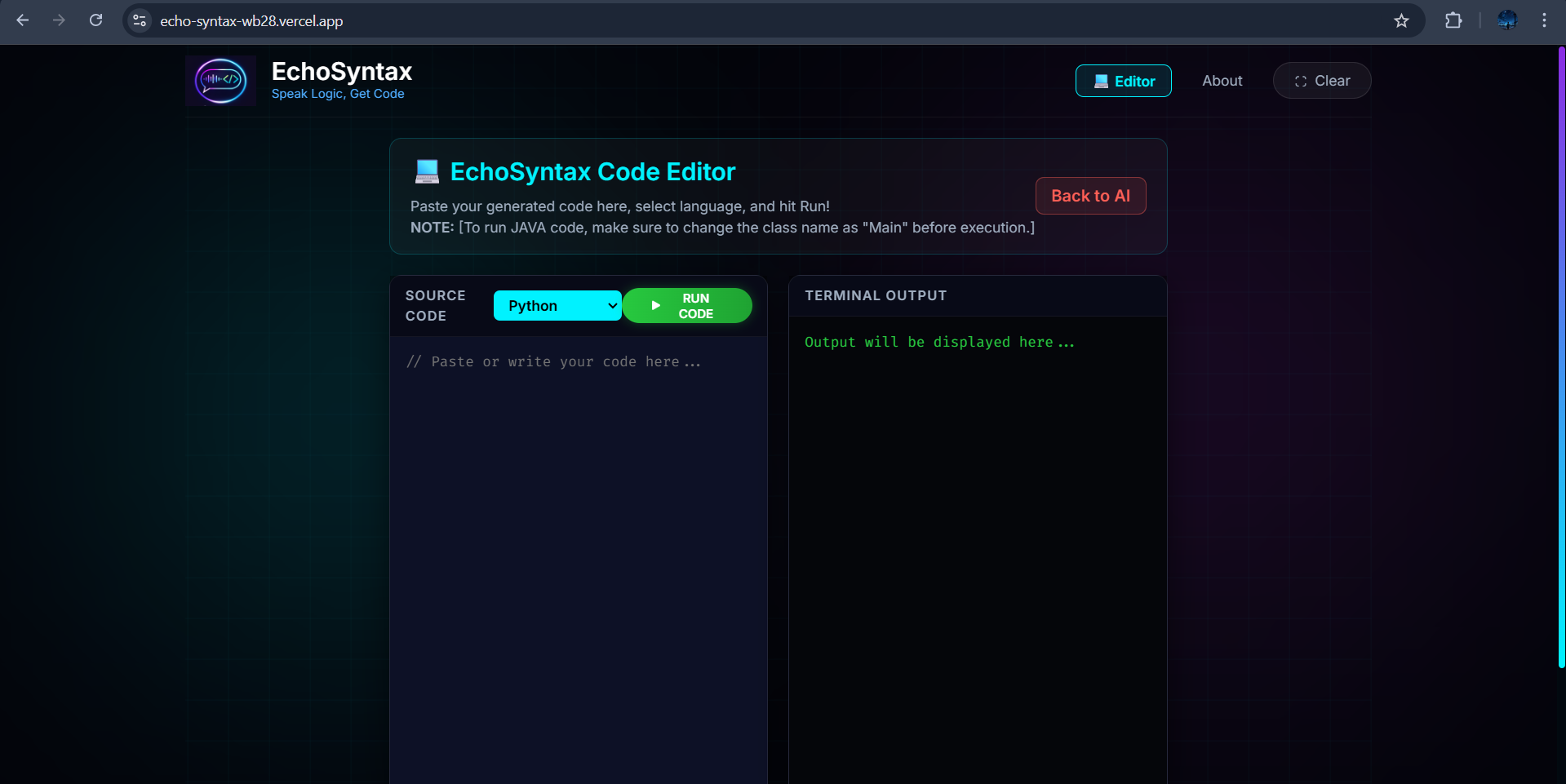
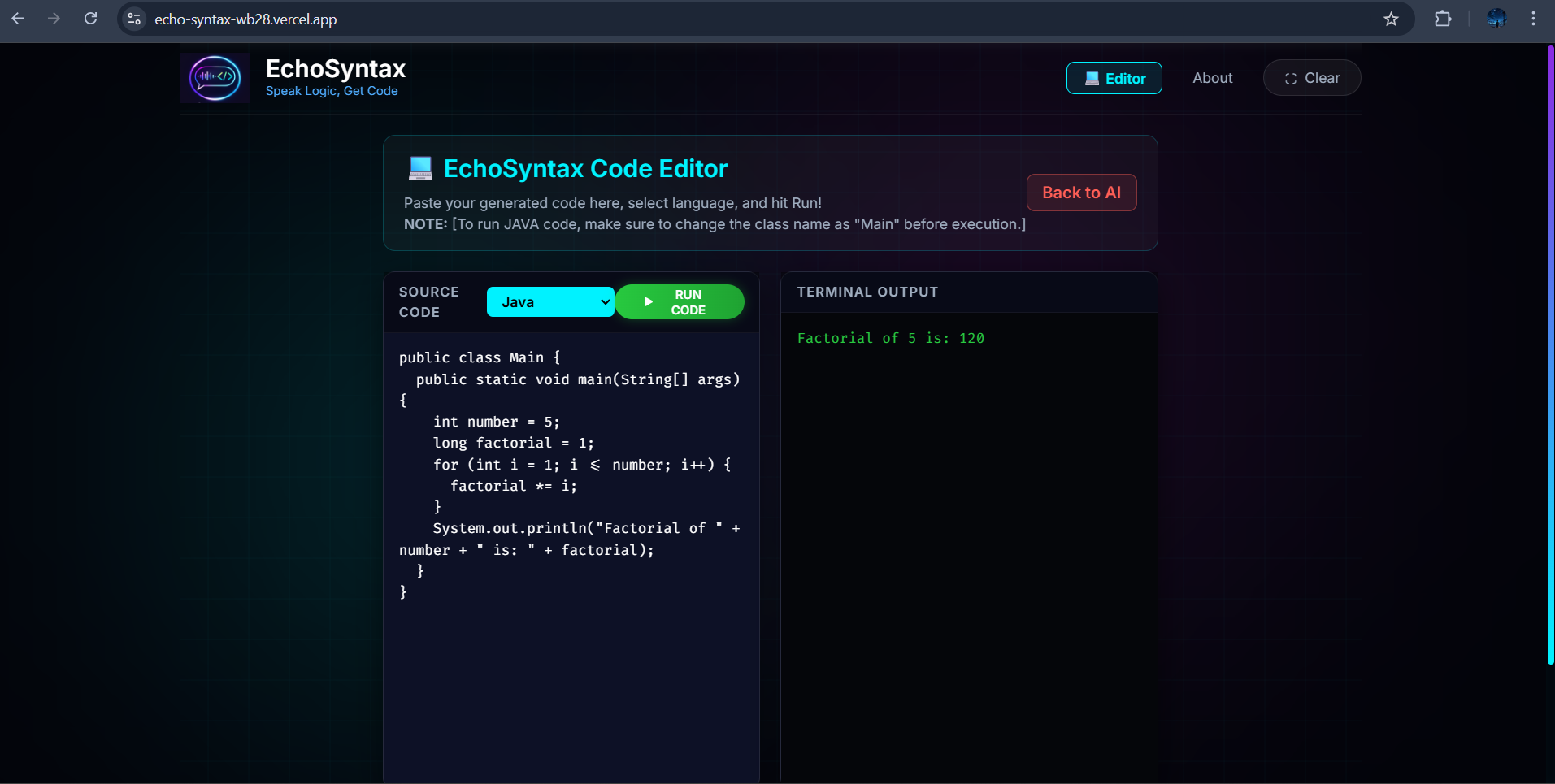
Built-in IDE: A seamless workspace to paste, review, and select your target programming language without leaving the app.
-
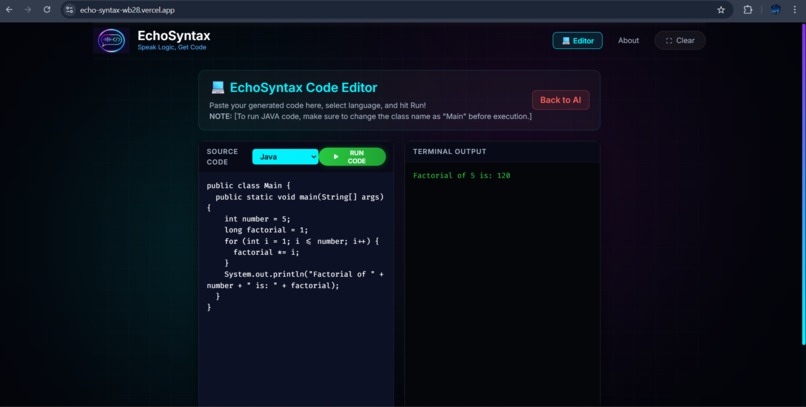
Live Cloud Execution: Run your generated code instantly and view the output via the integrated Judge0 compiler.
-
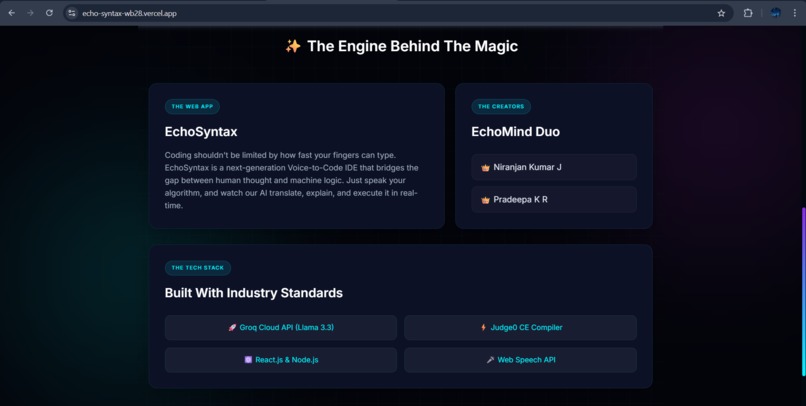
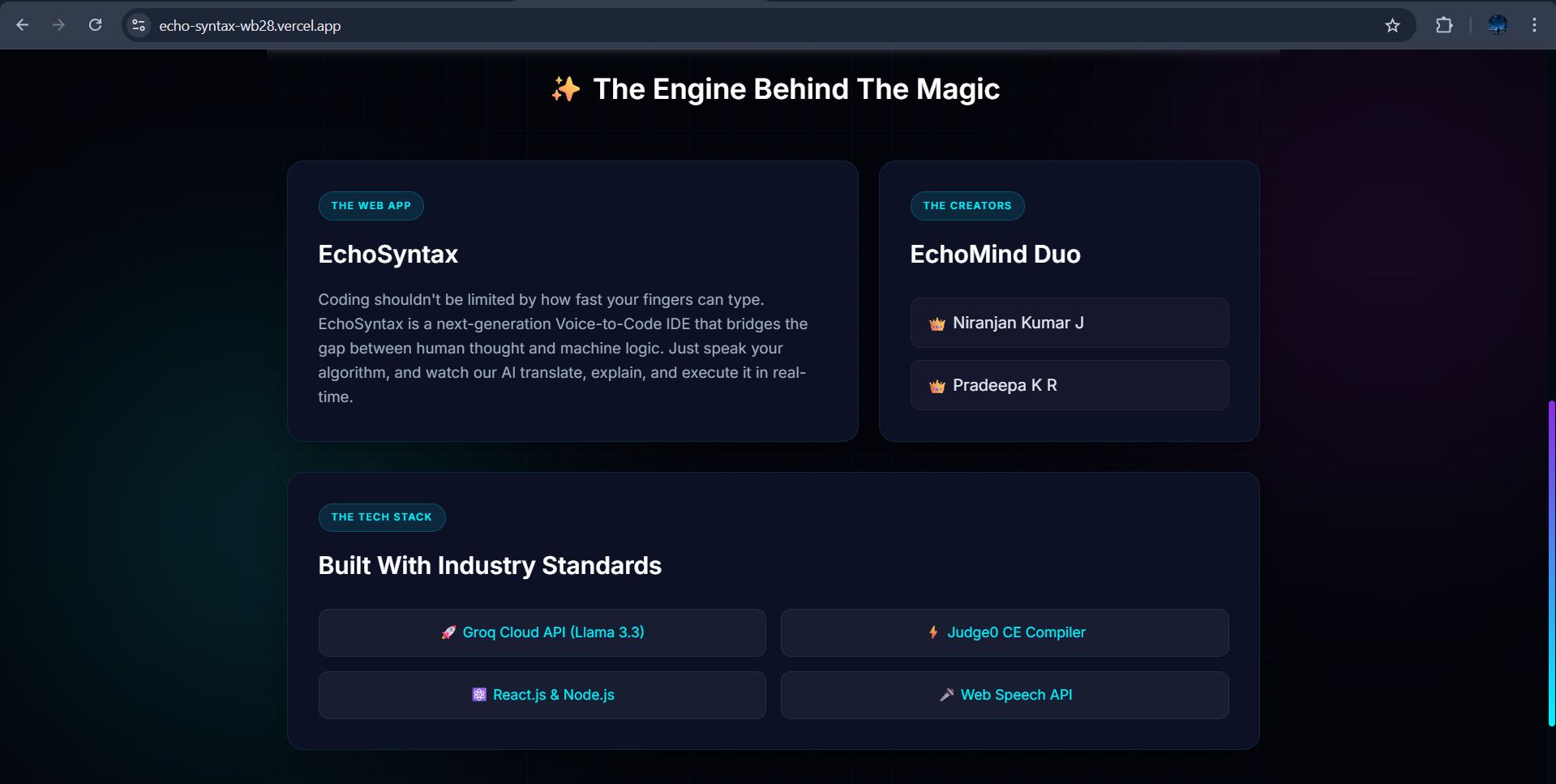
The Engine & Creators: Powered by a modern stack (React, Node, Groq, Judge0) and proudly built by the EchoMind Duo.
Inspiration
🚀 Inspiration
For decades, programming has been restricted by strict syntax rules and keyboard speed. Beginners often struggle to memorize boilerplate syntax, while experienced developers waste time typing it out. We realized that the true essence of programming isn't typing—it's logic. We asked ourselves: "What if you could just talk to your computer, explain your algorithm, and watch it build the software?" That idea birthed EchoSyntax.
💡 What it does
EchoSyntax is a next-generation, AI-driven Voice-to-Code IDE.
- Speak Logic, Get Code: You simply speak your logic (e.g., "Write a Python script to find the factorial of a number").
- AI Generation & Explanation: The app instantly converts your voice to text, sends it to a blazing-fast LLM, generates the exact working code, and literally speaks back a short explanation.
- Dual-Mode Execution: You don't need to copy-paste the code elsewhere. EchoSyntax features a built-in terminal for backend languages (Python, Java, C++, C) and a Live Web Preview window for HTML/UI code.
🛠️ How we built it
We built EchoSyntax with a focus on speed and seamless user experience:
- Frontend: Built with React.js (Vite) and custom glassmorphism CSS for a futuristic, cyberpunk UI. We utilized the native Web Speech API for both Speech-to-Text (capturing user logic) and Text-to-Speech (AI voice explanations).
- Backend: A robust Node.js & Express.js serverless setup.
- AI Engine: We integrated the Groq Cloud API (running Llama-3.3-70b-versatile) for near-instantaneous code generation. We heavily prompt-engineered the AI to return strict, parsable JSON.
- Compiler: We connected the Judge0 CE API to safely compile and execute user-generated code in the cloud.
- Deployment: Hosted full-stack on Vercel using serverless functions.
⚠️ Challenges we ran into
Building a production-ready AI IDE in a time-crunch was thrilling but tough:
- Voice Accent Recognition: Initially, the browser's voice API struggled with our accents, displaying text in regional languages. We had to strictly configure the
langattributes toen-USto ensure pure English input. - Strict JSON Parsing: The LLM would occasionally output markdown blocks along with JSON, breaking the app. We solved this by enforcing a rigid JSON response format in the system prompt.
- Deployment & Security: We faced GitHub Push Protection blocking our API keys, and later, "Mixed Content (HTTPS vs HTTP)" CORS errors when connecting the Vercel frontend to the backend. We successfully resolved these by setting up secure
.envvariables and enforcing HTTPS routes.
🎉 Accomplishments that we're proud of
- Successfully integrating two external APIs (Groq and Judge0) and making them communicate seamlessly under 2 seconds.
- Overcoming complex Git and Vercel deployment hurdles as a team.
- Building a fully functional cloud compiler interface directly inside the browser.
📚 What we learned
- Advanced prompt engineering to force LLMs into producing strict machine-readable formats (JSON).
- Handling Cross-Origin Resource Sharing (CORS) and serverless function routing on Vercel.
- The importance of keeping secret keys out of version control!
🚀 What's next for EchoSyntax
We plan to expand EchoSyntax to include:
- Real-time Collaborative Coding: Multiple developers speaking and coding on the same document.
- Cloud Storage: Saving workspaces and generated scripts to user accounts.
- Direct GitHub Integration: Pushing voice-generated code directly to a repository.
Built With
- css3
- express.js
- groq
- judge0-api
- llamma-3
- node.js
- react.js
- vercel
- vite
- web-speech-api


Log in or sign up for Devpost to join the conversation.