Inspiration
Over 430 million individuals globally experience disabling hearing loss, facing severe safety vulnerabilities when critical environmental cues occur. Conventional auditory alerts—such as commercial fire alarms, ambulance sirens, breaking glass, and cries of distress—fail to protect deaf and hard-of-hearing populations. Existing hardware alternatives, such as specialized strobe systems, remain cost-prohibitive, stationary, and confined to specific rooms.
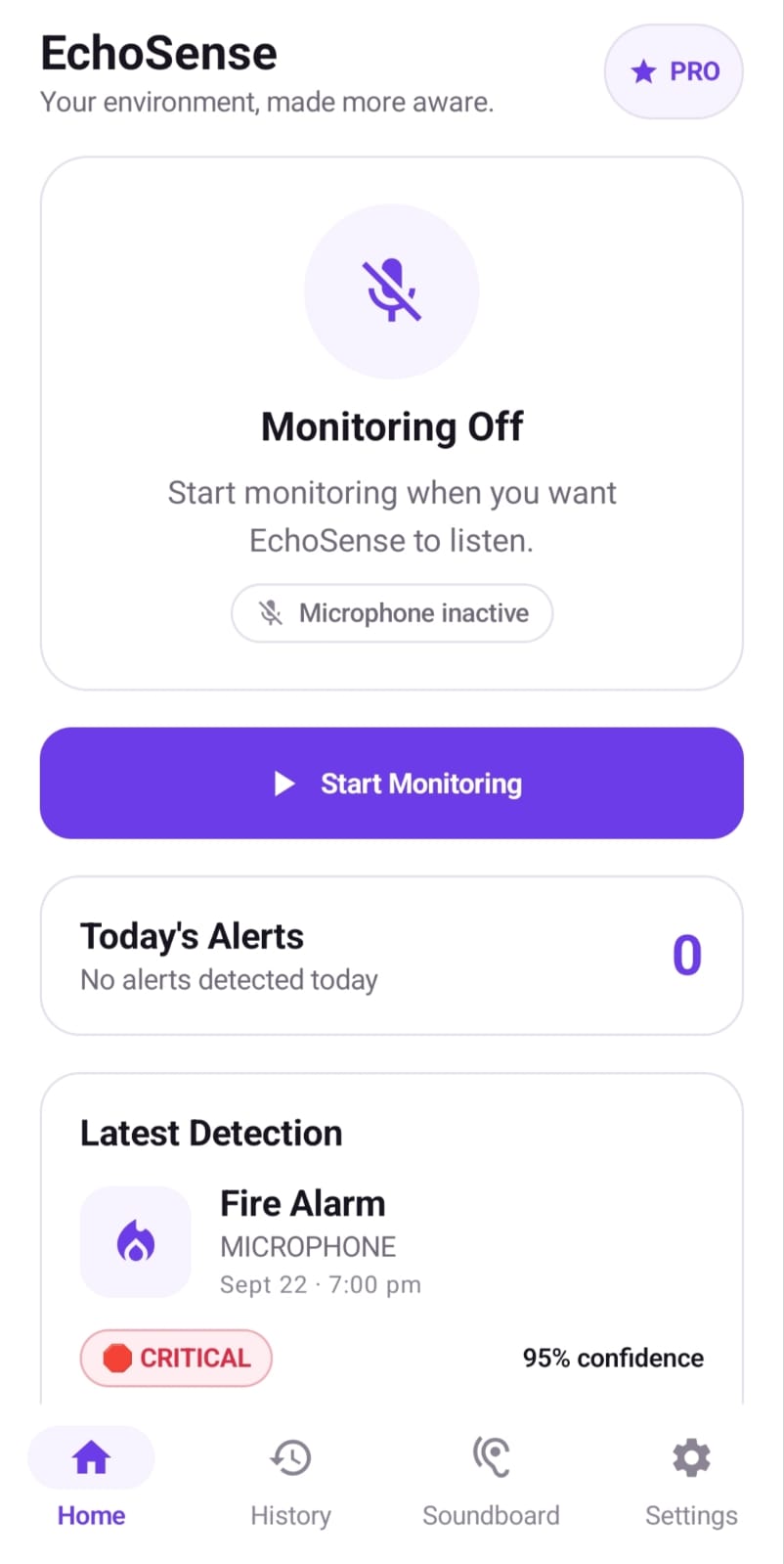
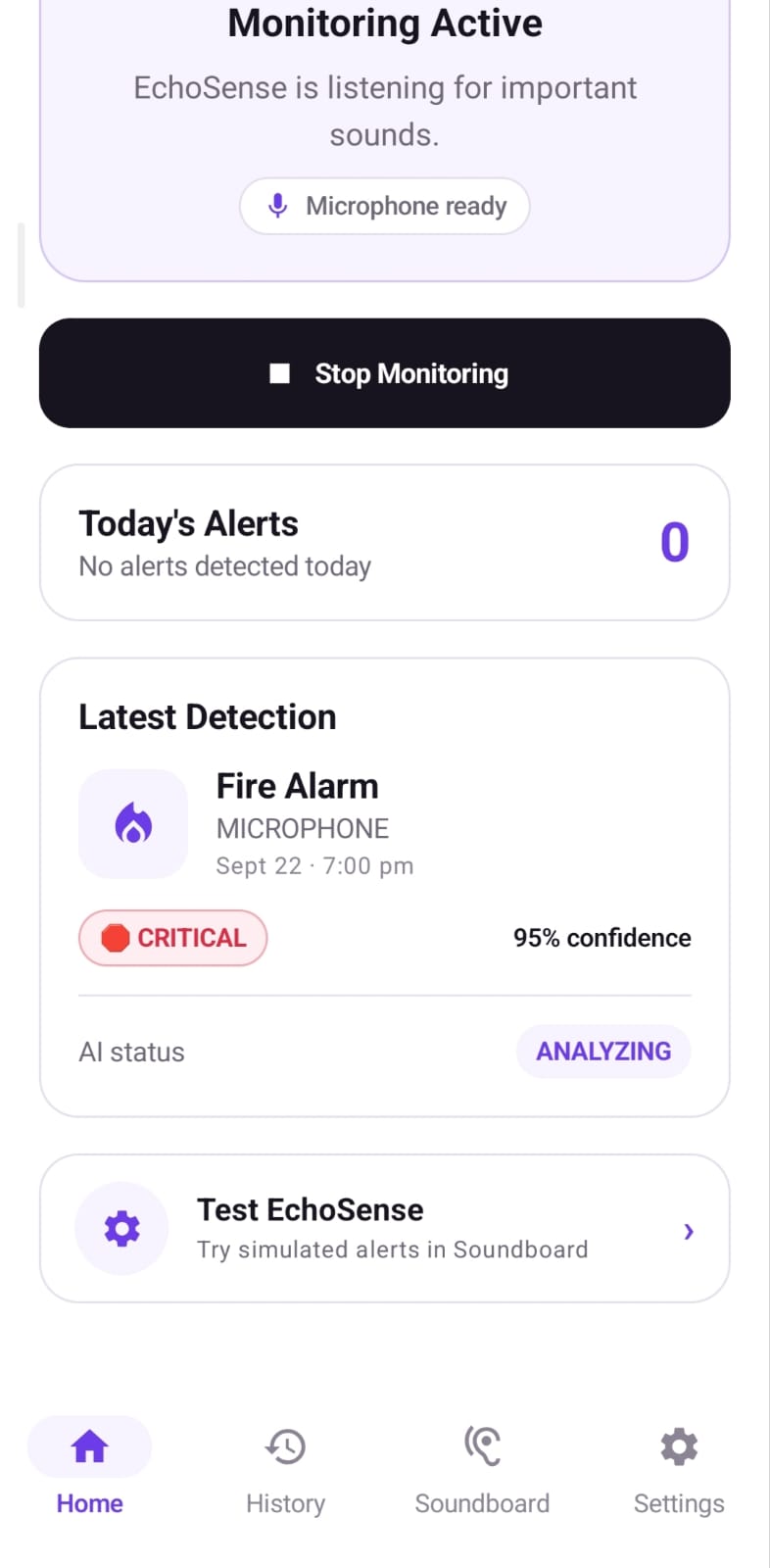
EchoSense was engineered to eliminate this barrier by delivering continuous, on-device acoustic awareness. Operating entirely at the edge, it transforms critical environmental sounds into actionable visual, tactile, and systemic indicators in real time.
What It Does
EchoSense functions as a persistent, low-latency background service designed for comprehensive acoustic threat detection and accessible multi-modal feedback:
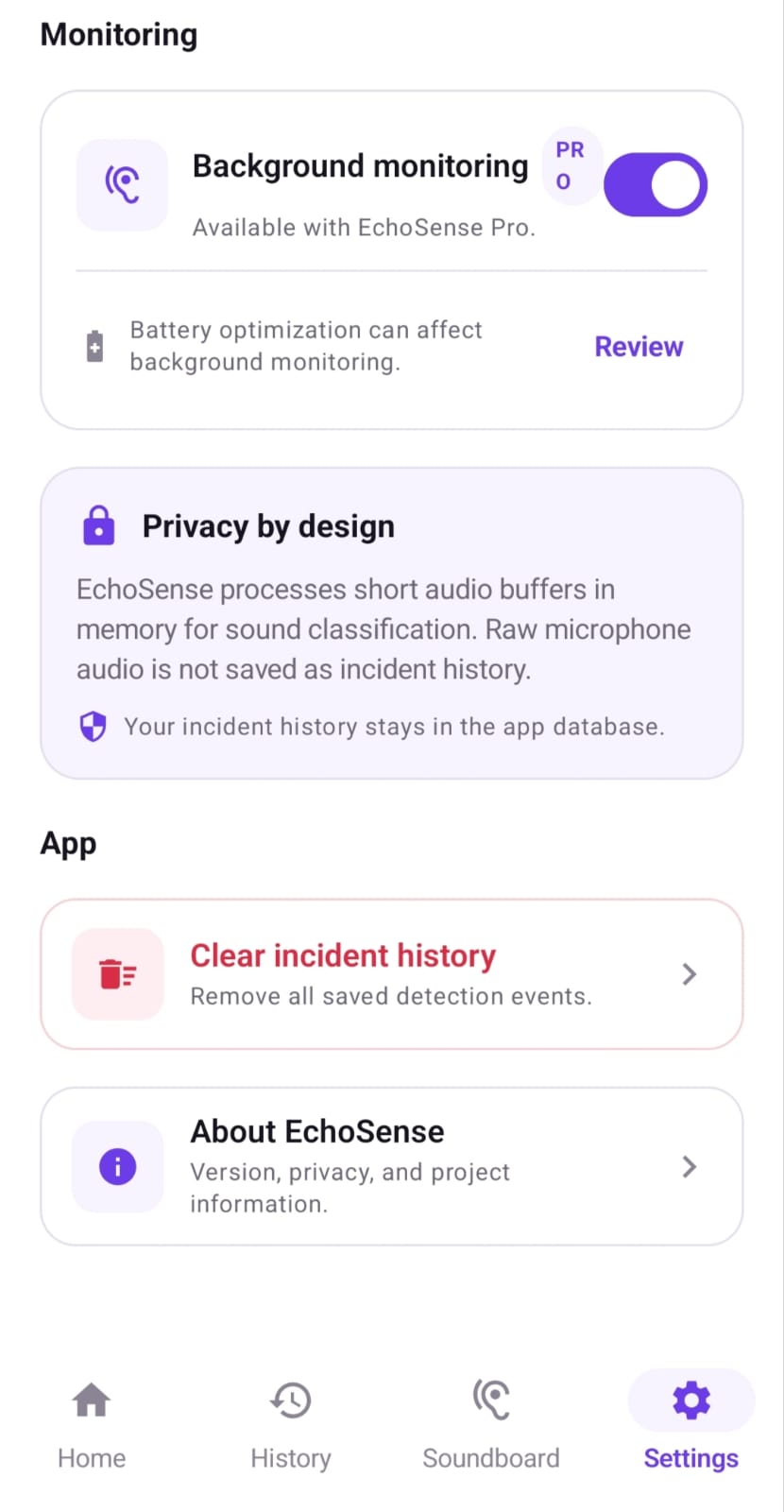
- Zero-Storage Privacy Framework: Ingests 16 kHz audio streams into a volatile 3-second circular RAM buffer, guaranteeing that raw audio files (
.pcm,.wav) are never written to physical disk or uploaded to remote endpoints. - Multi-Modal Threat Dispatch: Translates recognized acoustic hazards into instantaneous full-screen alert overlays, persistent custom haptic patterns, and prioritized system heads-up notifications.
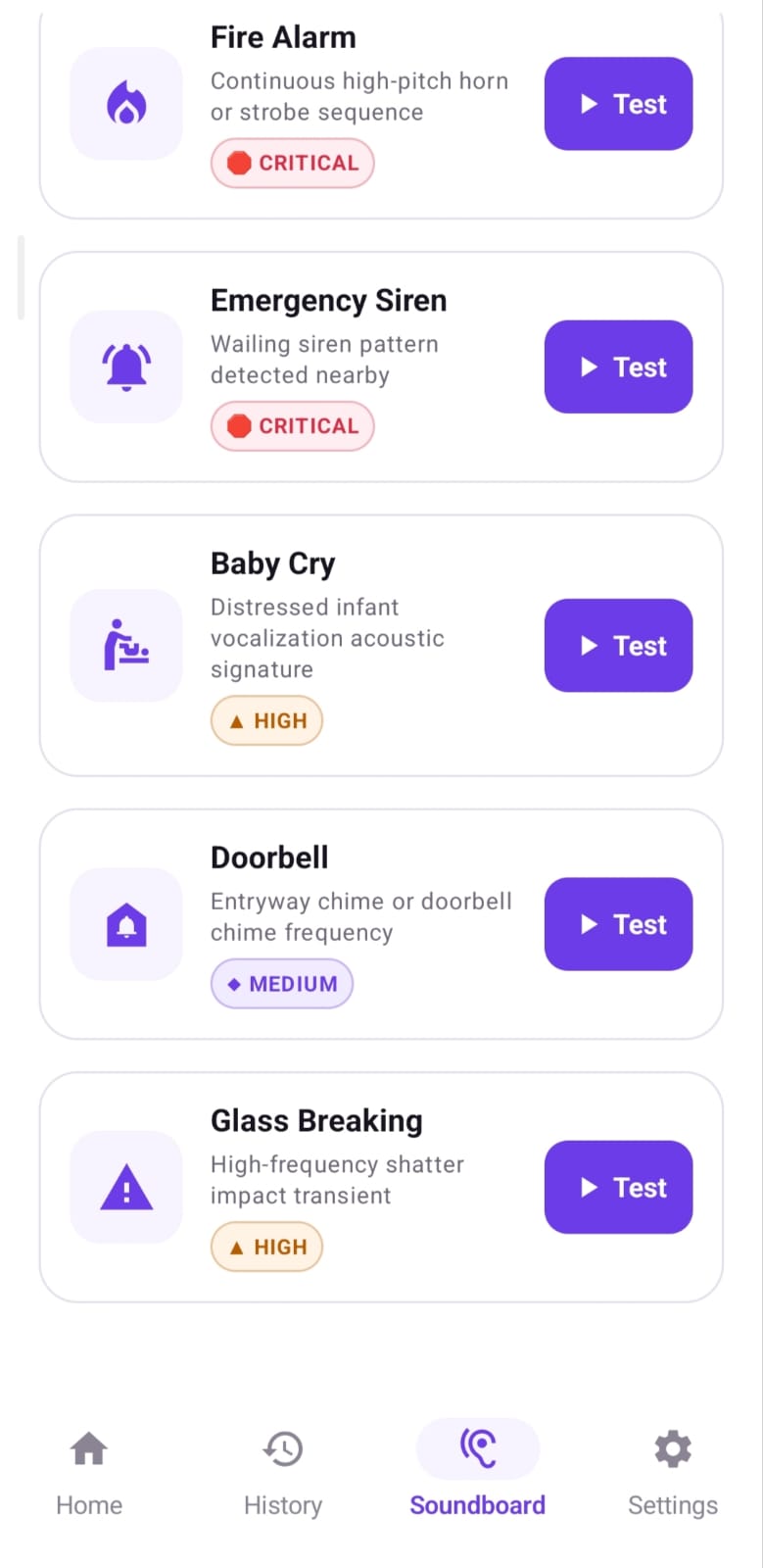
- WCAG-Compliant Visual Hierarchy: Employs unambiguous geometric iconography (
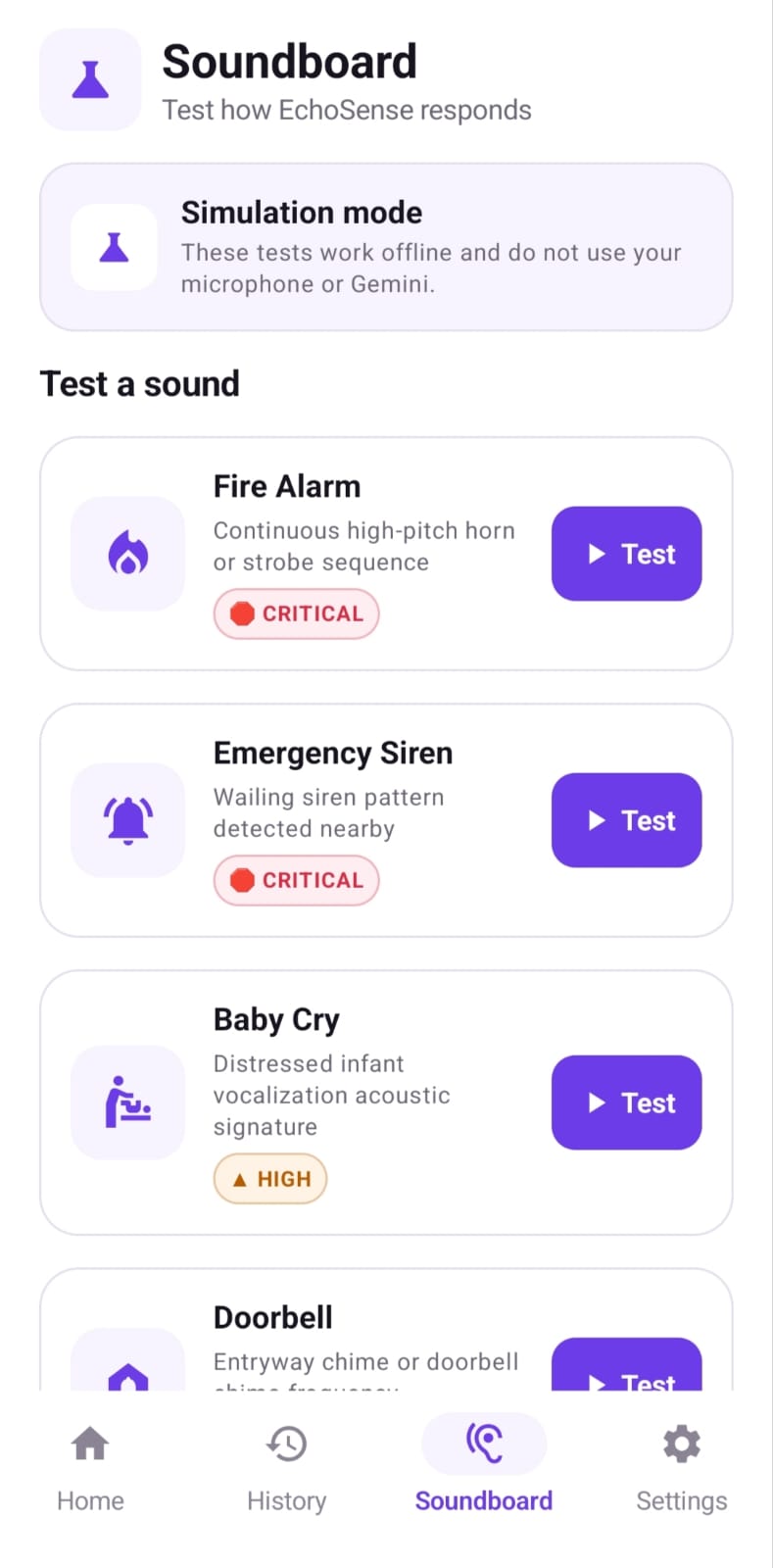
🛑 CRITICAL,▲ HIGH,◆ MEDIUM,● LOW) alongside adaptive color tokens to ensure full legibility for color-blind users. - Deterministic Simulation Engine: Features an integrated offline testing module that reliably simulates critical sound signatures (fire alarms, emergency sirens, infant cries, breaking glass) without network reliance.
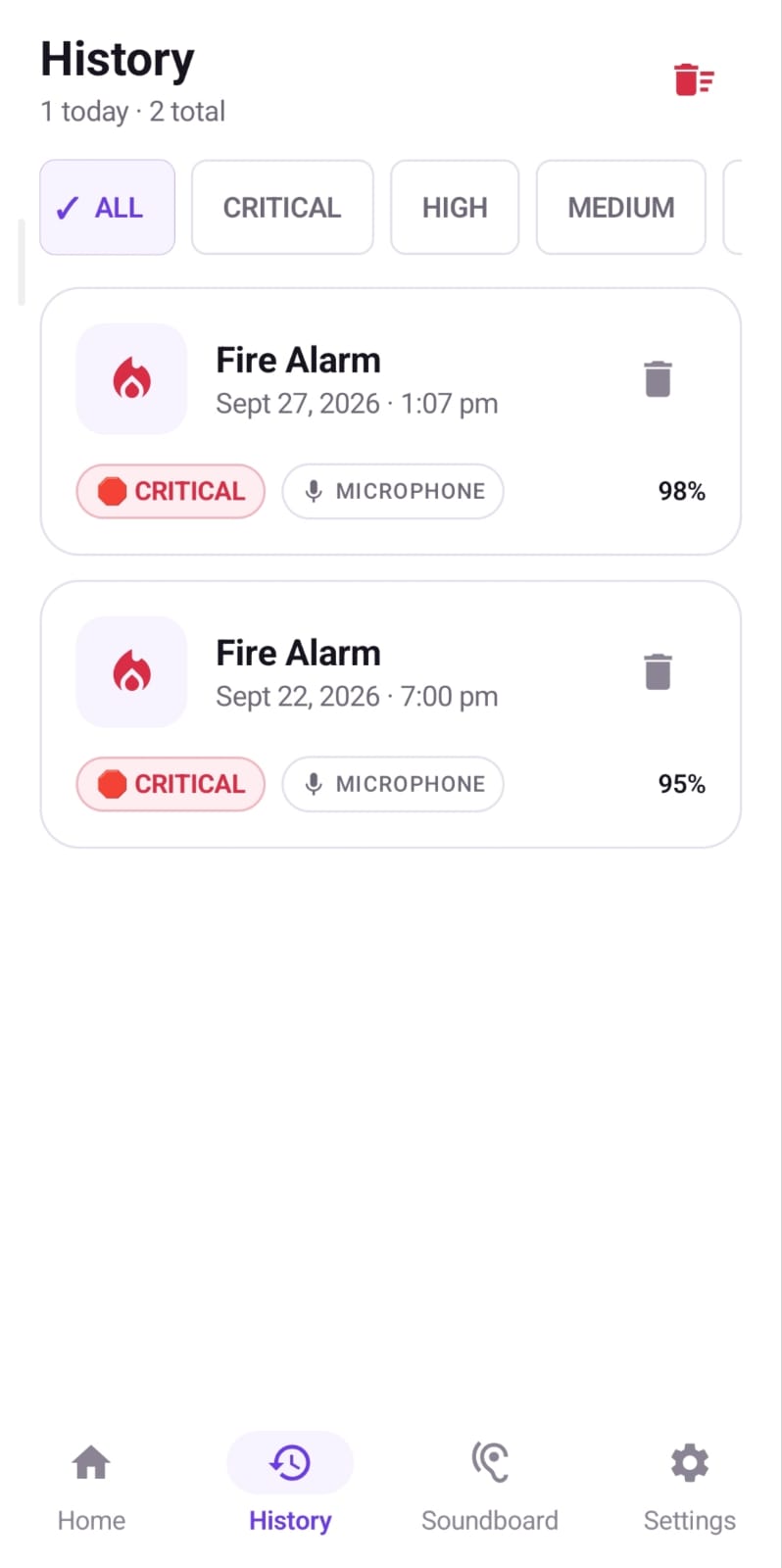
- Encrypted Local Audit Logging: Indexes detected incident logs locally via an indexed Room SQLite database, complete with fast-filter chips for triage and review.
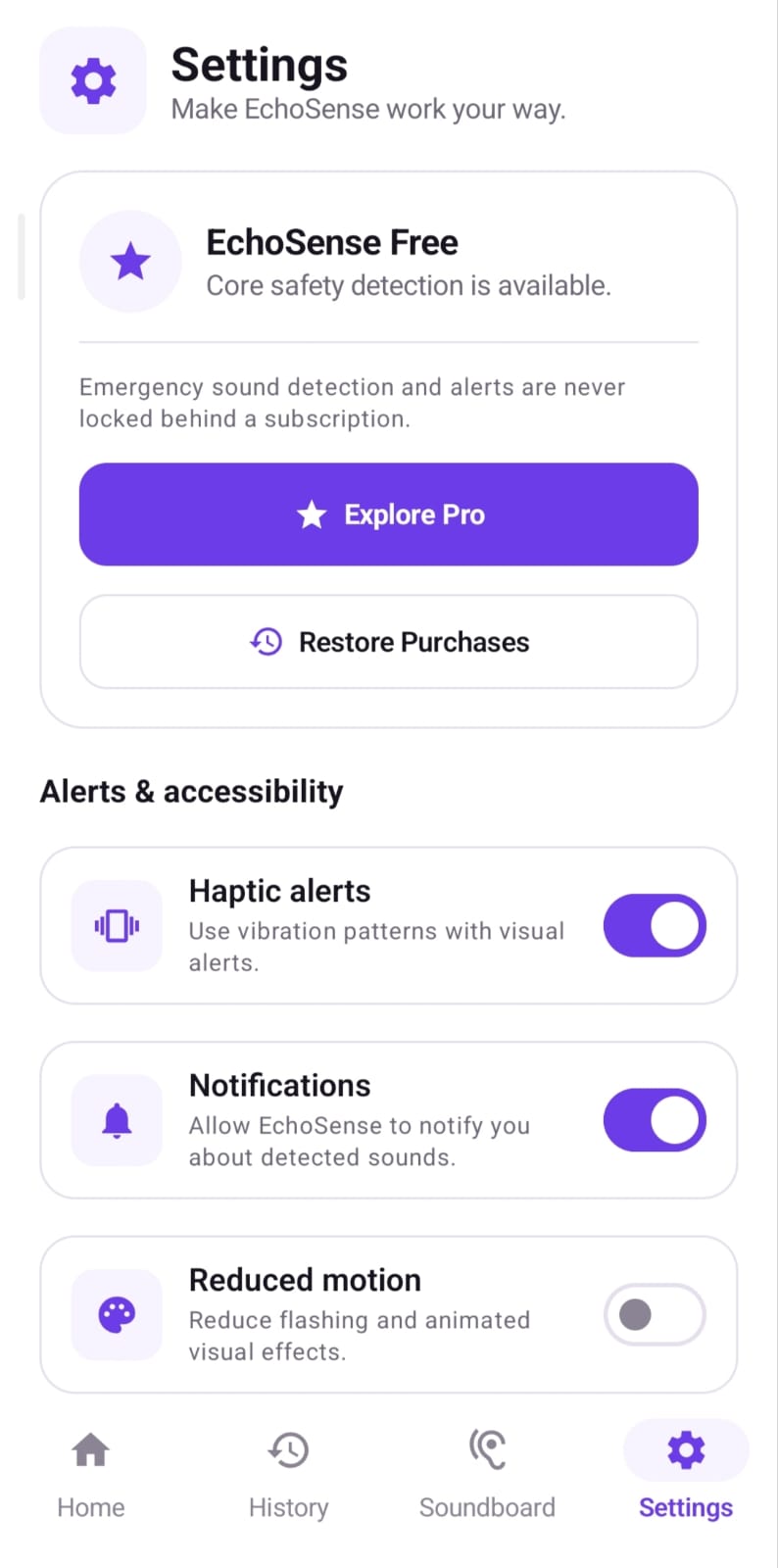
- Ethical Freemium Structure: Maintains all foundational emergency detection capabilities as permanently uninhibited public-interest utilities, while delegating advanced acoustic profiling and data analytics to premium tiers.
Architecture & Engineering
EchoSense leverages modern Android engineering standards to maintain high stability, low power draw, and determinism across the stack:
- Presentation & Pattern: Implemented Clean Architecture with Model-View-Intent (MVI) unidirectional data flow, orchestrated via Kotlin Coroutines and asynchronous
StateFlowstreams. - Declarative UI Design: Crafted with Jetpack Compose and Material 3, incorporating an accessible high-contrast layout, fluid animations, and granular toggles for motion suppression and haptic calibration.
- Low-Level Audio Ingestion: Configured Android
AudioRecordAPIs to stream high-frequency acoustic data into non-allocating memory ring buffers with active hardware acoustic echo cancellation and noise suppression. - Local Persistence: Structured an offline-first Room ORM abstraction layer over SQLite for low-overhead incident tracking.
- Entitlement Management: Integrated the RevenueCat Android SDK to arbitrate dynamic subscription tiers and telemetry without introducing barriers to emergency core functionalities.
Technical Challenges & Mitigations
- Aggressive OS Background Throttling: Non-standard OEM process management frameworks (such as HyperOS and OneUI) aggressively terminate long-running background tasks. This was resolved by binding the processing pipeline to an Android Foreground Service tied to persistent notification channels, paired with deep-linked system intents guiding users through battery-optimization exemptions.
- Asynchronous Test Concurrency: Coordinating multi-threaded audio buffer ingestion, mock classification streams, and reactive UI state dispatching introduced race conditions in testing environments. This was addressed by standardizing test suites on virtual coroutine test dispatchers and deterministic time manipulation.
Key Achievements
- Robust Test Coverage: Attained a comprehensive 100% pass rate across all 64 unit and integration tests, validating buffer integrity, concurrent state handling, and ViewModel stability.
- Privacy-Preserving Computation: Established a strictly ephemeral audio execution loop, validating that real-time machine listening can be deployed without persistent storage overhead or data harvesting risks.
- Universal Usability Compliance: Built an alerting interface adhering to rigorous WCAG 2.1 non-color-only sensory standards to guarantee rapid comprehension during emergencies.
Key Insights
- Low-Allocation Audio Handling: Gained deeper expertise in optimizing audio processing pipelines in Kotlin to bypass repetitive garbage collection cycles on the main render thread.
- Ethical Monetization Strategy: Successfully decoupled mission-critical life-safety features from revenue infrastructure, utilizing RevenueCat to drive sustainability through enterprise-tier telemetry and personalization rather than restricting foundational safety access.
Roadmap
- Edge Model Optimization: Deploying quantized, custom-trained on-device acoustic classification models to expand threat detection accuracy with minimal inference cost.
- Wear OS Extension: Building a companion wearable client to route targeted haptic pulses directly to the user's wrist during critical events.
- Spatial Acoustic Localization: Implementing multi-channel microphone phase comparison to provide directional visual vectors pointing toward sound origins.

Log in or sign up for Devpost to join the conversation.