Inspiration
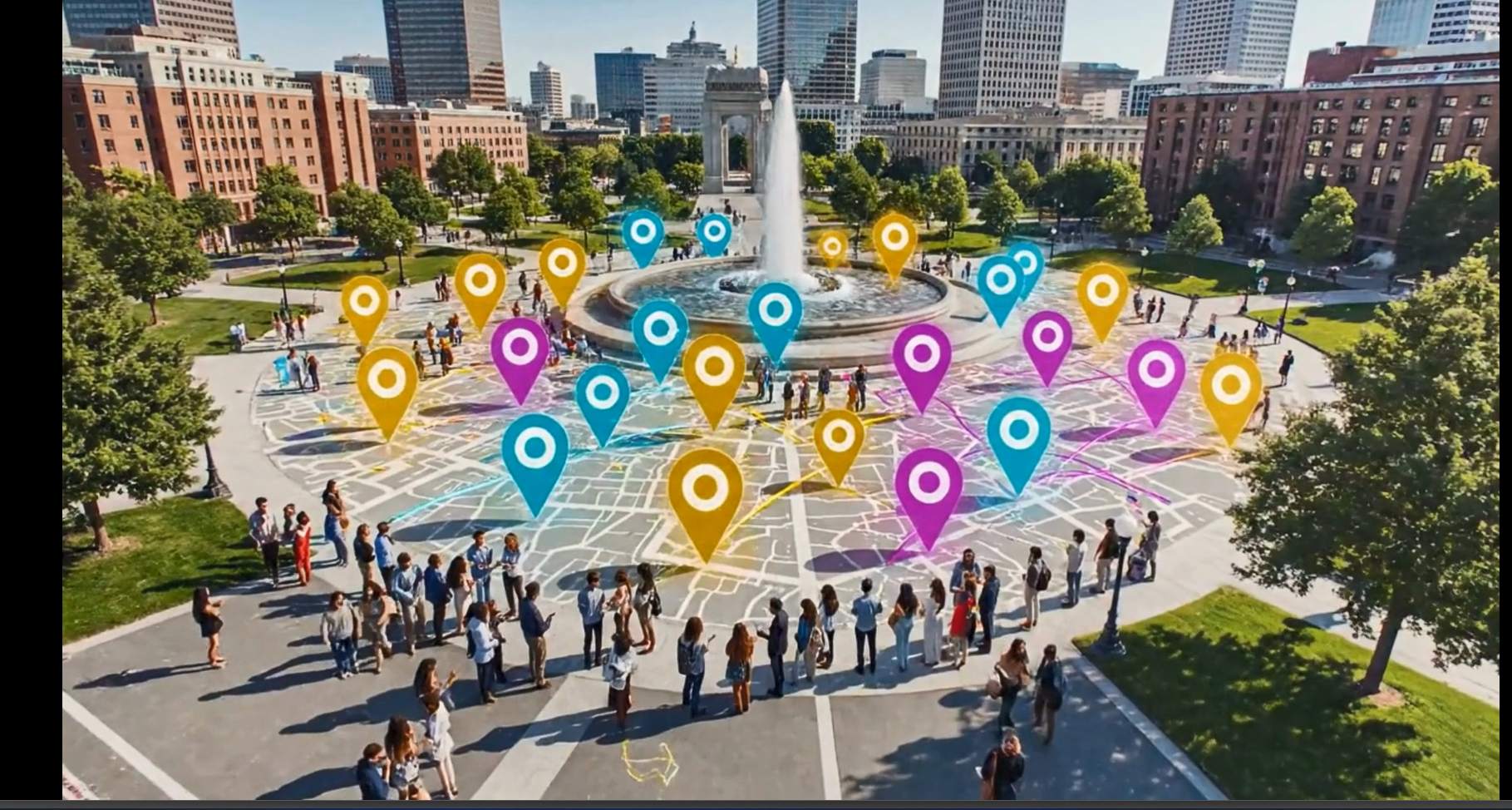
Every place carries memory. The corner where your grandfather used to sit. The alley where something remarkable happened decades ago. The trail where a stranger once told you something that changed how you saw the world. We've always passed these memories on through word of mouth — but word of mouth only reaches the people you happen to meet. What about the thousands of others who visit that same spot and never know? We were inspired by the simple idea that memory belongs to a place as much as it belongs to a person. And if that's true, then memory should be able to wait — anchored to that exact coordinate — until the next person arrives to hear it. EchoRoute is our answer to that question.
What it does
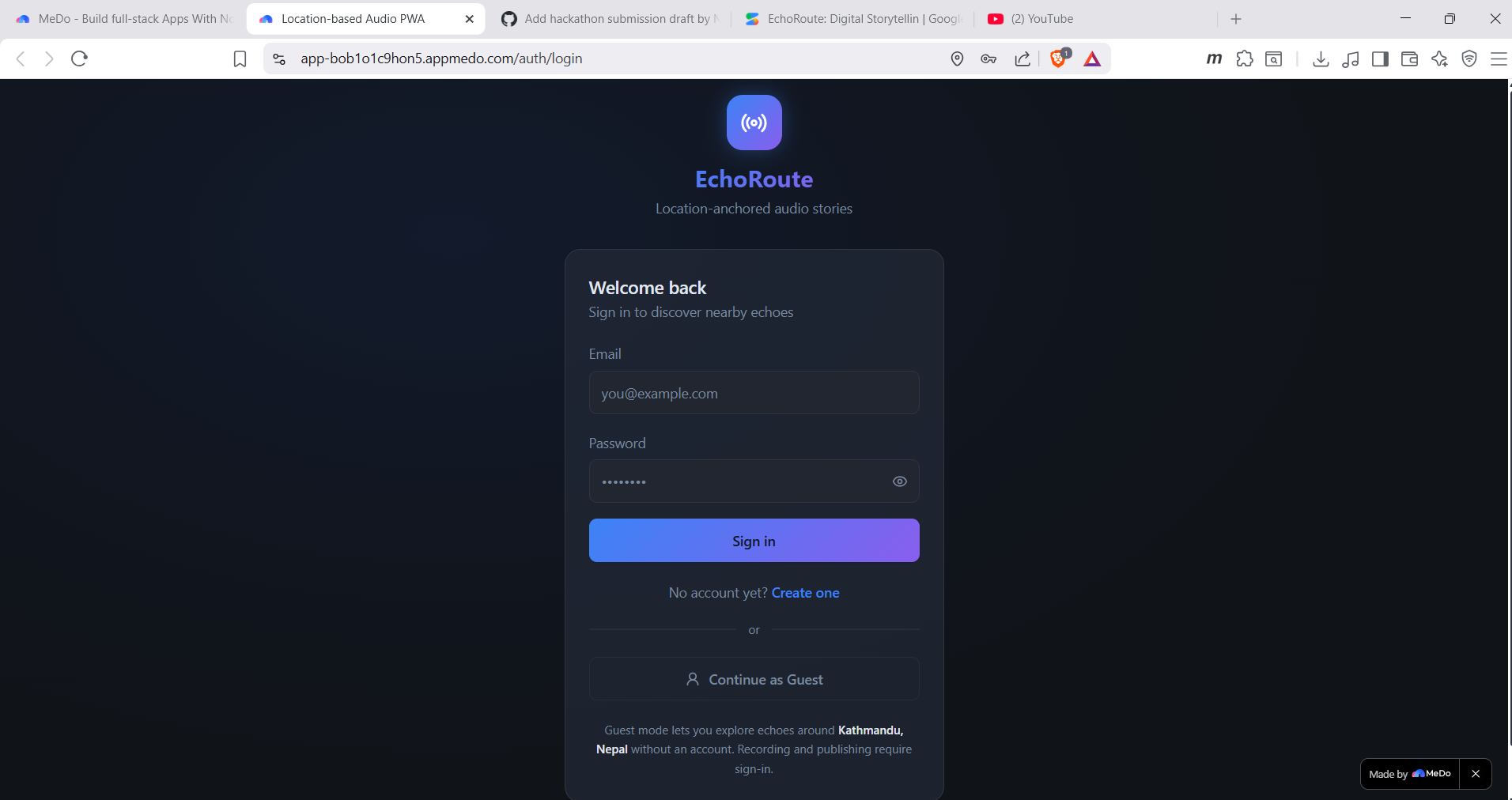
EchoRoute is a location-anchored audio storytelling platform. Drop a voice note at any GPS coordinate, set who can hear it, and let it wait — silently anchored to that spot — until the next person walks by and discovers it. A platform that turns every street, landmark, and hidden corner into a living archive of human memory.
How it works
Record → Drop a voice memory at any location Anchor → It's tied invisibly to a GPS coordinate Discover → Unlocked only when someone is physically nearby Spread → The memory lives on for every future visitor
Who it's for
| Segment | Audience | Use case |
|---|---|---|
| Consumer | Travelers & locals | Sharing personal place memories |
| Enterprise | Tourism boards & museums | Guided audio experiences at scale |
The moat
| Moat | Description |
|---|---|
| Network effect | More echoes placed = a richer world for every user who walks through it. |
What we built
- A Next.js frontend PWA for the interactive map and user experience.
- Location permission flow with geofence radius controls.
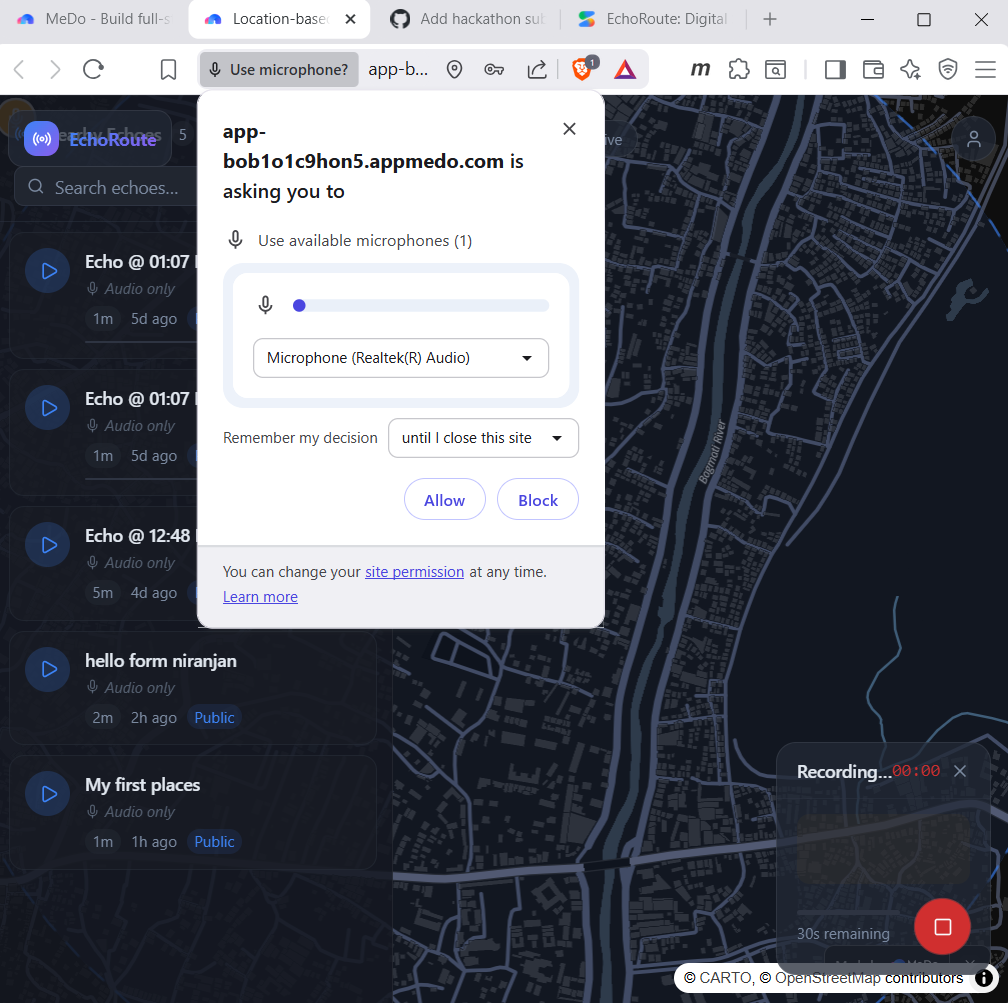
- Audio recording and playback flow using browser audio tooling.
- Supabase storage integration for uploaded echo audio.
- Echo creation and nearby discovery API integration.
- AI processing routes for transcription, moderation, and metadata workflows.
- Backend API documentation for authentication, user profiles, echo CRUD, nearby discovery, and rate limiting.
- Offline/demo resilience through cached nearby results, mock echo data, fallback audio manifest, error boundaries, and a load-test script.
- B2B-ready architecture notes including multi-tenant
org_id, moderation/admin hooks, analytics, and future institution use cases.
How it works technically
Frontend:
- Next.js App Router
- React map UI with MapLibre/react-map-gl
- Browser geolocation
- WaveSurfer/Web Audio recording flow
- Tailwind-based responsive UI
- Demo/fallback mode for reliable judging
Backend and data:
- Supabase Auth, Storage, and Postgres/PostGIS design
- Echo records with location, status, privacy tier, title, audio URL, and metadata
- Rate-limited API endpoints for auth, users, and echoes
- Nearby discovery designed around geospatial distance filtering
Why this matters
EchoRoute gives communities a simple way to preserve memory where it belongs: in place. A museum can attach curator commentary to exhibits. A campus can build student-led audio tours. A tourism board can surface authentic local voices. A family can leave a private memorial that only appears at a meaningful location.
The result is not just another social app. It is a safer, more contextual layer of human memory over the physical world.
Innovation
EchoRoute's main innovation is the combination of:
- Location-locked audio discovery
- AI-assisted transcription and moderation
- Privacy-aware publishing
- Offline/demo-safe PWA behavior
- Multi-tenant SaaS readiness for institutions
That blend makes the experience emotionally engaging for individual users and operationally credible for organizations.
Our highlights
- Clear problem: local oral stories are hard to preserve and discover in context.
- Strong user experience: record, pin, discover, and play audio by proximity.
- Technical depth: geolocation, maps, audio, Supabase/PostGIS, rate limits, and fallback logic.
- Responsible design: privacy tiers, moderation, consent, and admin roadmap.
- Scalability: B2B multi-tenant direction for organizations and institutions.
- Demo readiness: offline cache, mock data, fallback audio guidance, error boundaries, and load-test tooling.
Built with
- Next.js
- React
- TypeScript
- Tailwind CSS
- MapLibre / react-map-gl
- WaveSurfer / Web Audio APIs
- Supabase Auth, Storage, and Postgres/PostGIS
- FastAPI backend
- OpenAI-style transcription, moderation, and metadata pipeline design
- Vitest
- GitHub Actions
Roadmap
- Audio pipeline — Voice notes are processed through an AI layer for transcription (to make echoes accessible and searchable), automated content moderation, and metadata tagging
- Expand moderation dashboard and creator notifications.
- Add organization workspaces for museums, campuses, and tourism partners.
- Add analytics for plays, saves, route completion, and engagement.
- Package curated audio trails with QR-code entry points for events and venues.

Log in or sign up for Devpost to join the conversation.