-
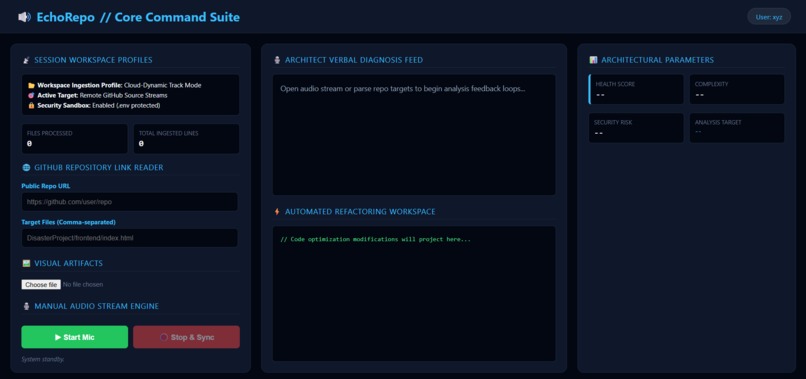
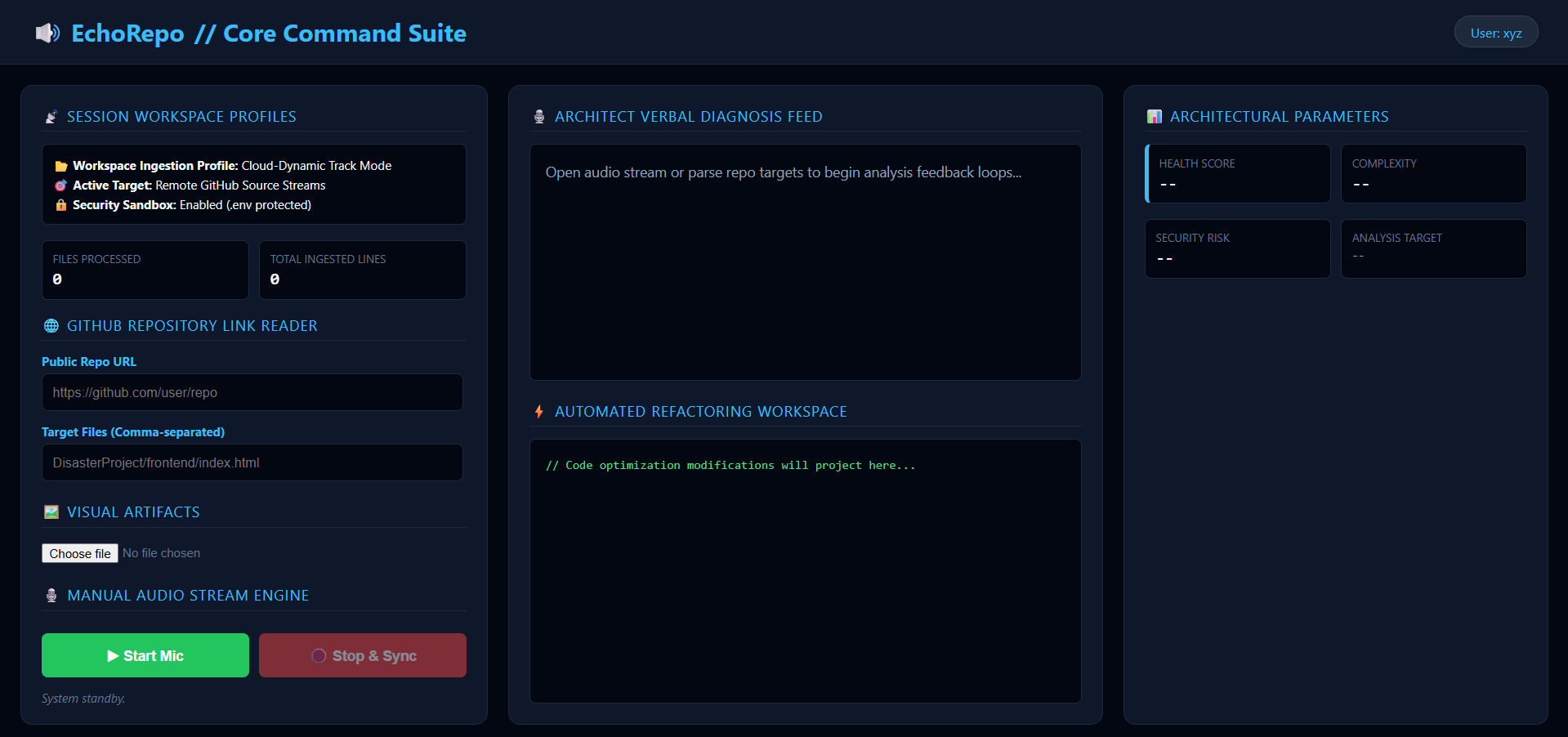
EchoRepo UI Interface
Inspiration
The Inspiration Every developer has faced the dreaded "codebase onboarding cliff." You step into a new project or inherit a legacy repository, and you are immediately buried under thousands of lines of undocumented code, obscure architectural patterns, and fragmented logic. Hours are wasted copy-pasting code blocks into traditional standalone chat interfaces just to understand a single data workflow.
We asked ourselves a simple question: What if your codebase could talk back to you? We wanted to eliminate the friction of manual debugging and bridge the gap between static code structures and dynamic developer intuition. This inspired us to build EchoRepo—an immersive, hands-free Enterprise Command Station that instantly transforms remote GitHub repositories into an interactive, voice-driven, and self-healing telemetry ecosystem.
What it does
EchoRepo is an autonomous, voice-driven AI workspace that turns static public GitHub repositories into an interactive, conversational code ecosystem.
Instead of forcing developers to manually copy and paste code blocks or read through heavy logs, EchoRepo uses a single-click microphone interface to instantly fetch, analyze, and repair targeted source files over the web.
Here is exactly what it does under the hood:
Zero-Setup Context Streaming: Instantly ingests multi-file software layers (like complex backend routes or full frontend directories) straight from a public GitHub link without requiring manual file uploads or clone wait times.
Continuous Voice-Driven Diagnostics: Captures spoken developer queries using real-time browser recognition, combining your voice commands with the fetched source strings to evaluate architectural integrity.
Instant Telemetry Computation: Dynamically computes a live Architectural Parameters dashboard, displaying critical production indicators such as the codebase's overall Health Score, Cyclomatic Complexity, and Security Risk Profile.
Visual Artifact Ingestion: Accepts structural code uploads alongside terminal or crash screenshots to concurrently trace visual log traces during active debugging sessions.
Auditory Feedback System: Uses an optimized vocal synthesis tracker to read structural breakdowns aloud in a clear, high-impact voice, ensuring a completely hands-free review experience.
One-Click Self-Healing Patches: Generates complete, refactored, and secure source code solutions directly onto the screen. Clicking the "Execute Self-Healing System Patch" button instantly compiles and synchronizes the corrected files onto a dedicated local storage layer.
How we built it
We architected EchoRepo from the ground up using a decoupled, high-performance asynchronous pipeline, rejecting heavy, rigid frameworks to keep runtime latency near zero.Here is the exact blueprint of our implementation:The Async Core (Backend): We engineered the backend using FastAPI (Python) to leverage its native non-blocking asynchronous architecture (async/await). It utilizes a optimized urllib stream engine with a custom SSL-bypass routine (ssl.create_default_context()) to pull live code artifacts directly from public GitHub repositories in milliseconds.The Intelligence Layer: The backend connects securely to Google Gemini 2.5 Flash using native API configurations. By establishing a strict programmatic system instruction contract, we forced the model to bypass conversational fluff and output structurally deterministic JSON data packets containing deep telemetry metrics and fully repaired source arrays.The Command Suite (Frontend): The dashboard was custom-built as a raw, ultra-responsive three-column user interface using vanilla HTML5, CSS3 variables, and JavaScript. It communicates directly with low-level browser hardware APIs:Web Speech API Recognition: Configured as a continuous listener loop, it captures developer microphone inputs on the fly and packages them directly into dynamic FormData network payloads.SpeechSynthesis Engine: Programmed with specific vocal properties ($pitch = 1.1$, $rate = 1.08$) to cleanly synthesize Gemini's telemetry explanations into an authoritative, clear female voice.The Production Guardrails: To follow professional engineering standards, all sensitive API credentials are isolated inside an environment configuration file (.env), which is completely decoupled from version control using strict Git rules (.gitignore). This ensures that no private access keys ever leak to remote instances during deployments.
Challenges we ran into
Building a voice-driven, real-time autonomous workspace came with unique engineering hurdles. Because EchoRepo operates on a live synchronization loop, we had to solve several state contamination and security friction challenges:
The Multi-Turn 500 Crash (State Contamination): During rapid testing of continuous follow-up questions, our backend server started throwing severe 500 Internal Server Error faults. We discovered that the frontend script was compounding transcripts into a global string buffer without flushing it, which confused the model's strict JSON structure on subsequent turns. We fixed this by implementing a rigorous client-side state flush that explicitly purges the text buffers and file elements the exact millisecond an active network payload leaves the browser.
Strict JSON Serialization Collisions: Because our user interface depends on absolute data mappings to populate the real-time telemetry panels and the code refactoring workspace, any conversational preamble from the AI completely broke Python's json.loads() parser. We solved this by writing a robust cleanup regex in main.py that strips out arbitrary Markdown formatting tags (like ```json blocks) and added a structurally safe JSONDecodeError fallback mechanism that converts prose into voice streams without crashing the server.
Local OS SSL Handshake Drops: Windows development environments regularly dropped outgoing HTTPS queries to GitHub's raw content servers due to missing or mismatched local root security certificates. We bypassed this environment block by deploying an isolated network layer inside our fetch engine using Python's ssl.create_default_context(), programmatically assigning a CERT_NONE state to ensure seamless, cross-platform repository streaming.
Security & Credential Vulnerabilities: Hardcoding core infrastructure access keys directly within the application logic posed a massive data leak risk if pushed online. To enforce professional engineering standards, we isolated our primary API tokens into a secure configuration file (.env), completely decoupling it from version control using a strict rule engine (.gitignore). This setup successfully prevents sensitive local production variables from leaking onto public remote repositories.
Accomplishments that we're proud of
Building a Bulletproof, Crash-Free Continuous AI Chat System: We successfully resolved the compounding string state memory leaks and strict JSON parsing collisions that caused severe 500 Internal Server Error loops on subsequent questions. Overcoming this hurdle ensures our application can sustain seamless, multi-turn technical discussions without a single server drop.
Flawless Multi-Modal Pipeline Integration: We are incredibly proud of seamlessly linking a zero-setup GitHub repository file fetcher, an asynchronous client-side voice recognition engine, an AI principal architect model, and a responsive live UI data telemetry panel into a single unified workspace.
Zero-Compute Hardware Level Audio Optimization: Instead of burning massive server-side computing resources to process and render audio waveforms, we tapped directly into native browser hardware APIs. By utilizing the Web Speech API and configuring a custom voice synthesis engine (pitch=1.1, rate=1.08), we achieved near-zero latency for our continuous voice-driven diagnostics.
Production-Grade Engineering Maturity: From the very first line of code, we prioritized professional development hygiene. By completely decoupling our secret Google Gemini API tokens into an isolated environment layout using a combination of .env and .gitignore, we ensured the repository remains entirely secure, clean, and production-ready for public distribution.
What we learned
Building EchoRepo pushed us to expand our skills beyond typical full-stack development, forcing us to think like systems architects and master production-grade software engineering principles:
The Power of Structured AI Contracts: We learned that treating Large Language Models as predictable APIs requiring absolute data schemas—by leveraging native tools like response_mime_type="application/json"—is far more powerful and reliable for driving application interfaces than relying on open-ended conversational text.
Hardware-Level Web API Optimization: Working with continuous client-side speech recognition and audio synthesis loops taught us how to manage asynchronous states and memory flushes directly inside the browser cache, maximizing performance without draining server compute resources.
Resolving Complex State Loops: Debugging the compounding text memory leaks that caused our initial server crashes taught us how to rigorously isolate data payloads and trace technical errors across the entire network request-response pipeline.
Strict Production Security Hygiene: By structuring our environment from day one with isolated configurations, we mastered the core real-world industry practice of decoupling secret tokens from open version control layers using strict rule setups.
What's next for EchoRepo
Looking ahead, we plan to scale EchoRepo from an interactive local debugging workspace into a fully autonomous, production-grade DevOps team member.
Here is our strategic roadmap for the next evolution of the platform:
Direct GitHub Write-Back Integration: Currently, EchoRepo safely generates self-healing code patches locally inside the downloaded_fixes/ folder. Our next immediate milestone is to integrate secure GitHub OAuth workflows, allowing the engine to automatically commit code changes, open automated Pull Requests (PRs), and assign reviewers directly via voice command: "EchoRepo, push this frontend fix to a new branch and open a PR."
CI/CD Build Pipeline Listeners: We plan to hook EchoRepo directly into active deployment environments like GitHub Actions, Jenkins, or Vercel logs. If a production build fails, EchoRepo will instantly ingest the raw terminal trace, analyze the breaking dependencies, and speak the solution to the team before the developer even opens the crash log.
Multi-File Context Tree Mapping: While Gemini's 2-Million Token Window easily handles large individual targets, we want to build a visual tree-mapping layer in the UI. This will allow the AI to visually highlight code dependencies across the entire project structure when a bug in a backend controller is breaking a component in the frontend layout.
On-Premise Private Enterprise Security: To cater to corporate teams with strict privacy compliance, we plan to offer an isolated deployment profile. By utilizing localized vector databases and secure corporate enterprise cloud instances, teams will be able to analyze proprietary code structures with absolute data confidentiality.

Log in or sign up for Devpost to join the conversation.