-
-
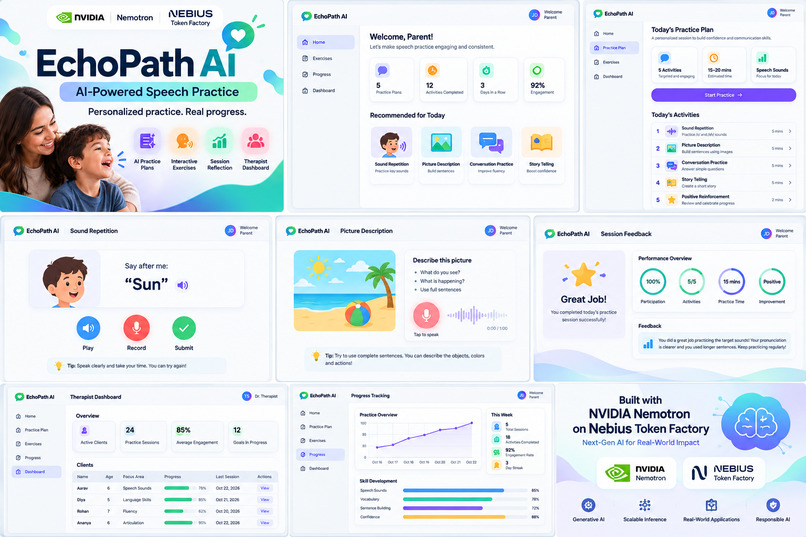
Personalized speech-practices, interactive exercises, progress tracking & AI-powered guidance with NVIDIA Nemotron on Nebius Token Factory.
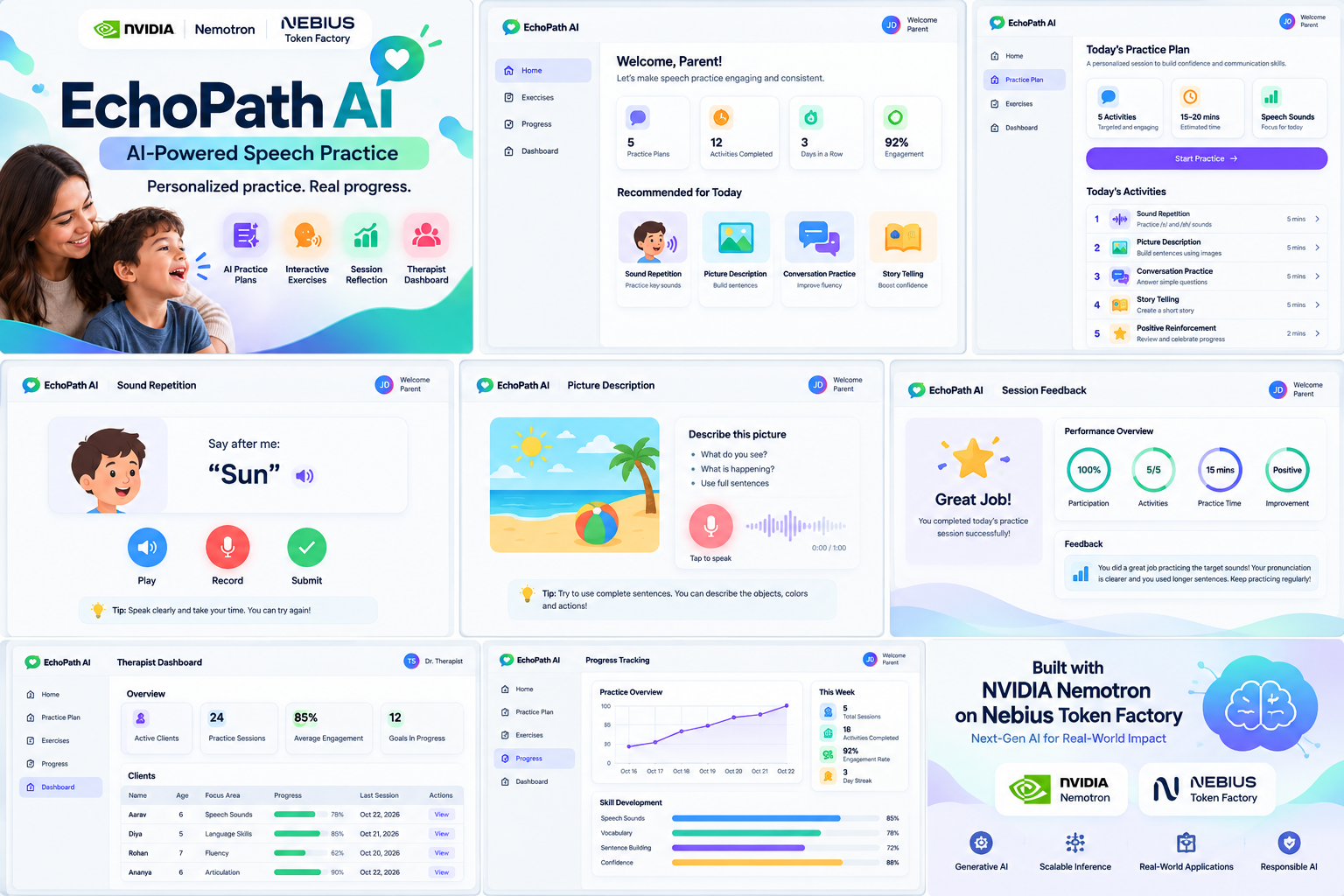
EchoPath AI: Personalized Speech Practice with AI
Inspiration
Speech practice can be challenging to organize consistently at home and in professional settings. Families and speech professionals need practical ways to structure activities, encourage repeated practice, and reflect on sessions.
We built EchoPath AI to explore how generative AI can help make speech-practice activities more organized and accessible. The goal is to support practice—not replace a qualified speech-language professional or provide a clinical diagnosis.
What it does
EchoPath AI is a web-based speech-practice support prototype featuring:
- Practice planning: Generates structured practice plans and activities tailored to the selected practice context.
- Interactive exercises: Presents prompts and activities to guide practice sessions.
- Progress reflection: Helps users review completed activities and reflect on practice.
- Therapist-oriented dashboard: Organizes practice information in a dashboard designed for families and speech professionals.
- AI-generated guidance: Uses NVIDIA Nemotron through Nebius Token Factory to generate structured practice content.
EchoPath AI is a support tool, not a clinically validated speech assessment system. Text comparisons should not be interpreted as measured pronunciation accuracy or a diagnosis.
How we built it
We built EchoPath AI with a web frontend and a Python FastAPI backend. The backend integrates with the Nebius Token Factory API to access NVIDIA Nemotron. The application uses structured outputs and validation to help keep generated practice plans consistent with the interface.
We deployed the backend on Render and prepared the project for reproducible setup through environment configuration and documentation. The application separates model credentials from frontend code so the API key can remain on the server.
How we used Nebius and NVIDIA
We used NVIDIA Nemotron through Nebius Token Factory for AI-generated speech-practice planning and guidance. Token Factory provided an API-based way to integrate model inference without having to manage model-serving infrastructure ourselves.
We selected this approach to focus our development effort on the user experience, structured outputs, and application workflow. We used prompt engineering and output validation rather than claiming to have fine-tuned the model.
Challenges and what we learned
One of our main challenges was connecting the AI service reliably to the application while keeping responses structured and handling errors appropriately. We worked on backend integration, environment configuration, deployment, and making the interface communicate what the AI can and cannot assess.
This project helped us learn how to integrate an open model through a hosted inference API, connect AI-generated content to a full-stack application, and consider reliability and responsible communication when building tools for a health-adjacent use case.
What's next
Future improvements could include more configurable practice activities, accessibility enhancements, better session history, clearer progress summaries, and feedback from qualified speech-language professionals and intended users. Any assessment-related features would require appropriate validation before being presented as clinically meaningful.
EchoPath AI is an early prototype intended to support structured practice and reflection—not to replace professional care.
Built With
- accessibility
- ai
- application
- fastapi
- generative-ai
- nebius-token-factory
- nvidia-nemotron
- python
- react
- speech-practice
- typescript
- vite
- web

Log in or sign up for Devpost to join the conversation.