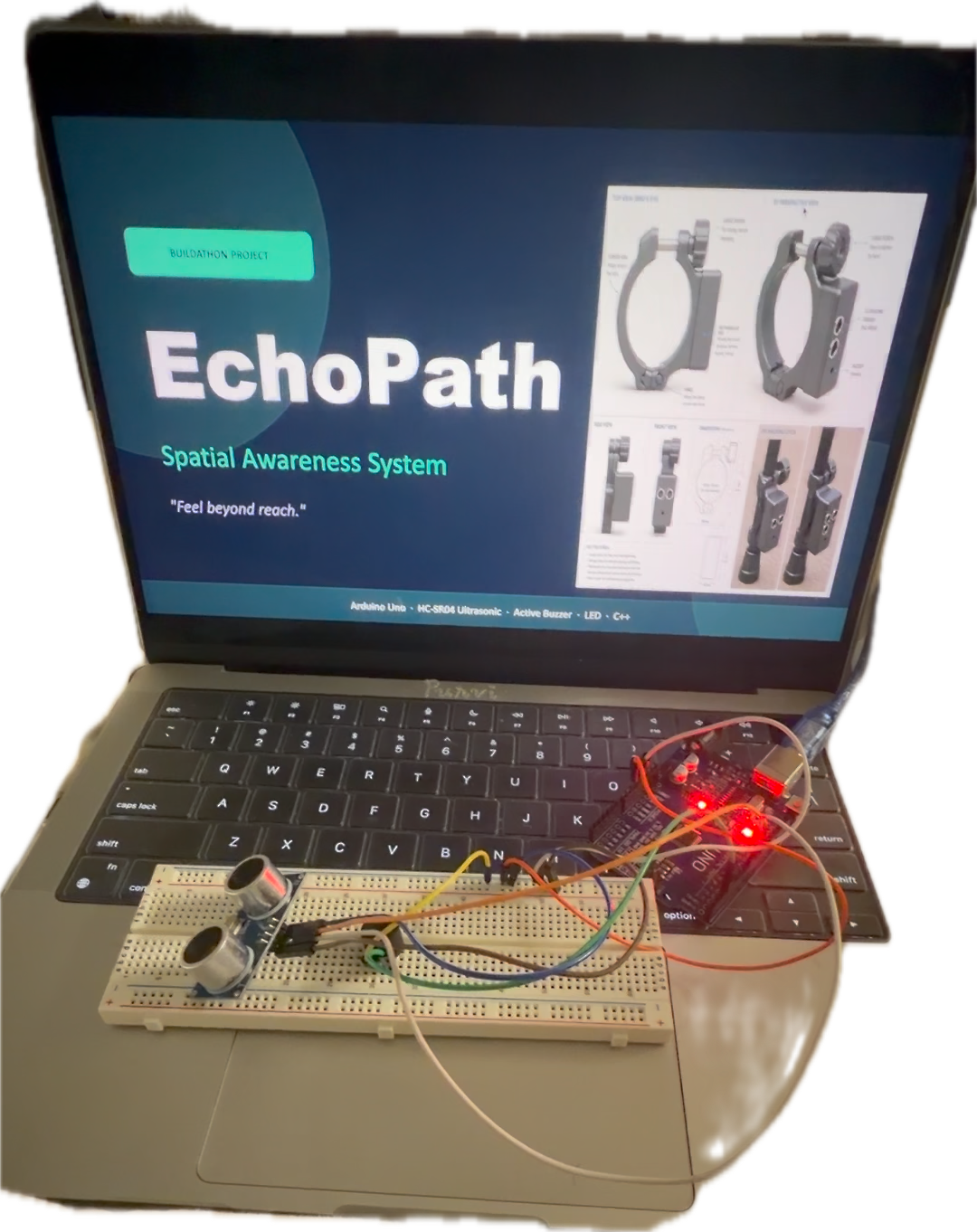
Inspiration: White canes only detect what they physically touch at ground level. Overhead branches, waist-high signs, sudden drop-offs — all invisible until it's too late. We wanted to build something that warns before contact happens, not after. Not a replacement for the cane, but a second sense for it.
What it does: EchoPath clips onto any standard walking stick and uses an HC-SR04 ultrasonic sensor to continuously scan for obstacles up to 400cm away. An Arduino Uno runs a real-time risk classifier that categorizes the situation into SAFE, CAUTION, DANGER, or CRITICAL based on distance and approach speed. Each level fires a distinct buzzer pattern — silent when clear, slow beeps for a stationary object, fast beeps for a nearby hazard, and a rapid burst for critical distance — so the user understands urgency instantly without thinking about it.
How we built it: We wired an HC-SR04 ultrasonic sensor, active buzzer, and LED to an Arduino Uno on a breadboard, then wrote a C++ risk classifier that reads distance every 100ms, calculates approach speed, and maps the result to one of four risk levels. Each level fires a different buzzer pattern and lights the LED accordingly. We then designed a hinged circular clamp with a rectangular electronics box on one arm that hand-tightens onto any 30–32 mm walking stick in under 30 seconds.
Challenges we ran into: Tuning the classification thresholds in real-world conditions was harder than expected — distances that felt safe at a desk felt very different while actually walking. Getting the buzzer patterns right took iteration too; the feedback had to be intuitive enough that a user could read the urgency instantly without thinking about it.
Accomplishments that we're proud of: Building a working ML risk classifier that runs entirely on an Arduino with no internet connection. Designing a physical enclosure that actually attaches to a real walking stick cleanly and securely. And creating a feedback system — the buzzer patterns — that communicates four distinct danger levels without any screen or voice output.
What we learned: How to bridge hardware and software into one cohesive system. How to design for a real user need rather than just a tech demo. And how to make machine learning feel useful even on a tiny microcontroller with no internet connection.
What's next for EchoPath: Adding a haptic vibration motor for silent mode, a rechargeable LiPo battery with USB-C charging, multiple sensor angles to cover left, right, and up, and a Bluetooth companion app with voice cues. Longer term, a 3D-printed enclosure for cleaner mass production.


Log in or sign up for Devpost to join the conversation.