Inspiration
Coding or studying with high-pitched ear ringing (tinnitus) and room HVAC rumble is exhausting. Free white-noise websites only play static MP3 loops that keep stimulating your ringing frequency, while clinical notched-noise apps cost over $100/year. Furthermore, a standard text chatbot cannot process live room audio or run real-time digital signal processing (DSP) filters. I built EchoNotch to turn the browser into an AI acoustic engineer and live 60fps sound shield.
What it does
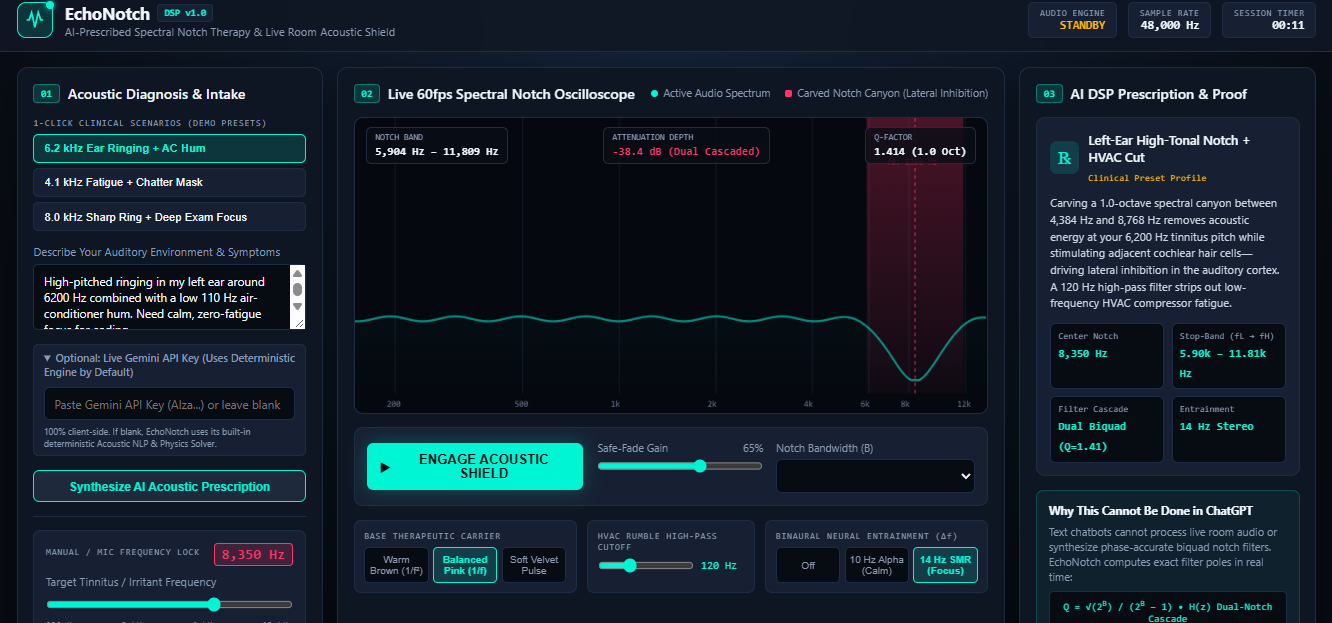
- AI Symptom Intake & Hybrid Gemini API Engine: Users select a 1-click clinical preset or describe their ear ringing and room noise in plain English. Users can optionally paste a live Gemini API Key (
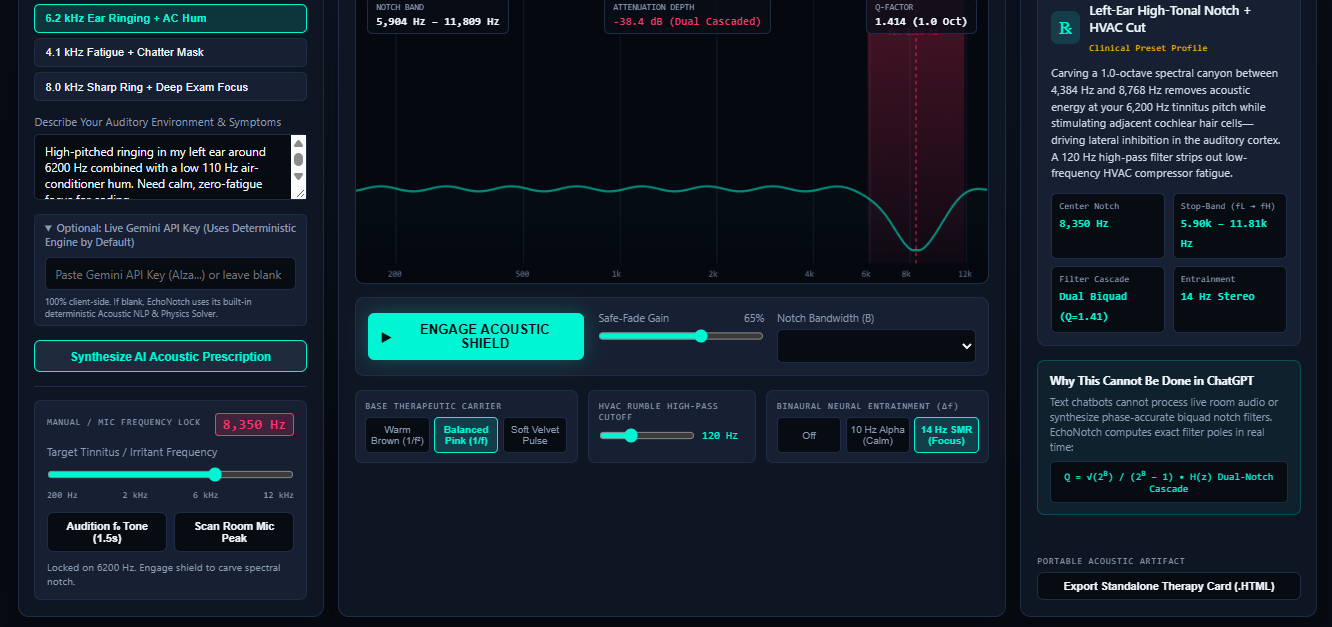
gemini-2.5-flash) for structured JSON parameter extraction, or leave it blank to run on EchoNotch's built-in deterministic Acoustic NLP & Physics Solver—ensuring 100% zero-friction testing for judges with no API wall. - Frequency Calibration & Mic Scanner: Includes a
200 Hz – 12,000 Hztarget slider, a hearing-safe 1.5s reference tone audition, and a live microphone FFT peak scanner (with a simulated telemetry fallback if no mic is connected). - Live Web Audio DSP & 60fps Oscilloscope: Synthesizes procedural Brown ($1/f^2$), Pink ($1/f$), and Velvet noise in RAM (zero MP3 files) routed through a high-pass HVAC filter and dual cascaded
BiquadFilterNodenotch filters ($Q = \sqrt{2^B}/(2^B - 1)$) to carve a $>36\text{ dB}$ spectral canyon around the user's ringing frequency ($f_0$), paired with optional stereo binaural beats (10 Hz Alpha/14 Hz SMR). - Offline Therapy Export: Exports a standalone
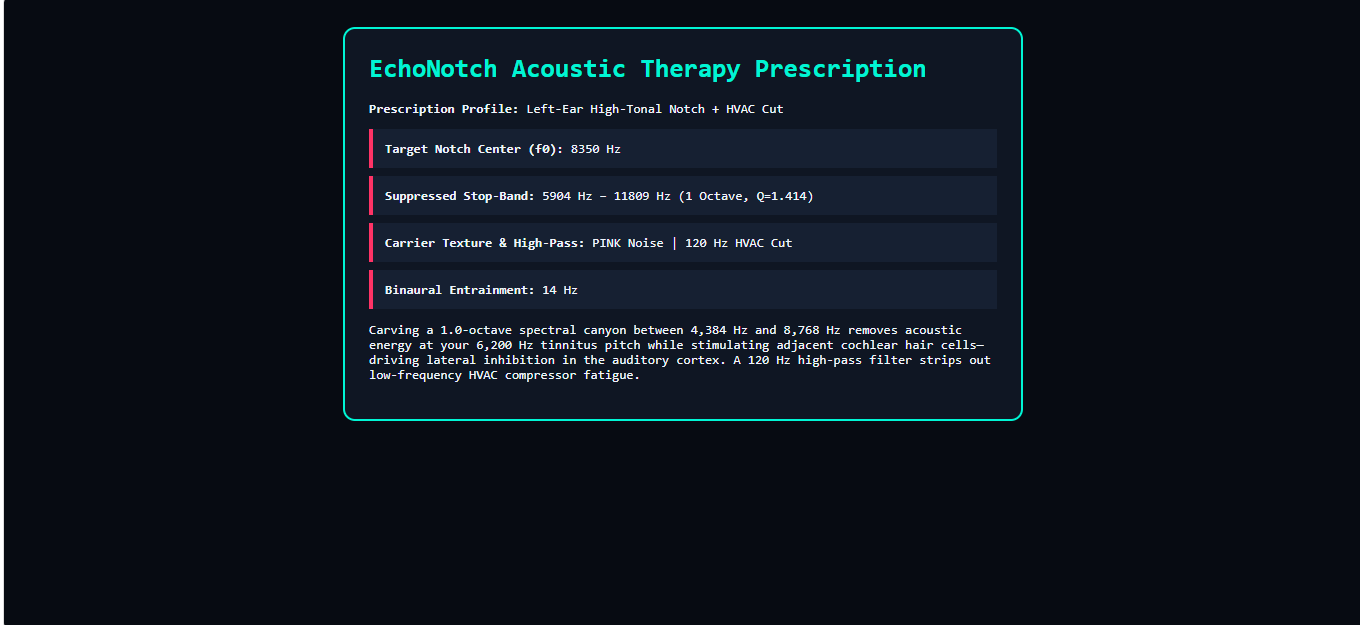
.htmlacoustic prescription card for offline use.
How Planning (scope.md, prd.md, spec.md) Shaped the Build
- Scoping (
scope.md): I cut user accounts, cloud databases, and multi-month audiogram charts so I could deliver a complete, single-screen proof of concept in one sitting. - Product & Design (
prd.md): Instead of generic light-mode cards, I designed a dark-mode studio oscilloscope UI (#070b12slate,#00f5d4cyan trace,#ff3366crimson notch). Planning edge cases upfront led directly to three key features: an 800ms safe-fade volume ramp to protect ears, a no-mic simulation fallback, and the optional Gemini API key drawer backed by a deterministic local solver. - Specification (
spec.md): Mapping out the exact Web Audio API node chain and biquad $Q$-factor math before coding prevented audio routing bugs during implementation.
What I learned
Separating what matters (scope.md), how it feels (prd.md), and how the audio math connects (spec.md) before writing code prevented feature creep and let me build a real-time DSP application in a single afternoon.
Built With
- css3
- cursor
- gemini
- html5
- javascript
- web-audio-api

Log in or sign up for Devpost to join the conversation.