Inspiration
The current landscape of AI often relies on monolithic models attempting to do everything at once, which can lead to brittle enterprise workflows. We were inspired by human organizational structures—where specialized experts collaborate to achieve complex goals. We wanted to bring this paradigm to enterprise AI by building a robust, observable, and secure multi-agent network that can autonomously handle end-to-end business pipelines.
What it does
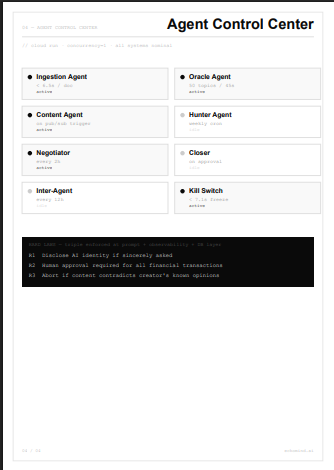
Echomind is an enterprise-grade, event-driven multi-agent coordination platform. It deploys a fleet of specialized autonomous agents—including Ingestion, Hunter, Content, Pitcher, Negotiator, Closer, and Oracle agents—that collaborate to execute complex business workflows.
Instead of a single prompt-response loop, Echomind agents act as a virtual task force. They autonomously ingest enterprise data, generate strategies, negotiate parameters, and finalize tasks. The system utilizes a resilient event-driven architecture, ensuring that agents can pass context and tasks to one another seamlessly.
How we built it
We engineered Echomind with enterprise-grade resilience, heavily utilizing Google Cloud Platform for our infrastructure.
Core Architecture: Built with TypeScript and Node.js.
Infrastructure: We deployed the system as containerized microservices using Google Cloud Run.
Event-Driven Choreography: Agent-to-agent communication and task orchestration are handled asynchronously via GCP Pub/Sub. We implemented comprehensive topic routing, subscriptions, and Dead Letter Queues (DLQ) for fault tolerance.
Tool Integration: We utilized the Model Context Protocol (MCP) to provide our agents with standardized, secure access to external tools and databases (including MongoDB, GitLab, Fivetran, and Elastic).
Observability: Integrated with Arize and Dynatrace to monitor agent performance, trace multi-step reasoning, and ensure system reliability.
Challenges we ran into
Orchestrating multiple autonomous agents without them getting stuck in infinite loops or drifting off-topic was a major hurdle. We had to design strict conversational boundaries and a robust, globally broadcasted "kill-switch" mechanism to halt runaway processes safely across all workers.
Additionally, implementing asynchronous multi-agent communication via GCP Pub/Sub required careful state management. We had to ensure idempotent design so that messages (agent instructions) weren't processed redundantly, which drove us to implement our robust DLQ architecture.
Accomplishments that we're proud of
We are incredibly proud of successfully implementing the Model Context Protocol (MCP) to standardize how our agents interface with vastly different systems without writing brittle, custom API wrappers for each. We are also proud of our production-ready deployment on GCP—achieving a fully containerized, serverless, and event-driven microservice architecture that is genuinely scalable rather than just a local prototype.
What we learned
We learned that in multi-agent systems, deep observability is not optional; it is mandatory. Tracing the "thought process" across multiple independent agents requires robust logging and monitoring to understand exactly why a decision was made. We also learned the intricate nuances of designing stateful, context-aware interactions in a stateless serverless environment using distributed messaging queues.
What's next for EchomindWe plan to expand our roster of specialized agents to cover more niche enterprise verticals, such as dedicated Legal and Compliance oversight agents. We also intend to build a real-time visualization dashboard so users can watch the agents collaborate, pass data, and negotiate live. Finally, we want to implement continuous active learning, allowing the "Oracle" agent to autonomously fine-tune the system's overall routing strategies based on past successful resolutions.
Built With
- cloudrun
- cloudscheduler
- mcp
- node.js
- pub/sub
- typescript
- vpcconnectors


Log in or sign up for Devpost to join the conversation.