-
-
logo
-
-
Inspiration
Every single day, entrepreneurs and creators make massive, life-altering decisions under extreme pressure. Unfortunately, our brains are hardwired with unconscious cognitive blind spots. We rush deployments out of FOMO, we fall prey to the sunk cost fallacy, and we often neglect critical human factors like universal design and accessibility compliance ($WCAG$) until it is too late.
We were inspired to build EchoMind OS to change that. We wanted to move away from boring, static enterprise dashboards and traditional diagnostic tools. Instead, we imagined a high-fidelity, interactive sci-fi simulation—a psychological mirror that forces creators to confront the deep systemic consequences, ethical dilemmas, and parallel futures of their current choices before reality does.
What it does
EchoMind OS is a full-stack, immersive decision-validation ecosystem. The user enters a multi-stage simulated biometric scan that extracts their core motivations, financial anxieties, and ethical boundaries (such as a commitment to inclusivity).
From there, the application triggers two main analytic modules:
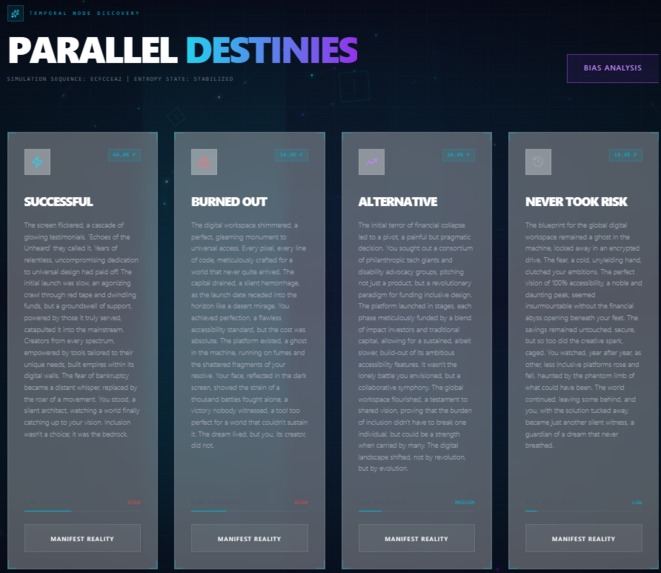
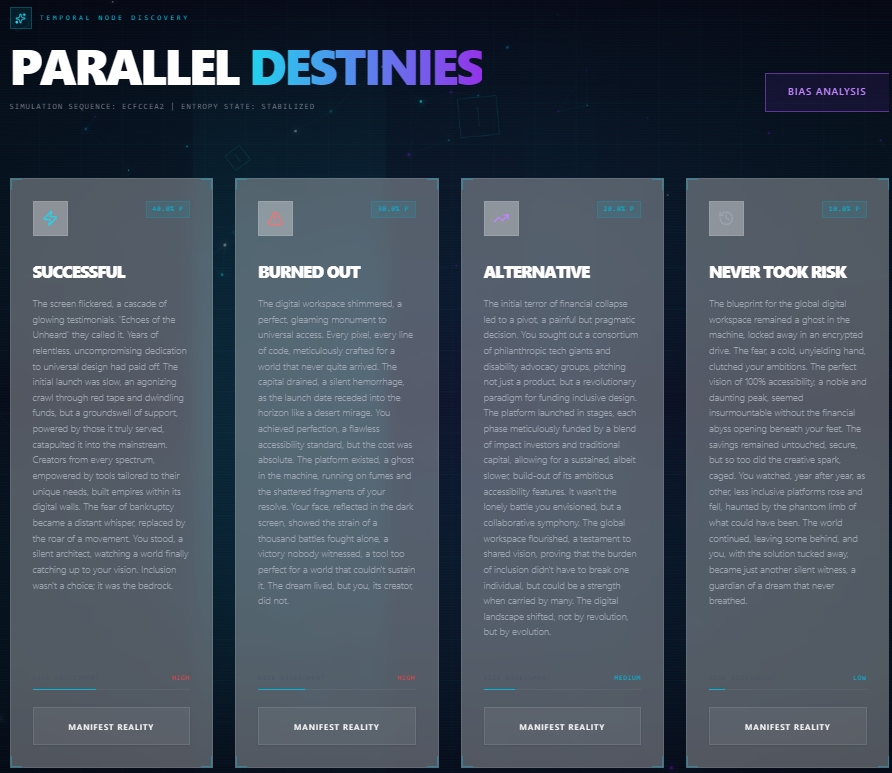
- The Parallel Destinies Engine: Simulates 4 distinct future timelines (Successful, Burned Out, Alternative, and Never Took Risk), calculating specific risk probabilities and rendering a deep narrative trajectory for each.
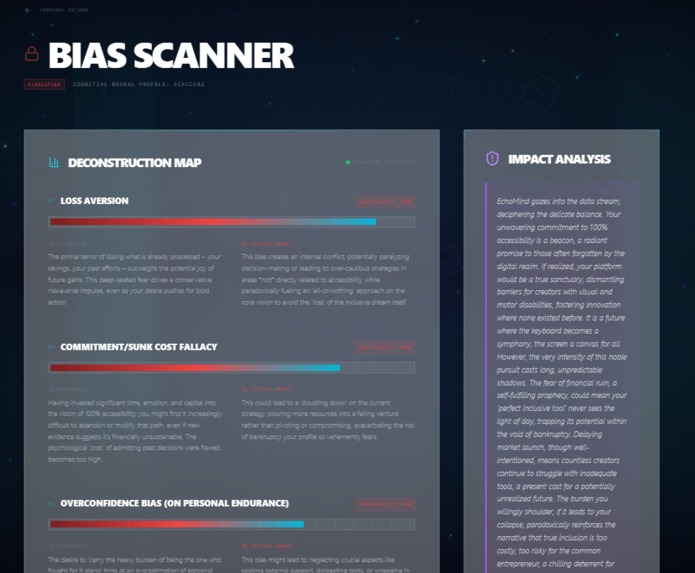
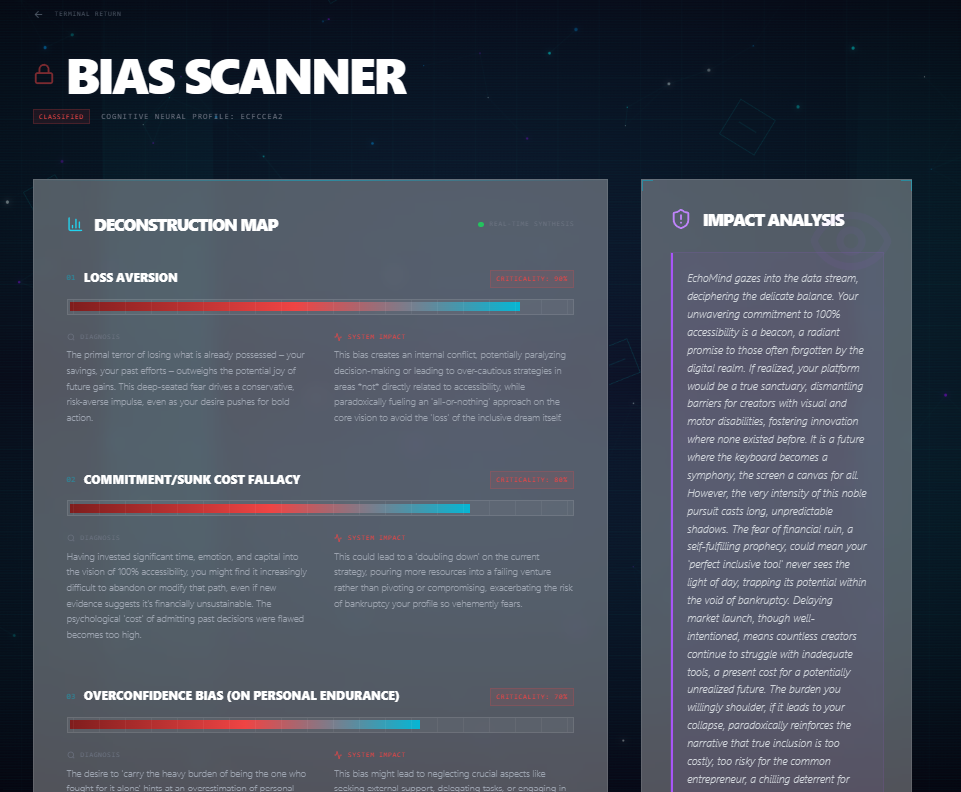
- The Cognitive Bias Scanner: Deconstructs the user's inputs in real time to map psychological blind spots—such as Loss Aversion, Sunk Cost Fallacy, Overconfidence Bias, and Confirmation Bias—assigning visual criticality bars and measuring their societal impact.
Finally, the user enters the Neural Cluster. Here, they can initiate a real-time conversational simulation with localized personas, such as their own Future Self or an Honest Mentor, who challenge the user's current strategy based on the entire accumulated data context.
How we built it
EchoMind OS was engineered from the ground up using MeDo's conversational and visual full-stack generation capabilities.
- State Management & Logic Architecture: We established a robust multi-turn prompt pipeline that acts as a biometric orchestrator. As the user moves through the sequence phases, the system extracts variables and streams them into a backend simulation matrix.
- Dynamic Generation UI: We instructed MeDo to bypass standard templates and render a sleek, high-contrast cyberpunk operating system interface. The Bias Scanner dynamically computes and visualizes data using custom analytical criticality bars ($70\% - 90\%$).
- Neural Chat Contextual Bonding: The real-time chat workspace uses an advanced prompt structure to inject historical context into specific agent personas. The backend ensures that when talking to the Future Self, the LLM holds memory of the precise failure points and accessibility targets identified in earlier phases. ## Challenges we ran into One of our biggest hurdles was achieving genuine context persistence across different view states. Ensuring that an AI agent in the final chat phase could flawlessly retrieve specific variables from the initial onboarding scan—without diluting its narrative persona—required meticulous prompt optimization. We had to carefully guide MeDo's backend state mapping so that the Future Self could actively reference things like "empty coffers" or "uncompromising accessibility targets" organically. ## Accomplishments that we're proud of We are incredibly proud of the depth and emotional resonance of the AI's generated narratives. Seeing the Future Self deliver a haunting, philosophically complex monólogo ("My reality is stable because you were not. Because you fought...") proved that we succeeded in creating an experience that feels alive. We also managed to seamlessly embed systemic risk frameworks (measuring the ripple effect of inclusive design choices) directly into a gorgeous, fully deployed production-ready UI in record time. ## What we learned We learned that natural language, when coupled with a powerful engine like MeDo, can manipulate complex UI states and deeply branched narrative logic just as effectively as traditional hard-coded systems. We also realized how powerful it is to frame technical constraints—like security, market validation, and web accessibility—through an immersive, story-driven interface to alter user behavior for the better. ## What's next for EchoMind We want to expand the EchoMind OS suite by integrating live API plugins. Imagine connecting your actual startup financial runway via an accounting API or importing your product's live repository code. EchoMind could continuously scan your real-world development velocity and financial health, transforming day-to-day operations into an ongoing, evolving multi-agent narrative simulation to keep you ahead of your biases.
Built With
- fullstack
- ia
- medo
- ux

Log in or sign up for Devpost to join the conversation.