-
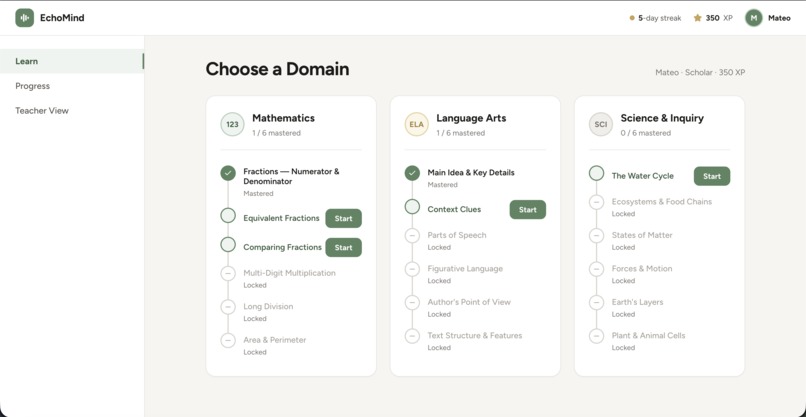
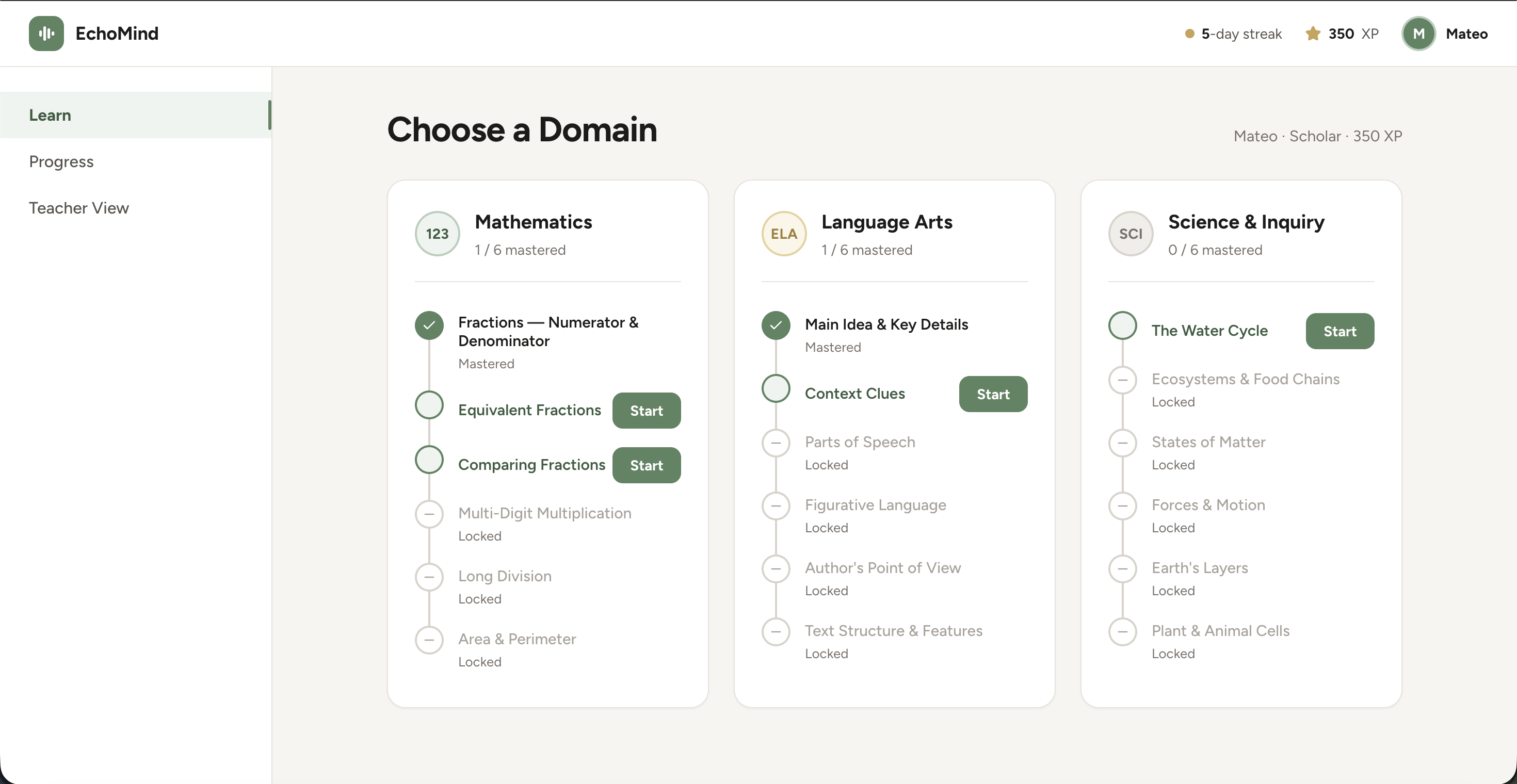
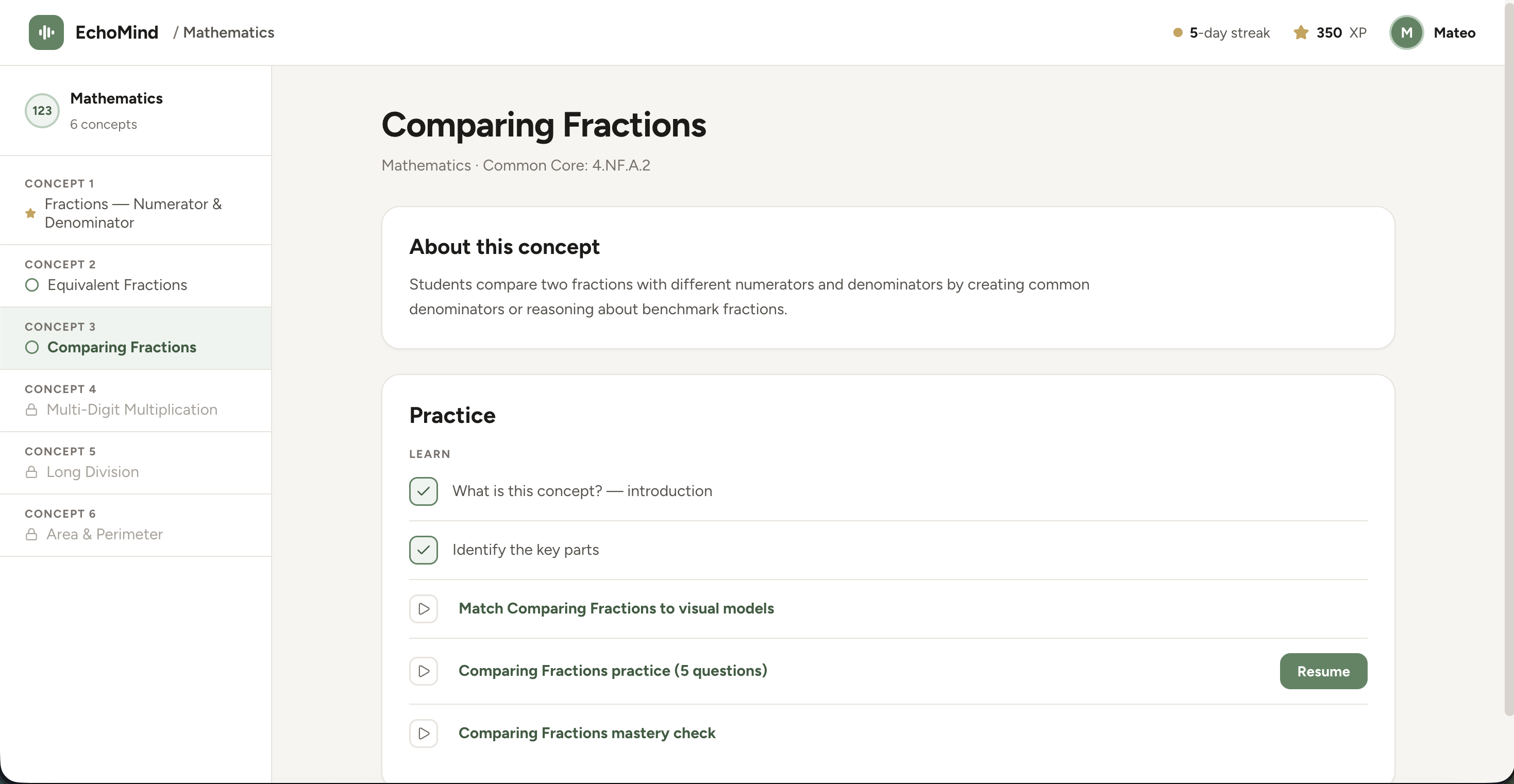
Dashboard so the student can choose what track they want
-
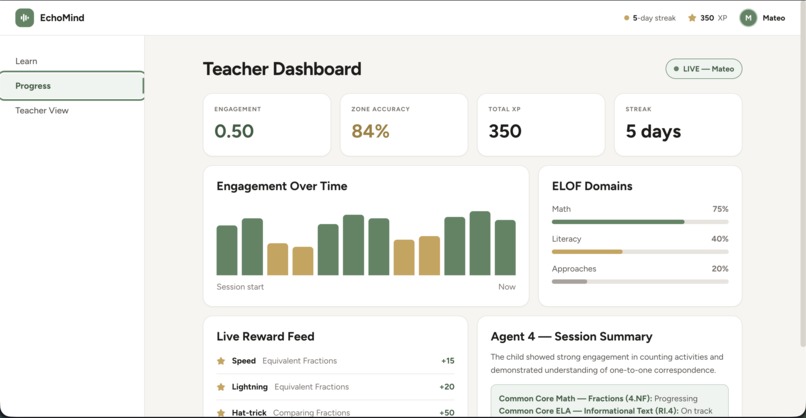
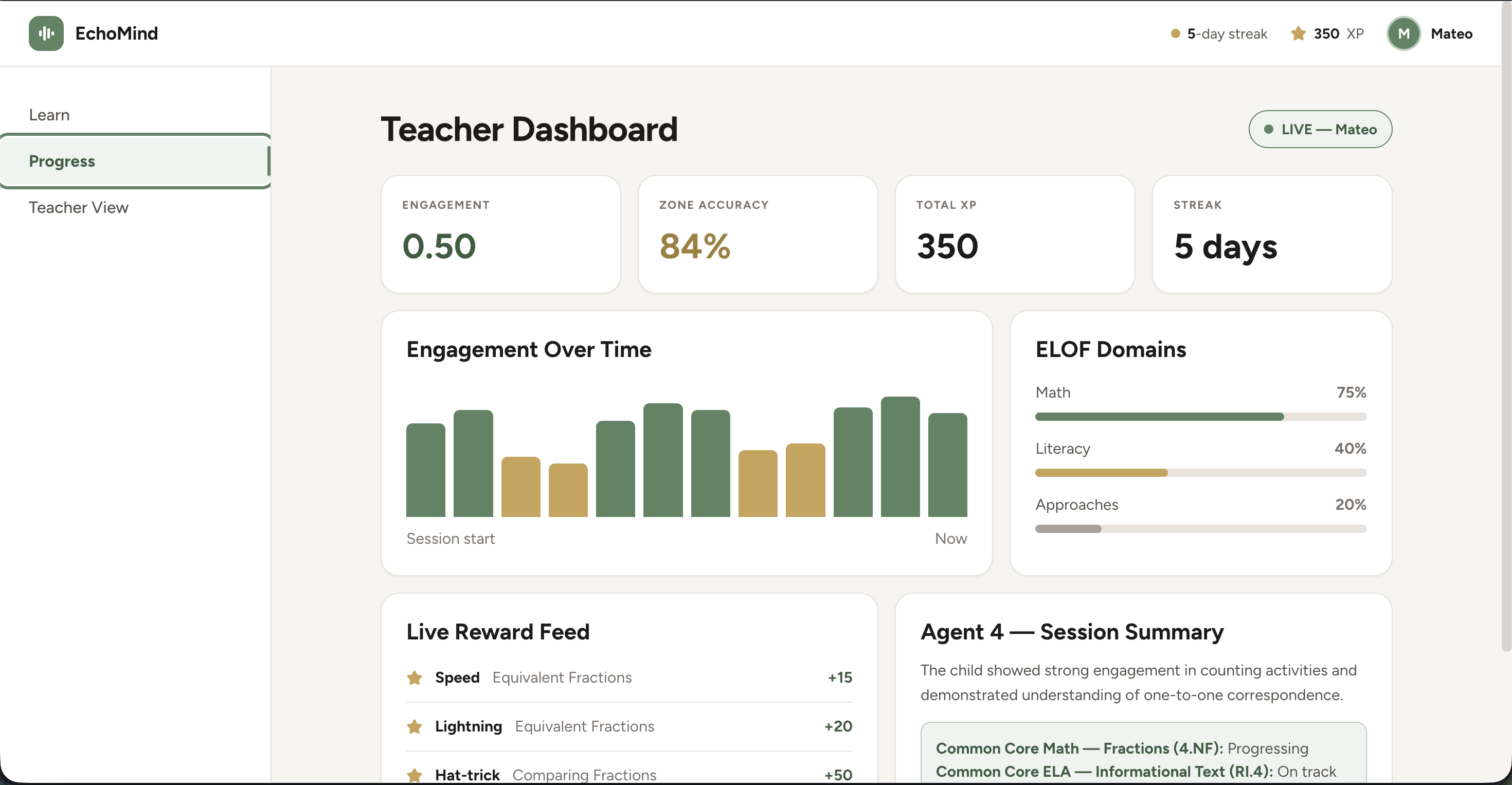
analytics dashboard based on the student
-
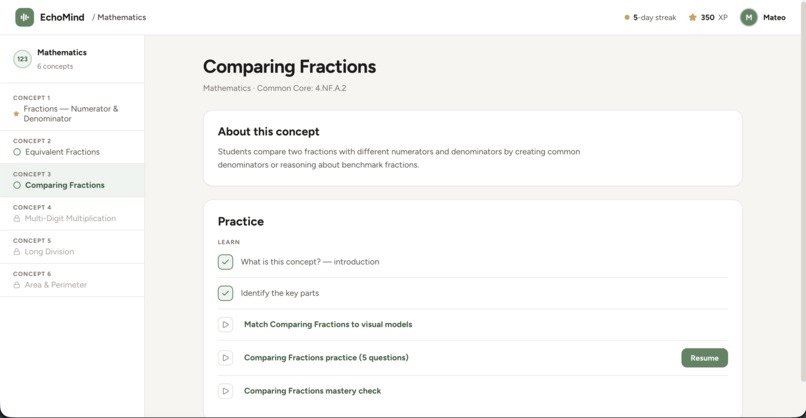
lesson plan generated by ai to mold to the students need
Inspiration
By 4th and 5th grade, classrooms split into kids who are coasting and kids who are quietly falling behind — and most learning software treats them identically, serving the same worksheet at the same pace no matter what's actually happening in a student's head. The instant a 10-year-old gets bored or hits a wall, they disengage, and nothing on the screen notices. Meanwhile teachers are stretched across 25+ students and spend hours turning what they observe into standards-aligned progress notes by hand. We wanted one session to do both: meet each student where they are in real time, and generate the teacher's documentation automatically.
What it does
EchoMind is a web-based learning platform for 4th–5th graders. Students move through a journey-style skill path — Khan Academy structure, Duolingo reward system — across 18 standards-aligned concepts in three domains (Math, Language & Literacy, and Approaches to Learning / critical thinking).
Behind every session, six specialized AI agents run in concert:
- Sensor Agent — scores engagement every 3 seconds from response latency and interaction rhythm, relative to a per-student baseline.
- Intervention Agent — when engagement drops, it shifts the experience (pacing, format, a fresh challenge, a reset) before the student checks out — no reload, no visible cut.
- Curriculum Agent — sequences concepts through each student's zone of proximal development via a prerequisite concept graph, deferring concepts a student is struggling with and advancing the ones they've mastered.
- Memory Agent — at session end, persists mastery, XP, and streaks, and auto-writes a standards-aligned teacher summary plus a warm, plain-language parent update.
- Screen Monitor Agent — tracks answer-zone accuracy and interaction patterns to drive rewards and feed difficulty signals back to the curriculum.
- Question Generator Agent — generates a fresh batch of 5 questions for every lesson with Claude Haiku, so no two lessons repeat and students can't just memorize the bank.
The student gets a lesson that adapts to them; the teacher gets standards-aligned documentation from the same session.
How we built it
- Backend: Python (FastAPI + Uvicorn), with the six agents orchestrated via LangGraph. Real-time signals (engagement, interventions, screen activity, reward feed) stream over WebSockets, with Redis for pub/sub and question caching. State persists through SQLAlchemy + Alembic migrations.
- AI: Claude Haiku for fresh question generation via structured tool-use output (validated against a strict Pydantic schema with retry + deterministic fallback); additional LLM routing for concept sequencing and report generation.
- Frontend: React 19 + TypeScript on Vite, with Zustand for state, Framer Motion for the animated journey and rewards, and Recharts for the teacher dashboard. Screens flow Start → Domain Hub → Snake Path → Lesson → Lesson Complete.
- Testing: pytest across the backend agents, Playwright for the frontend.
Challenges we ran into
- Tuning intervention timing. Reacting too fast made the experience thrash; too slow and the student was already lost. We landed on debounced thresholds, a hard floor for severe disengagement, and a 45-second cooldown to prevent flapping.
- Reliable, grade-appropriate questions on demand. Generated questions had to be schema-perfect and hit 4th–5th grade difficulty every time. We added strict Pydantic validation, a single retry, and a deterministic seed-question fallback so a lesson nev
- Keeping six agents in sync without stepping on each other. Each agent has a single responsibility and a clean contract — the Sensor Agent has zero curriculum knowledge, the Memory Agent is the only writer to the DB — so signals flow one direction
- Real-time without jank. Adaptive shifts had to land as smooth React state changes over WebSocket, with no reload or visible cut.
- XP/streak edge cases — avoiding double-counting mastery XP across repeatd-day streak resets correctly.
Accomplishments that we're proud of
- A genuinely real-time adaptive loop — engagement sensed, lesson reshapedjust static if/else branching.
- Every lesson is unique, generated fresh by Claude rather than pulled from a static bank, so kids engage with the material instead of gaming it.
- Teacher documentation that writes itself, mapped to grade-level standard
- A clean six-agent architecture where each agent does one thing well — understandable, testable, and extensible.
- A polished, genuinely fun Duolingo-style journey with a layered reward sted XP and streaks).
What we learned
- Single-responsibility agents beat one big prompt. Splitting sensing, decg into separate agents made the system far easier to debug and reasonabout.
- The right model for the job. A fast, cheap model (Claude Haiku) with strfect for high-volume question generation — speed and schema reliabilitymattered more than raw capability.
- Design for the failure case first. Validation, retries, and deterministie between a lesson loading and a student staring at a broken screen.
- Engagement signals are subtle. For this age group, disengagement looks different from genuine difficulty, and separating the two was key to intervening at the right moment.
What's next for EchoMind
- Deeper subject coverage — expand beyond the initial 18 concepts into full 4th–5th grade math and ELA scope and sequence.
- Richer sensing — incorporate more behavioral and on-device signals to dey and interaction rhythm.
- Longitudinal insights — trend dashboards showing each student's trajectory across weeks, not just one session.
- Classroom mode — a live teacher view of who needs help right now across
- Standards flexibility — configurable, region-specific standards (Common Core and state frameworks) so any district can map content to its own requirements.
- Pilot with a real 4th/5th grade classroom to validate both the learning ime savings.

Log in or sign up for Devpost to join the conversation.