Inspiration
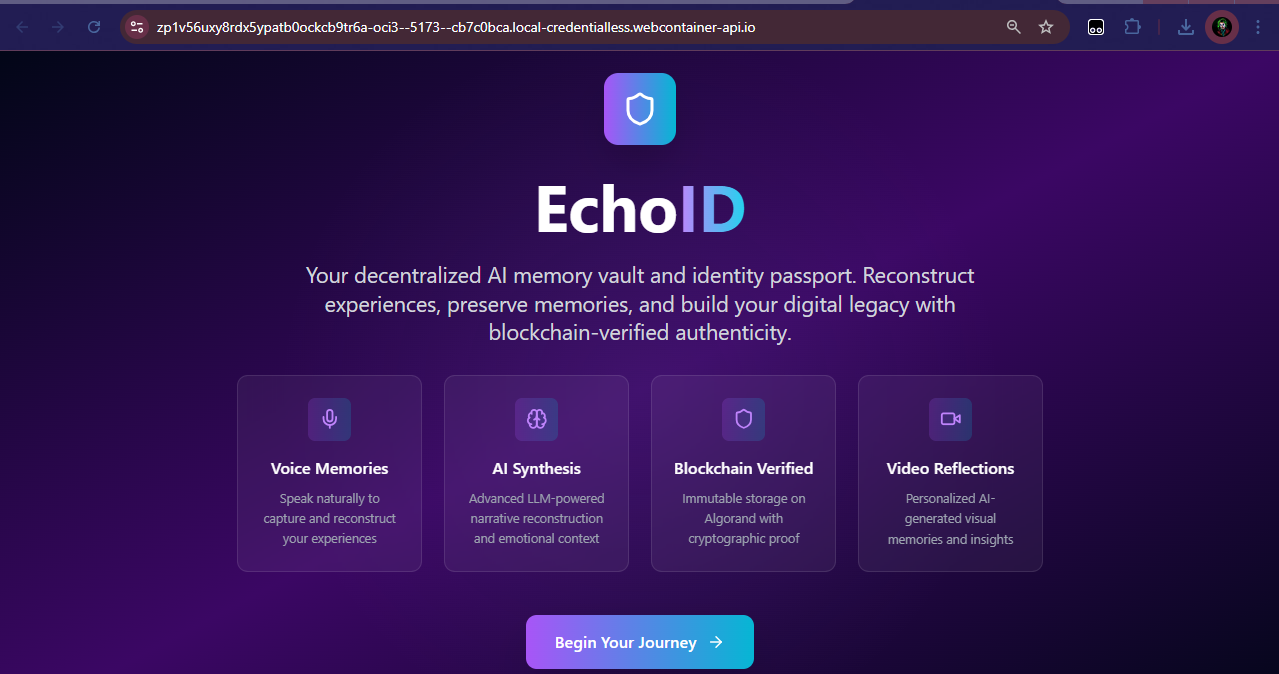
We lose sight of the continuity of our individual identities in a world that is becoming more and more shaped by digital interactions. Our digital footprints continue to be fragmented across platforms as memory fades. What if we could produce an AI-reconstructed version of our own memories that is cryptographically verified on the blockchain, narrated in our own voice, and visualized through AI video?
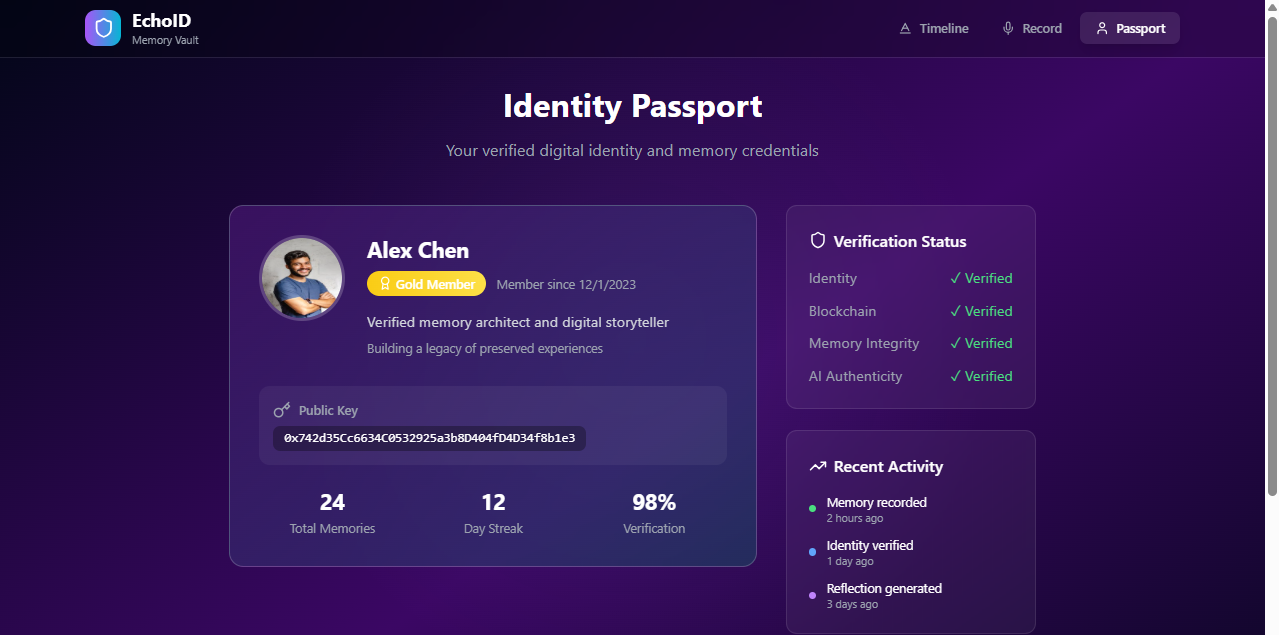
This question served as the impetus for EchoID. It allows people to document their lives, relive poignant moments, and create a proof-of-memory that changes over time by fusing identity, memory science, and storytelling into a single platform. EchoID makes memory tangible, secure, and ownable, whether it is used for legacy creation, cognitive preservation, or therapeutic journaling.
What it does
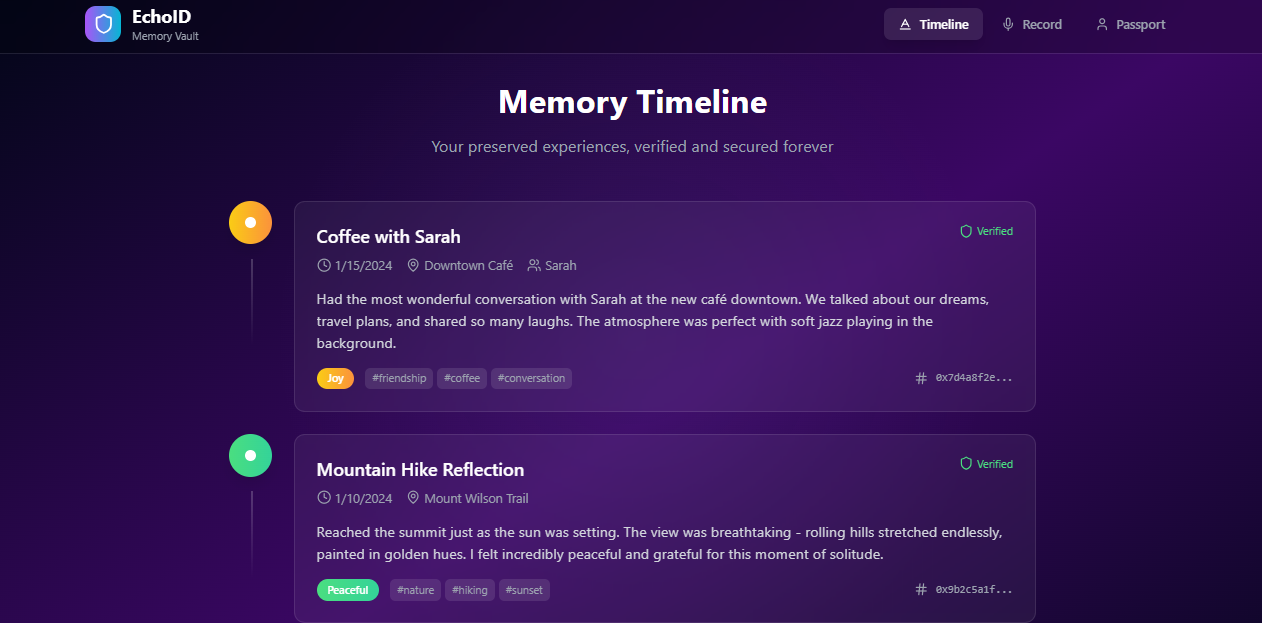
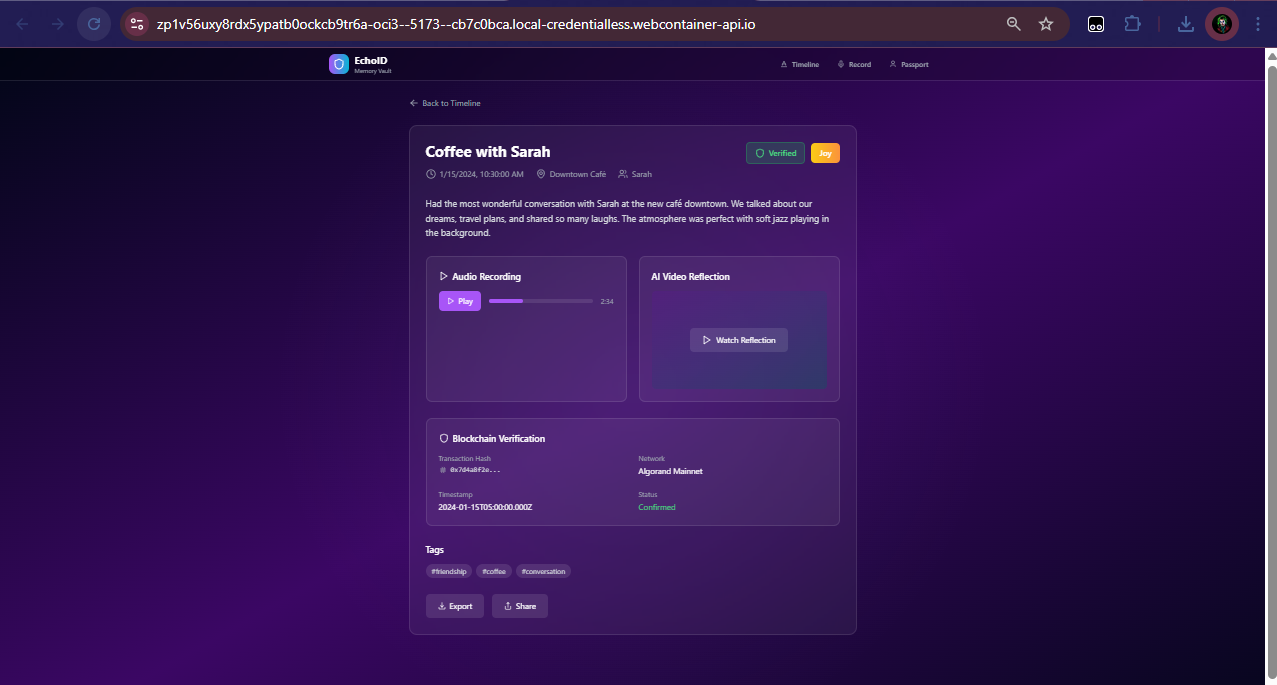
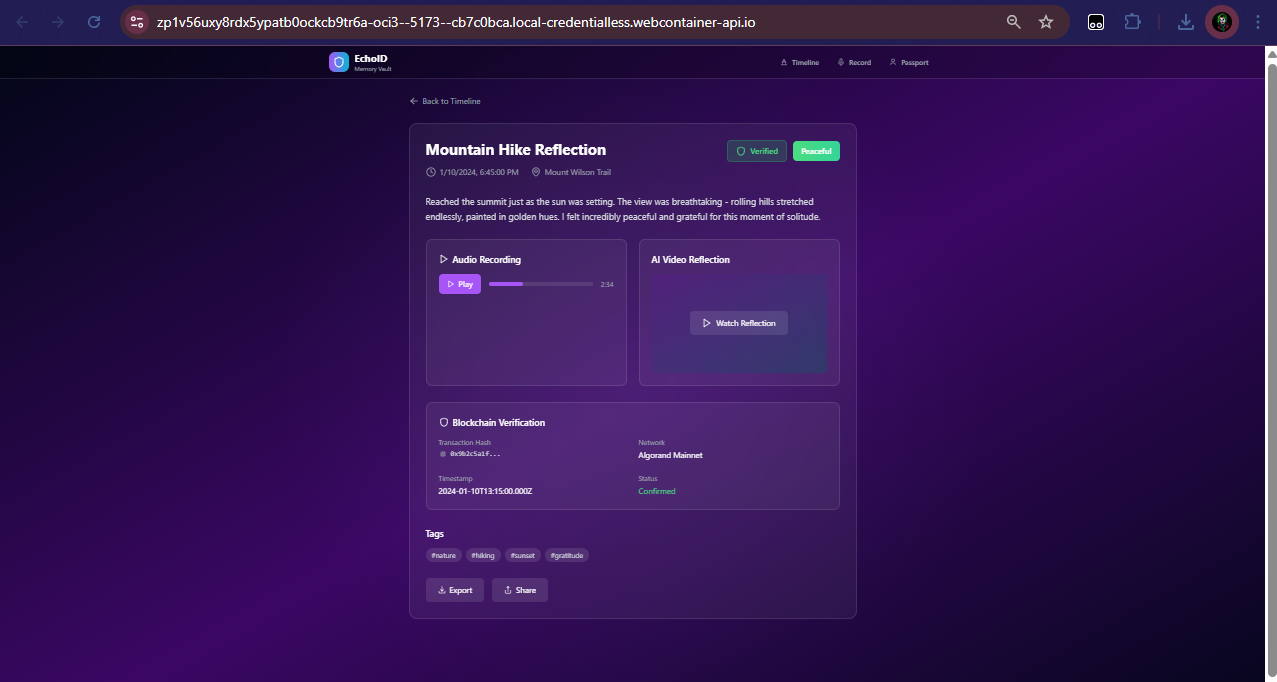
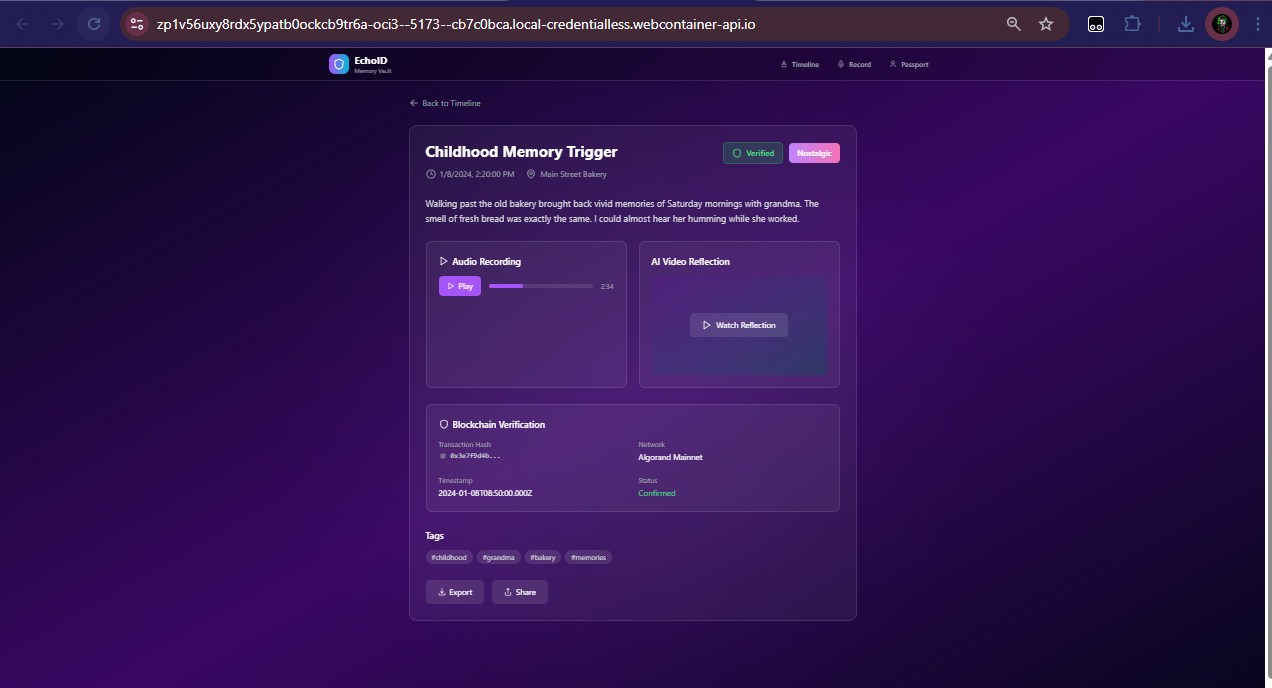
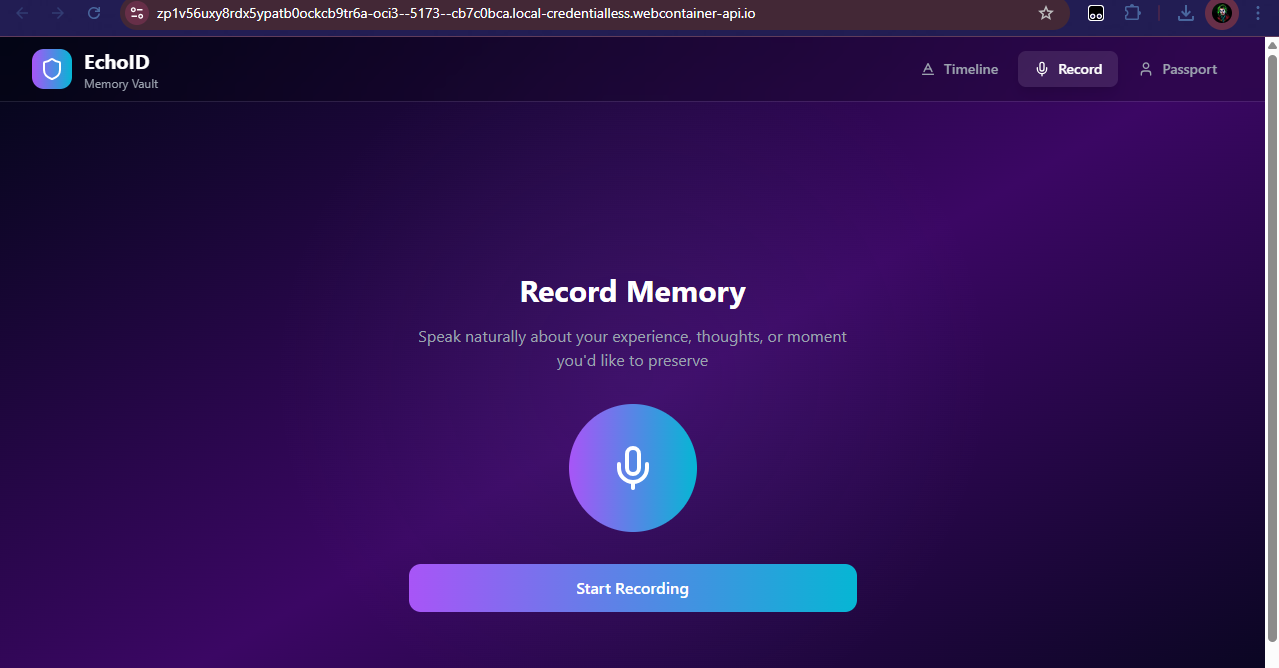
EchoID enables users to: Use voice input (through ElevenLabs) to record a memory or reflection by speaking naturally. Watch as LLM-powered synthesis turns it into a narrative journal entry. Get a video avatar reflection created by AI (through Tavus) for visual storytelling. Create an unchangeable chain of memory by storing a verifiable hash of every entry on Algorand. Using a modern, mobile-friendly app based on Bolt.new, users can explore, share, and relive their own timeline. Use RevenueCat's paywall to access premium features, and use Entri to control their identity on a unique domain.
How we built it
We began by using Bolt.new's drag-and-drop builder and custom code integrations to completely prototype the user interface and user flows. ElevenLabs was integrated to convert user voice input into clear, heartfelt transcripts. These transcripts were fed into Bolt.new's LLM-based prompt system to produce narratives in the style of journals. Created customized AI video reflections using the Tavus API in accordance with the stories. Developed a proof schema and lightweight hash that was implemented on Algorand for immutable memory storage. Paywall control and in-app subscriptions were added using the RevenueCat SDK. The "Built with Bolt.new" badge was prominently displayed while the finished product was deployed using Netlify and integrated Entri to provide custom domains.
Challenges we ran into
Bolt.new needed innovative workarounds using unique JavaScript functions to integrate several APIs (Tavus, ElevenLabs, and Algorand). Blockchain verification and memory hashing are required to strike a balance between cost, speed, and privacy. It was technically and architecturally challenging to synchronize narrative input with real-time AI video feedback. It took several design iterations to produce an emotive yet simple user experience. Custom storage logic was needed to manage cross-platform data integrity given Bolt's limitations.
Accomplishments that we're proud of
Created a platform for end-to-end memory ownership inside the Bolt.new ecosystem. Using voice, video, and narrative generation, a smooth multi-modal user interaction was accomplished. Used blockchain technology to store verifiable emotional identities rather than for publicity. In less than two weeks, a usable and emotionally impactful user experience was delivered. Created a platform with practical applications in legacy planning, therapy, and wellness.
What we learned
How to build full-stack apps with real-world API integrations using Bolt.new. The possibility of creating a unified product by fusing blockchain, video synthesis, voice AI, and LLMs. When creating emotionally charged apps, design is just as important as technology. Multimodality (text, video, and voice) opens up new possibilities for user interaction. We discovered new connections between digital identity, cryptography, and memory science.
What's next for EchoID
Extend to accommodate culturally sensitive narrative tones and multilingual voice inputs. To safeguard the privacy of on-chain memories, add ZK-encryption. Introduce a feature that allows users to link entries with loved ones to create family memory trees. Examine ways to integrate with healthcare providers for tracking emotional health and early dementia therapy. Write a study on "Proof-of-Memory," a novel category of digital identity that can be verified.


Log in or sign up for Devpost to join the conversation.