-
-
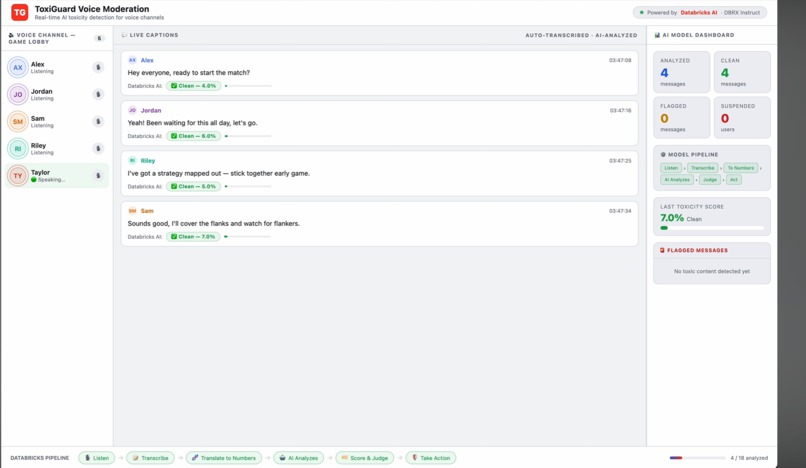
Demo Picture
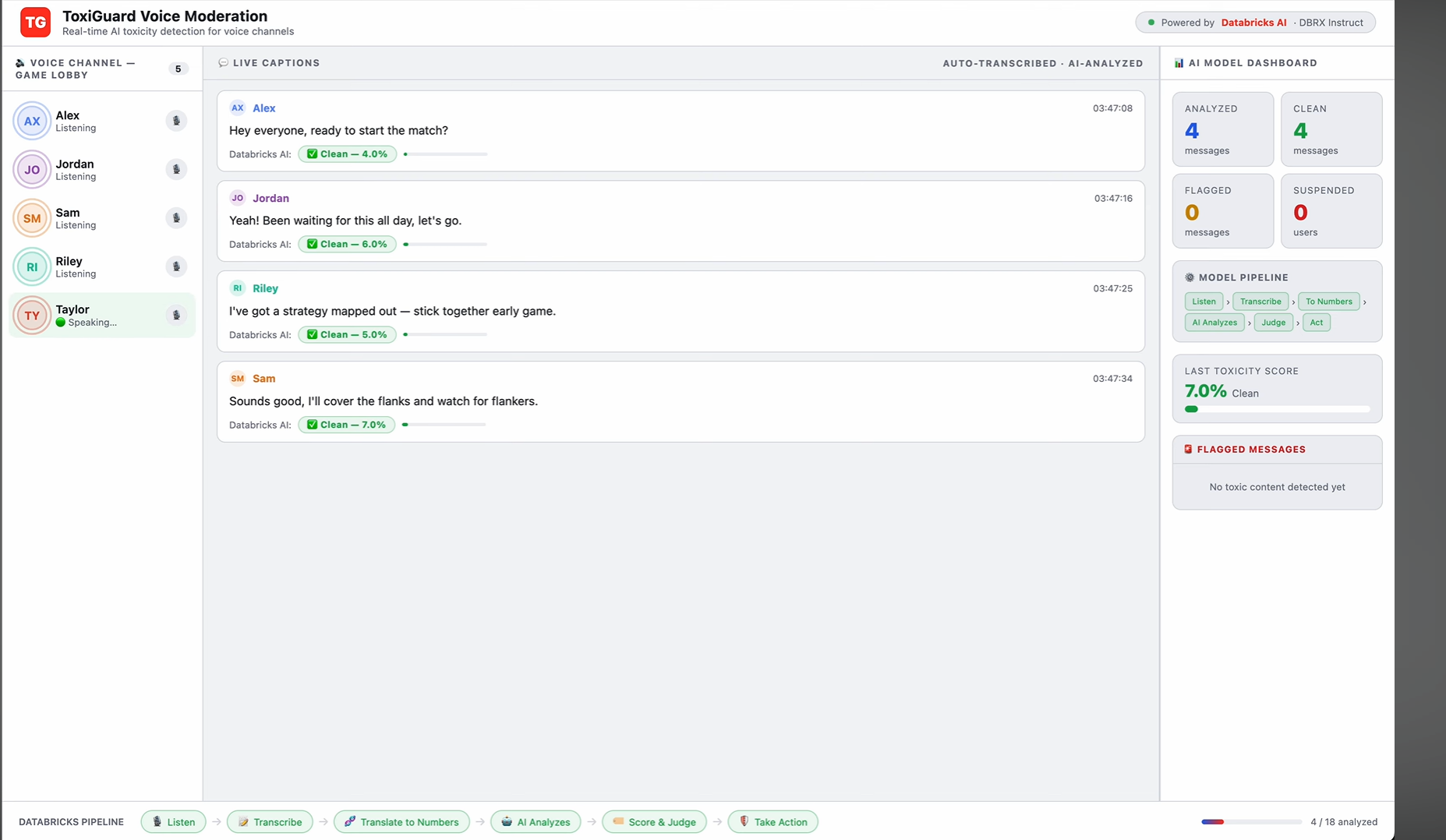
Inspiration
Multiplayer games are meant to be competitive, immersive, and social, yet many matches deteriorate because toxic behavior escalates in real time. Most existing moderation systems are reactive. They rely on reports, bans, or penalties applied after a match has already been ruined. These approaches fail to address the root cause of toxicity: emotional escalation under pressure.
While reviewing our demo gameplay and voice interactions, we observed a consistent pattern. Toxicity almost never appears instantly. Instead, it develops gradually through rising voice intensity, increased chat frequency, negative sentiment trends, and declining gameplay performance. This progression was clearly visible in the demo transcript, where frustration accumulated well before any explicit toxic language appeared.
This insight inspired our central question:
What if AI could detect when a player is approaching that tipping point and intervene before the match collapses?
That question became the foundation for EchoGuard.
What it does
EchoGuard is a real-time AI system that converts voice-to-text, chat activity, and gameplay telemetry into a continuously updated Toxicity Risk Index (TRI). Instead of labeling players as “toxic,” EchoGuard predicts escalation risk and triggers short, proportional cooldowns that interrupt emotional feedback loops and help stabilize gameplay.
As demonstrated in the video:
- Live voice chat is transcribed into text
- Chat sentiment, message frequency, and behavioral signals are analyzed in real time
- A TRI score is continuously recalculated
- Tiered interventions such as chat muting, micro-timeouts, and cooldowns are automatically recommended
The system is designed around prevention rather than punishment.
Ideation and Development Process
We began by identifying common pain points in multiplayer gaming and quickly narrowed our focus to toxicity escalation rather than simple toxicity detection. From there, we structured our ideation around three guiding questions:
- What measurable signals indicate emotional escalation?
- How can interventions feel supportive instead of punitive?
- How can the system be built and demonstrated end-to-end within a hackathon setting?
From ideation, we moved into rapid prototyping. We designed the Toxicity Risk Index as a dynamic score that evolves over time rather than a static label. We then scoped the project to focus on trend-based signals that could be realistically simulated, processed, and visualized during the event.
How we built it
We built EchoGuard using a full-stack, Databricks-native architecture with a lightweight web layer for interaction and documentation.
Backend and API (Django):
We used Django as the backend framework, exposing APIs for ingesting gameplay events, chat logs, and voice-to-text data. Django handled request routing, session logic, and communication between the analytics layer and the frontend.
Data and Analytics (Databricks):
- Bronze Layer: Ingested simulated gameplay events, chat logs, and voice-to-text transcripts
- Silver Layer: Engineered rolling, windowed features such as message-rate spikes, sentiment slopes, ping spam, AFK duration, and gameplay performance drops
- Gold Layer: Computed the Toxicity Risk Index and mapped scores to tiered intervention actions
The TRI is calculated as: $$ TRI = \alpha(\text{behavioral drift}) + \beta(\text{sentiment slope}) + \gamma(\text{contextual frustration}) $$
We tracked experiments and scoring logic using MLflow and visualized results through a Databricks SQL dashboard, which was shown in the demo to highlight how escalation signals changed before and after interventions.
Documentation (Sphinx):
We used Sphinx to generate structured project documentation, including system architecture, API endpoints, data schemas, and model logic. This ensured the project was reproducible, explainable, and easy to extend beyond the hackathon.
Challenges we ran into
- Defining toxicity clearly while moving beyond keyword detection to trend-based behavioral signals
- Simulating realistic real-time gameplay and voice data under time constraints
- Balancing interventions so cooldowns were effective without feeling disruptive or unfair
- Integrating Django, Databricks pipelines, and dashboards into a cohesive workflow
- Addressing ethical concerns around bias and over-policing voice data
Accomplishments that we're proud of
- Building an end-to-end, streaming-style AI pipeline in Databricks
- Integrating a Django-based backend with real-time analytics
- Producing clear, maintainable documentation using Sphinx
- Delivering a live demo that connected voice-to-text, analytics, and real-time decision-making
- Reframing moderation as emotional de-escalation rather than punishment
What we learned
- Toxic behavior is often predictable when analyzed as a progression rather than isolated incidents
- Small, timely interventions can significantly improve player experience
- Databricks is well-suited for real-time behavioral AI use cases
- Strong documentation and architectural clarity matter even in hackathon projects
- Human-centered design improves both technical outcomes and trust in AI systems
What's next for EchoGuard
Next, we plan to integrate lightweight machine learning models to improve escalation prediction accuracy, expand voice analysis to include non-linguistic signals such as pace, volume, and variance, test EchoGuard on real multiplayer datasets, enhance the Django backend for real-time game integrations, extend Sphinx documentation into a full developer guide, and explore applications beyond gaming including esports, live streaming, and virtual collaboration platforms.
Final Thoughts
EchoGuard reimagines moderation as emotional intelligence rather than enforcement. By combining real-time data processing, AI-driven insight, and a scalable full-stack architecture, EchoGuard demonstrates how multiplayer environments can remain competitive, inclusive, and engaging without sacrificing intensity.
Our goal wasn’t to silence players.
It was to save the match.
Built With
- ai
- css
- databricks
- figma
- html
- machine-learning
- python
- spinx


Log in or sign up for Devpost to join the conversation.