Inspiration
Public speaking is an essential skill for students, professionals, and competition participants. However, feedback such as "speak more confidently" or "improve your voice modulation" often fails to explain exactly where a speaker went wrong and how to improve.
We created EchoGrade AI to make speech evaluation more objective, explainable, and actionable. Our vision is to help speakers understand their delivery, strengthen their scripts, and improve through personalized AI-powered coaching, even when no reference recording is available.
What it does
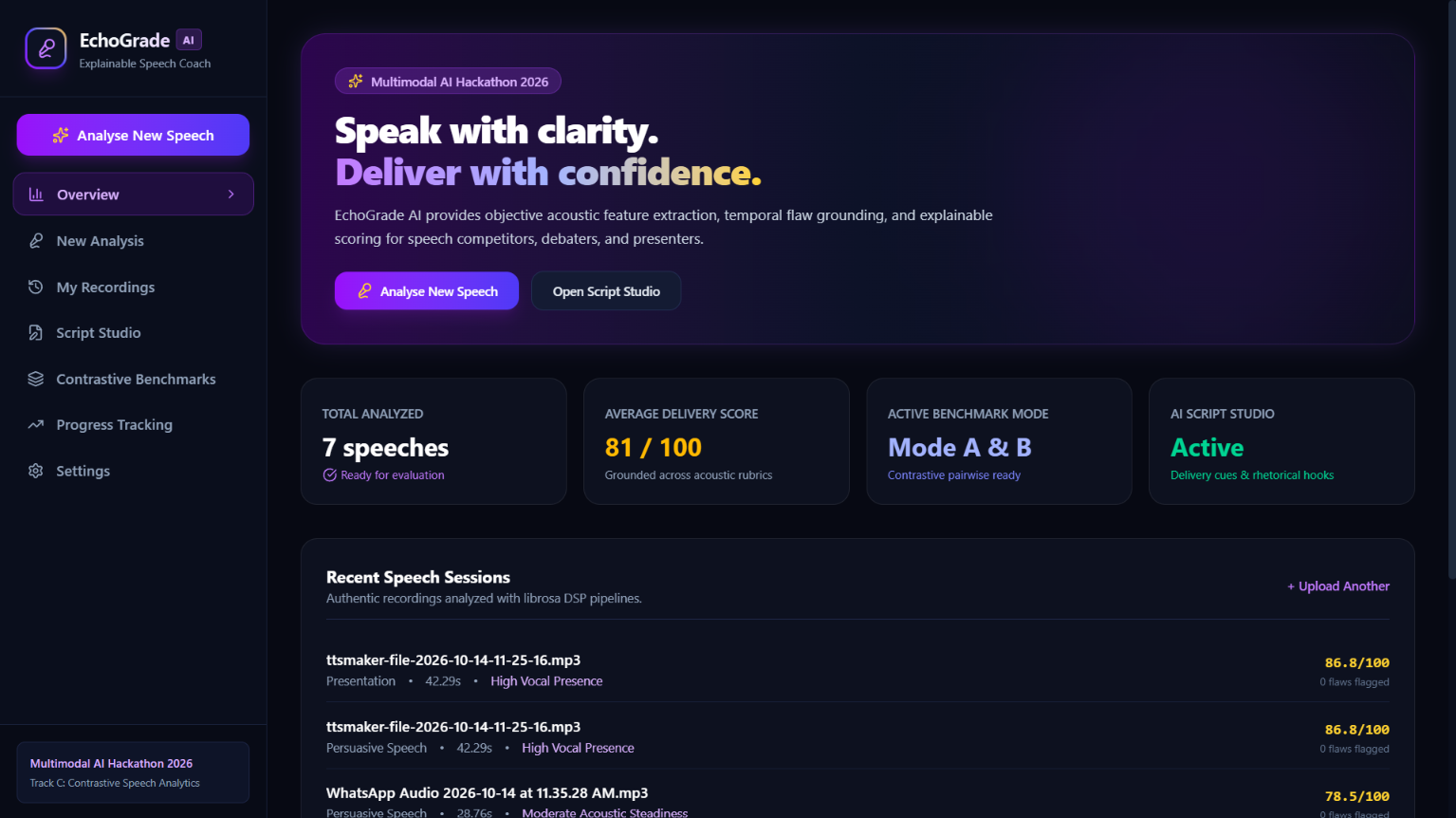
EchoGrade AI combines speech evaluation, vocal delivery analysis, and AI-powered script enhancement in one platform.
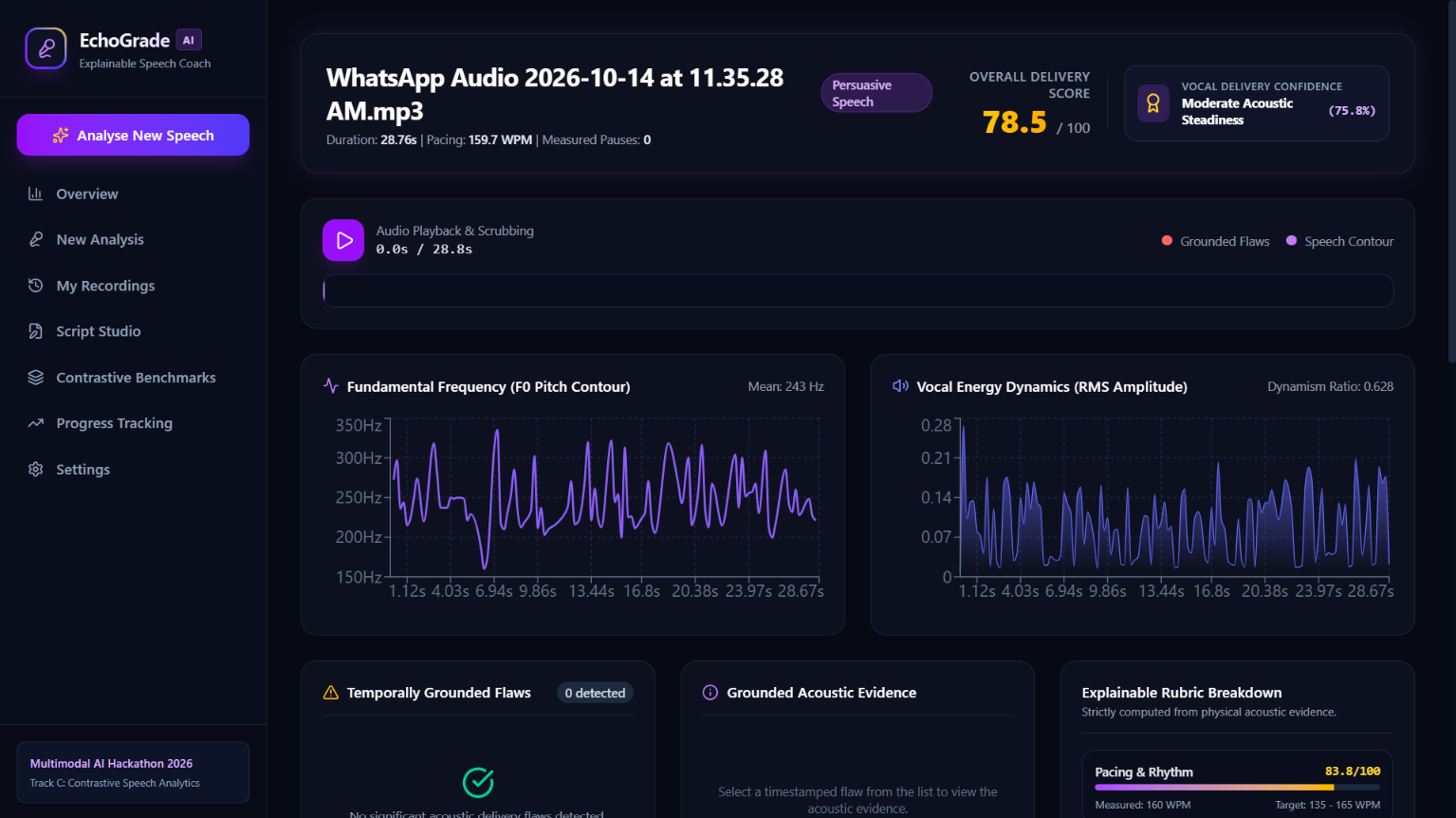
- Speech Analysis: Analyses speaking rate, pauses, pitch variation, vocal energy, and other acoustic features.
- Temporal Flaw Detection: Identifies potential delivery issues at specific timestamps and explains the measured deviations.
- Vocal Confidence Indicators: Estimates confidence-related vocal delivery cues and highlights areas for improvement without claiming to measure a person's internal psychological state.
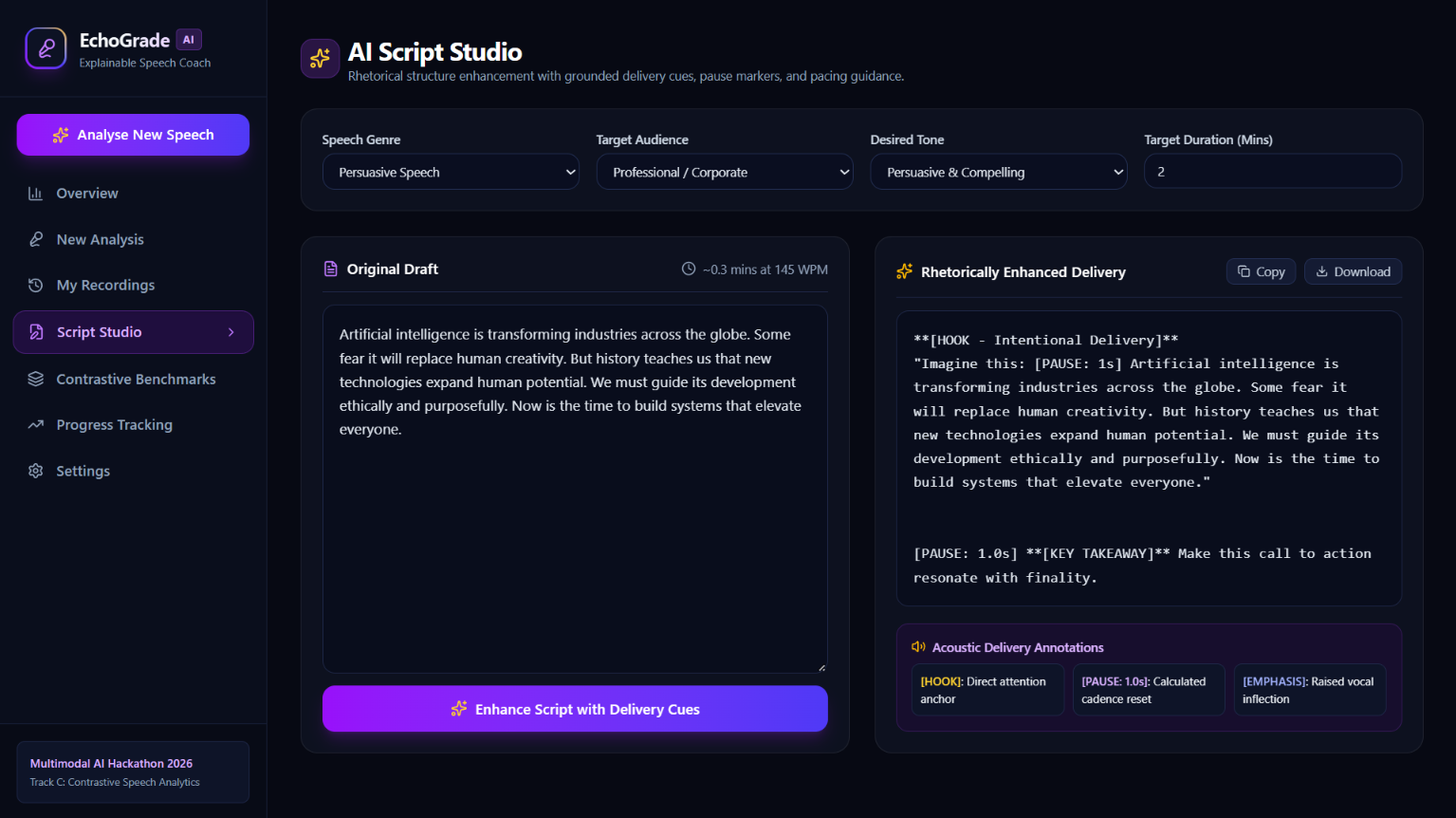
- AI Script Enhancer: Improves sentence structure, removes unnecessary repetition, strengthens openings and conclusions, and makes scripts more professional and persuasive while preserving their intended meaning.
- Personalized Coaching: Recommends practical exercises for pacing, pauses, articulation, and vocal variation.
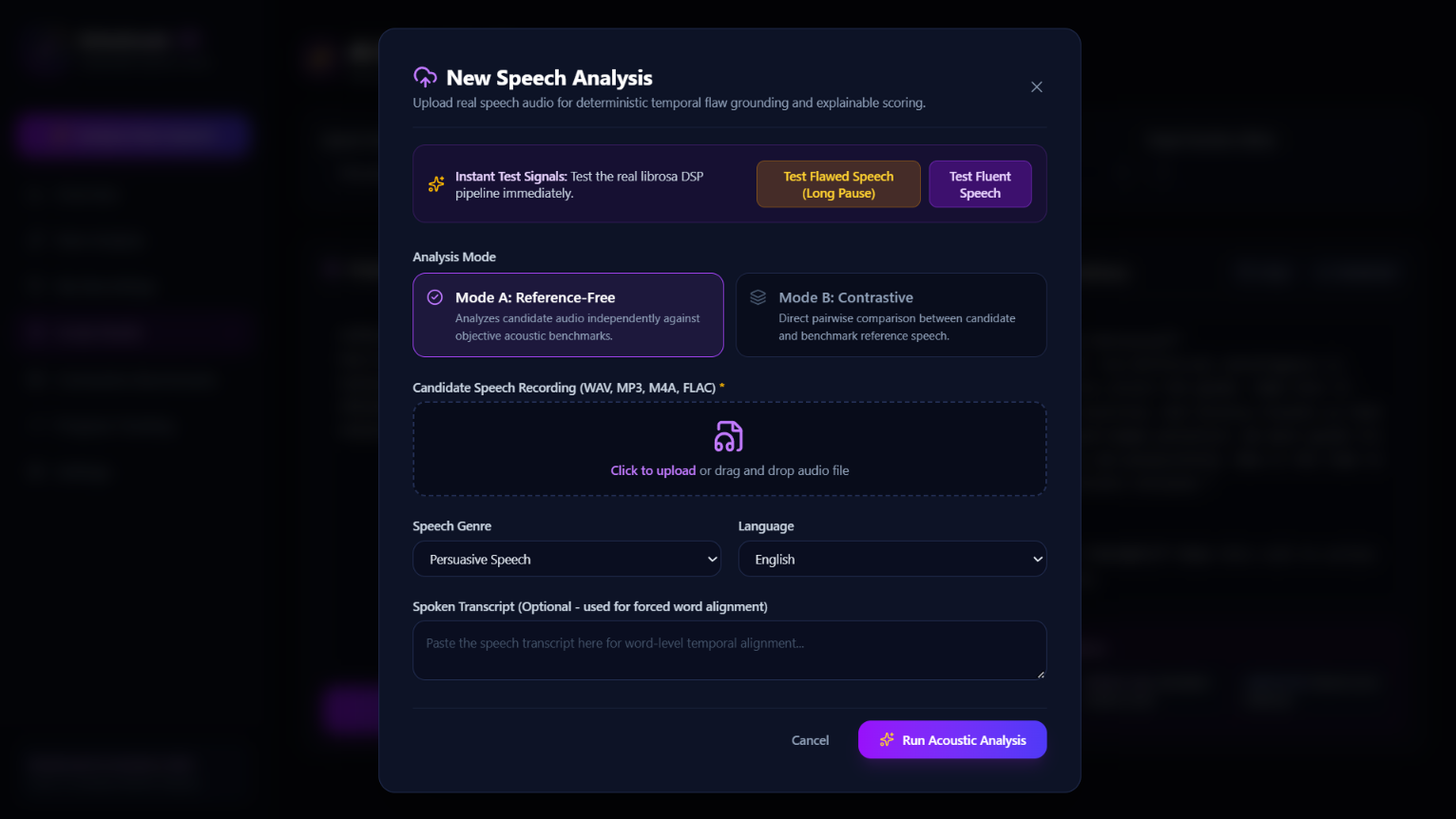
- Contrastive Analysis: When reference audio is available, compares corresponding segments to identify delivery differences using a consistent evaluation rubric.
How we built it
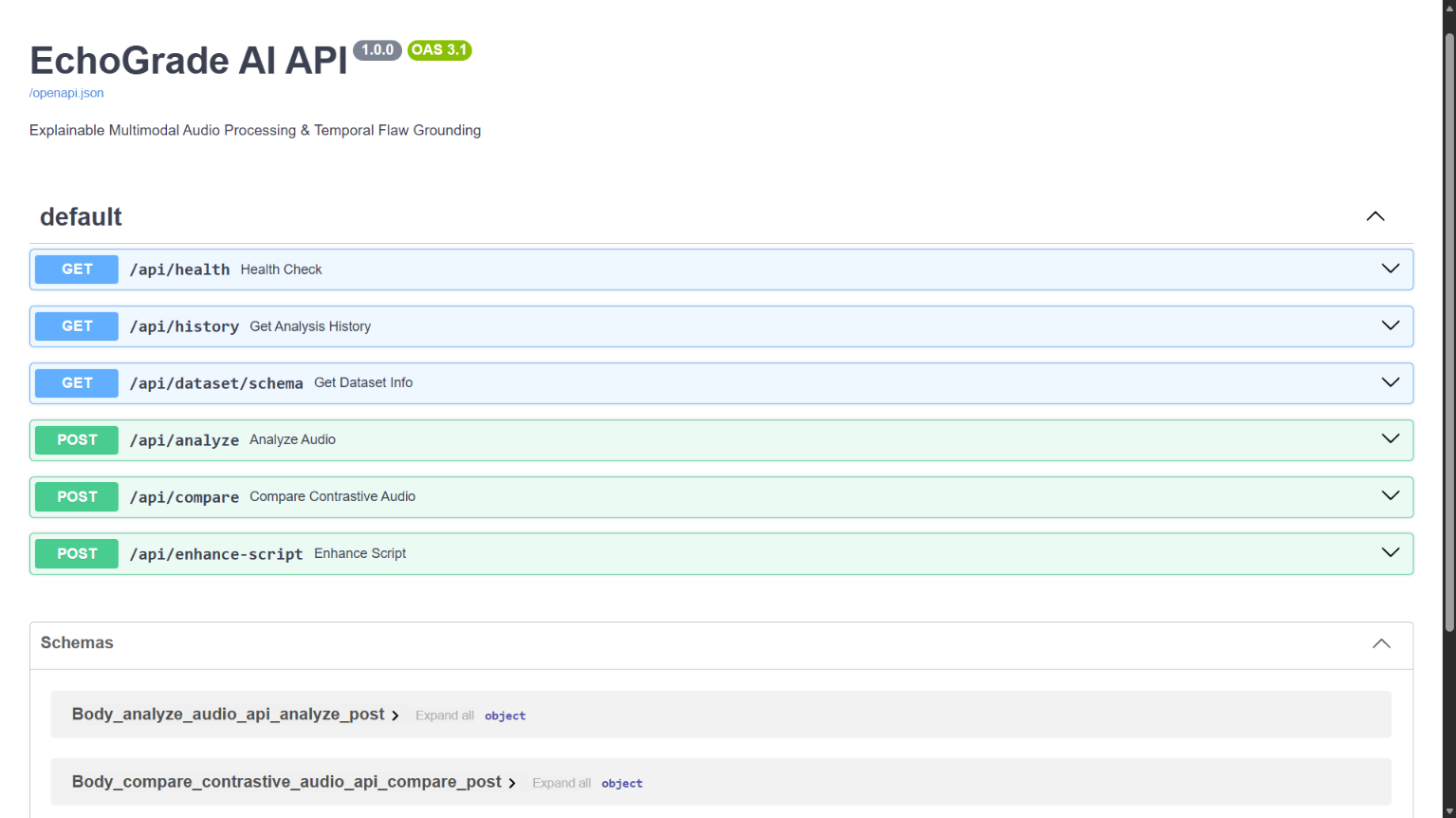
EchoGrade AI is designed around an audio-processing pipeline, an explainable scoring engine, and an interactive web dashboard.
The audio-processing component extracts acoustic features such as Mel-Frequency Cepstral Coefficients (MFCCs), pitch contours, RMS energy, speaking rate, and pause durations. Speech-to-text and forced alignment techniques help associate spoken words with audio timestamps.
A rubric-based analysis engine uses these measurements to identify potential delivery flaws and generate evidence-based explanations. When reference audio is provided, the system compares corresponding speech segments while accounting for natural differences between speakers.
The frontend brings these insights together through score summaries, audio timelines, timestamped findings, and script-improvement suggestions. Generative AI supports script rewriting and personalized recommendations.
Challenges we ran into
One major challenge is distinguishing genuine delivery issues from natural differences in accent, pitch, speaking style, and rhetorical emphasis. A louder voice or a higher pitch does not automatically indicate greater confidence.
Another challenge is accurately locating delivery flaws in time and explaining why they were detected rather than presenting unexplained scores. Forced alignment, feature normalization, and carefully defined evaluation rubrics are essential to addressing this problem.
We also aim to support reference-free analysis while retaining contrastive evaluation when a suitable reference recording is available. Balancing analytical accuracy, useful feedback, and an intuitive user experience is an important part of the design.
Accomplishments that we're proud of
We are bringing several complementary capabilities together in a single speech-coaching concept: timestamp-based delivery analysis, explainable scoring, confidence-related vocal indicators, AI-assisted script enhancement, and personalized practice recommendations.
We are particularly focused on turning acoustic measurements into understandable feedback. Instead of simply assigning a score, EchoGrade AI aims to explain what happened, where it happened, and what the speaker can do next.
The project also emphasizes a reproducible, rubric-driven approach to speech evaluation, with contrastive recordings and temporal labels forming the foundation for further testing and validation.
What we learned
We explored how audio signal processing, speech alignment, feature extraction, and generative AI can work together to support public speaking improvement.
We learned that meaningful speech evaluation requires more than speech recognition. It requires accurate timestamps, careful comparisons, speaker-aware normalization, consistent scoring rules, and explanations grounded in measurable evidence.
We also recognized the importance of separating observable vocal delivery patterns from assumptions about a person's actual confidence. AI feedback should support speakers rather than unfairly judge their natural speaking styles.
What's next for EchoGrade AI
Our next steps are to expand and validate a high-quality contrastive dataset containing reference speeches and controlled flawed-delivery recordings with accurate temporal annotations.
We plan to improve timestamp precision, validate scoring against human evaluations, strengthen speaker-agnostic feature normalization, and test the system across different accents and speaking styles.
Future versions will include progress tracking across repeated practice sessions, more personalized coaching plans, improved script analysis, and a more comprehensive interactive dashboard.
Our goal is simple: help every speaker understand their delivery, practise with purpose, and communicate with greater clarity and impact.
Built With
- generative-ai
- github
- librosa
- numpy
- python
- react
- typescript


Log in or sign up for Devpost to join the conversation.