-
-
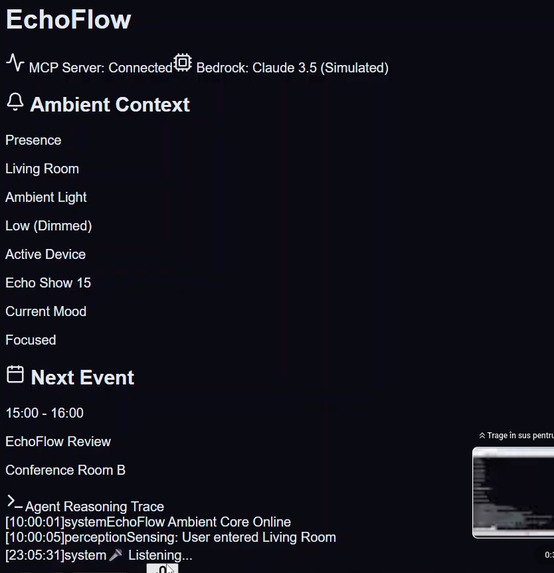
Interface
The Inspiration
Most voice assistants today are reactive; they wait for a wake word and execute a single command. I wanted to build something proactive. I envisioned a system that doesn't just hear you, but perceives you. The inspiration for EchoFlow was the idea of "Ambient Intelligence"-a system that correlates voice input with environmental context (like your location and the time of day) to take meaningful action before you even have to ask.
How I Built It
EchoFlow is engineered as a three-tier agentic system:
The Perception Layer (MCP Server) I implemented a custom server using the Model Context Protocol (MCP). This allows the agent to treat the physical world as a set of tools. By defining a standard JSON-RPC interface, the agent can call query_context to "sense" the environment or get_calendar to understand the user's schedule.
The Decision Layer (Agentic Core) The "brain" is powered by Claude 3.5 Sonnet via AWS Bedrock. I implemented a recursive reasoning loop that follows a strict mathematical logic: Perception > Context > Reasoning > Tool call > MCP Observation
This ensures the agent never guesses; it observes, reasons, and then acts.
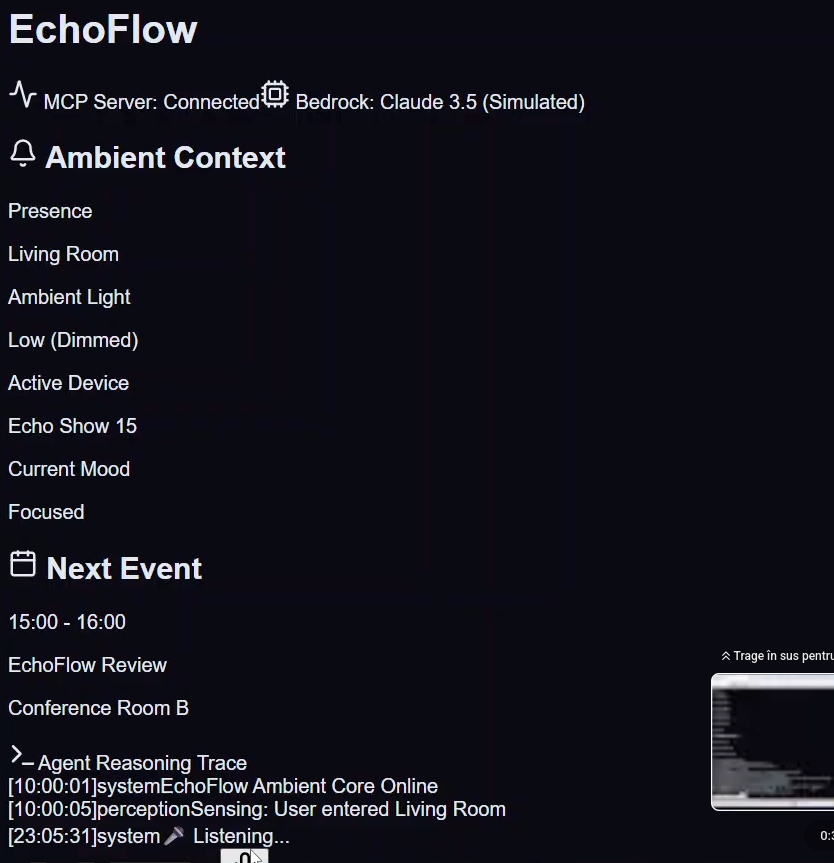
- The Interaction Layer (Frontend) I built a React-based dashboard that serves as a "window" into the AI's mind. It features a Real-time Reasoning Trace, which streams the agent's internal monologue, showing the exact transition from sensing to acting. To complete the experience, I integrated the Web Speech API for a full voice-in/voice-out loop.
Challenges Faced
The biggest technical hurdle was the asynchronous nature of the agentic loop. Getting the frontend to stream "thoughts" in real-time while the backend was waiting for an LLM response required implementing a robust state management system and a custom WebSocket-like stream to avoid UI freezes.
Additionally, configuring the AWS IAM policies and Bedrock model access was a steep learning curve. I had to navigate complex permission sets to ensure the agent had the correct AmazonBedrockFullAccess while maintaining a secure environment.
What I Learned
This project taught me that the future of AI isn't just about larger models, but about standardized integration. Using the Model Context Protocol (MCP) showed me how to decouple the reasoning engine from the tools it uses. I also learned the importance of AI Transparency-by building the Reasoning Trace, I realized that users trust an AI significantly more when they can see the "why" behind a decision.
Built With
- amazon-web-services
- bedrock
- claude
- css
- mcp
- node.js
- react
- tailwind
- typescript


Log in or sign up for Devpost to join the conversation.