-
-
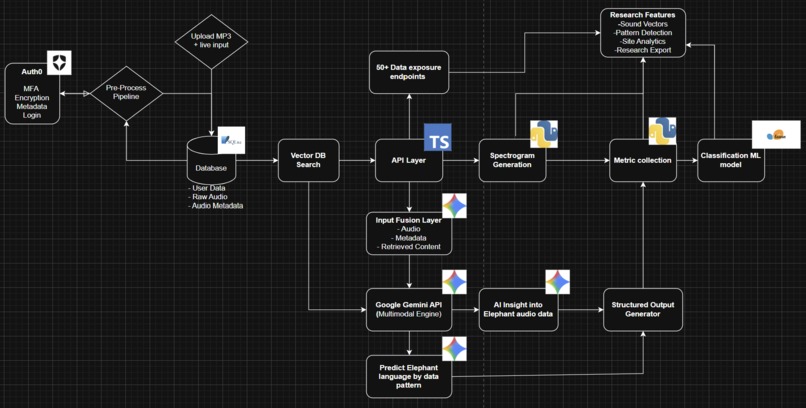
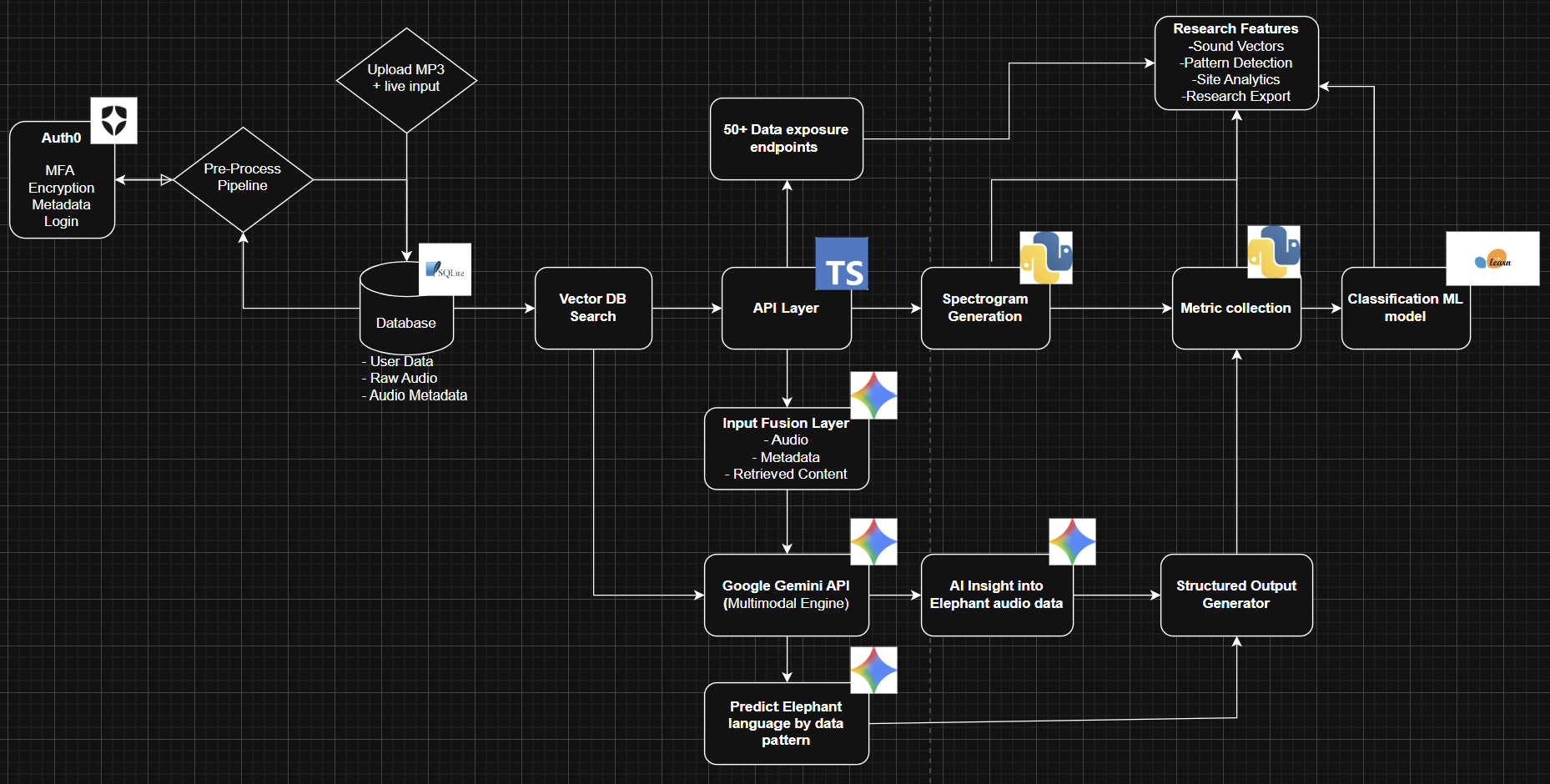
Flowchart
-
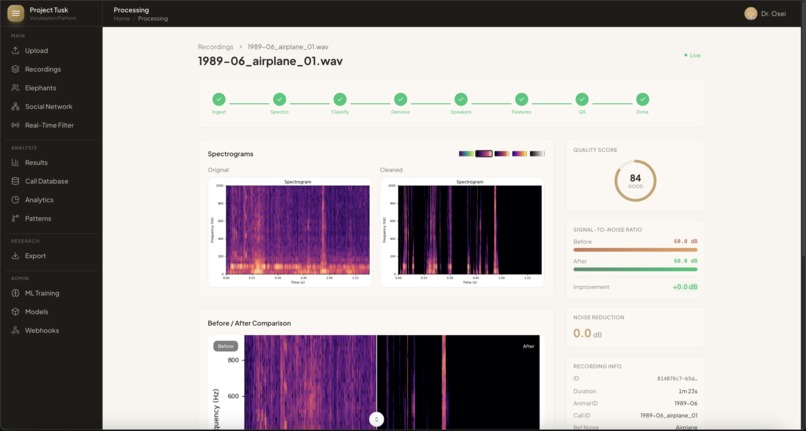
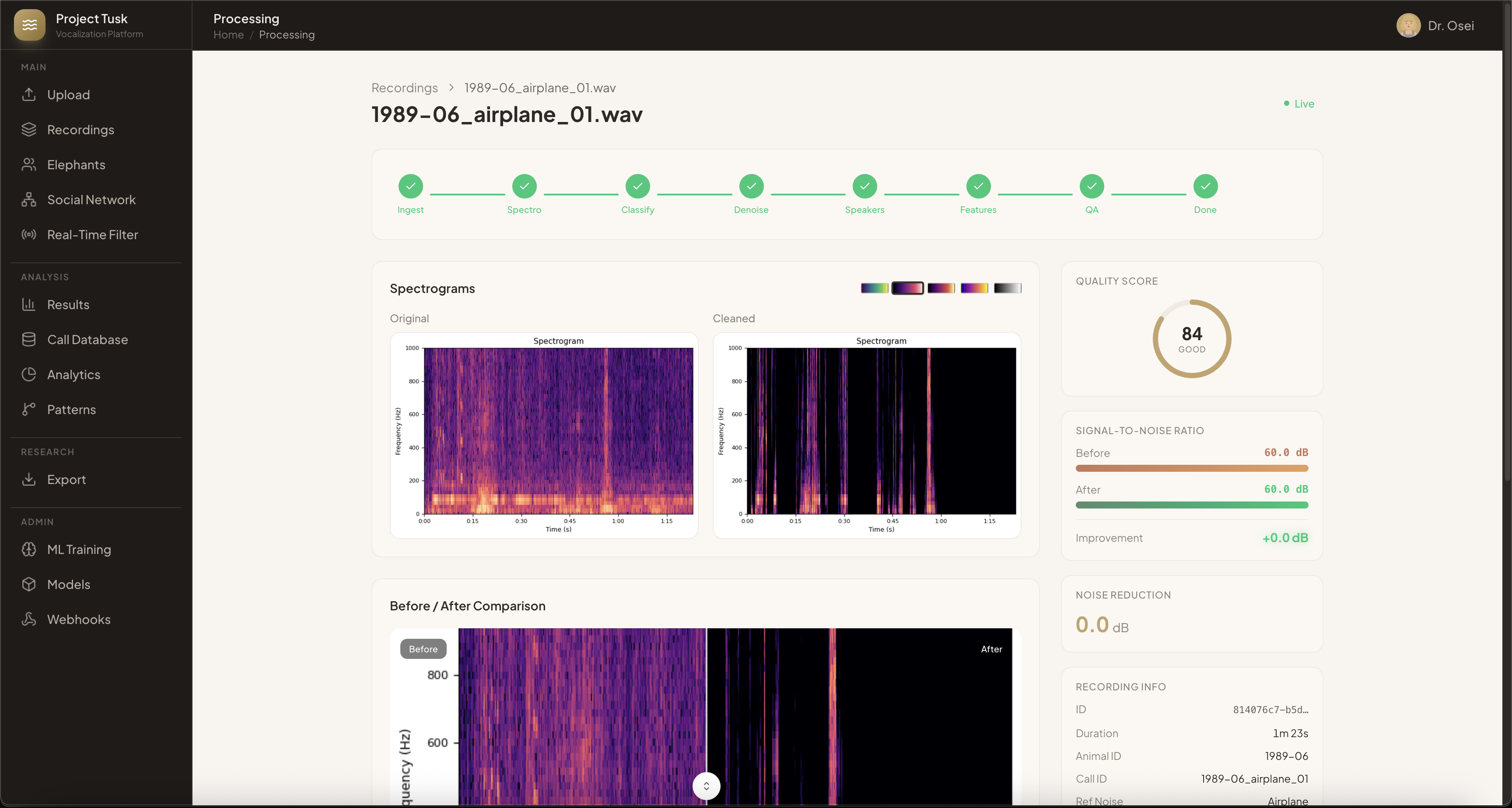
Spectogram
-
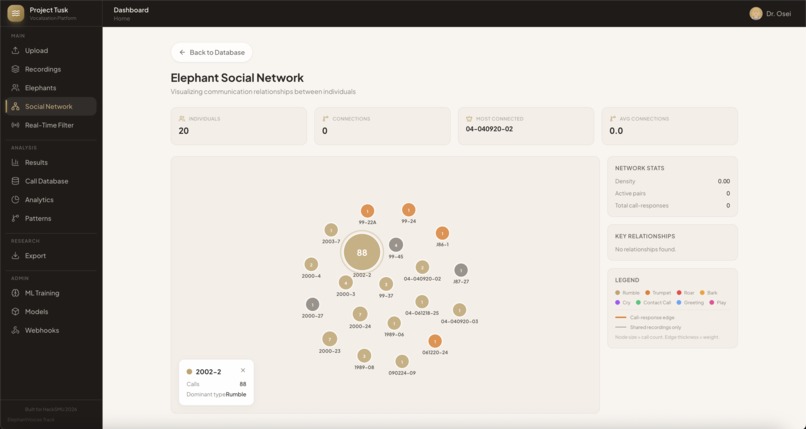
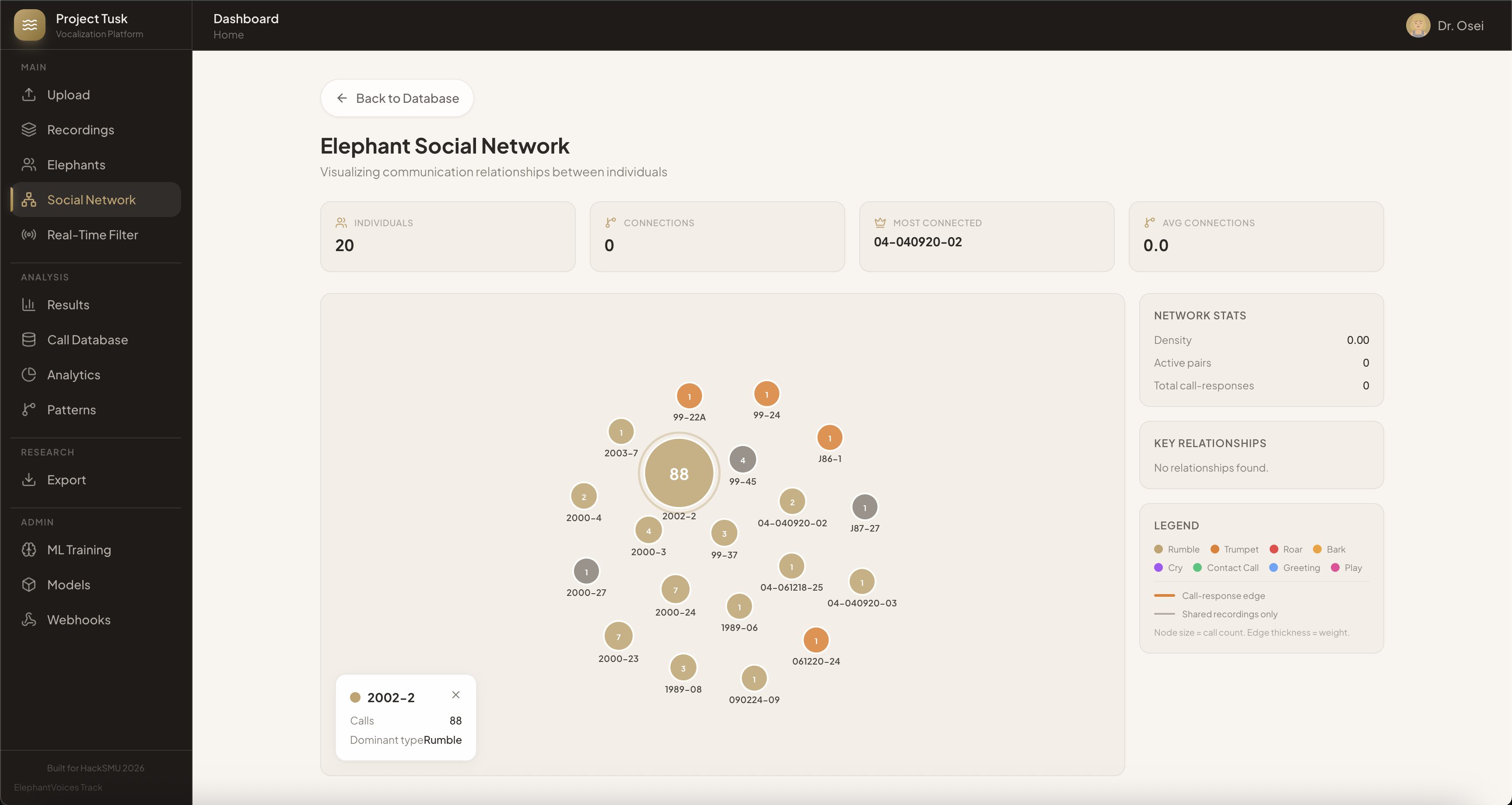
Elephant Social Network
-
-
landing page
-
Dashboard
-
Landing Page
-
Landing page
Project Tusk: The Elephants Were Talking. We Just Couldn't Hear Them.
Project Tusk doesn't fix elephant communication. It fixes our ability to listen to it. The signal was always there. We just buried it under airplane engines and generator hum and pretended that it was fine.
Inspiration
Picture this: a researcher treks into the Amboseli basin with a $3,000 recording rig. She sets it up at dusk. She waits. An elephant family passes within 40 meters, producing greeting calls, contact rumbles, and low-frequency coordination signals traveling through the ground itself. She gets it all on tape.
She gets home. She puts it into her DAW.
Underneath the elephants: a Cessna at 2,000 feet. A diesel generator 800 meters north. Wind across the mic at exactly the frequency range she needs.
Three months of fieldwork. Eighteen hours of recordings. Thirty percent of it is usable.
That's not an edge case. That's every researcher working in the field, everywhere, all the time.
We found out about this problem through ElephantVoices, the world's largest open repository of elephant vocalizations. They don't have a noise problem. They have thousands of noise problems stacked on top of each other, spanning decades of recordings that no one has the tools to clean systematically.
So we built the tools.
The Problem
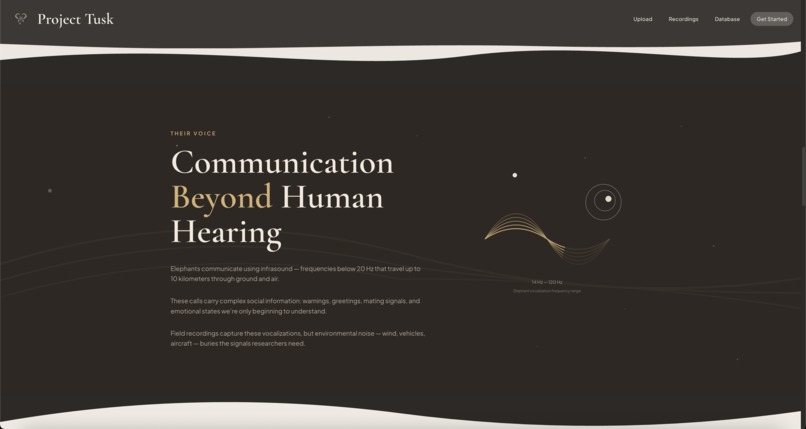
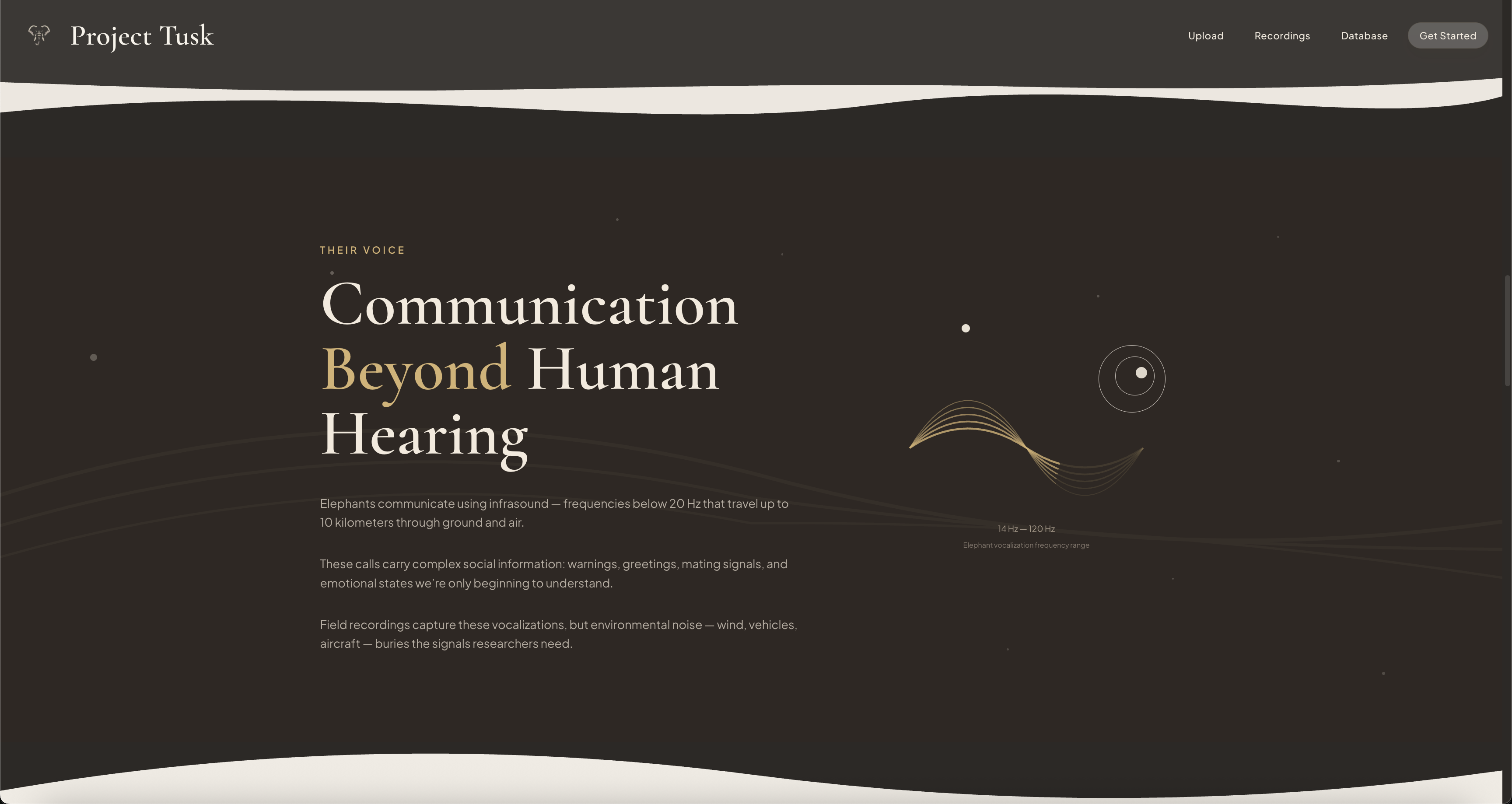
Elephants communicate in infrasound, frequencies below 20 Hz, inaudible to humans, capable of traveling 10 kilometers through the ground and air. These are full conversations: family reunions, danger warnings, migration coordination, grief.
We have been recording these conversations for 40 years and still can't fully read them. Not because the data doesn't exist. Because we can't isolate it.
- African elephants produce calls between 14 Hz and 9,000 Hz, spanning the full acoustic battleground where environmental noise lives
- Field recordings lose 30 to 70 percent of usable data to noise contamination depending on the site
- Existing noise removal tools are built for speech, not bioacoustics. They destroy the signal while removing noise
- The average research lab processes recordings by hand, one at a time, using tools designed for music production
Nobody built a bioacoustic pipeline for wildlife researchers. So we did.
What Project Tusk Does
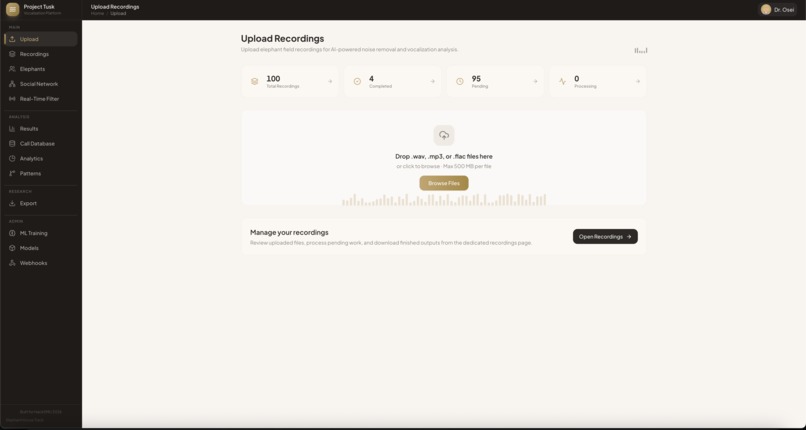
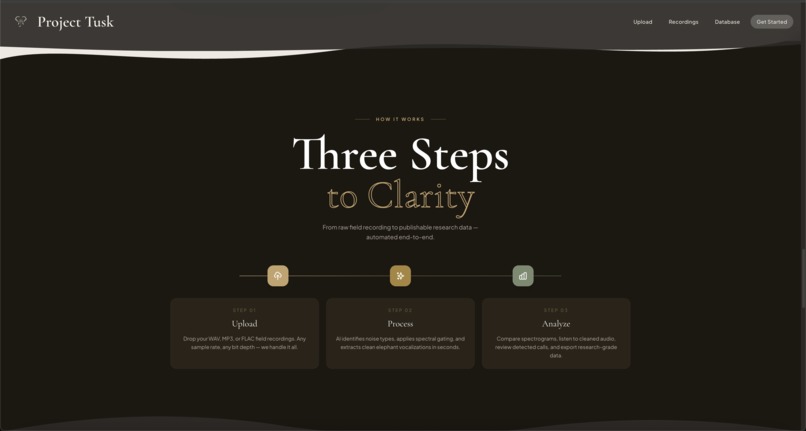
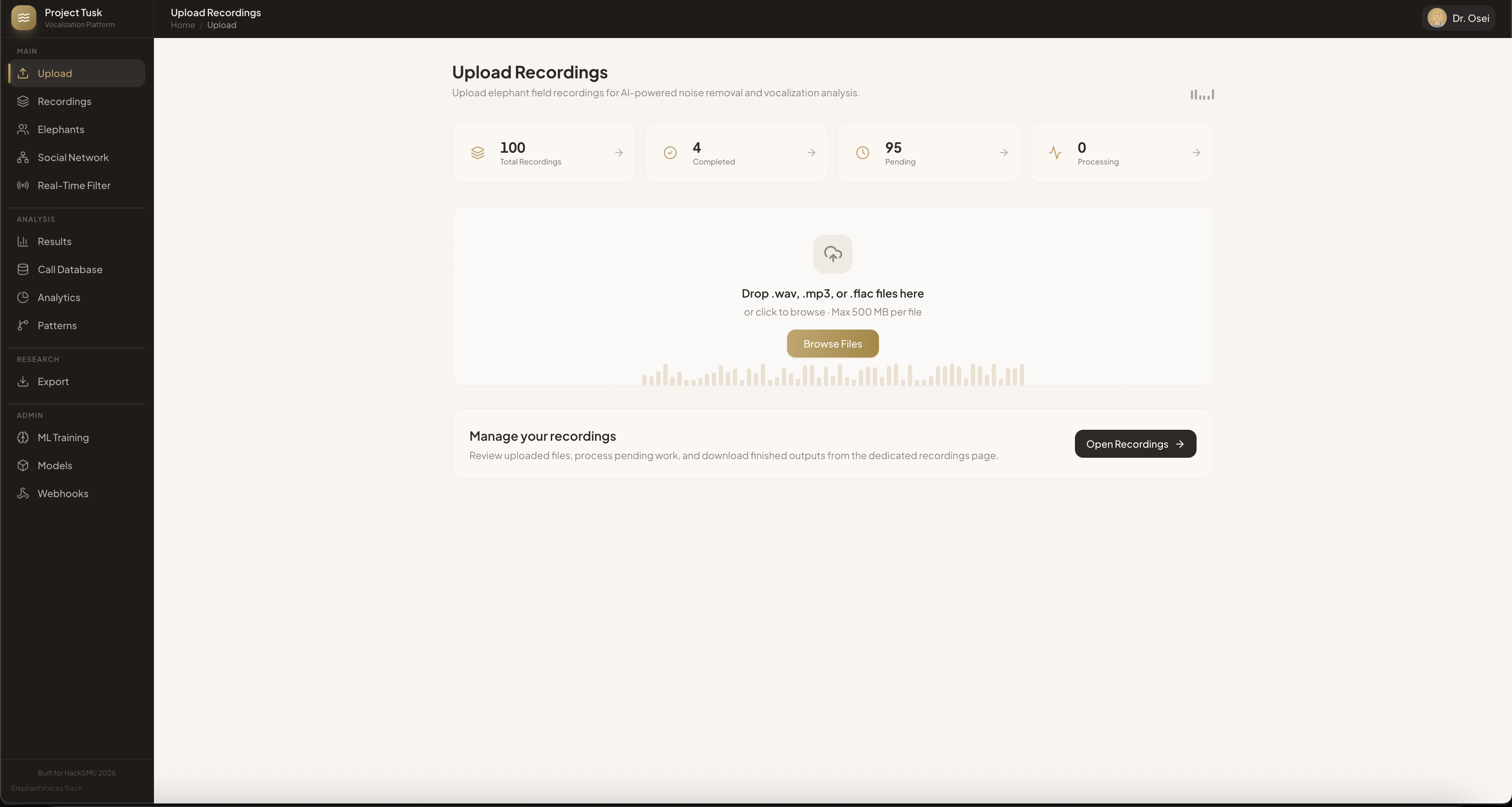
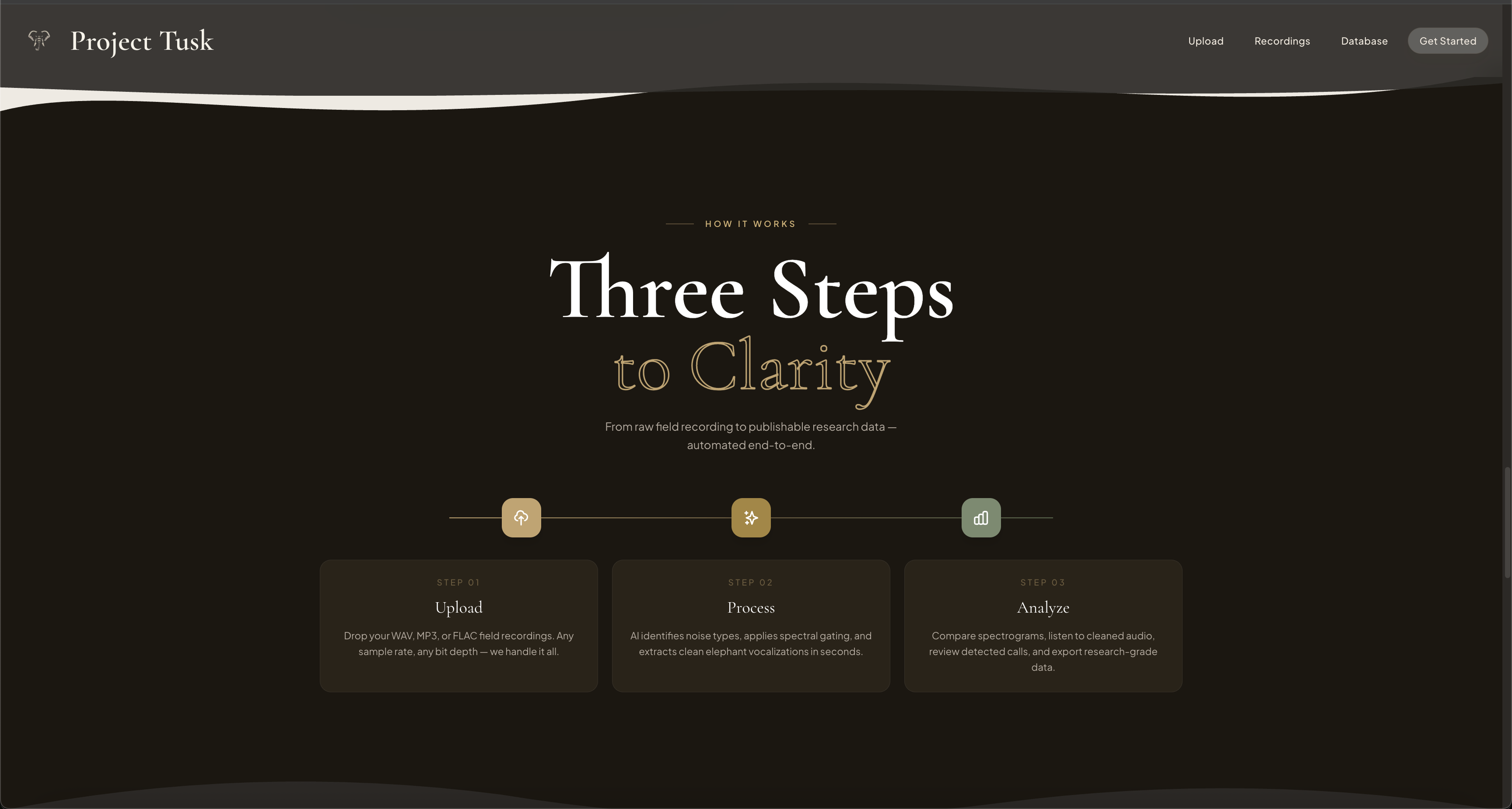
Project Tusk is an end-to-end bioacoustic analysis platform. You drag in a dirty field recording. You get back clean audio, labeled calls, acoustic measurements, and a research-ready export. All of it live.
Noise Removal
Upload WAV, MP3, or FLAC. Project Tusk runs spectral gating and Wiener filtering to identify and strip the exact frequency signatures of airplanes, vehicles, generators, and wind while leaving elephant vocalizations intact. A before and after spectrogram slider shows exactly what was removed.
Acoustic Analysis
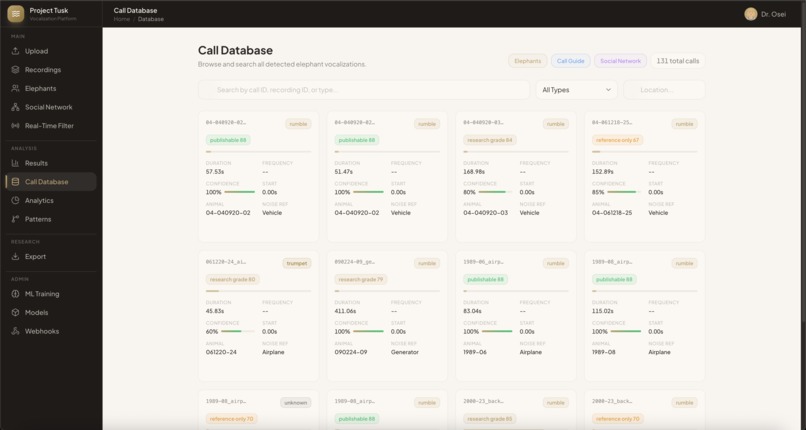
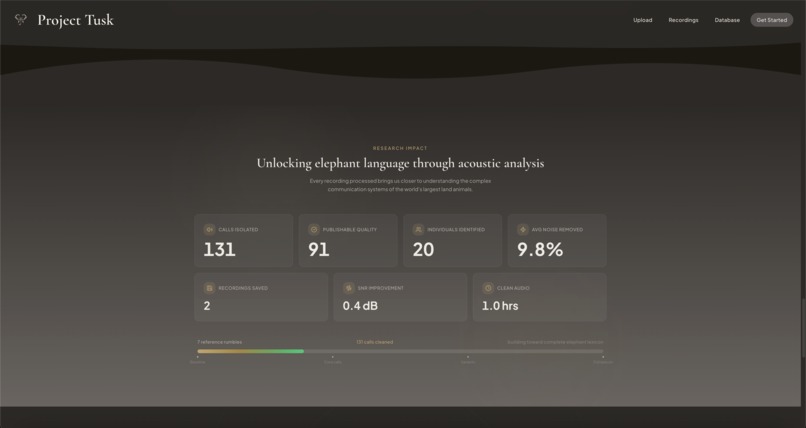
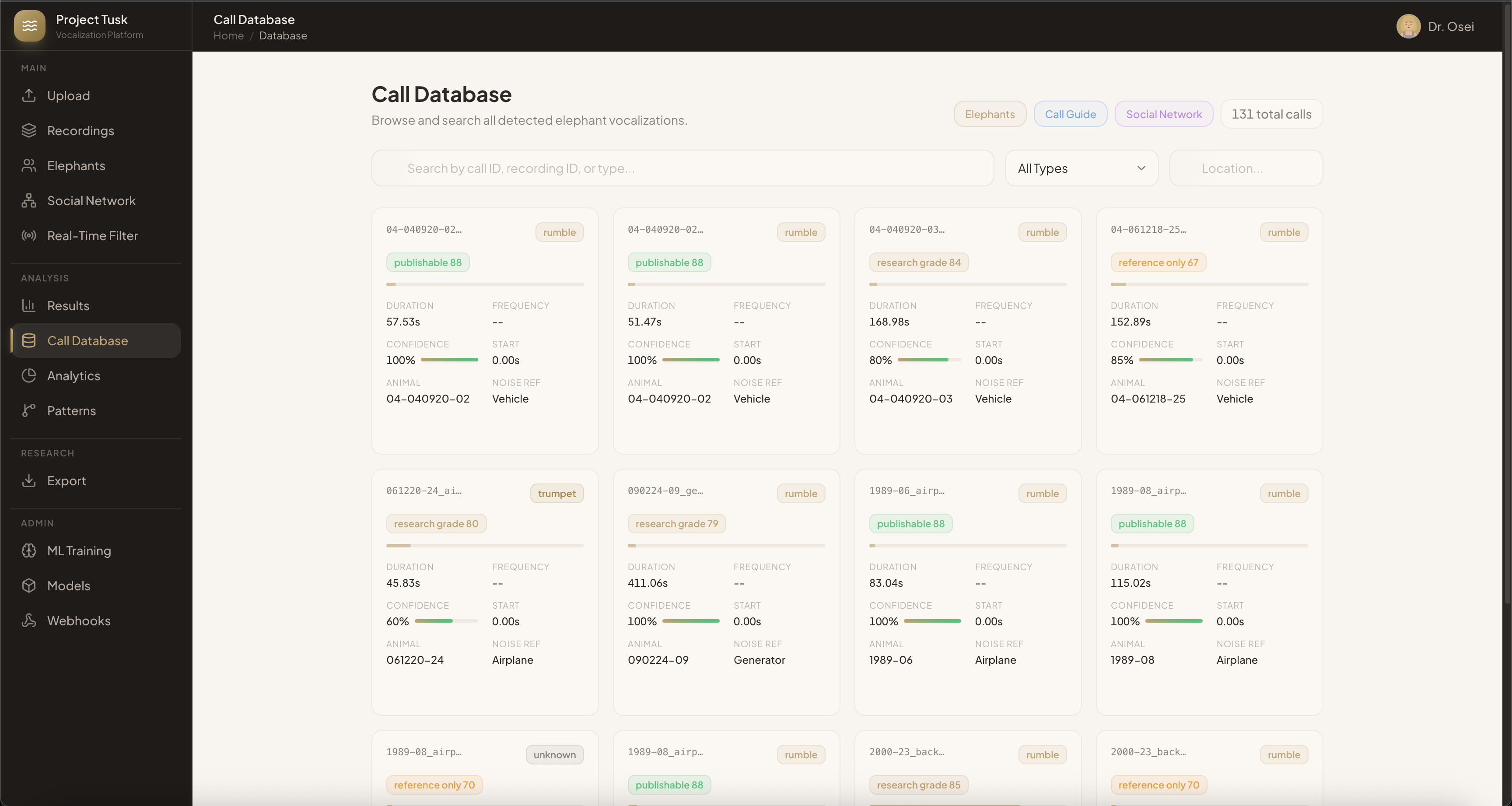
Every detected call gets profiled across 12 acoustic metrics: fundamental frequency, harmonicity, bandwidth, spectral centroid, zero-crossing rate, SNR, and more. The 13 MFCC coefficients create a 75-dimensional voice fingerprint unique to each animal.
AI Classification
A trained Random Forest classifier identifies call types such as rumble, trumpet, roar, contact call, greeting, and distress cry with confidence scores. Low-confidence calls are flagged for researcher review, and corrections feed back into retraining.
3D Globe Interface
Every processed recording appears on an interactive Three.js globe at its recording location. Click a site, hear the calls, and view the waveform.
Research Export
Export results as CSV, JSON, or ZIP. Structured and ready for Excel, R, or Python.
How We Built It
Three people. One weekend.
Frontend
Next.js 14 with TypeScript and Tailwind Three.js and React Three Fiber for the globe GSAP for animations wavesurfer.js for waveform playback
Backend
Python FastAPI running async on Uvicorn librosa for audio processing and MFCC extraction noisereduce for spectral gating scipy for Wiener filtering soundfile for output scikit-learn for the classifier
Real-Time Pipeline
WebSocket connection streams updates stage by stage: ingestion, spectrogram, noise classification, denoising, feature extraction, call detection, and quality check.
Challenges We Ran Into
Separating infrasound from environmental noise is difficult. Airplanes and elephant rumbles overlap in frequency. Too aggressive removes the signal. Too gentle leaves noise.
The 3D globe and real-time processing competed for CPU resources.
STFT window size tuning took significant time.
Accomplishments We're Proud Of
Existing tools are either generic audio plugins or expensive proprietary systems.
Project Tusk is the first open platform that takes a raw elephant recording and outputs clean audio, structured data, and a learning classifier in one pipeline.
The spectrogram comparison slider clearly shows noise removal while preserving signal.
What We Learned
Bioacoustics has lacked modern software for decades.
Signal processing is the core. Machine learning is only one part.
Three.js adds complexity but enhances the experience.
What's Next for Project Tusk
Multi-species support for whales, wolves, bats, and more
Integration with large datasets like ElephantVoices
Individual animal identification using voice fingerprints
Offline field deployment for remote environments
Built in 48 hours. Needed for far longer.
Built With
- auth0
- gemini
- globegl
- json
- librosa
- nextjs
- python
- react
- scikit
- scikit-learn
- scipy
- sqlite
- typescript
- webgl


Log in or sign up for Devpost to join the conversation.