-
-
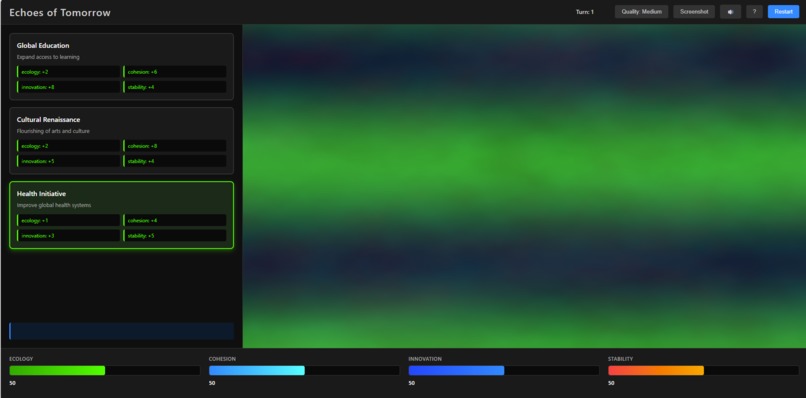
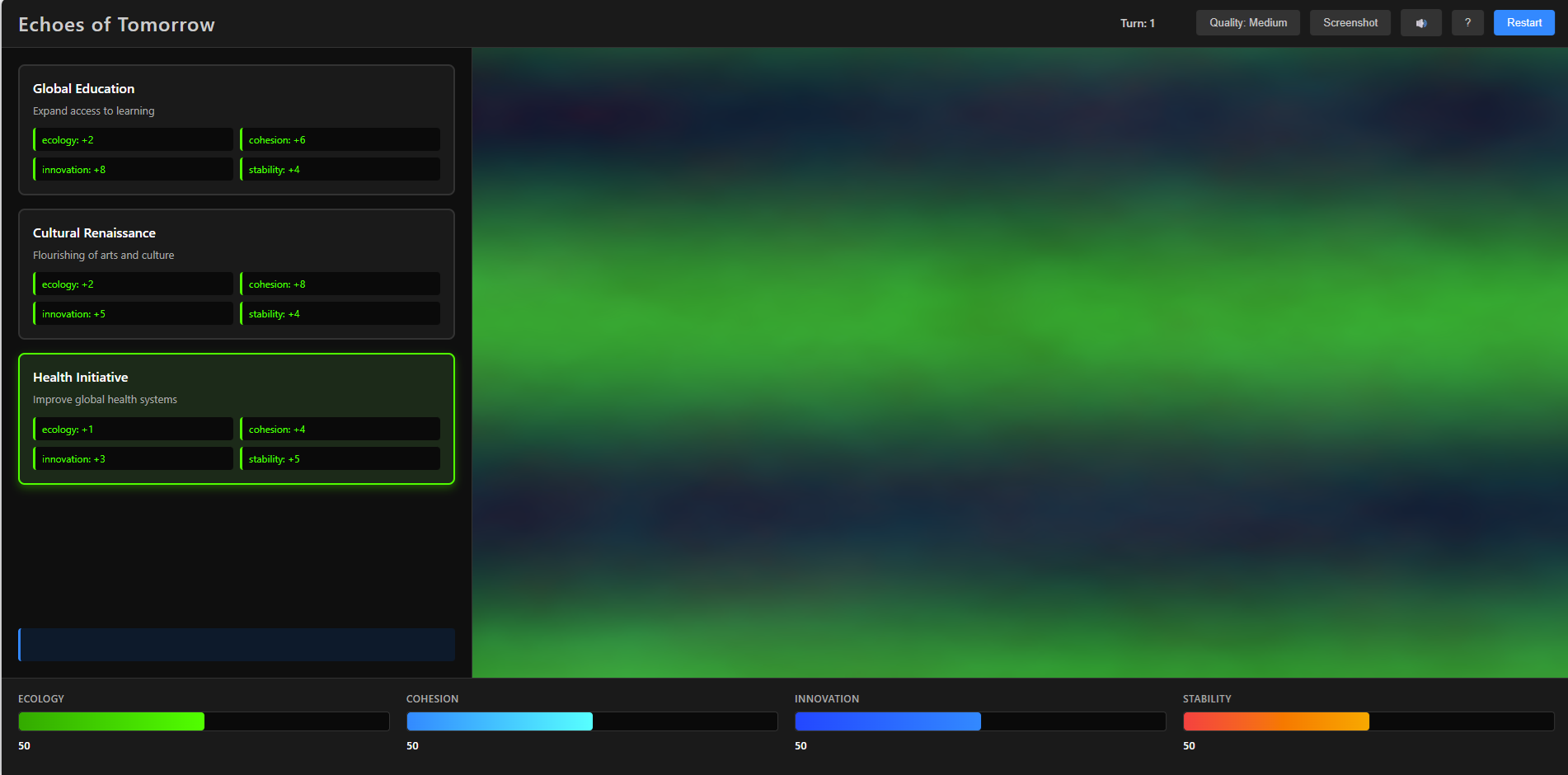
Start strategical thinking...
-
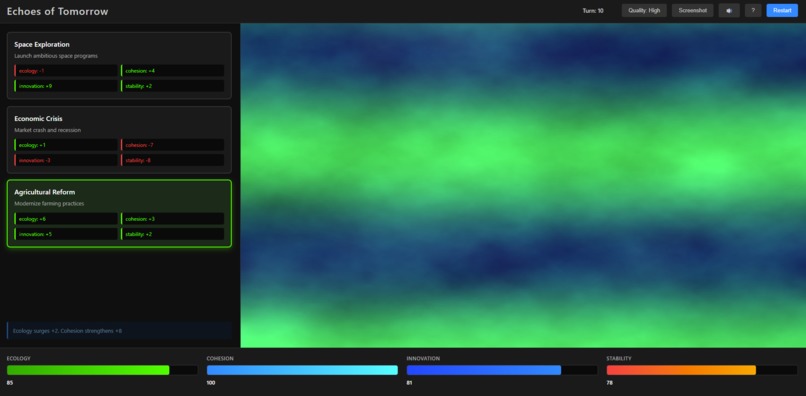
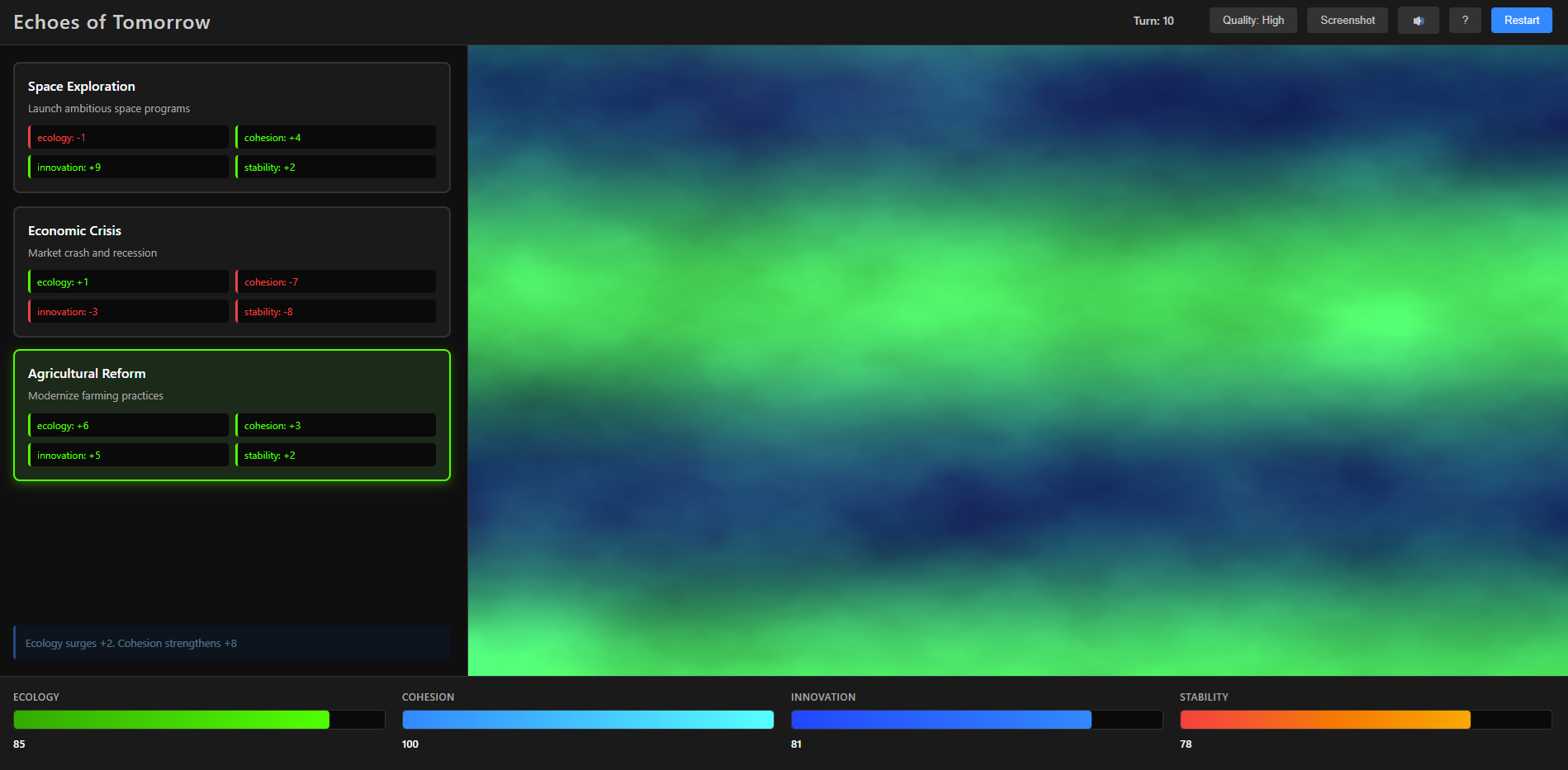
Keep on going with smart decisions..
-
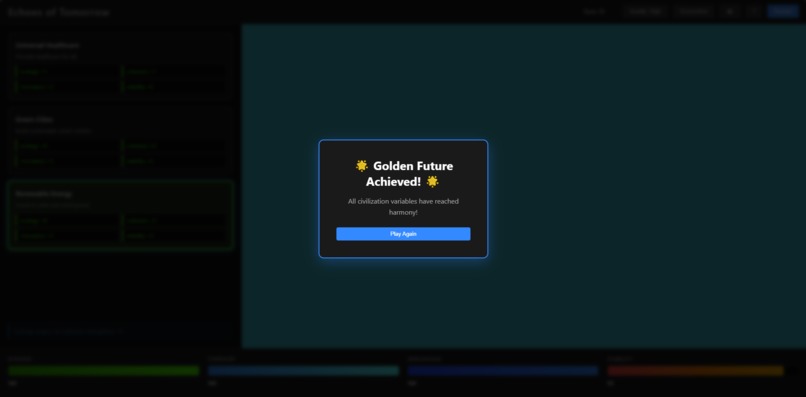
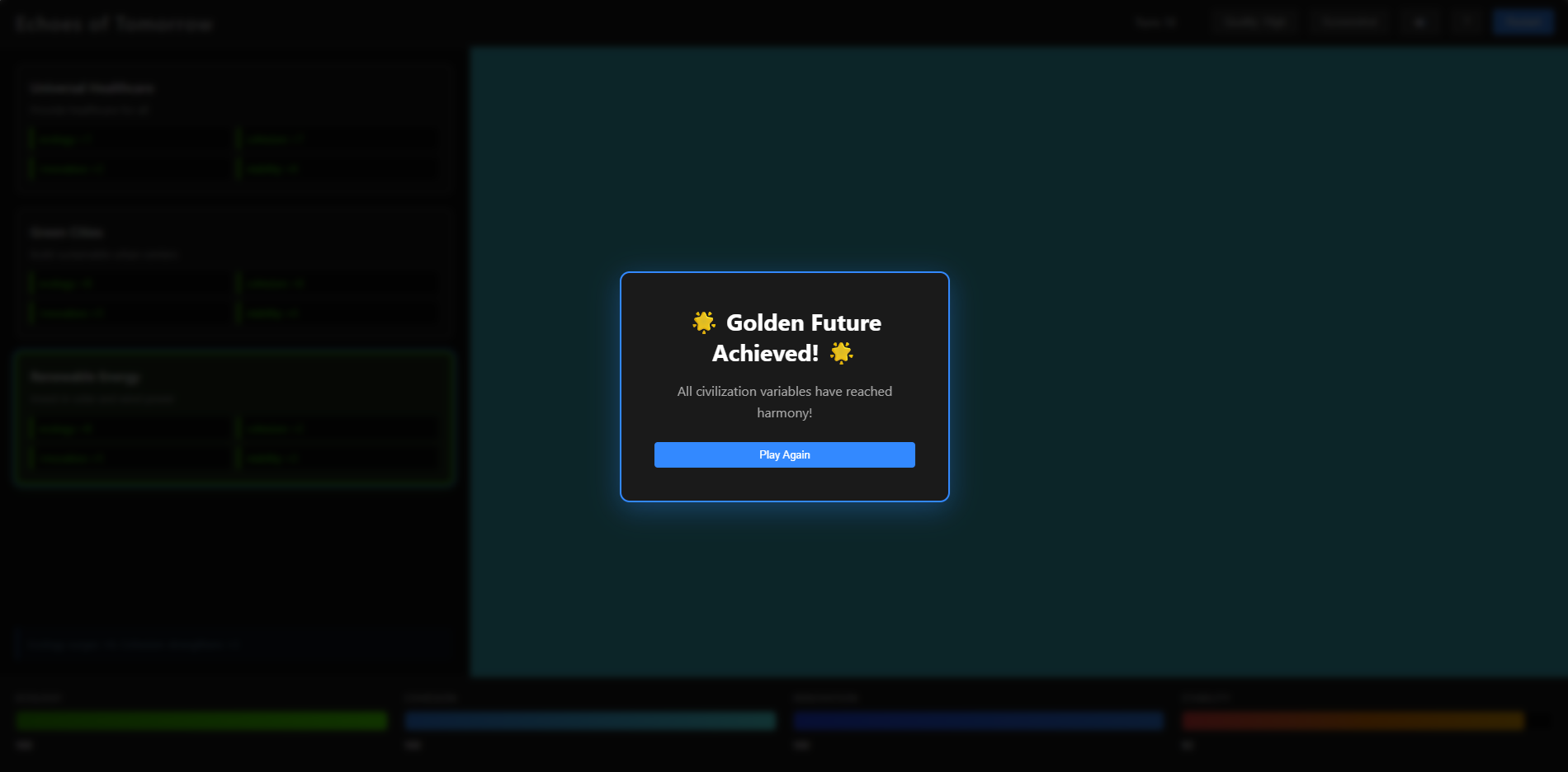
Victory! Sustainable Golden Future achieved!
-
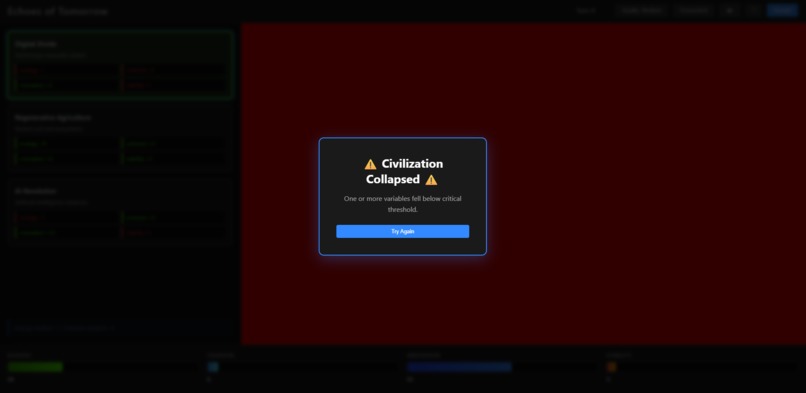
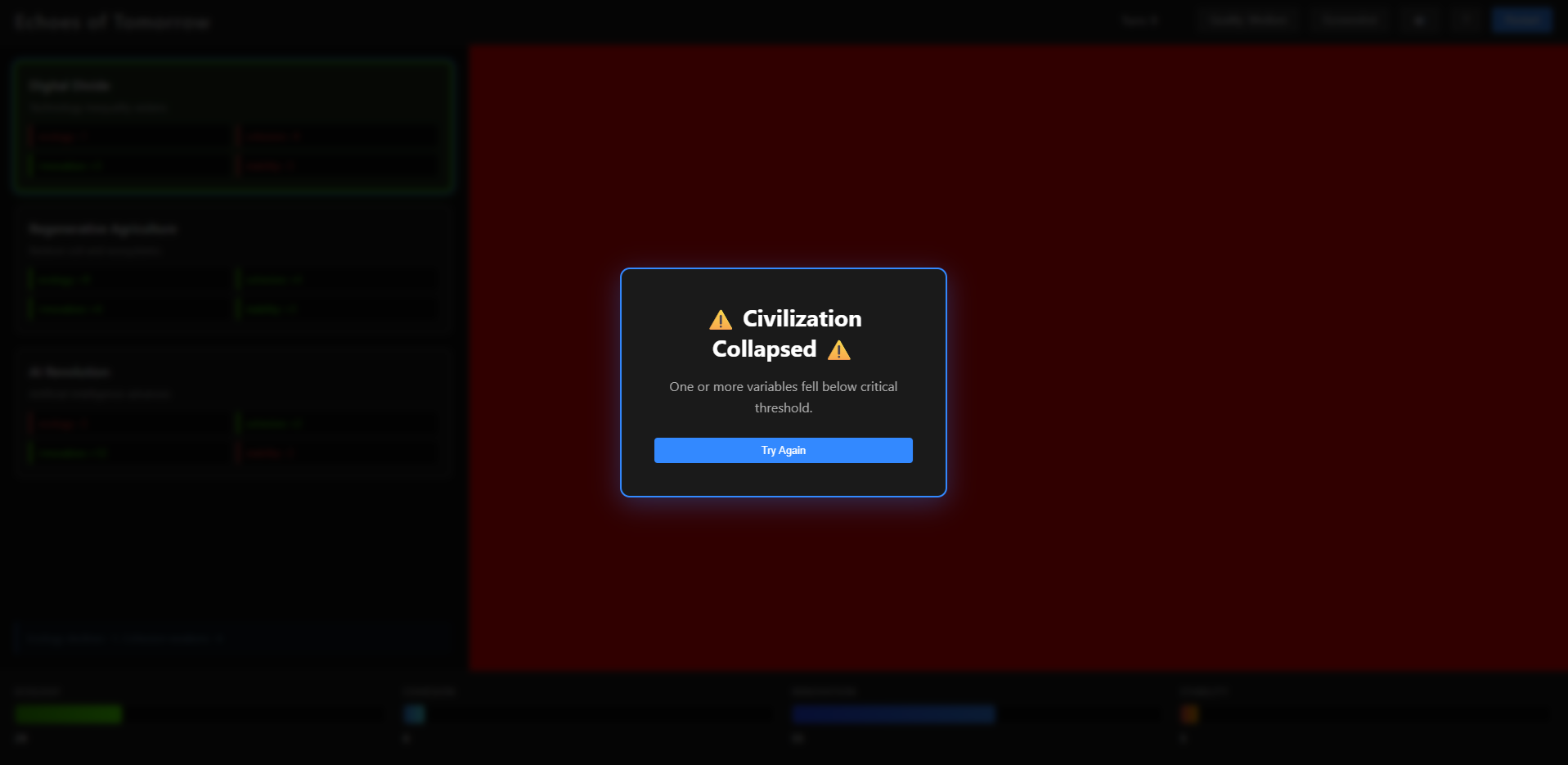
Oops... Seems like you have lost...
Inspiration
Climate change issues and sustainable development goals have very little or almost no representation in modern game development industry. These problems are often out of focus of game developers. Therefore, I felt that my mission, as a scientist in this field, is to provide fascinating game experience to push current environmental concerns to a broad audience, and make people aware of global challenges related to climate change and irrational environmental usage.
As the time span for development was quite limited, the idea for Echoes of Tomorrow was born from a simple challenge: How can we portray the fate of an entire civilization without any characters, artwork, or complex assets?
Instead of traditional visuals, the game draws inspiration from the way real-world systems - ecosystems, societies, technologies - can be understood through patterns, signals, and the forces that shape them. Climate change, social stability, scientific progress, and human resilience all leave "echoes" that can be seen long before they are felt.
This led to a unique concept: a future visualized not through images, but through living abstract patterns. Waves become ecological stability, networks become social cohesion, fractals become innovation, and red noise reflects collapse. By sending choices back in time, the player interacts directly with these signals, guiding a procedural world that reacts like a breathing organism.
The game is inspired by system thinking, minimalism, and the idea that even small actions ripple across decades. With zero pre-made assets and fully generative visuals, Echoes of Tomorrow aims to make players feel the beauty, fragility, and responsibility of shaping the future - one decision at a time.
What it does
Echoes of Tomorrow is a strategic card-based game where players assume the role of the Future, sending Echo Cards back in time to guide civilization toward victory or away from collapse. Players manage four interconnected variables - Ecology, Cohesion, Innovation, and Stability - by selecting from three unique cards each turn. The game features:
- Strategic Depth: 30+ Echo Cards with varied effects and risk/reward tradeoffs (e.g., Tech Breakthrough boosts Innovation but harms Ecology)
- Dynamic Visualization: A procedurally-generated "Time Mirror" that evolves in real-time based on civilization state, with no external assets
- Victory & Collapse States: Win by maintaining all variables ≥80 for five consecutive turns; lose if any drops to ≤5
- Accessibility: Full keyboard controls, responsive design, quality mode toggle, and optional procedural audio
How we built it
Echoes of Tomorrow is a lightweight web project using modern JavaScript, Three.js for rendering, and a custom GLSL fragment shader to generate all visuals procedurally. The project is split into small, focused modules to keep things clean and easy to maintain:
- sim.js handles the game state, applies card effects, and checks for win or collapse conditions.
- ui.js manages everything the player interacts with - cards, meters, and short system messages.
- visuals.js drives the graphics: the Three.js scene, shader settings, and smooth transitions between states.
- **app.js88 ties the pieces together and runs the main loop.
- fragment.glsl contains the core visual logic - layered noise, waveforms, network lines, and fractal patterns that change as the world evolves.
- index.html is an entering point of the game.
Each of the four variables influences the visual field directly: Ecology shapes the green waveforms, Cohesion strengthens or breaks the node networks, Innovation adds blue fractal detail, and Stability keeps red noise in check. Reaching a stable future or triggering collapse produces distinct animated shifts in the shader.
Challenges we ran into
There were several major challenges related to the game development:
- Card Balance: Designing 30+ cards with meaningful tradeoffs that create strategic depth without being overwhelming required extensive playtesting and iteration.
- Responsive Design: Making the 30/70 layout (card panel / visualization) work seamlessly on mobile while maintaining visual impact was not the simplest task.
Accomplishments that we're proud of
- Zero External Assets: The entire game is procedurally generated - no images, no pre-rendered graphics. Everything is computed in real-time.
- Science behind the Game: The game is not only fun, it has an educational value and is based on scientific foundation to provide the estimation of each game Card impact on the Future.
- Accessibility: Full keyboard controls, semantic HTML, WCAG AA color contrast, and responsive design make it playable for everyone.
- Replayability: Procedural card selection and variable interactions ensure no two games feel identical.
What we learned
During the game development I learnt that:
- Constraints Drive Creativity: Time limits pushed me to build the game with no external assets, but to find minimal solutions that work.
- Game Balance is Hard: Creating meaningful strategic choices requires careful tuning and playtesting so that provide the balanced game.
What's next for Echoes of Tomorrow
There are many ways to improve Echoes of Tomorrow. If the game is a success, I will probably add such features as:
- Connection to DB: This will ensure sign-in/log-in functionality for players, and tracking their in-game performance through the Leaderboard.
- Multiplayer Mode: Competitive and cooperative playing modes.
- Procedural Card Generation: Dynamic Cards creation based on game state for even better replayability.
- Mobile App: Package native apps for iOS and Android so that the players could use a single player mode even without internet connection.
- Modding Support and Blockchain: Allow players to create custom Cards and own them as NFTs holding on Solana wallets.
- Analytics: Enable players to track their decisions and variable trajectories to understand the most effective strategies.


Log in or sign up for Devpost to join the conversation.