Inspiration
The inspiration behind Echoes of the Dark comes from a simple question: What if you were trapped in a world where you couldn't see your surroundings, and sound was your only way to discover the truth?
I wanted to create something more than a traditional adventure game. I imagined a mysterious underground civilization filled with forgotten temples, hidden pathways, ancient mechanisms, and secrets waiting to be discovered.
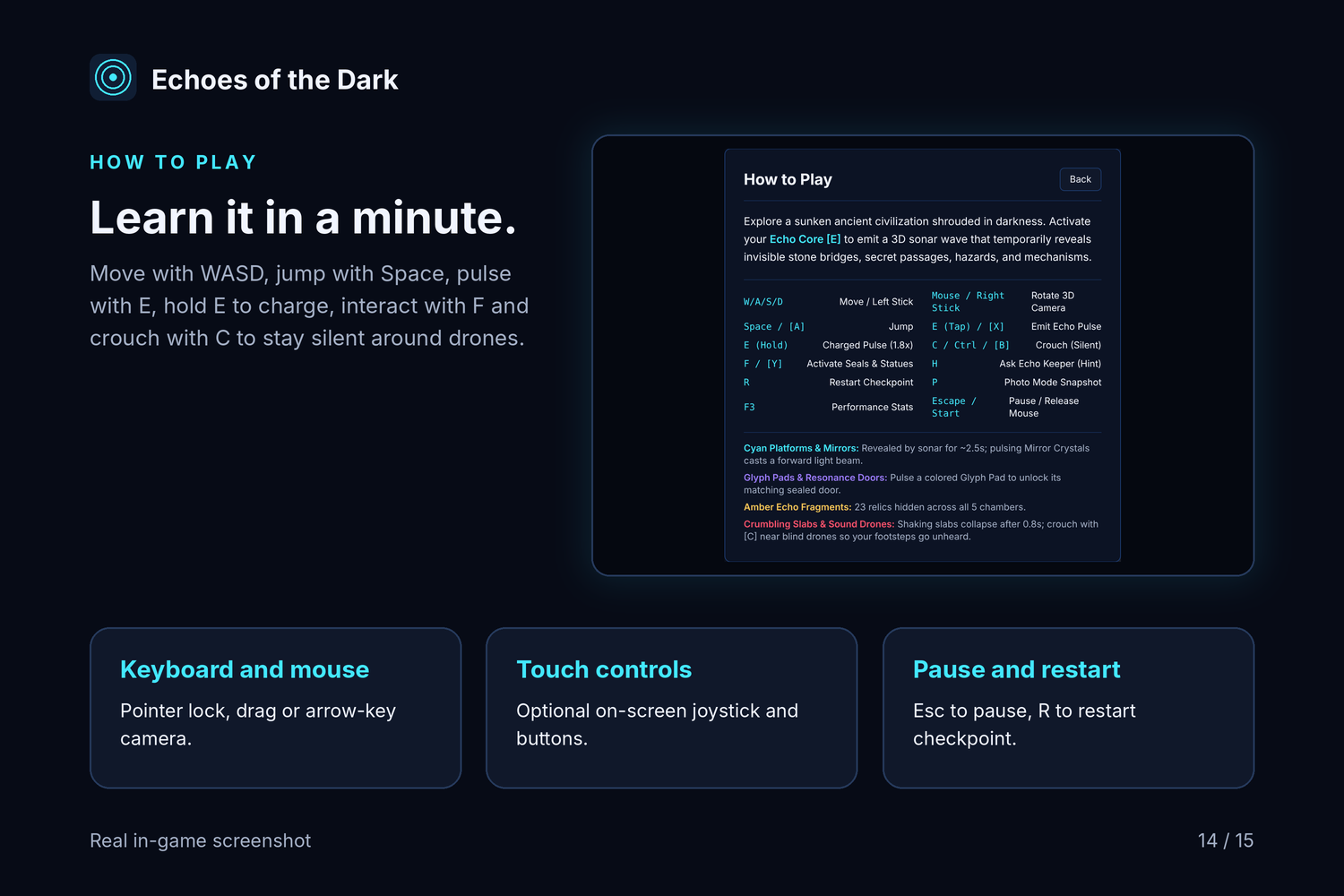
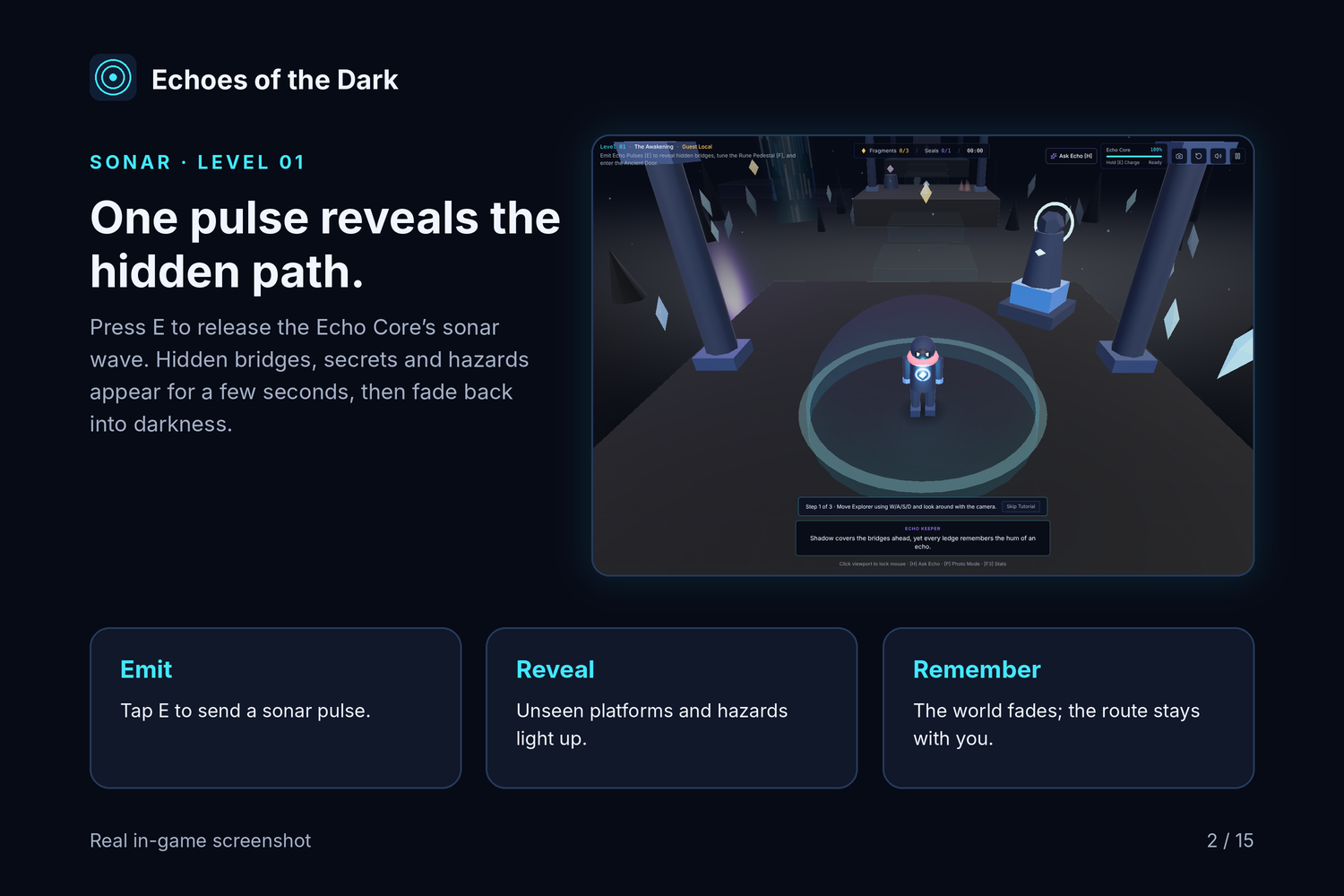
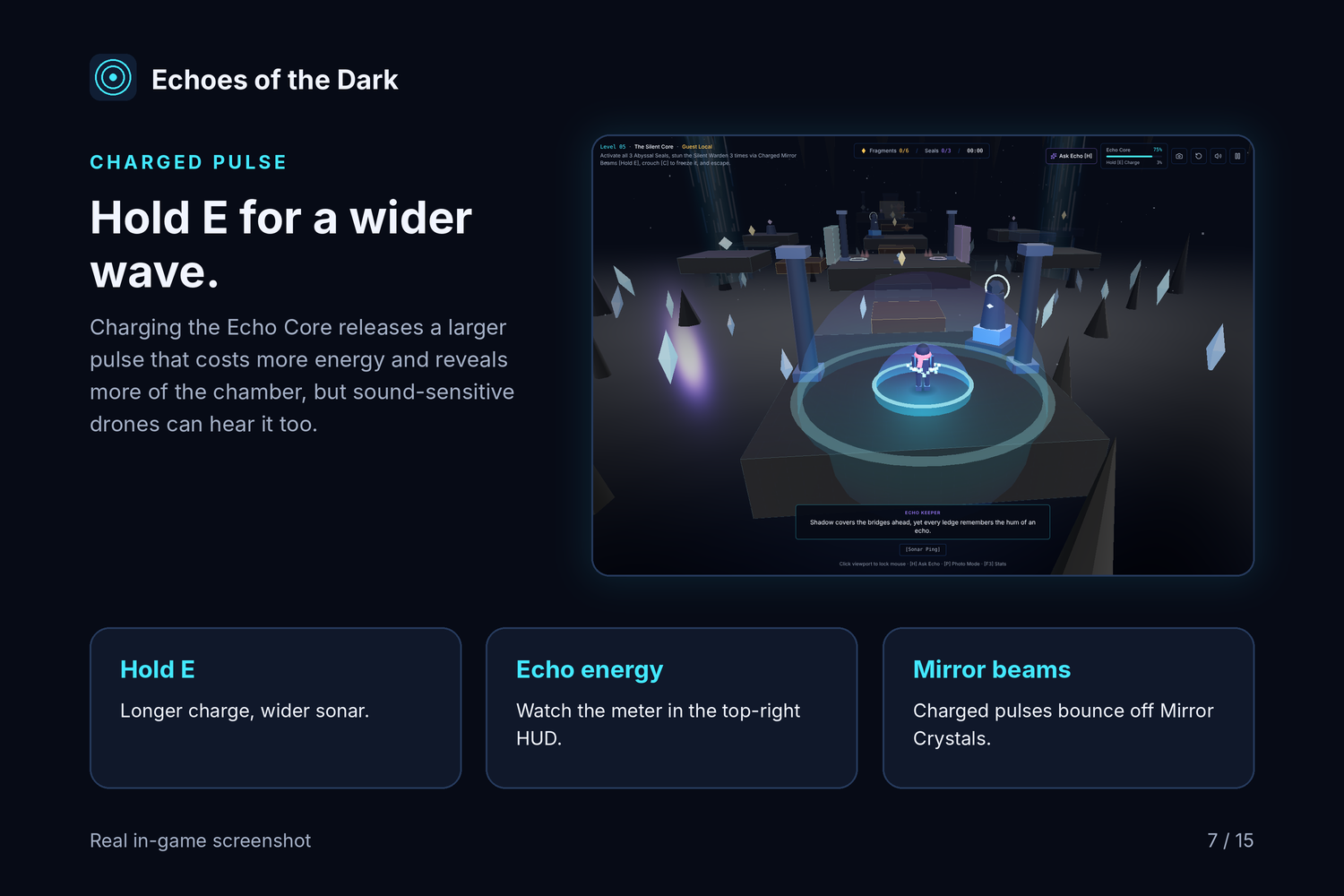
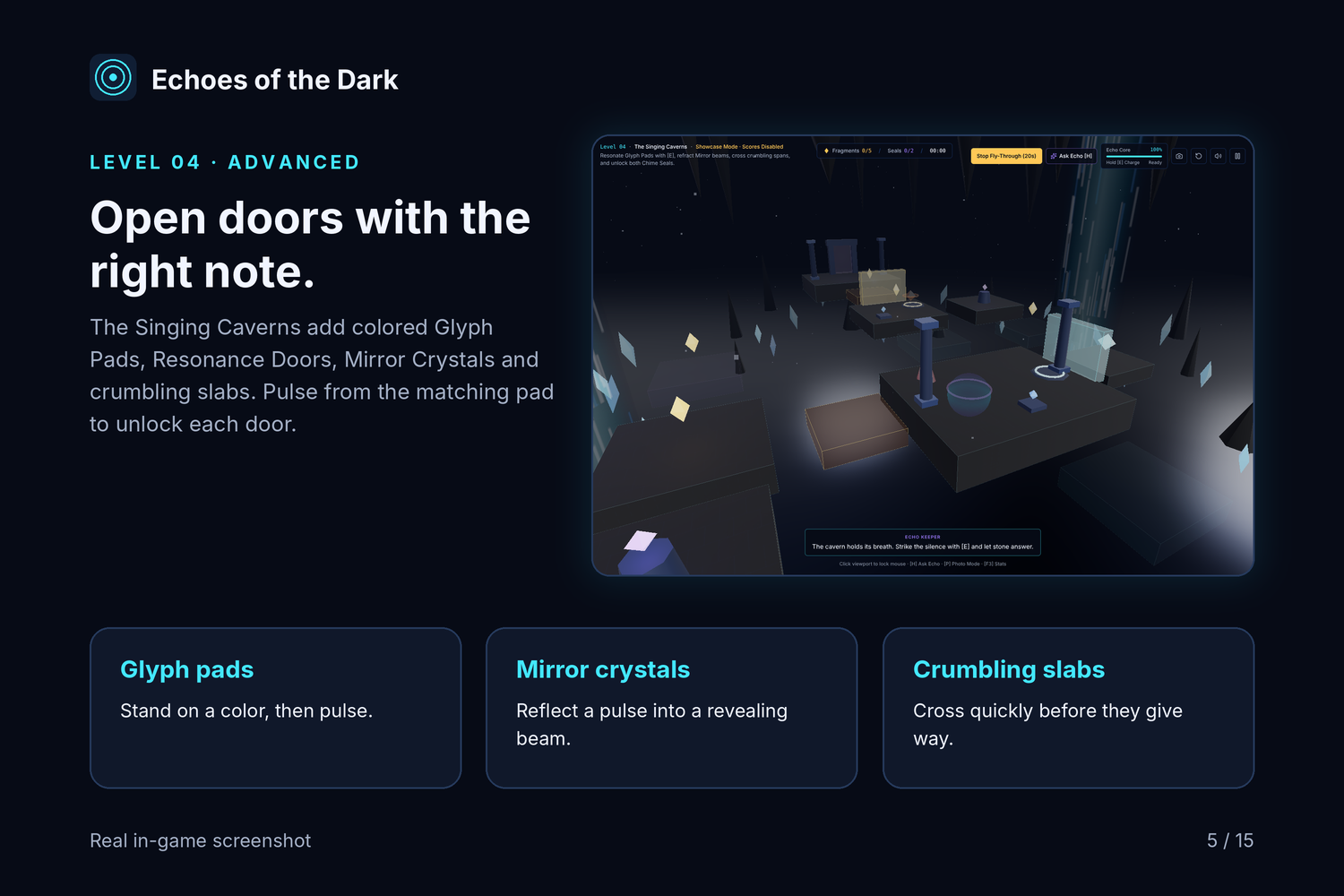
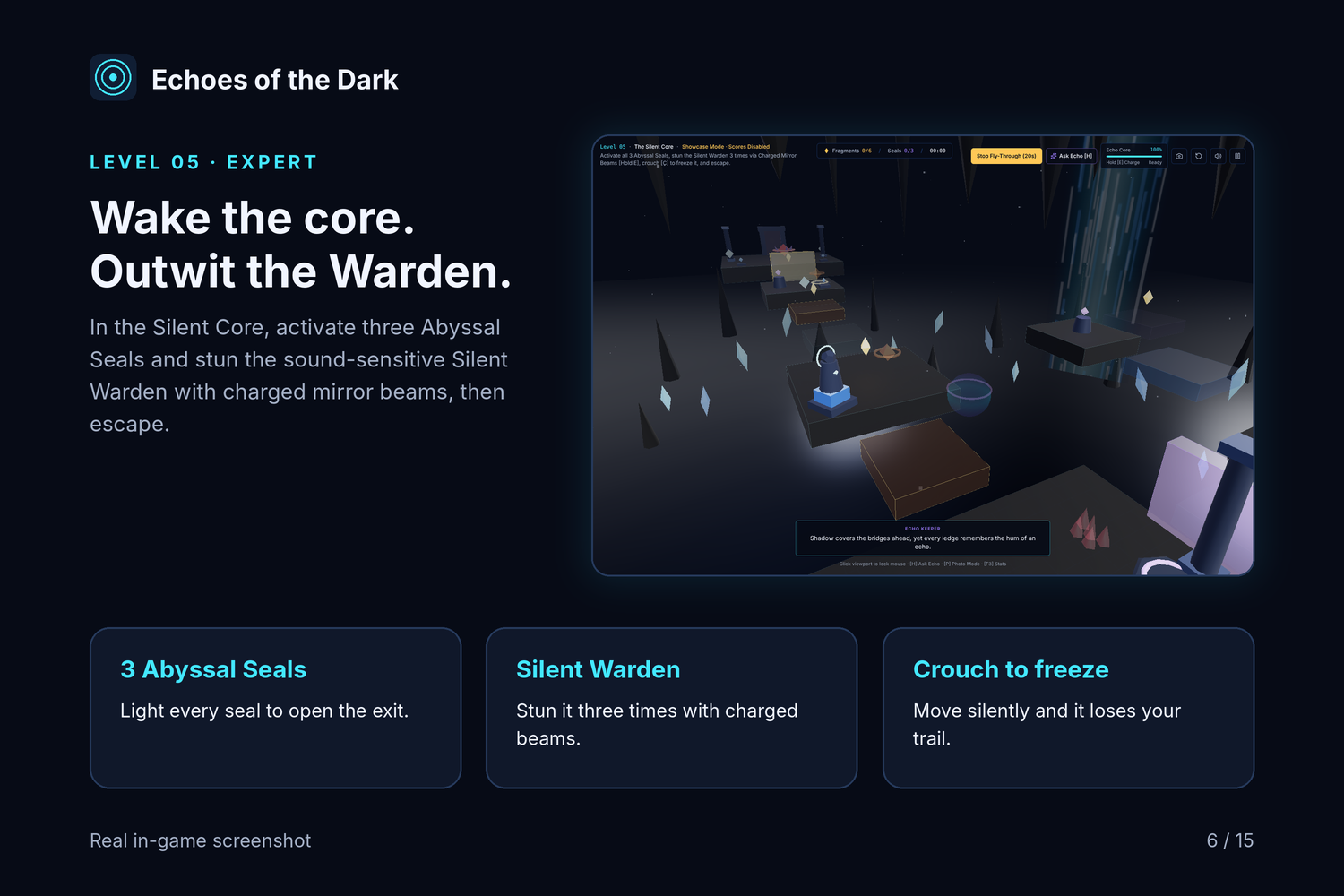
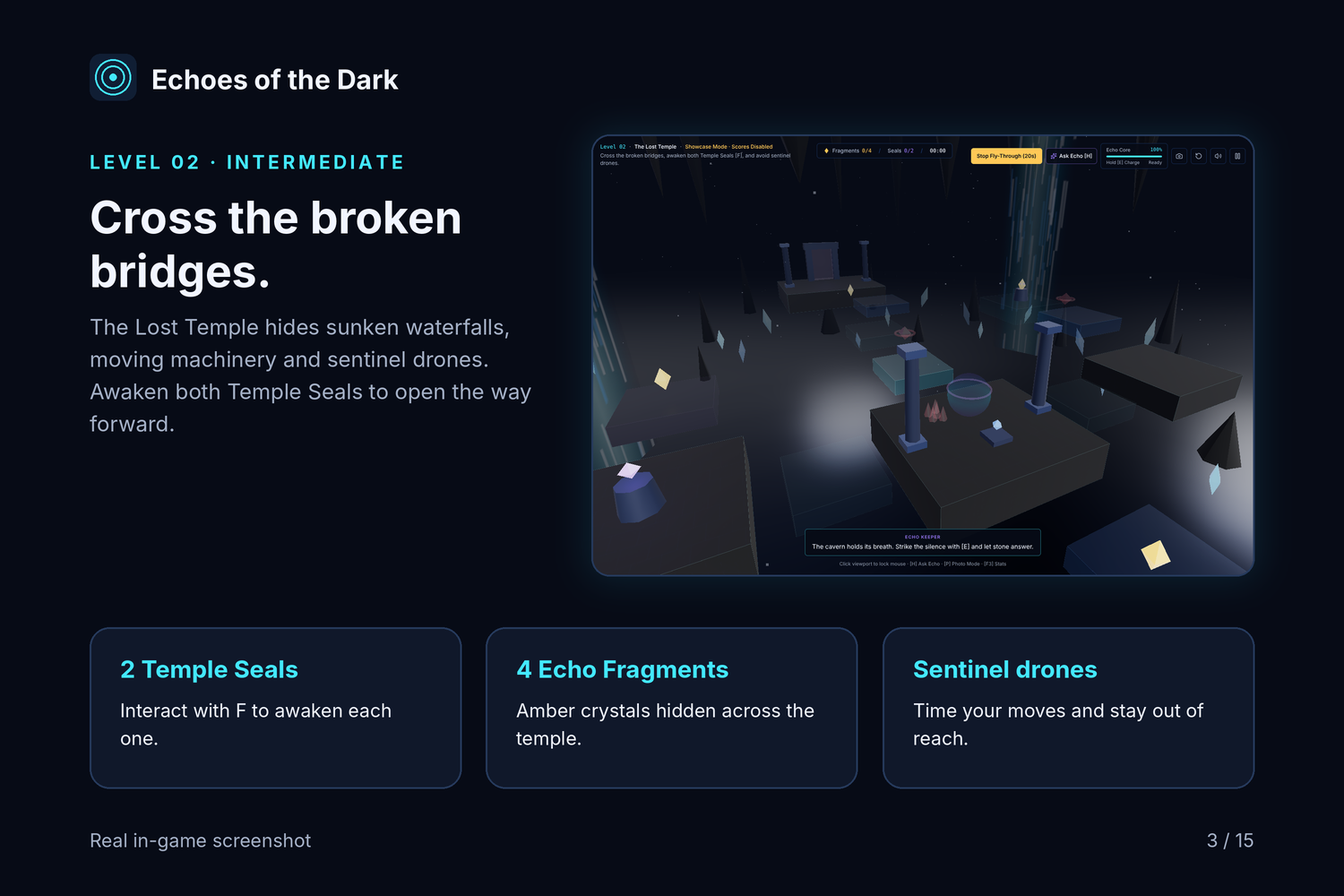
This idea inspired the Echo Pulse mechanic — an ability that allows players to send out a sonar wave and temporarily reveal the world around them.
My goal is to create an immersive experience where exploration, curiosity, observation, and problem-solving are more important than simply moving forward.
What it does
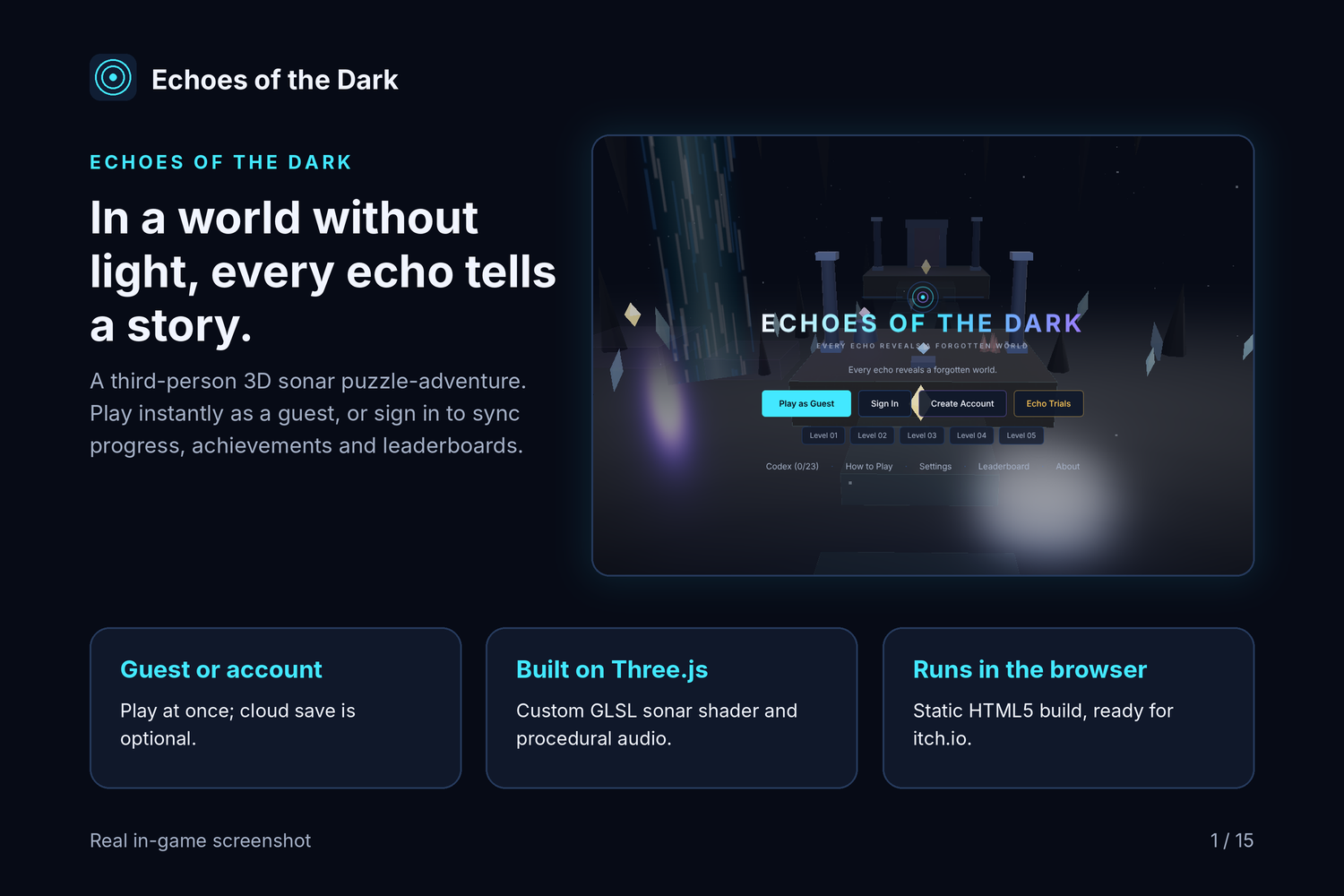
Echoes of the Dark is an atmospheric 3D puzzle-adventure game designed for browser-based gameplay.
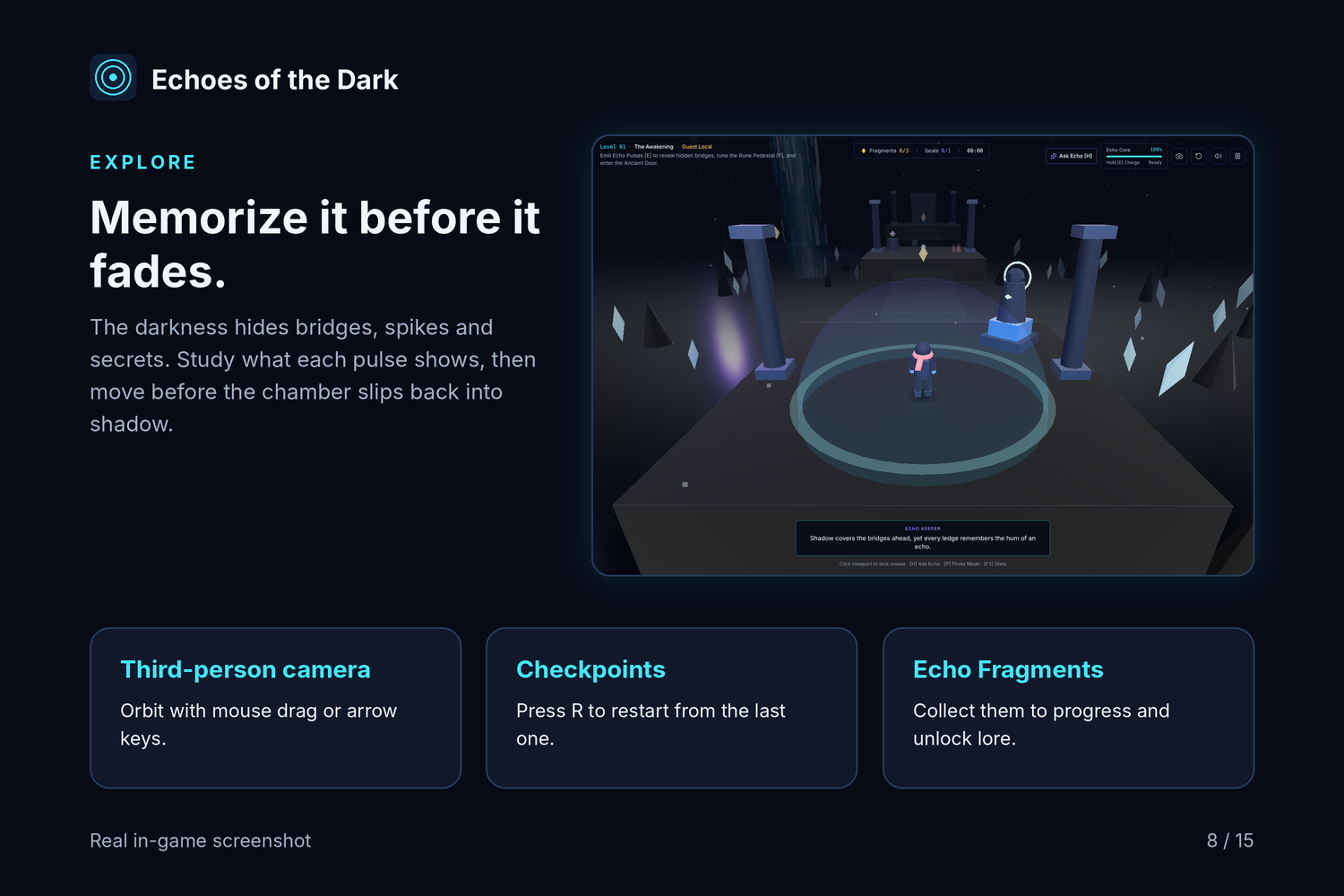
Players take the role of a young explorer navigating a mysterious underground world covered in darkness.
The central gameplay mechanic is the Echo Pulse. By activating this ability, players can temporarily reveal:
- Hidden platforms and pathways.
- Dangerous obstacles and environmental hazards.
- Secret objects and collectibles.
- Ancient symbols and interactive mechanisms.
- Routes leading to unexplored areas.
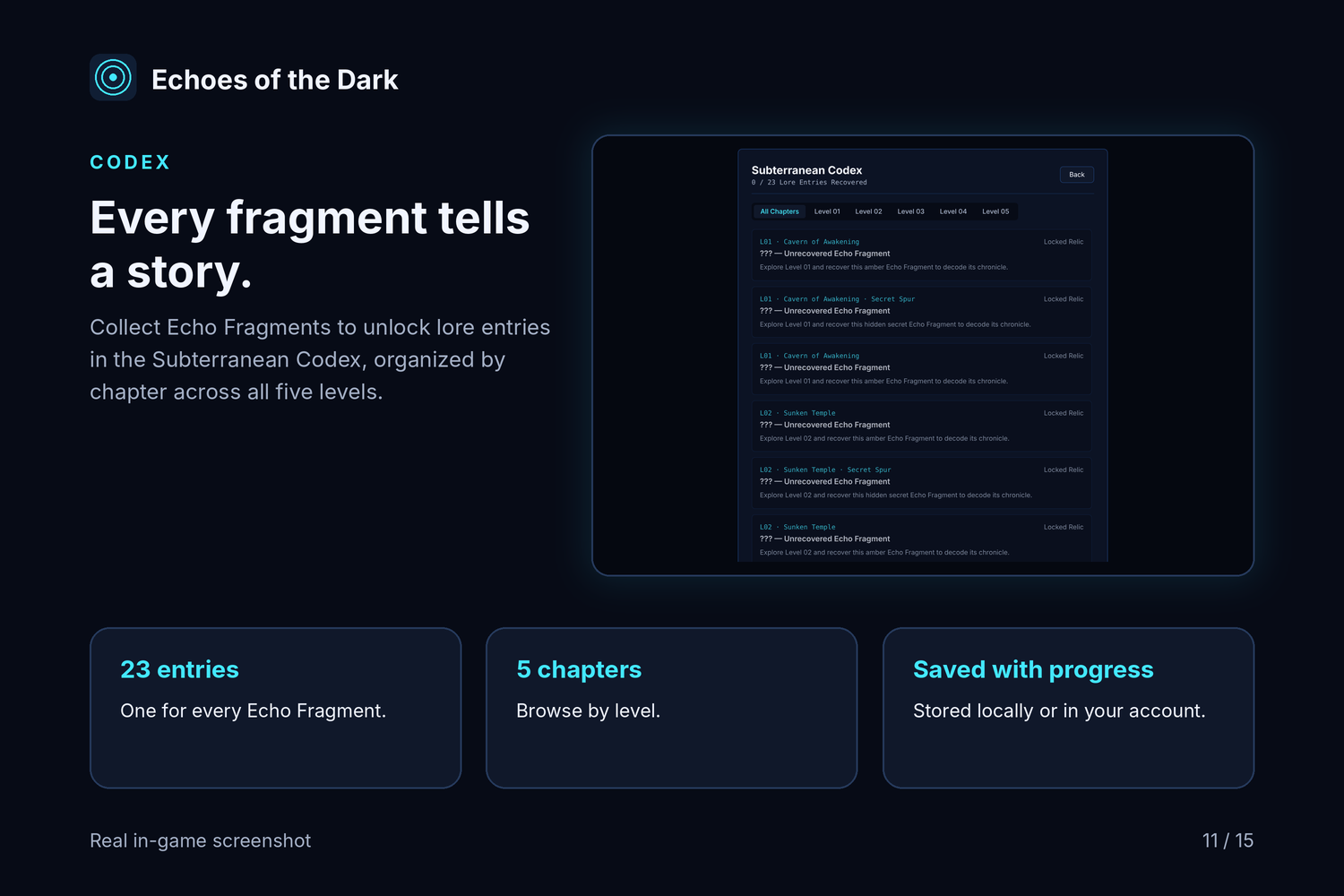
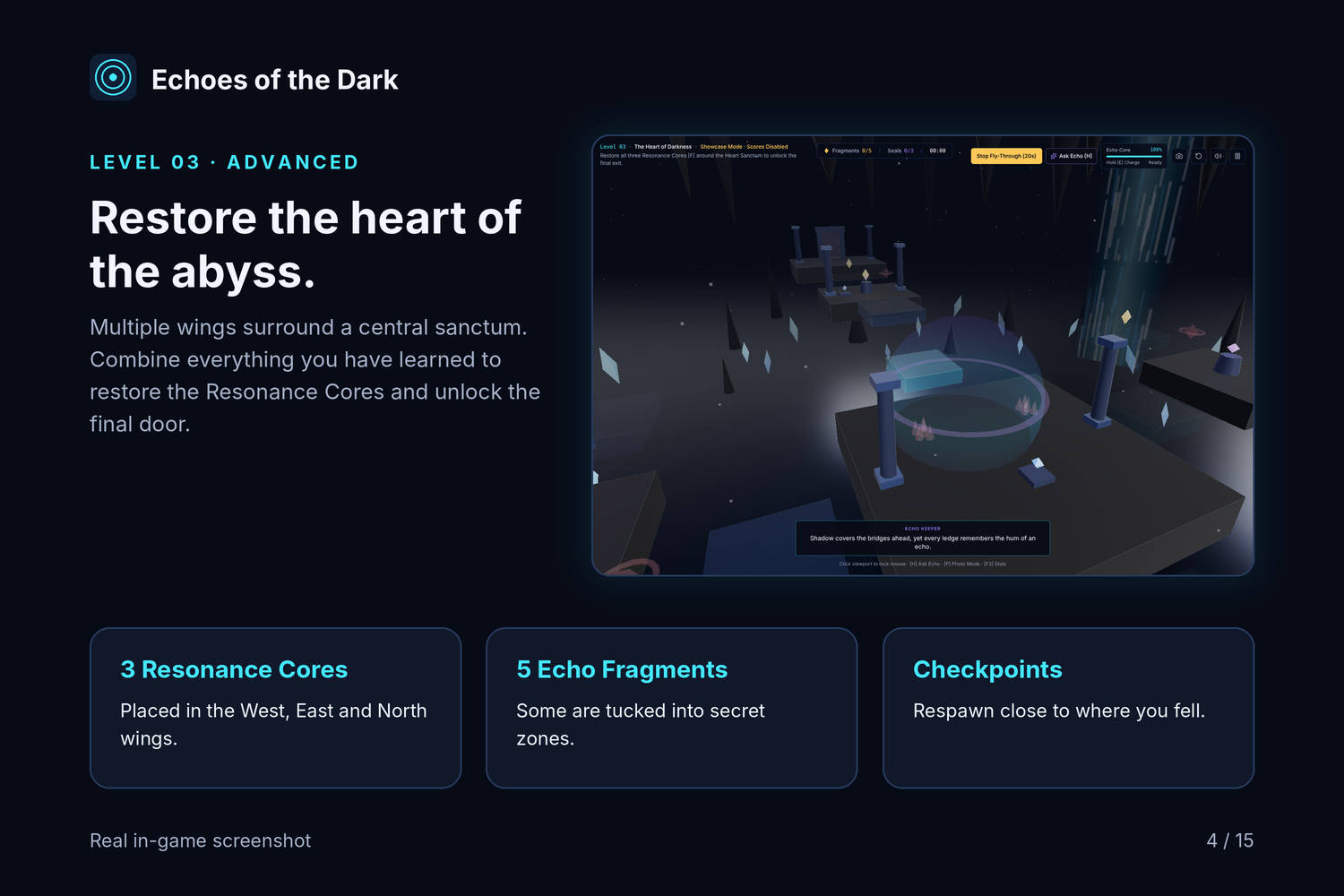
Players must use their surroundings, remember what they discover, solve environmental puzzles, collect Echo Fragments, and progress through increasingly challenging levels.
The planned experience includes:
- A beginner-friendly tutorial.
- Three progressively challenging stages.
- Third-person 3D exploration.
- Sonar-based environmental discovery.
- Collectibles and checkpoints.
- Optional player accounts and saved progress.
- A leaderboard and achievement system.
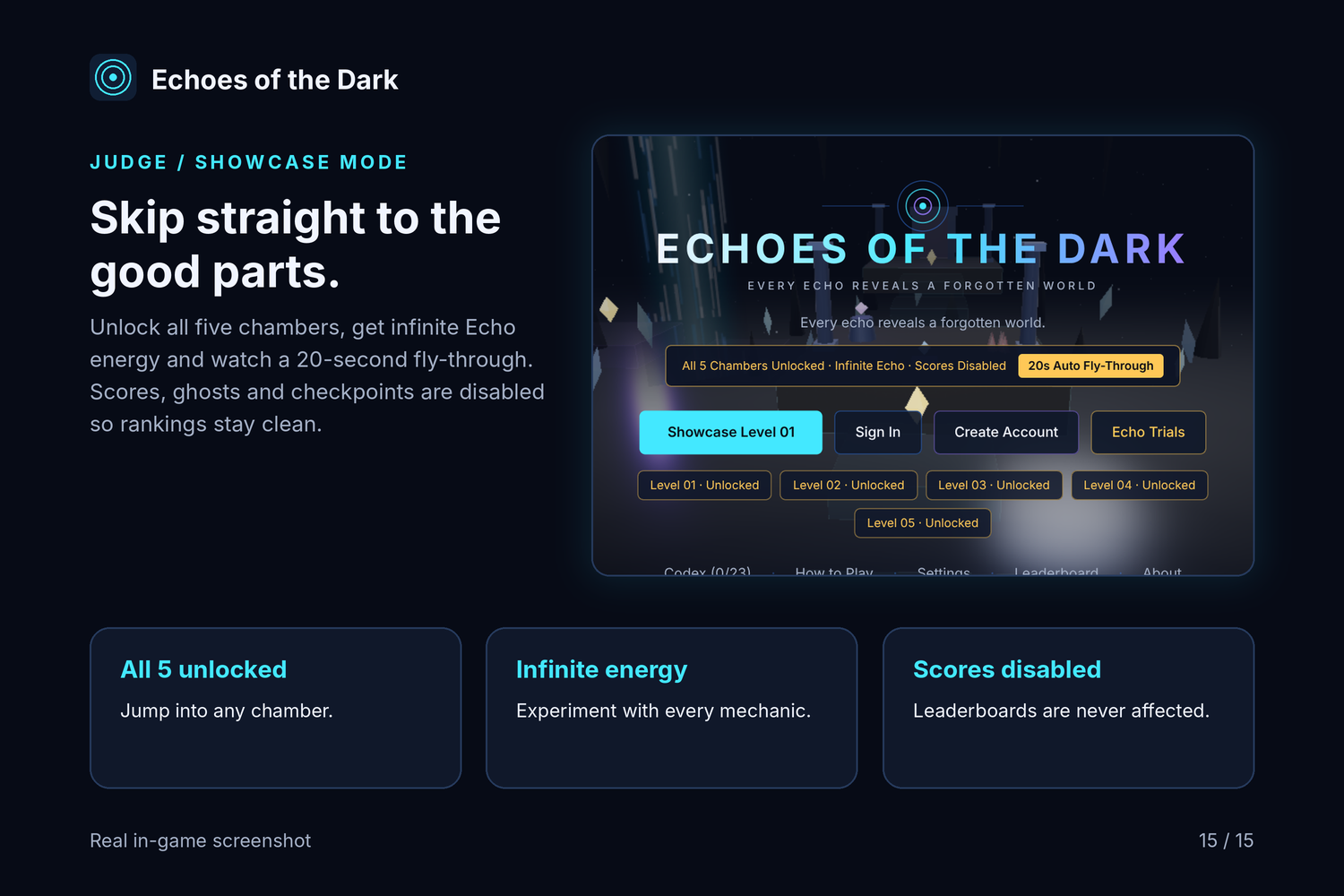
The game is designed to support guest players so that anyone can start exploring without creating an account.
How we built it
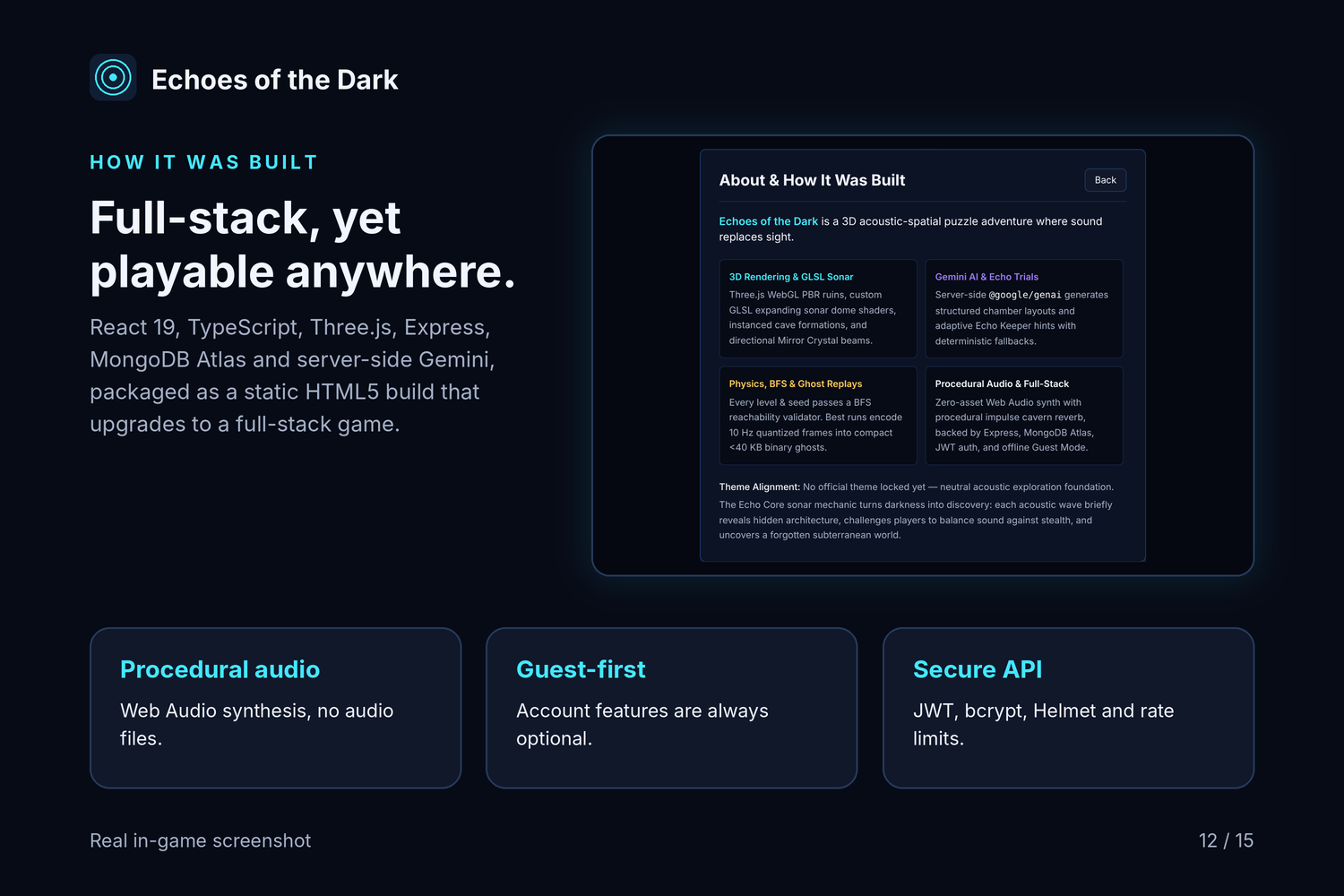
I am developing Echoes of the Dark as a full-stack browser-based 3D game.
The planned technology stack includes:
Frontend and 3D Game Development
- Three.js for 3D rendering and environments.
- JavaScript for game mechanics and interactions.
- Vite for frontend development and production builds.
- HTML5 and CSS3 for the interface.
- Web Audio API for sound effects.
Backend Development
- Node.js for the server environment.
- Express.js for REST APIs.
- JWT for authentication.
- bcrypt for secure password hashing.
Database
- MongoDB Atlas for storing user accounts, game progress, achievements, and leaderboard information.
- Mongoose for database modeling and data management.
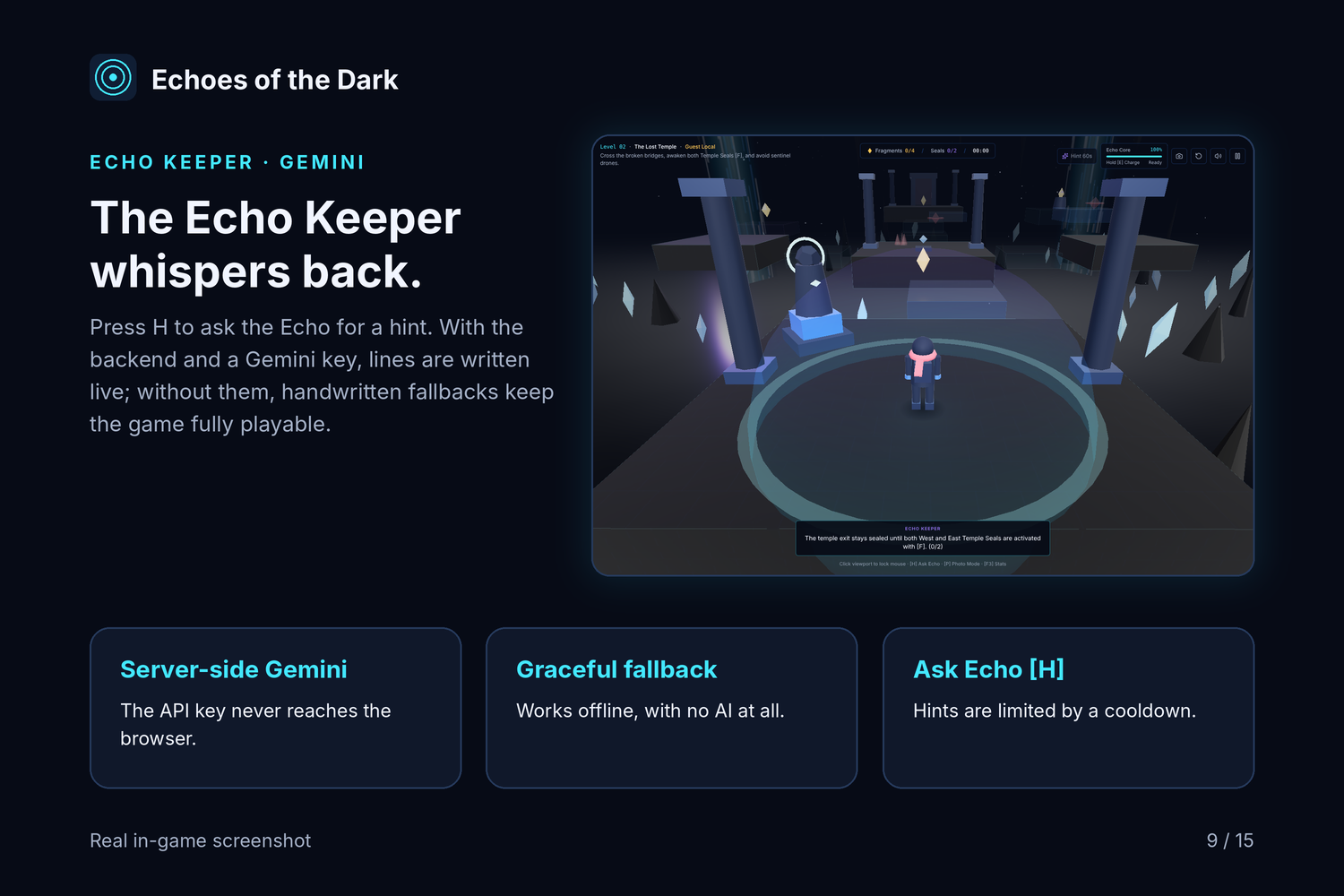
The architecture is designed to separate the actual gameplay from account management and cloud-based progress synchronization. This allows the game to remain playable even when the backend is unavailable.
Challenges we ran into
One of the biggest challenges has been designing a sonar mechanic that is both visually impressive and genuinely useful for gameplay.
A simple glowing circle would not be enough. The pulse needs to reveal meaningful environmental objects while encouraging players to think strategically about their next move.
Other major engineering challenges include:
- Creating an atmospheric 3D environment without sacrificing browser performance.
- Designing intuitive third-person movement and camera controls.
- Balancing visibility, darkness, and puzzle difficulty.
- Making hidden platforms and obstacles understandable without making the game too easy.
- Integrating a backend and database without making registration mandatory.
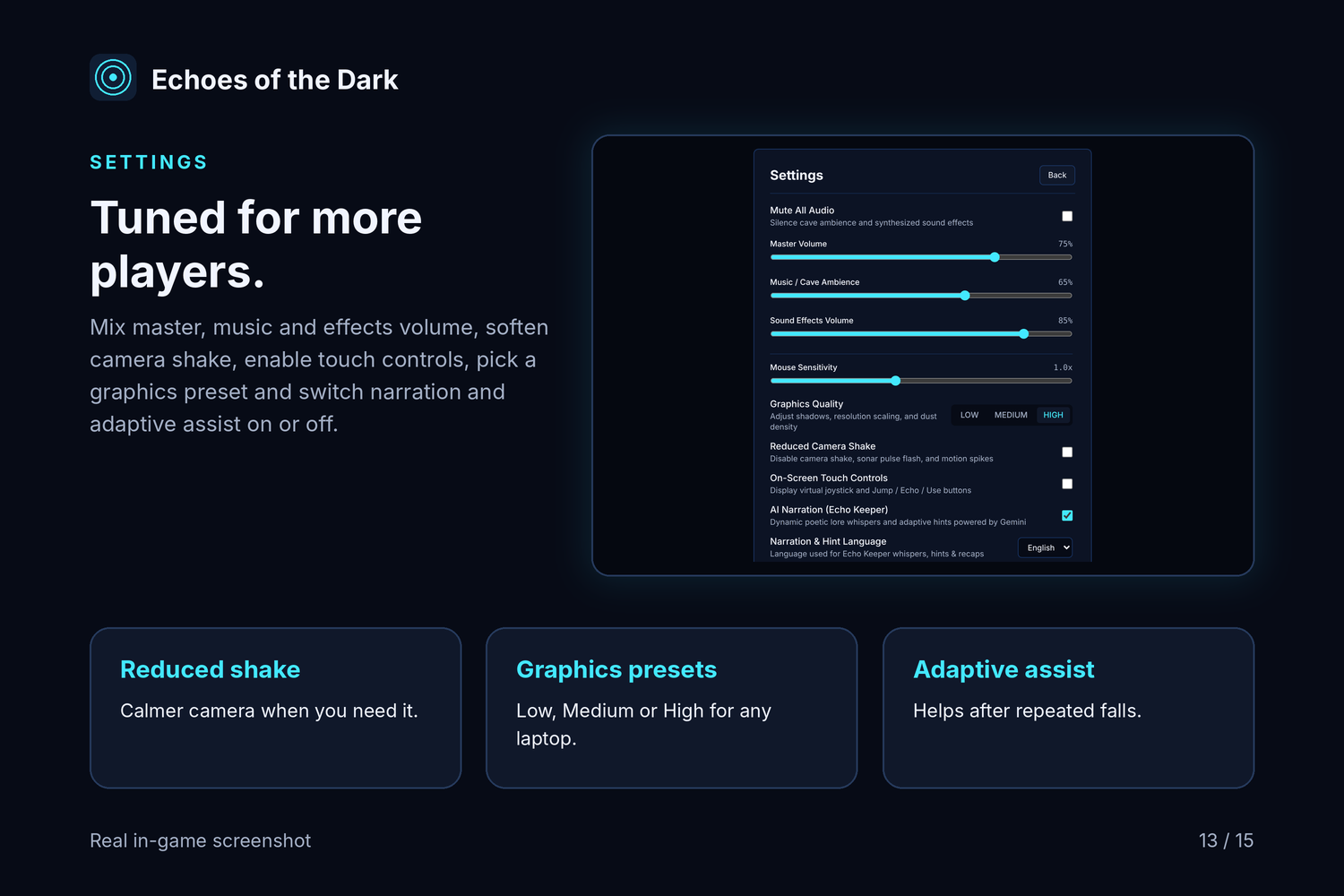
- Keeping the game accessible across different screen sizes and hardware configurations.
These challenges are guiding the development priorities and technical decisions.
Accomplishments that we're proud of
I am particularly proud of the idea of turning sound into a central exploration mechanic.
Instead of using darkness only as a visual effect, Echoes of the Dark uses it as an important part of the gameplay experience.
I am also proud of designing the project with both game development and full-stack engineering in mind.
The goal is to combine a distinctive 3D adventure experience with a maintainable software architecture, optional accounts, cloud-based progress, and an accessible browser-first experience.
As a solo student developer, building an original game concept with both creative and technical depth is an exciting challenge.
What we learned
This project is teaching me that successful game development requires much more than writing code or creating impressive graphics.
It requires balancing gameplay, visual communication, performance, accessibility, and technical architecture.
Some of the key areas I am exploring include:
- Real-time 3D rendering with Three.js.
- Game physics, movement, and collision systems.
- Interactive shader and particle effects.
- Game-state management.
- REST API development and authentication.
- MongoDB data modeling and persistence.
- Performance optimization for browser-based games.
- Designing intuitive experiences for first-time players.
Most importantly, this project has reinforced the value of keeping gameplay at the center of every technical decision.
What's next for Echoes of the Dark
The next goal is to turn the complete vision into a polished, playable experience.
Planned improvements include:
- Completing and refining all three 3D adventure stages.
- Improving the Echo Pulse visual effects and environmental interactions.
- Adding more environmental puzzles and secret areas.
- Completing optional account registration and cloud-based progress synchronization.
- Introducing achievements and a competitive leaderboard.
- Improving performance across different desktop and mobile devices.
- Publishing an accessible HTML5 version on itch.io.
Ultimately, I want Echoes of the Dark to become more than a short game-jam project. I want it to demonstrate how creative game design, interactive 3D technology, and full-stack development can come together to create a memorable experience.
Every pulse reveals a forgotten world.
