-
UCI Design-a-thon 2026 Lost and Found theme
Inspiration
Every family carries invisible archives — a grandmother's pepper soup recipe memorized but never written down, a grandfather's dialect slowly fading with age, a wedding tradition practiced for generations with no one left who remembers why. We started thinking about what "lost" really means in a cultural context. It isn't always dramatic. Most of the time, culture disappears quietly — one unanswered phone call, one missed visit, one passing. We spoke to students from Nigerian, Filipino, and Indian backgrounds and heard the same thing repeated: "I wish I had asked more questions while I still could." That sentence became the soul of Echoes.
What it does
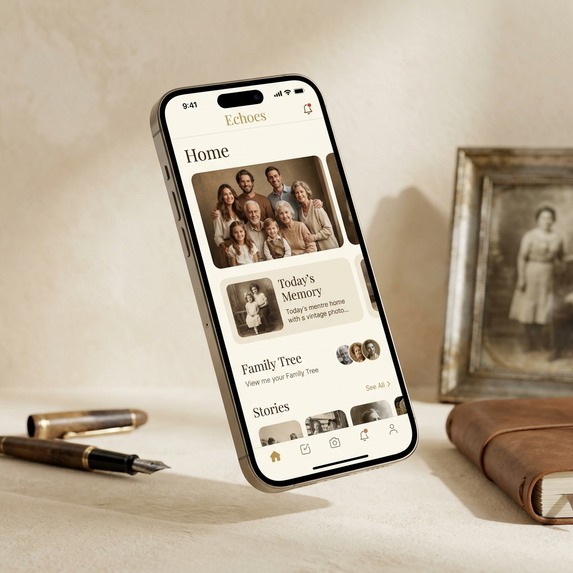
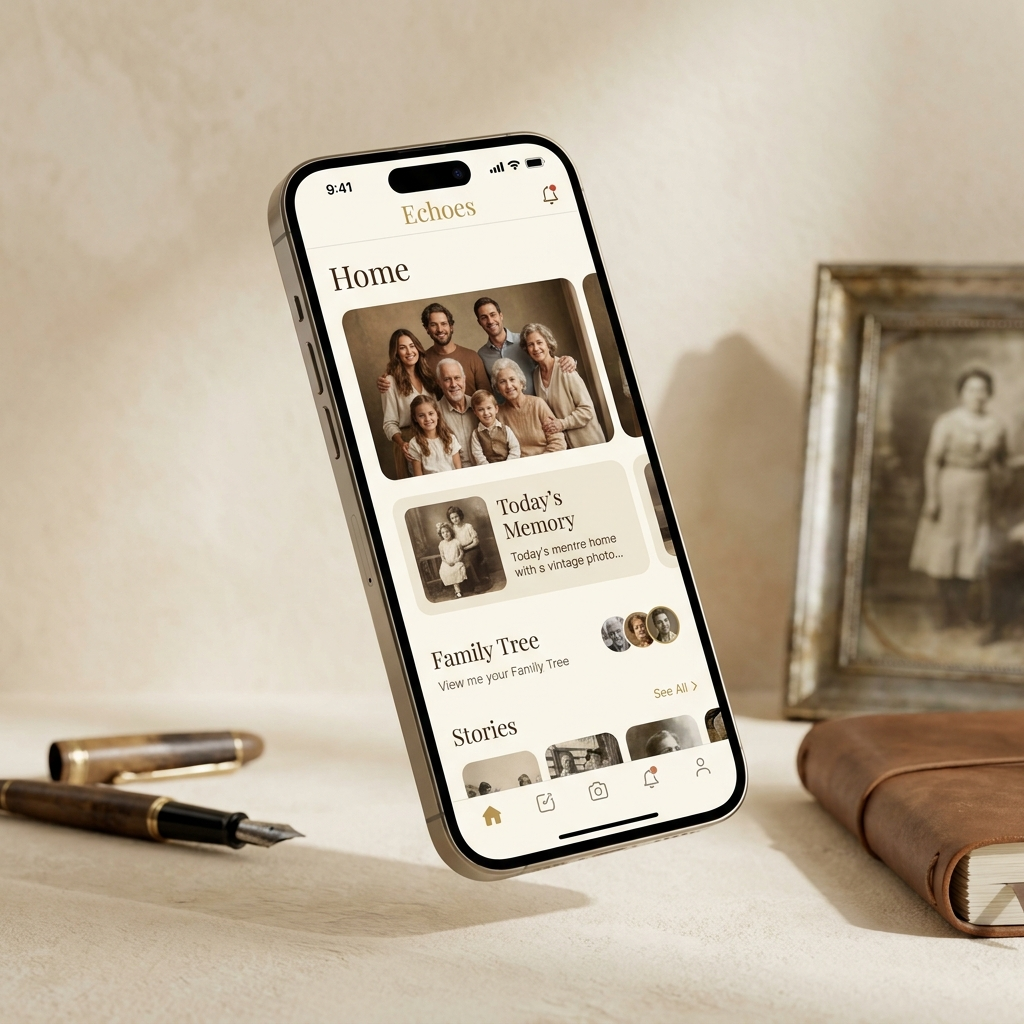
Echoes is a mobile app that helps families collaboratively archive and rediscover their cultural memories before they disappear. Elders can contribute voice recordings of stories, songs, and oral traditions, photos of recipes, places, and family moments, and written narratives enhanced by AI assistance. Explorers, the younger family members, can browse the family archive filtered by category across Recipes, Stories, Traditions, and Places, react to memories and leave responses, and discover a visual constellation of every family member's contributions. The AI story enhancement feature helps elders who find writing difficult transform rough notes into warm, vivid first-person narratives, lowering the barrier for the people whose memories matter most.
How we built it
We started by designing the full app prototype in Stitch, using it to rapidly generate the initial screens and establish the visual language, a warm cream and amber palette built to evoke the feeling of a handcrafted family photo album. Once the foundational layout was in place, we exported everything into Figma and rebuilt and refined each screen manually, adjusting spacing, typography, component states, and interaction flows to match our exact design vision. The four main tabs, Home feed, Archive, Add Memory, and Family Tree, were each iterated on individually in Figma, with particular attention to the contrast between the Elder and Explorer experiences within the same interface. The Family Tree screen was our most visually ambitious, a constellation of connected family member nodes hand-crafted in Figma to feel like stars forming a living family map.
Challenges we ran into
The hardest challenge was designing for two completely different users within the same app. Elders needed an experience that was simple, forgiving, and required no learning curve. Explorers needed something engaging and discovery-driven. Balancing those two modes without building two separate apps pushed us to simplify the Add Memory flow multiple times. We went from seven steps down to five after realising the original flow felt like filling out a form rather than sharing a memory. We also wrestled with the AI enhancement feature. The risk of an AI improving someone's grandmother's story and making it sound generic was something we took seriously. The solution was constraining the prompt strictly so the model could only work with facts the user provides, never invent, and must preserve the voice and specificity of the original.
Accomplishments that we're proud of
Designing a full four-tab mobile prototype from scratch in under 48 hours as a first-time hackathon team felt like a real milestone. Designing an AI-assisted story enhancement flow that genuinely makes the app more accessible to the users who need it most, not as a gimmick but as a tool for inclusion, was something we are especially proud of. The Family Tree constellation screen turned a functional feature into an emotional moment, and seeing your whole family mapped as a network of light felt like the visual embodiment of the theme. Grounding every design decision in real user research, even with limited time, shaped the product in ways we did not expect.
What we learned
We learned that the best design problems are not solved by adding features but by asking better questions. The breakthrough moment for Echoes was not when we added the AI enhancement, it was when we reframed the problem from how do we store family data to how do we make it feel safe and meaningful for an elder to share a story with a grandchild they rarely see. We also learned that user research, even at small scale, fundamentally changes the product. Three interviews gave us more useful signal than hours of solo ideation.
What's next for Echoes
Multilingual support would allow memories to be recorded and stored in the family's native language, with optional translation for younger members who grew up speaking a different one. Memory prompts would send a daily or weekly nudge to Elders asking something like whether they could tell us about a meal their mother made, reducing the blank page problem. Generational timelines would create a visual map of the family's history across decades, built automatically from the eras tagged on each memory. Offline mode matters because the elders who have the most to share are often the least reliably connected. The long-term vision for Echoes is a living cultural archive that outlives its contributors, a place where a great-grandchild born decades from now can hear their ancestor's voice telling a story, in their own words, in their own language.
Built With
- claude
- figma
- stitch


Log in or sign up for Devpost to join the conversation.