Echoes — memories worth keeping, and worth something Inspiration I do business development for Superteam Ukraine, the local Solana chapter. My job is to sit with founders, roast their ideas, and try to guess what the next big thing looks like. So I spend most of my week being professionally skeptical.
Then I went to visit my grandparents.
They're getting old fast lately, and they were telling the same stories I've heard a hundred times before. The same jokes, in the same order, with the same pauses. I caught myself getting irritated — and then it hit me: one day I will never hear those stories again. Not the story, not the pause, not the voice. That thought stayed with me for weeks.
So I did what I do at work: I researched the space. Almost every app built "for seniors" was deadly boring — pill calendars, payment helpers, hospital maps, hobby wikis. Tools for managing decline. Meanwhile the apps the rest of us live in — Instagram, TikTok — were overwhelming for my grandparents. Most seniors there only consume. Almost none create.
There was a gap sitting right in the middle: a place to record a memory, share an experience, or confess something — without a camera, a studio, a face on screen, or a second career as a content creator. And crucially, a place where those recordings are preserved somewhere truly independent, and where the person telling the story can actually earn from it.
That became Echoes. What it does The whole flow is designed so that a 78-year-old can finish it without ever hearing the word "blockchain."
Light sign-up. A Solana wallet is created silently in the background. No seed phrase ceremony, no scary screens.
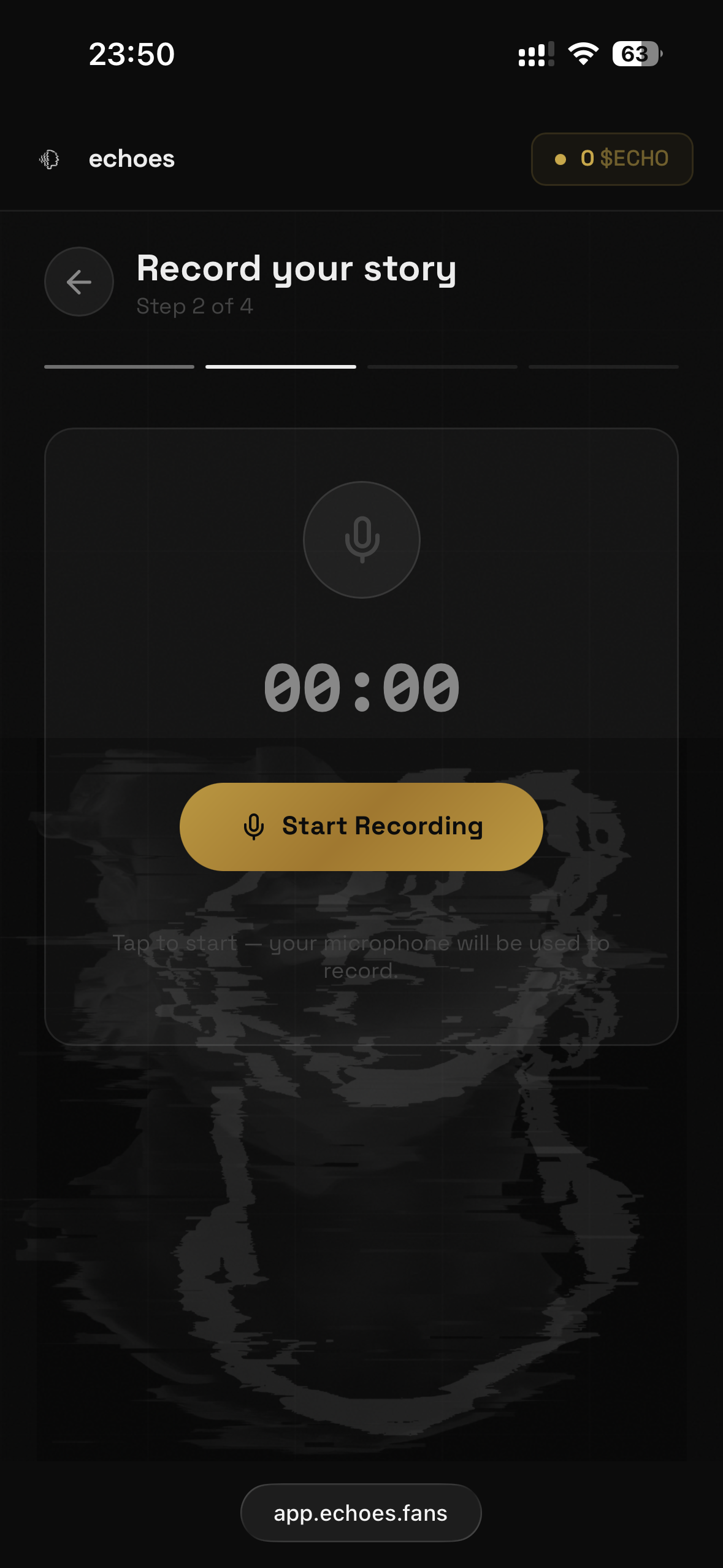
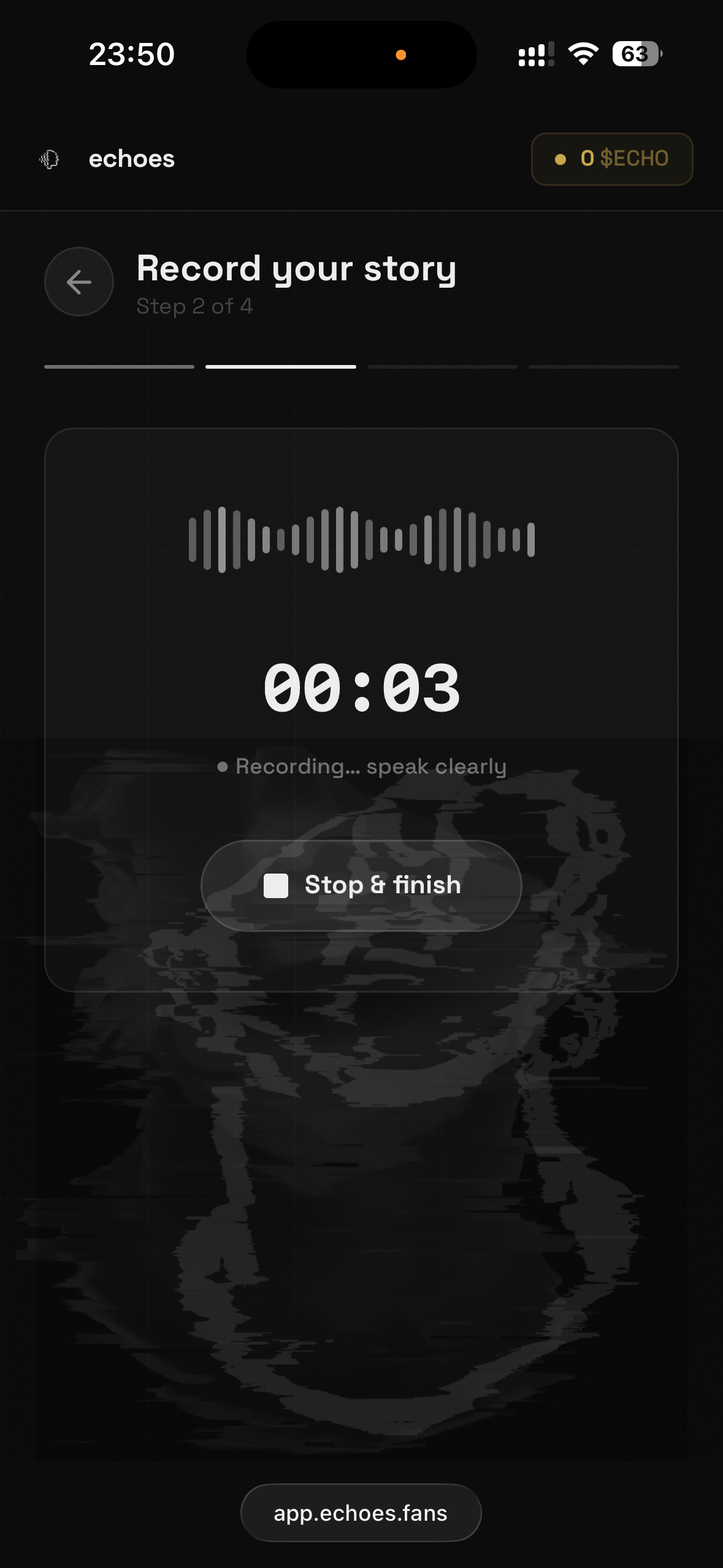
Record. Up to 5 minutes of audio, phone mic only. Add a title, description, cover image, and category.
Enhance (optional). Built-in ElevenLabs AI cleans up noise and improves clarity. Old phones and quiet voices are the norm here, not the exception.
Publish. To list a story you either pay a small fee or listen to 3 other stories and evaluate them — audio quality, whether the category is right, and whether it was interesting to listen to. Then the file is stored on Cloudflare.
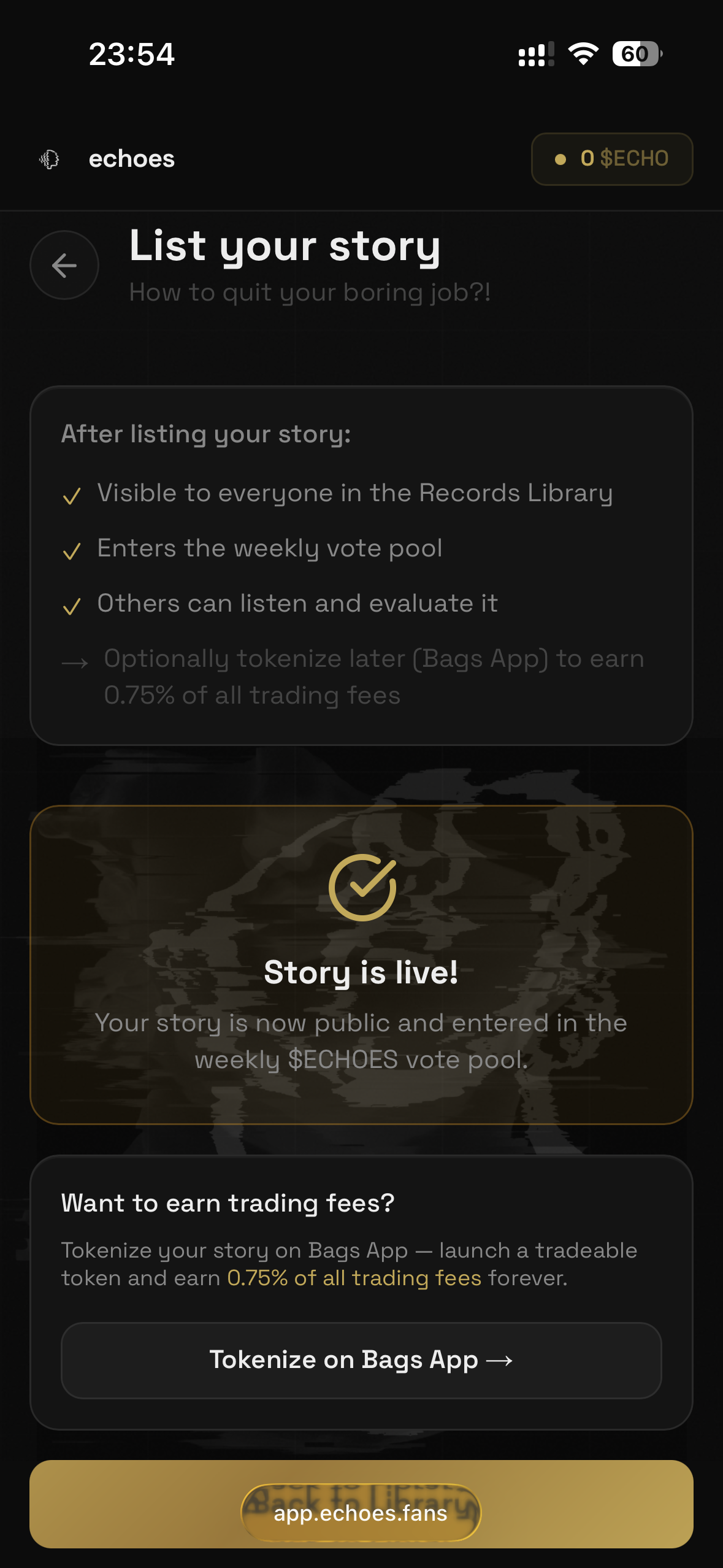
Tokenize. This is where it gets interesting. A memory can be permanently preserved on Arweave — a global, permissionless hard drive that stores data forever — and paired with a token launched through the Bags launchpad, with a fee-sharing program that stays active forever. Cost: around $3, varying with the AR price.
If the creator skips tokenization, any user can become a sponsor and pay for it instead.
Once the token is live it trades, and a 1% trading fee is split three ways. The platform always keeps 0.25%. If the creator paid for tokenization themselves, they take 0.75%. If a sponsor paid, the creator keeps 0.25% and the sponsor earns 0.5% — forever. Nobody has to front the cost of preserving their own life. The part that solves distribution Initial attention comes from Bags, from us, and from the creator's own circle. But I wanted the seniors to do the bare minimum. So attention is manufactured on the platform instead.
Every week we run a challenge. Stories are ranked by likes and dislikes, tips received, and the peer reviews left by users who chose to evaluate 3 stories instead of paying the listing fee. Likes and tips count on a diminishing scale rather than one-for-one — otherwise a single large family or one whale tipper owns the leaderboard every week.
The top 10–20 stories get spotlighted on the front page for 24 hours, and everyone else votes for the best one with real money. When the challenge closes, the entire reward pool is used to buy the tokens of the top 3 winners, and those winners are paid out in their own tokens.
That single mechanic does three things at once. It injects real liquidity. It gives traders a reason to speculate on stories before results are announced, because guessing right means holding a token that's about to be bought. And it gives creators visibility and status that carries into their next recording — a winner's next story starts with an audience.
That's how you turn someone who has never posted anything in their life into a creator. How we built it Solana for embedded wallets and payments, invisible to the user Bags launchpad for token creation and permanent, programmable fee sharing (long term, we want to be the launchpad) Arweave for permanent storage of tokenized memories Cloudflare for hot storage of everything before tokenization ElevenLabs for audio enhancement A curation layer built on proof-of-listen rather than proof-of-payment Challenges we faced Crypto UX for people who don't want crypto. Every wallet decision was made by asking one question: would my grandmother quit here? That question killed a lot of otherwise clever features.
The cold start on curation. Nobody wants to be the first listener. Making "listen to 3 stories and review them" a substitute for the listing fee solved supply and demand with a single rule.
Not turning grief into a casino. A memory becoming a tradeable asset is a genuinely uncomfortable idea, and I've spent a lot of time on where the line sits. Where we landed: the market never touches ownership of the story, tokenization is always optional and always the creator's call, and the reward pool buys winner tokens rather than dumping on them.
Cost volatility. Permanent storage priced in AR means the $3 promise isn't fixed. The pricing model has to absorb that, not the 80-year-old. What I learned The hard problem for a non-creator is never recording. It's distribution. If someone is going to post exactly once in their life, that one post has to find an audience by design, not by luck. Almost everything we built after the recording screen exists to solve that.
I also learned the "app for seniors" framing was too small. The people who wanted this first weren't only grandparents. They were veterans, survivors, parents — people with one thing they needed to say out loud before it was gone.
Everyone has something worth preserving. Echoes is where it stops disappearing.
Built With
- anchor
- android
- arweave
- bags
- cloudflare
- cloudflare-r2
- elevenlabs
- iconfirm
- irys
- javascript
- next.js
- node.js
- postgresql
- privy
- react
- react-native
- rust
- smart-contracts
- solana
- solana-web3.js
- supabase
- tailwindcss
- typescript
- web3

