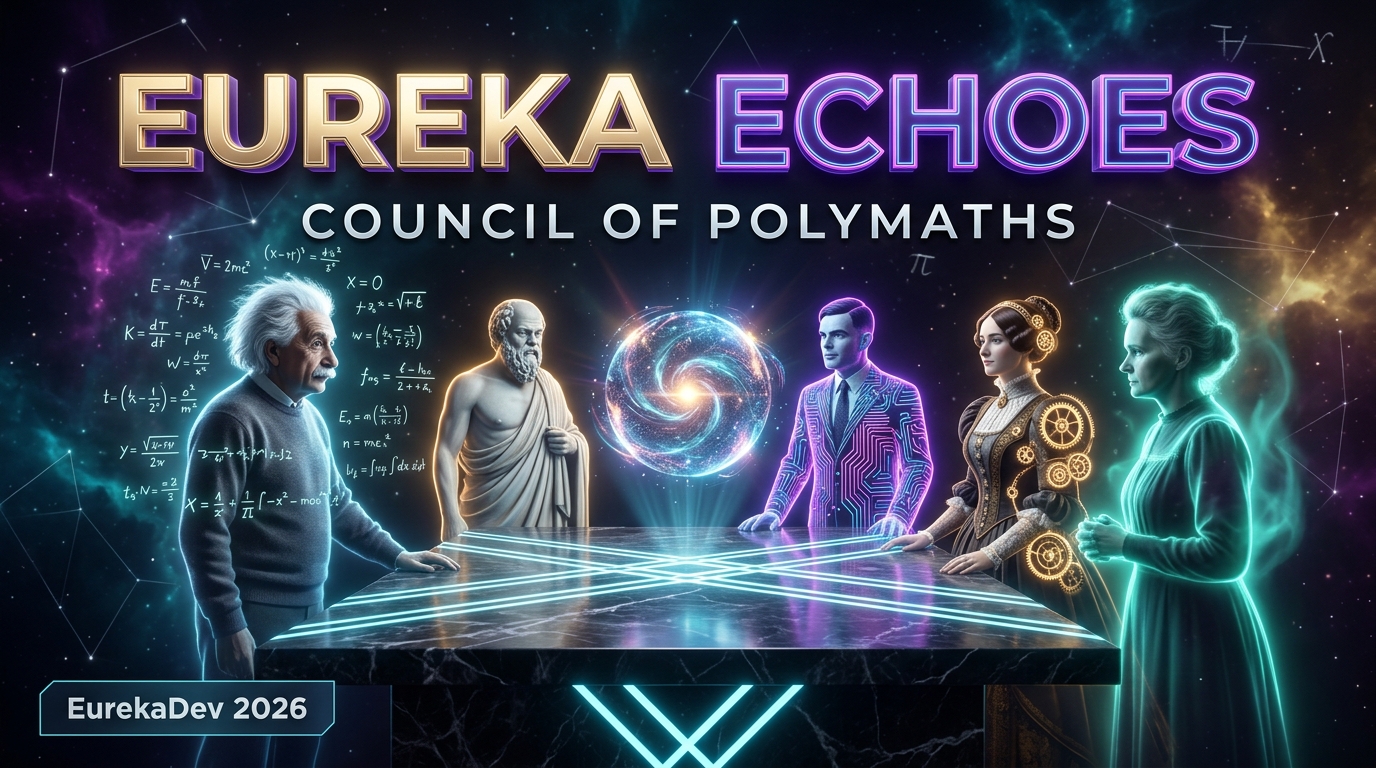
Echoes: A Historical Intelligence Platform for Modern Challenges
Inspiration
When humanity faces some of its most daunting challenges—artificial superintelligence, CRISPR gene editing, algorithmic polarization, and post-scarcity economics—we often approach them purely as engineering problems. In doing so, we overlook thousands of years of philosophical, scientific, and ethical inquiry that could help us understand their deeper implications.
Modern conversational AI systems can simulate historical figures, but they often suffer from three major limitations:
- Anachronistic Contamination: Historical figures may refer to technologies, concepts, or terminology that emerged long after their lifetimes.
- Homogeneous Consensus Drift: AI models tend to favor agreeable responses, often smoothing over the disagreements and contradictions that have driven intellectual progress.
- Citation Hallucination: AI-generated responses may include fabricated quotations, inaccurate references, or fictional historical sources.
We asked ourselves: What if we could build an AI-powered platform where history's greatest thinkers could examine today's most complex challenges while respecting their historical knowledge boundaries, citing verified primary sources, and engaging in meaningful intellectual debates?
This vision inspired Echoes, a historical intelligence platform that brings the ideas of 25 influential thinkers into interactive dialogue with the modern world.
What It Does
Echoes is an AI-powered historical intelligence platform that enables users to explore complex modern challenges through the perspectives of historical thinkers. It combines individual Socratic dialogues, multi-agent debates, historical knowledge constraints, and source-based reasoning.
1. One-on-One Socratic Dialogues
Users can engage in multi-turn conversations with 25 historical thinkers from philosophy, science, mathematics, computing, politics, and economics. Featured personalities include Alan Turing, Albert Einstein, Ada Lovelace, Marie Curie, Charles Darwin, Karl Marx, Socrates, and Confucius.
Each persona is designed to reflect the individual's documented ideas, intellectual methods, and historical context.
2. Historical Knowledge Boundaries
Each persona operates within a defined historical knowledge horizon corresponding to their lifetime. For example, Einstein's knowledge boundary is set to 1955, Turing's to 1954, and Socrates' to approximately 399 BCE.
This constraint helps prevent historical figures from presenting later discoveries as knowledge they personally possessed.
3. Explicit Speculation Detection
When users ask about modern developments such as artificial general intelligence, social media, or CRISPR gene editing, Echoes identifies the response as an Extrapolated View.
Rather than pretending that historical thinkers understood modern technologies, the system explores how their documented principles and philosophical positions might apply to contemporary challenges.
4. Primary Source Citations
Echoes connects historical arguments to relevant primary sources, including published works, essays, letters, and scientific papers.
Examples include Einstein's On the Electrodynamics of Moving Bodies (1905), his essay Why Socialism? (1949), Turing's Computing Machinery and Intelligence (1950), Ada Lovelace's 1843 notes on Charles Babbage's Analytical Engine, and Darwin's On the Origin of Species (1859).
These references help users investigate the original ideas behind each simulated argument.
5. The Council of Polymaths
The Council of Polymaths is Echoes' multi-agent debate environment. Users can assemble custom panels of two to four historical thinkers or choose from predefined debates, including:
- Can Silicon Feel and Think?
- CRISPR and Directed Evolution
- Automation and Surplus Value
Each participant responds to previous arguments, challenges opposing assumptions, and develops counterarguments based on the relevant thinker's documented ideas.
The goal is not to force agreement but to preserve meaningful intellectual disagreement.
6. Six Innovation Tracks
Echoes organizes discussions around six innovation tracks:
- Computer Science and Artificial Intelligence
- Biology, Medicine, and the Environment
- Mathematics and Physics
- Economics and Labor
- Community Problems
- Ethics and Epistemology
These tracks help users connect historical reasoning with contemporary research, social challenges, and technological innovation.
7. Dual-Engine Architecture
Echoes supports two operating modes:
- Live AI Mode: Uses Google's Gemini 2.5 Flash model through the official Google GenAI SDK to generate contextual responses and multi-agent debates.
- Offline Knowledge Mode: Uses a curated archive of predefined dialogues, historical knowledge, and source references to provide immediate access to supported content without requiring an API key or an active internet connection.
The offline mode makes the platform easier to demonstrate during hackathons and evaluations, even when network access or API availability is limited.
8. Persona Audio Narration
The platform uses the browser's Web Speech API to read responses aloud, with configurable speech pitch and pacing to distinguish between personas.
9. Academic Research Viewer
Echoes includes a research-paper viewer designed to present technical explanations, mathematical formulations, benchmark tables, and academic references. It also supports Markdown and PDF export for research-oriented workflows.
How We Built It
Technology Stack
- Frontend: React 18
- Build Tool: Vite 5
- Styling: Tailwind CSS
- Icons: Lucide
- AI Integration: Google GenAI SDK
- Language Model: Gemini 2.5 Flash
- Audio Narration: Web Speech API
- Visual Effects: Canvas Confetti
- Offline Knowledge System: JavaScript ES modules, structured dialogue trees, and curated source-reference databases
Epistemic Reasoning Framework
Echoes models a persona's response as:
[ R = f(Q, B_H, D_A) ]
where:
- (Q) represents the user's question.
- (B_H) represents the historical knowledge boundary.
- (D_A) represents the persona's documented ideas and principles.
- (R) represents the generated response.
When a question concerns developments beyond the persona's lifetime, the system aims to construct an extrapolated response grounded in the thinker's documented principles rather than presenting modern knowledge as historical fact.
Conceptually, this process can be represented as:

Log in or sign up for Devpost to join the conversation.