Inspiration
Modern social media has made us globally connected but locally isolated. We walk the same streets every day, completely unaware of the thousands of hidden stories, thoughts, and memories left behind by others. We wanted to bridge the gap between the digital and physical worlds. What if you could tune into the "frequency" of a city? What if you could leave a piece of your mind exactly where you experienced a moment, for someone else to find later?
What it does
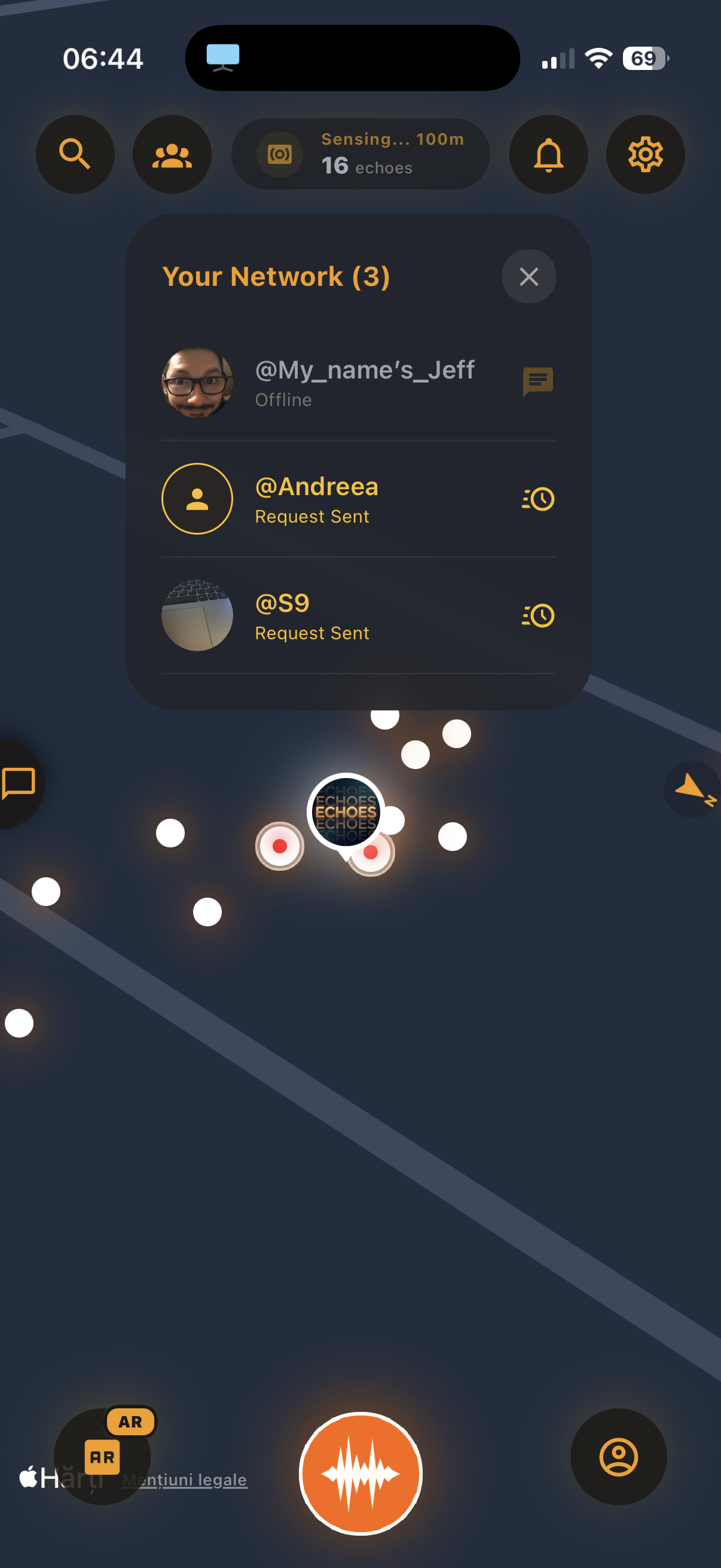
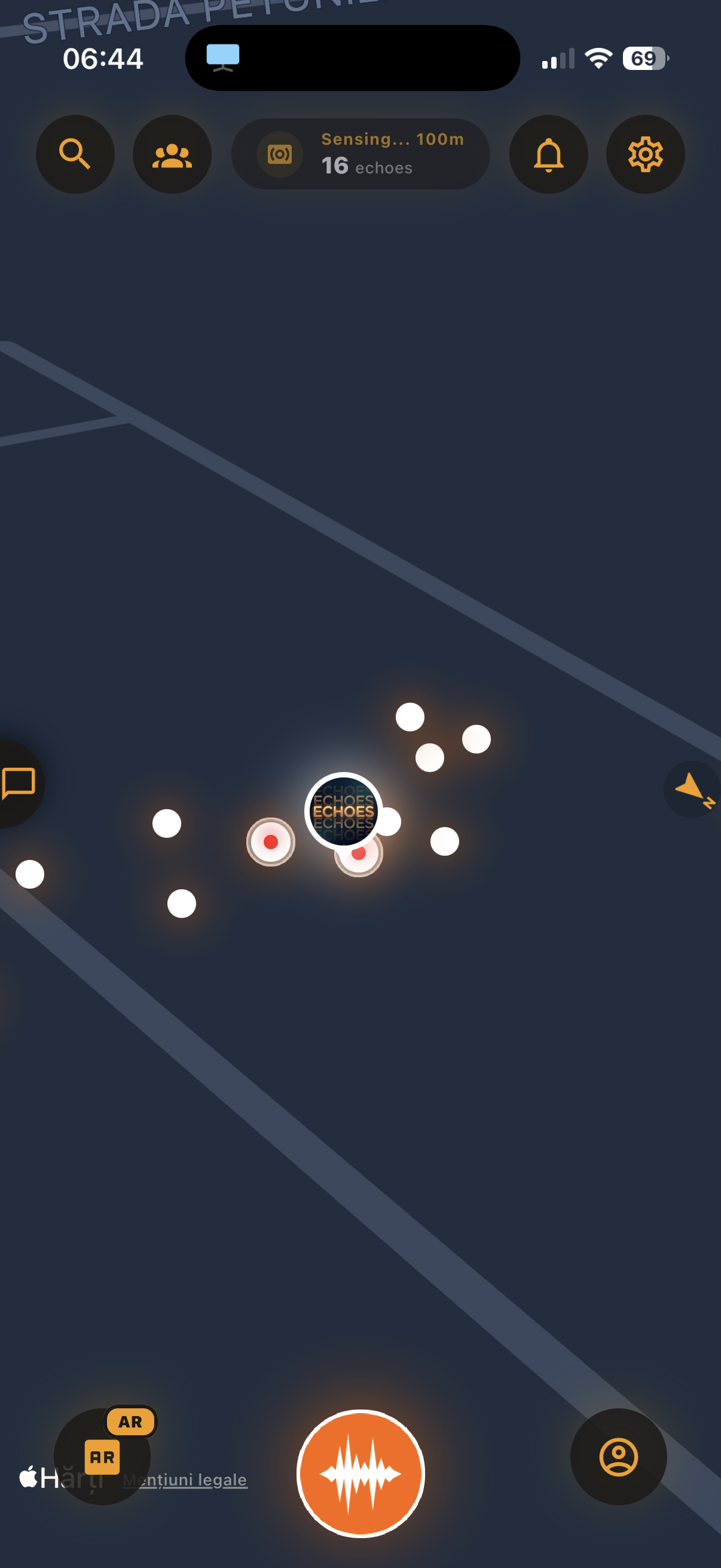
Echoes is an immersive, map-based social platform for modern "Travelers". Users can record short audio memories (Echoes) and physically anchor them to their current GPS coordinates. When other travelers walk nearby, their radar detects the echoes. They can explore these memories using a cinematic 3D map or switch to the Aural Space (AR Mode) to see the echoes floating in the real world as pulsing, interactive energy nodes. Users can like, comment, and send direct "Whispers" to the creators, forging connections based on shared physical spaces rather than just algorithms.
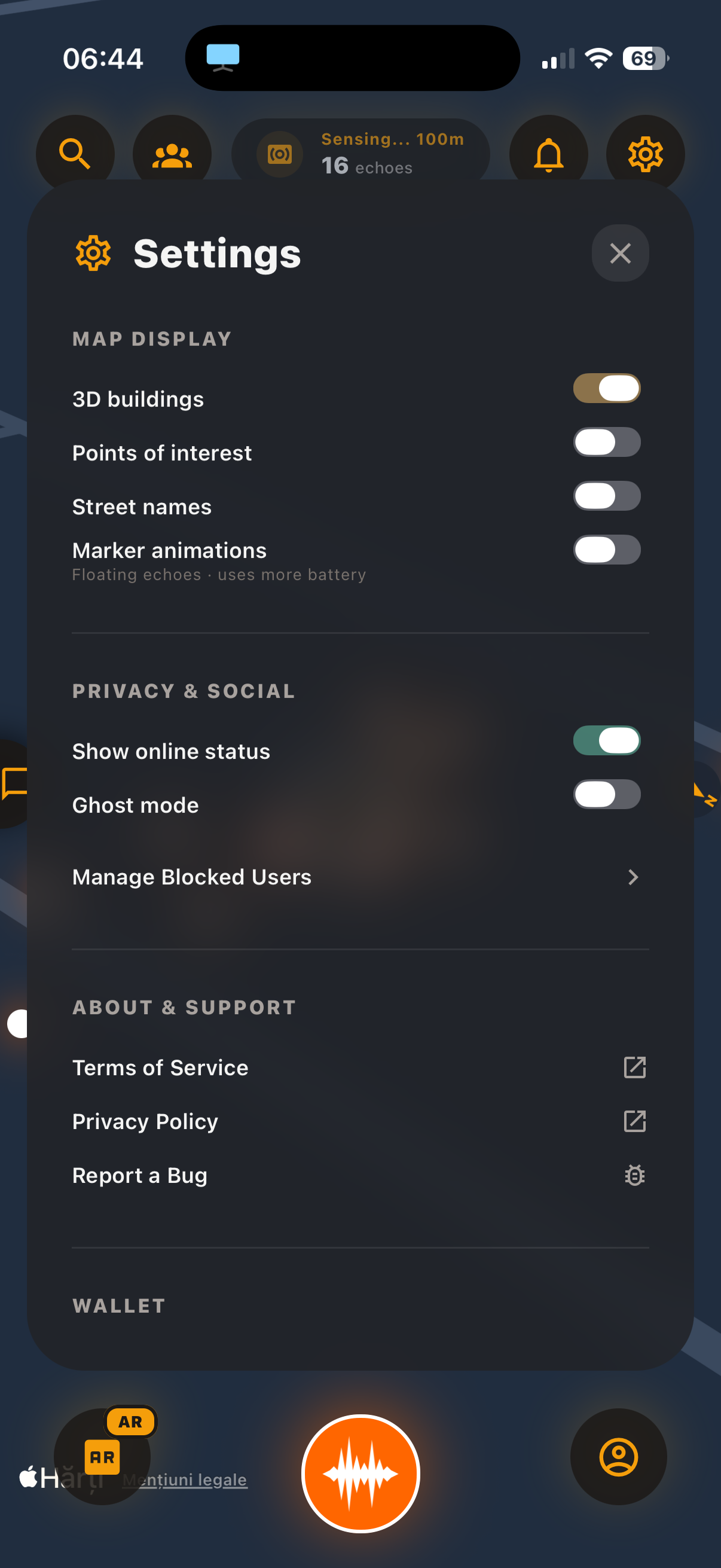
Core Features Tactical AR Discovery: Using the device's camera and compass, digital audio files are projected into the real world as 3D resonance nodes. Live Traveler Presence: A buttery-smooth, custom-styled map that displays the real-time movement and status of other online users in your vicinity. Stealth HUD & Glassmorphism UI: A highly polished, immersive interface featuring dynamic blur pop-ups, haptic feedback, and a military-inspired aesthetic. Real-time Social Engine: Instant "Whispers" (direct messaging), friend requests, live comments, and a completely spam-proof notification system. Privacy First: A dedicated "Ghost Mode" that instantly drops you off the public radar when you want to explore unseen.
How we built it
Frontend: We built the app using React Native (Expo) to ensure a native-like experience on both iOS and Android. We utilized expo-audio for high-quality voice capture and react-native-maps for the spatial interface. AR Engine: We integrated ViroReact, writing custom mathematical models to translate real-world GPS coordinates (latitude, longitude, and bearing) into compressed relative 3D space for stable AR anchoring. Backend & Infrastructure: Supabase is the absolute heart of Echoes. We used Supabase Auth for seamless Apple/Google onboarding. Supabase Storage handles the optimized delivery of profile pictures and audio files. Supabase Realtime powers the entire heartbeat of the app: live traveler presence tracking, instant chat synchronization, and real-time map updates (optimized with custom debounce queues to prevent battery drain and race conditions).
Challenges we ran into
Balancing a hyper-active real-time map with battery life. Constant GPS polling and 3D map rendering can drain a phone fast. We engineered a custom "pulse" system where map markers animate organically at randomized intervals, and we coalesced Supabase Realtime payloads using a debounce queue to keep the cellular radio asleep as much as possible while maintaining a "live" feel.
Accomplishments that we're proud of
From Code to the App Store: We are incredibly proud that we managed to take a highly complex AR and location-based concept, build it, polish it, and officially submit it to Apple for TestFlight and App Store Review right before the hackathon deadline. Flawless Real-Time Architecture: We successfully engineered a bulletproof real-time social engine using Supabase. By implementing a custom debounce queue and strict channel cleanup protocols, we completely eliminated race conditions, memory leaks, and notification spam—even under rapid user interactions. The Stealth HUD Design: We moved away from generic app interfaces and built a custom, tactical "Glassmorphism" UI. The dynamic blur pop-ups and haptic feedback make the app feel like a premium, immersive radar system. Optimized Battery Performance: Balancing constant GPS polling, live map rendering, and 3D Augmented Reality is incredibly resource-intensive. We're proud of our "heartbeat" rendering logic that keeps the map buttery-smooth without immediately draining the user's battery.
What we learned
The Traps of Real-Time State Management: We learned the hard way about "stale closures" and race conditions in React Native. When users interact rapidly (like spamming a "Like" button), instant UI updates clash with slower database requests. We learned how to build asynchronous Promise queues and Debouncers to bridge this gap perfectly. WebSocket Memory Management: We discovered that unmanaged real-time database listeners (Supabase Channels) can quickly cause massive memory leaks and duplicated events if the cleanup functions aren't handled synchronously during component unmounting. Bridging AR and GPS: Translating real-world coordinates (latitude, longitude, and bearing) into a stable, relative 3D coordinate system (XYZ) for the AR camera requires complex math and a deep understanding of mobile hardware sensors.
What's next for echoes
Surviving Apple Review! 🍏 Build #115 is officially compiled and submitted. Our immediate next step is getting through Apple's strict App Store Review process and rolling out the TestFlight Beta to our first batch of early adopters. Lighting up Timișoara: Once approved, we plan to physically seed the city of Timișoara with our first hidden audio memories and onboard our first local community of "travelers" to test the app in the wild. Echo Chains: Developing a feature that links multiple memories together, allowing users to create immersive, geo-located podcasts, scavenger hunts, or guided audio tours. Web3 Integration: Exploring tokenized rewards for users who discover rare echoes or consistently leave highly-rated memories in their cities.
Built With
- jsc
- react
- react-native
- viro
