Inspiration
According to the World Health Organization, more than 55 million people worldwide live with dementia, with Alzheimer's disease contributing to 60–70% of cases. In clinical and home-care settings, Reminiscence Therapy (RT) is one of the most effective non-pharmacological interventions known to reduce agitation, spark autobiographical recall, and rebuild emotional bonds between patients and caregivers. However, standard modern digital tools and generic AI models fail dementia patients in a devastating way: cultural displacement. When a caregiver prompts a standard large language model (LLM) for "things to spark memories for someone born in 1945," the model almost uniformly hallucinates American or British post-war pop culture: Elvis Presley, diner apple pie, drive-in movies, and The Ed Sullivan Show. If the patient is an 82-year-old grandmother who grew up listening to All India Radio in Old Delhi, or a retired civil servant in Lagos who danced to highlife music in Surulere, these generic Western outputs cause confusion, frustration, and sensory alienation. Furthermore, traditional conversational AI tends to quiz patients ("Do you remember who sang this in 1965?"), creating acute cognitive stress and agitation. We built Echoes to solve this: an agentic, zero-hallucination reminiscence therapy companion grounded entirely in Qloo’s Cultural Taste Graph, pairing historical temporal anchoring with real-time adaptive emotional safety loops.
What It Does
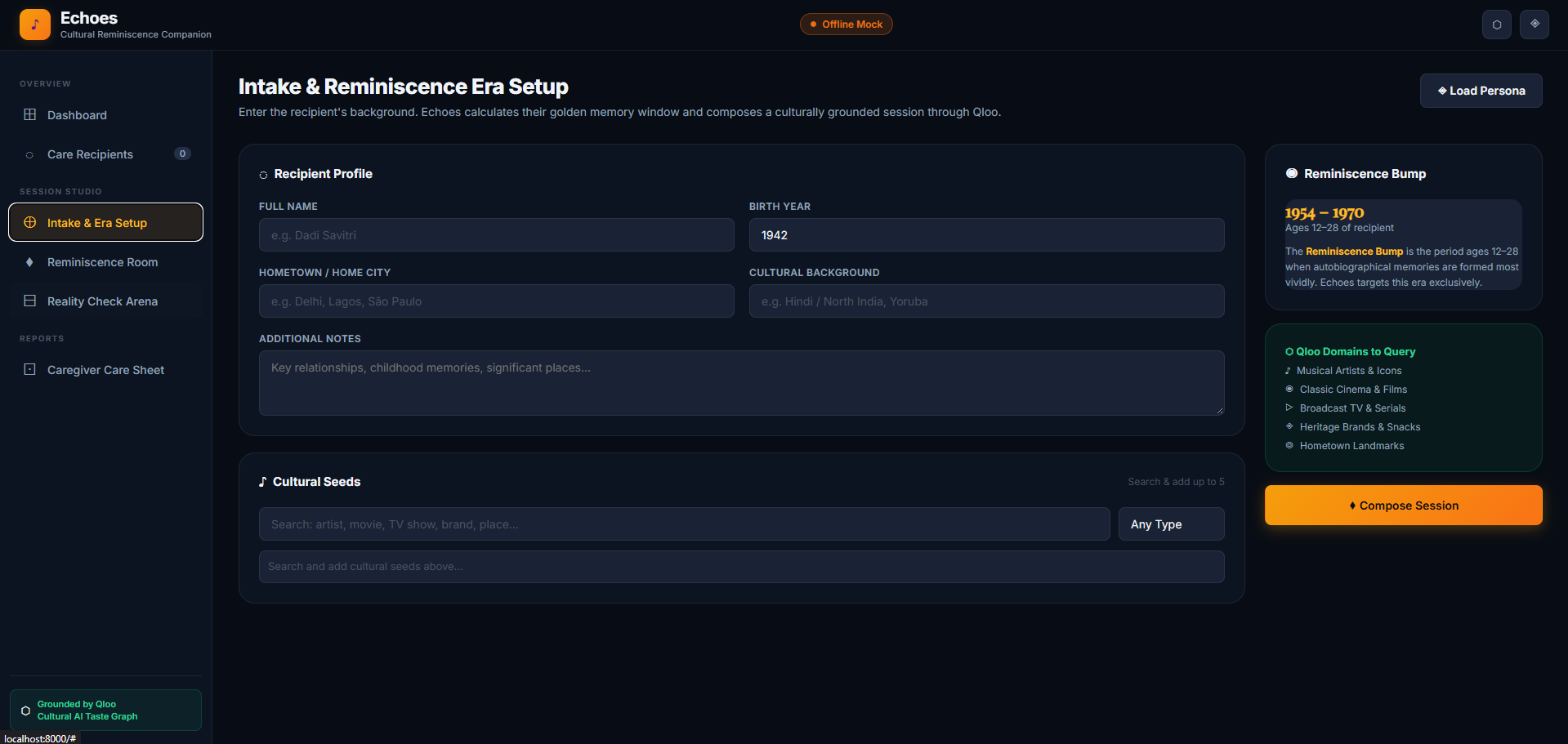
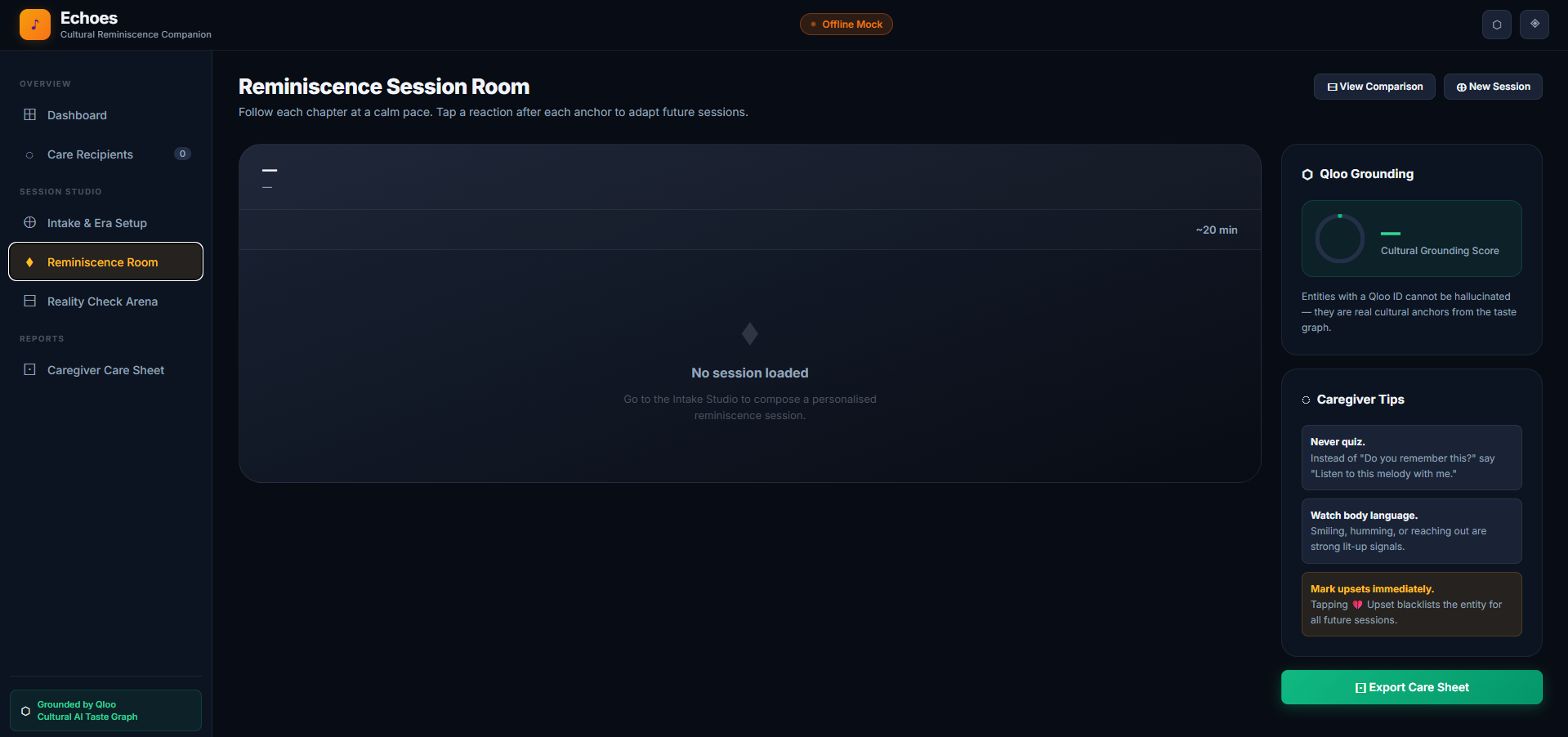
Echoes bridges cultural taste intelligence and clinical dementia care: Golden-Era Temporal Anchoring: Computes the patient's neurological reminiscence bump (ages 12 to 28) from their birth year. Multi-Domain Taste Traversal via Qloo: Takes 1–2 cultural seeds (a favorite singer, a childhood film) and queries Qloo across 5 sensory domains: Music, Cinema, Television, Heritage Brands/Flavors, and Hometown Places. 5-Chapter Sensory Session Synthesis: Formulates a 15–20 minute therapy session with non-confrontational conversation invitations ("Listen to this gentle rhythm with me...") and culturally tailored sensory cues (e.g., brewing warm cardamom masala chai, tapping gentle polyrhythms, or sharing warm pão de queijo). Adaptive Safety & Feedback Loop: Caregivers record real-time reactions per chapter:
- Lit Up: Reinforced as positive taste anchors.
- Neutral: Kept as passive context.
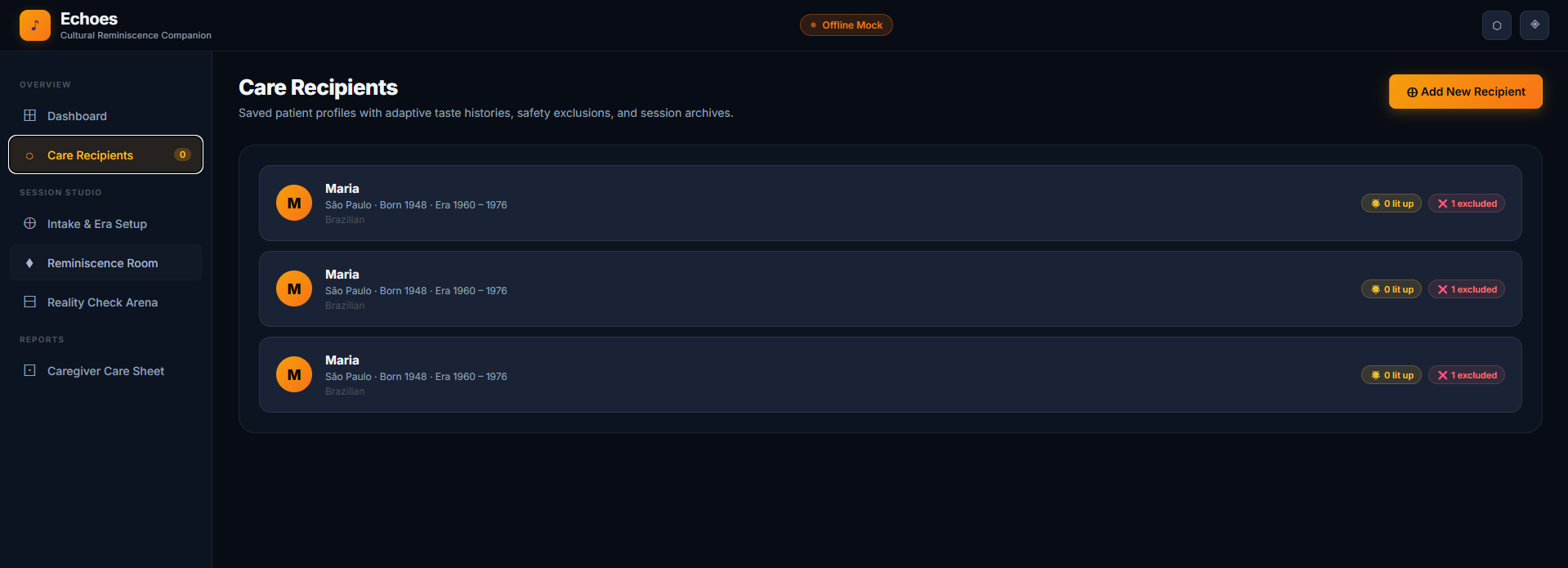
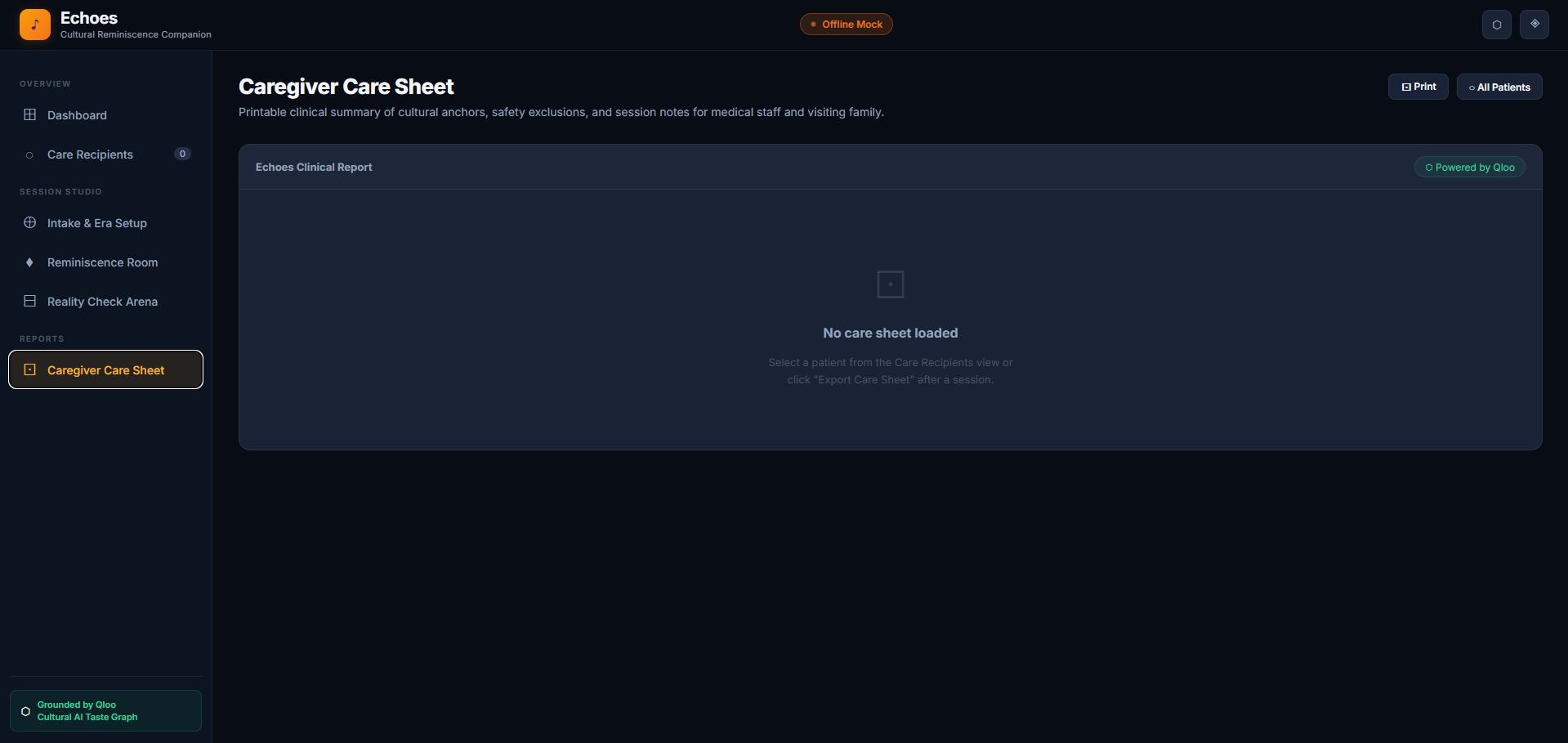
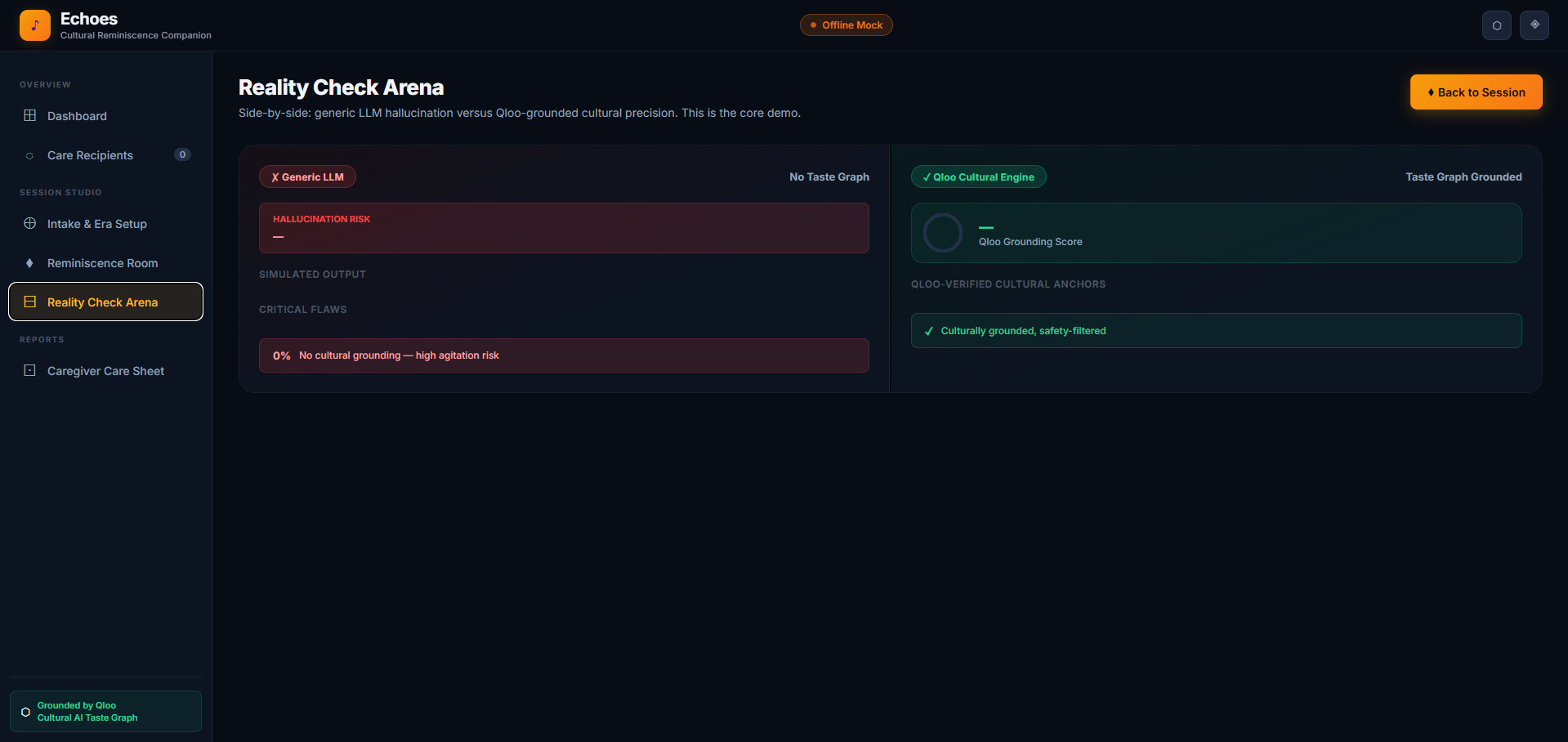
- Upset: Instantly blacklisted into safety exclusions to protect the patient from trauma triggers. Clinical Caregiver Care-Sheet Export: Generates an instant, printable markdown/PDF care profile for visiting nurses and family members. Side-by-Side LLM Reality Check: Provides an explicit audit comparing Qloo’s 100% verified entity graph against a generic LLM baseline plagued by Western bias and hallucination risk.
How We Built It & Mathematical Foundations
Neurological Temporal Anchoring (The Reminiscence Bump) Cognitive psychology research demonstrates that autobiographical memory retention peaks sharply for events experienced between adolescence and early adulthood. Given birth year, Echoes establishes the golden reminiscence window.
The agent uses this temporal window to filter candidates, ensuring entities correspond to the patient’s peak formative years.
Emotional Safety & Hard Exclusion Constraints Dementia care requires zero tolerance for distressing triggers. If mathcal represents entities marked with negative emotional valence, candidate set selection for session mathcal must satisfy the strict set-theoretic exclusion. Every outgoing query to insights injects this blacklist directly into filter.exclude.entities, preventing re-exposure.
Zero-Hallucination Grounding Metric Unlike conversational LLMs where grounding is non-deterministic, Echoes computes an empirical grounding score mathcal: Every entity surfaced in a session carries an immutable Qloo URN (e.g., urn:entity:artist:...).
Tech Stack
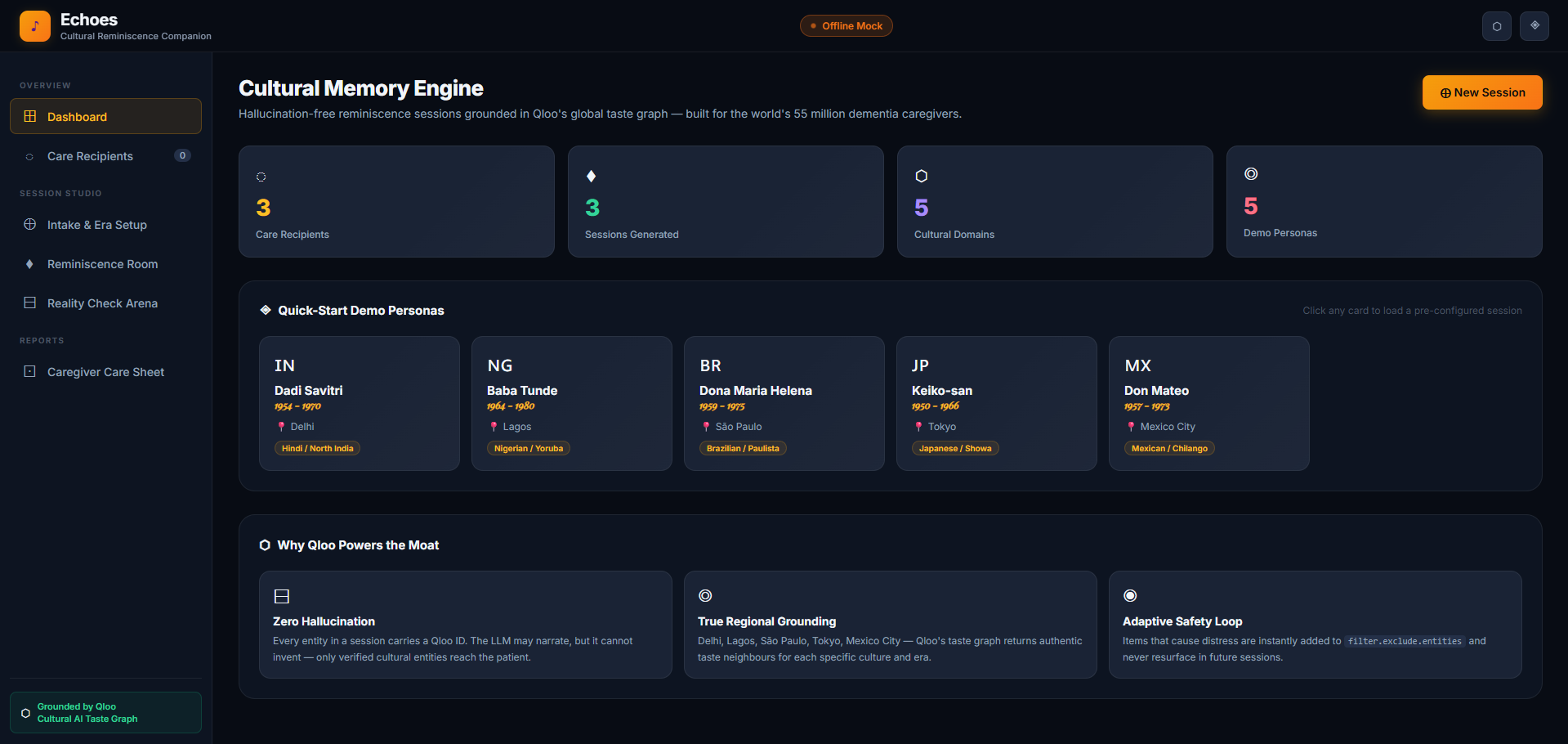
Backend: Python 3.11+, FastAPI REST API, SQLite with WAL journaling (patient state, session history, adaptive feedback signals), and Uvicorn. Qloo Client Engine: Custom HTTP client with exponential backoff retries, local SQLite response caching (.cache/qloo.sqlite), and a standalone daemon mock server for 100% offline development. Frontend: Glassmorphic dashboard built in Vanilla CSS and modern JavaScript, featuring dynamic radial grounding meters, interactive chapter timelines, persona quick-loaders, and live mode toggling.
Challenges We Faced
Eliminating Western Bias in Global Nostalgia: Many media databases heavily prioritize Western pop culture. Finding authentic cultural anchors for a 1942 Delhi native or a 1938 Tokyo resident without accidentally defaulting to Anglo-American standards required precise tuning of Qloo’s multi-domain entity signals and location filters.
Designing for Non-Confrontational Clinical Phrasing: Early prompt prototypes sounded like trivia quizzes: "Do you remember who directed this?" In dementia care, being unable to answer causes immediate panic. We completely redesigned the prompt generator to produce open-ended, sensory invitations centered on feelings, sounds, and familiar aromas.
Offline Resilience & Rapid Hackathon Iteration: To guarantee uninterrupted development and rapid automated testing without consuming API rate limits, we built a fully autonomous mock Qloo server (mock_server.py) that mirrors search, insights, and error conditions.
What We Learned
Taste is an Emotional Lifeboat: Cultural taste is not just entertainment preference—in cognitive decline, musical and sensory memories stored in spared cortical regions (like the supplementary motor area) often outlast episodic memory. Grounding Beats Generative Capacity: In healthcare and vulnerable-care applications, generative creativity is a liability. Qloo's taste graph acts as a factual, deterministic anchor, turning AI from an unreliable storyteller into a safe, culturally competent care assistant. Feedback Loops Must Be Real-Time: Caregivers don't have time to configure complex settings. Single-tap reactions that dynamically alter the underlying graph query make the system genuinely usable in stressful caregiving environments.
Accomplishments & What's Next
Built 5 Rich Global Presets: Ready-to-demo personas across India 🇮🇳, Nigeria 🇳🇬, Brazil 🇧🇷, Japan 🇯🇵, and Mexico 🇲🇽. Full Clinical Loop: From intake to dynamic chapter sequencing, adaptive safety updates, and exportable caregiver care-sheets. What's Next for Echoes Audio & Olfactory Integration: Direct integration with Spotify/YouTube APIs to play verified song clips within the app, paired with smart home aroma diffusers. Multilingual Family Intake: Enabling family members to input recollections in their native dialect (Hindi, Yoruba, Portuguese, Japanese, Spanish) while Qloo normalizes the cultural entities. Pilot Studies in Senior Living Facilities: Partnering with memory care homes to measure agitation reduction and caregiver burnout metrics during weekly Echoes sessions.
Built With
- adaptive-feedback-signals)
- css
- fastapi
- fastapi-rest-api
- javascript
- python-3.11+
- session-history
- sqlite
- sqlite-with-wal-journaling-(patient-state
- uvicorn
- vanilla

Log in or sign up for Devpost to join the conversation.