-
-
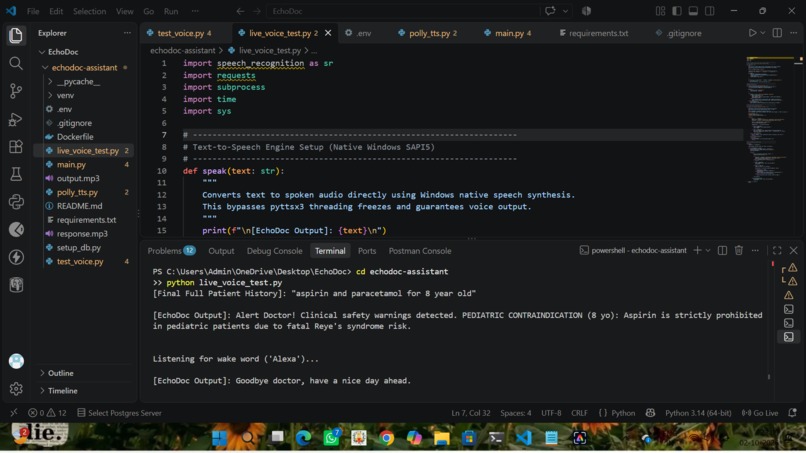
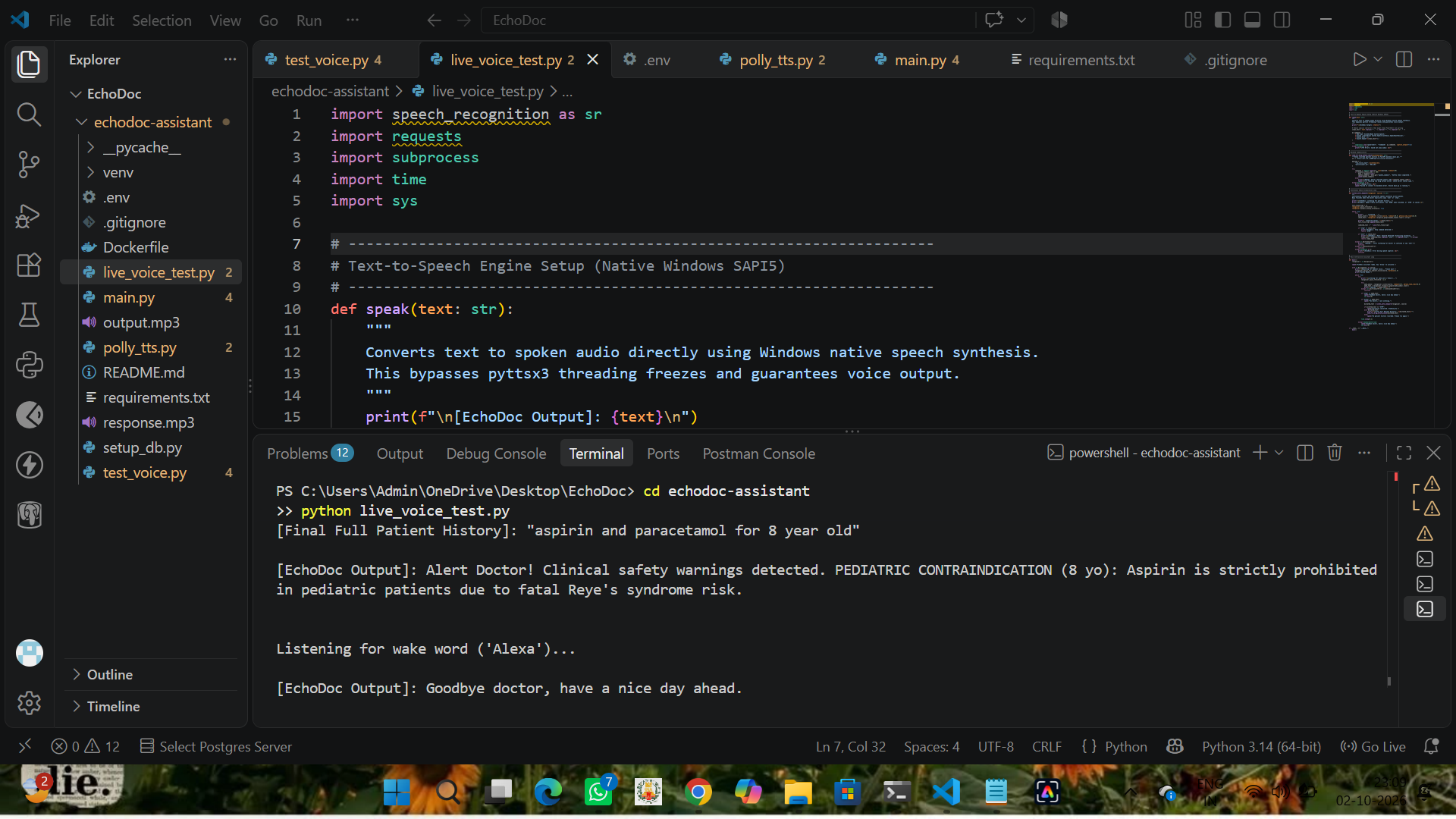
Ambient Voice Listener Client (live_voice_test.py) with Integrated Speech Recognition and TTS Synthesis
-
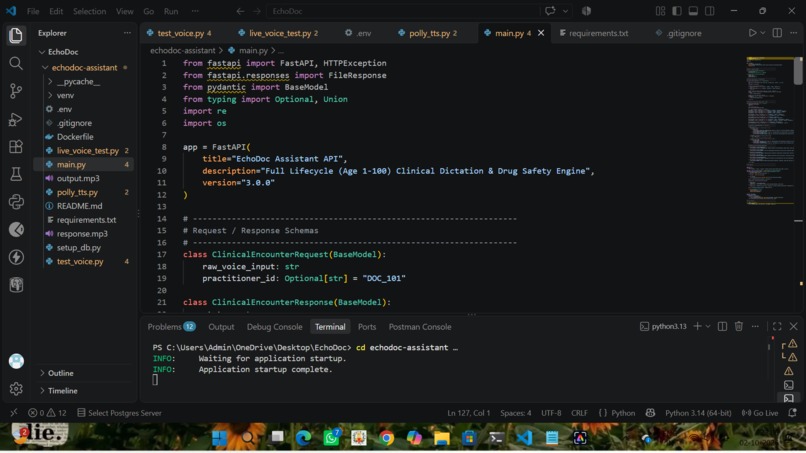
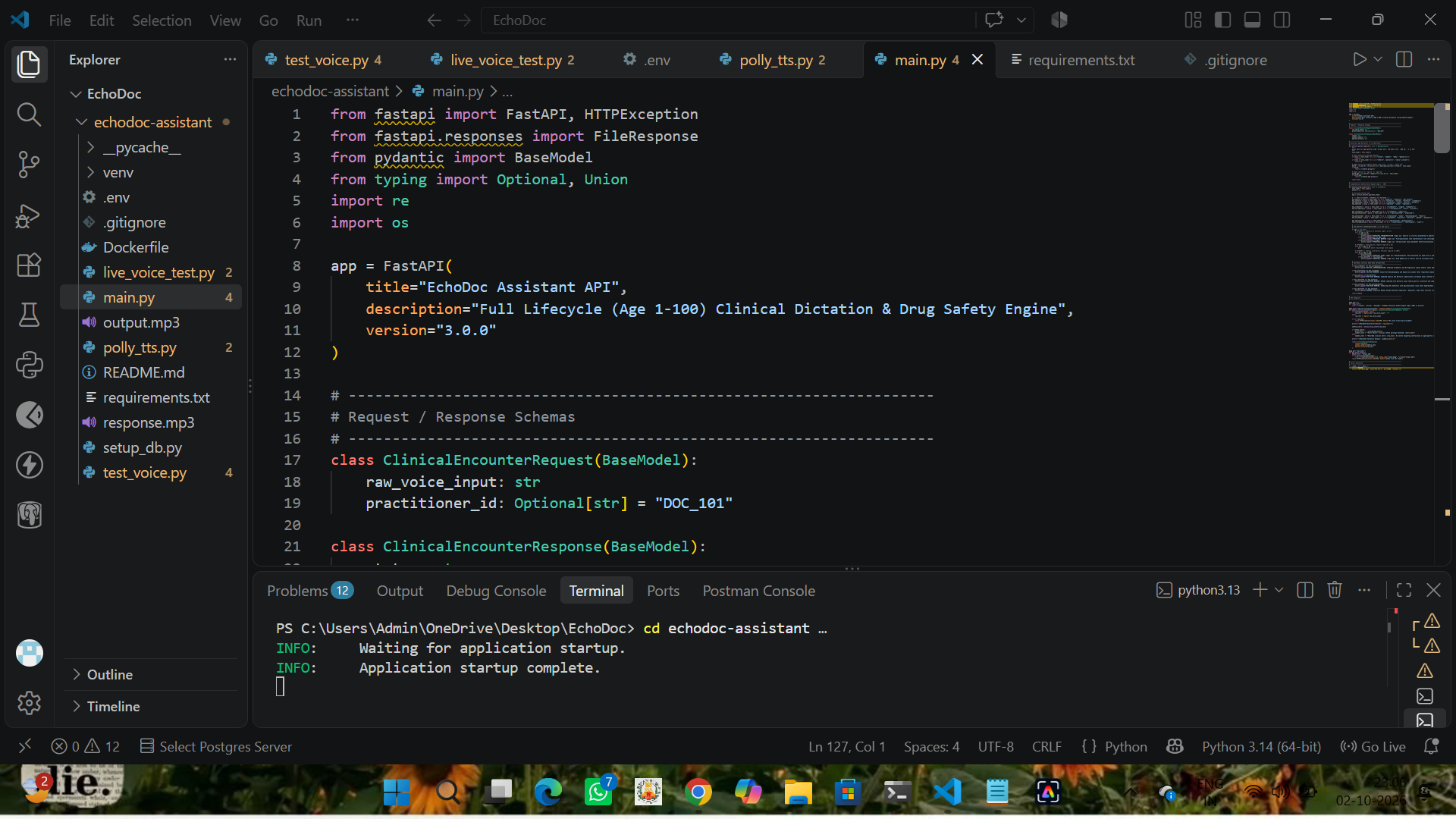
Ambient Voice Listener Client (live_voice_test.py) with Integrated Speech Recognition and TTS Synthesis
Inspiration## Inspiration
In high-pressure clinical environments, healthcare professionals spend hours manually dictating and typing patient notes. Under time pressure, critical polypharmacy risks, age-specific contraindications, or speech-to-text misspellings can lead to severe adverse drug events (ADEs). We built EchoDoc to serve as an ambient, voice-first clinical assistant that not only transcribes doctor dictation hands-free but also acts as a real-time safety copilot—evaluating drug interactions and age-specific warnings across ages 1 to 100 before prescriptions are finalized.
What it does
EchoDoc listens to natural clinician dictation, processes the voice transcript, and instantly evaluates potential medical risks. Key features include:
- Hands-Free Ambient Voice Dictation: Listens for wake words (e.g., "Alexa") and processes complete patient history entries ending with "over".
- Phonetic STT Defense Engine: Handles speech-to-text misinterpretations by mapping fuzzy phonetic dictations (e.g., "warren" for "warfarin") to actual pharmaceutical terms.
- Full-Lifecycle Age Sensitivity (Ages 1–100): Dynamically extracts patient age from voice input and applies age-tailored safety alerts—such as flagging Aspirin in pediatric patients due to Reye's syndrome risk or highlighting fall risks with Benzodiazepines in elderly patients.
- Critical Interaction Alerts: Detects severe drug-drug interactions (e.g., Sildenafil + Nitroglycerin causing fatal hypotension, Alprazolam + Opioids causing fatal respiratory depression, or Warfarin + NSAIDs causing internal hemorrhage) and provides real-time spoken audio alerts.
How we built it
- Backend API: Built with FastAPI and Python for ultra-low latency request handling.
- Speech-to-Text (STT): Utilized Python's
SpeechRecognitionlibrary configured for ambient listening and wake-word triggers. - Safety Rules Engine: Developed custom regular expression (Regex) parsers and phonetic dictionary matchers for real-time age extraction and multi-category risk analysis.
- Text-to-Speech (TTS): Integrated native Windows SAPI5 / AWS Polly speech synthesis for reliable, crisp spoken feedback to the clinician.
Challenges we faced
- Audio Synthesis Reliability: Initial implementations with third-party audio loops caused silent output failures on Windows environments. We overcame this by transitioning to direct Windows SAPI5 / AWS Polly synthesis.
- Phonetic Misrecognitions: STT engines frequently hear medical terms as common names or slang (e.g., "warren" instead of "warfarin"). We addressed this by building a dedicated phonetic alias dictionary within our backend rules engine.
- Complex Polypharmacy Logic: Structuring safety checks that balance pediatric contraindications, adult drug-drug interactions, and geriatric risks without adding latency required optimizing our parsing algorithms.
What we learned
We learned how to design robust, fault-tolerant clinical NLP pipelines that bridge voice UI with medical decision support systems. We gained deep insights into speech-to-text edge cases, dynamic age parsing, and building asynchronous FastAPI microservices optimized for real-time feedback.
What's next for EchoDoc
- AWS Cloud Deployment: Containerizing the FastAPI service using Docker and deploying it on AWS EC2 / AWS Lambda for scalable multi-clinic access.
- EHR Integration: Connecting EchoDoc directly to electronic health record systems (e.g., FHIR API integration) for auto-populating patient charts.
- Expanded Drug Database: Integrating live clinical APIs (like RxNorm or First Databank) for dynamic, real-time access to global pharmaceutical databases.
Built With
- amazon-web-services
- fastapi
- natural-language-processing
- python
- rest-api
- sapi5
- speech-recognition


Log in or sign up for Devpost to join the conversation.