EchoCheck: Forensic Sentiment Audit Inspiration
The stock market is increasingly driven by social media hype rather than underlying value. We’ve seen "meme stocks" skyrocket and then crash, often leaving retail investors holding the bag. We noticed that these pumps share a specific digital footprint: thousands of bot accounts repeating the same scripts. We built EchoCheck to give regular traders a way to audit the crowd and see if the hype is actually coming from humans or just a programmed loop.
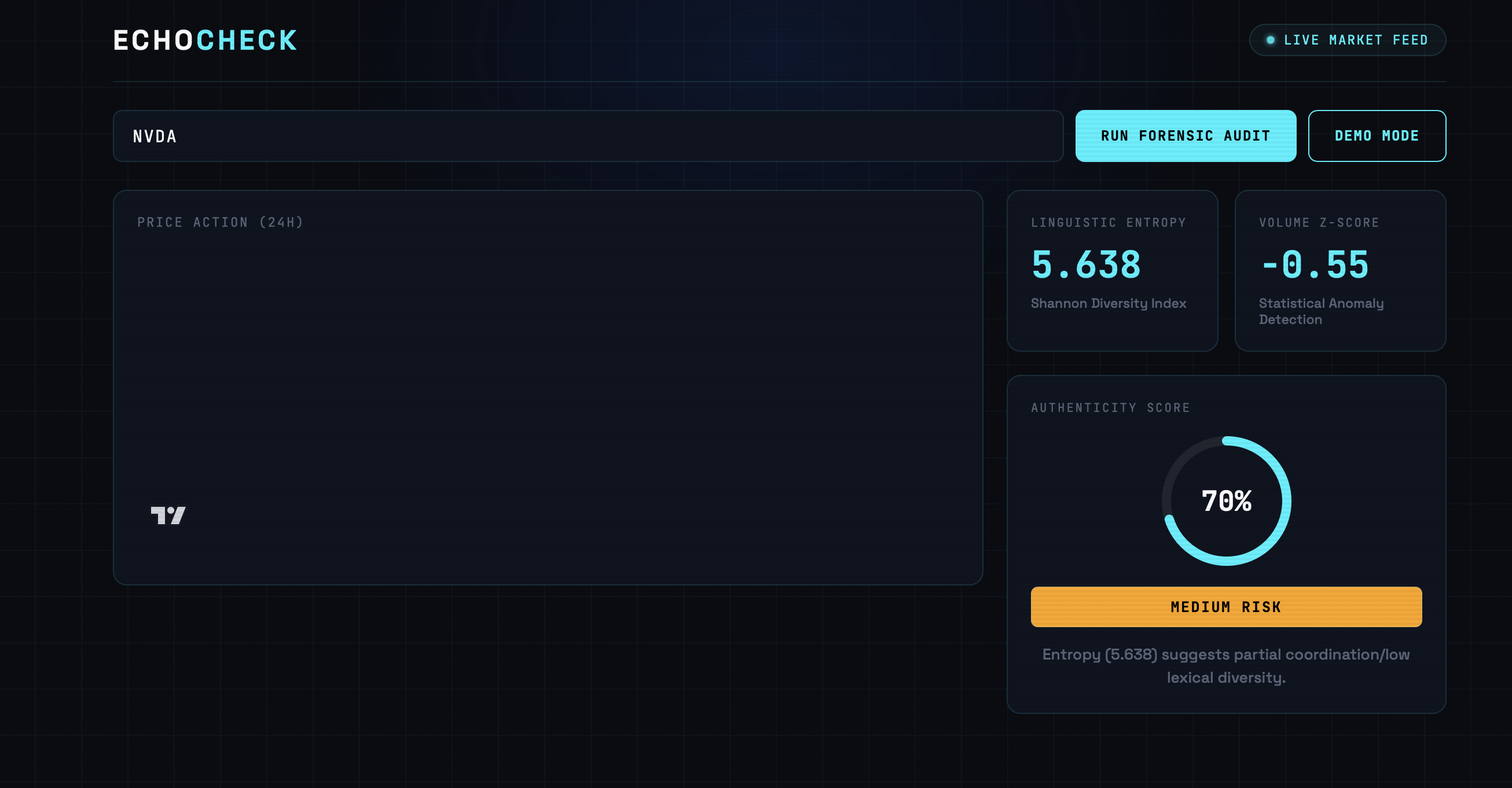
What it does: EchoCheck is a diagnostic terminal that runs a "stress test" on a ticker's social presence through three main vectors:
Linguistic Entropy: We use the Shannon Diversity Index to measure the randomness of the conversation. Humans use varied language; bots use templates. Low entropy is a mathematical red flag for automation.
Hype Surge (Z-Score): We track posting velocity in real-time. If the volume spikes significantly above the historical norm, we flag it as a statistical anomaly.
Financial Sentiment Tuning: Standard NLP libraries often miss the nuance of trading. We re-weighted our sentiment engine to recognize that words like "Short," "Squeeze," and "Breakout" are high-intensity directional signals.
Authenticity Score: We compress these vectors into a single "Trust Rating" so the data is actionable at a glance.
How we built it: The backend is a FastAPI server running Python 3.11. We implemented Shannon Entropy to quantify lexical randomness.
We used Z-score logic to catch volume spikes that deviate from the mean (μ) by more than 1.5 standard deviations (σ).
The frontend is a dark-mode dashboard built with Tailwind CSS and Lightweight Charts to mirror the look and feel of institutional trading tools.
Challenges: The biggest hurdle was the signal-to-noise ratio. Raw social media data is incredibly messy. As first-year students, we had to learn how to bridge the gap between abstract probability theory and code that runs in milliseconds. We spent a lot of the weekend fine-tuning our entropy thresholds—if they're too strict, you flag real excitement; if they're too loose, the bots get through. Finding that balance was the hardest part of the project.
Accomplishments: We’re proud that we didn’t just build a basic sentiment tracker. We built a forensic tool. Taking a concept like Information Entropy—which usually stays in textbooks—and making it work on live market data was a massive win for the team.
What we learned: We learned that data has a "texture." Beyond just positive or negative sentiment, there is a measurable difference in how humans communicate compared to machines. We also got a crash course in building a full-stack asynchronous app under a tight 24-hour deadline.

Log in or sign up for Devpost to join the conversation.