-
-
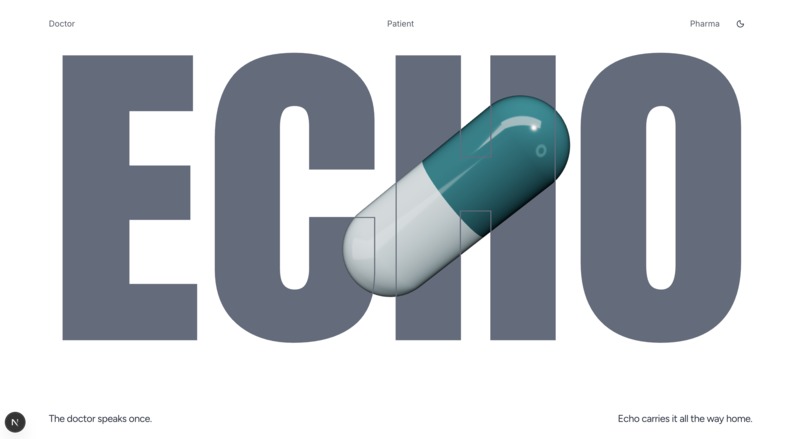
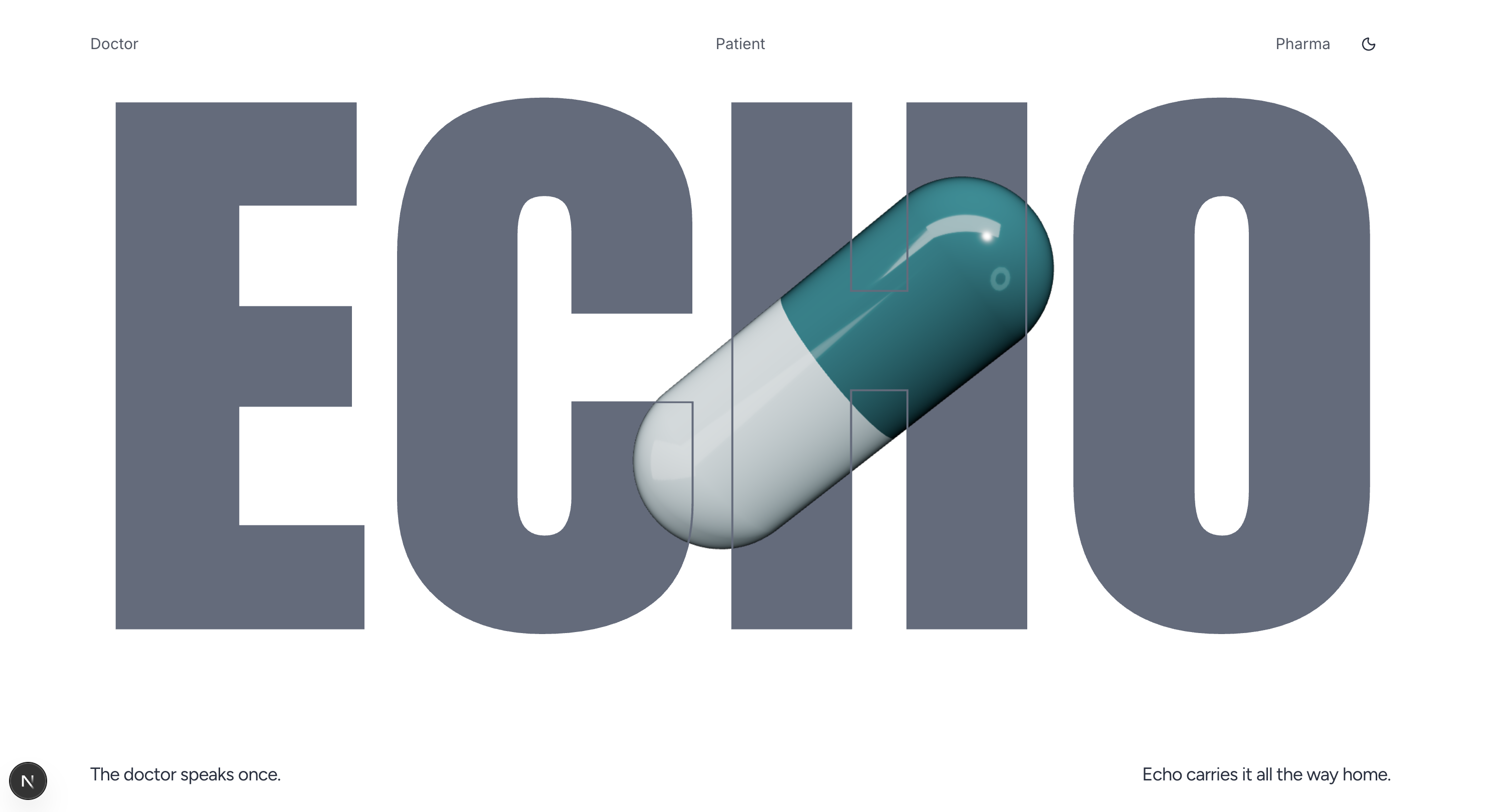
Landing Page
-
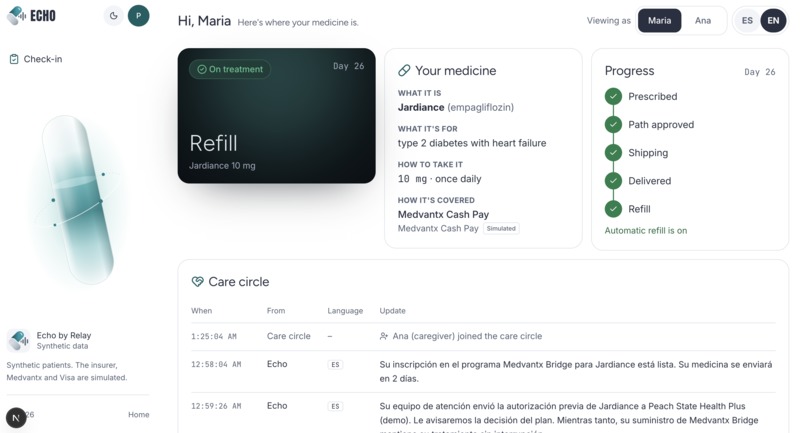
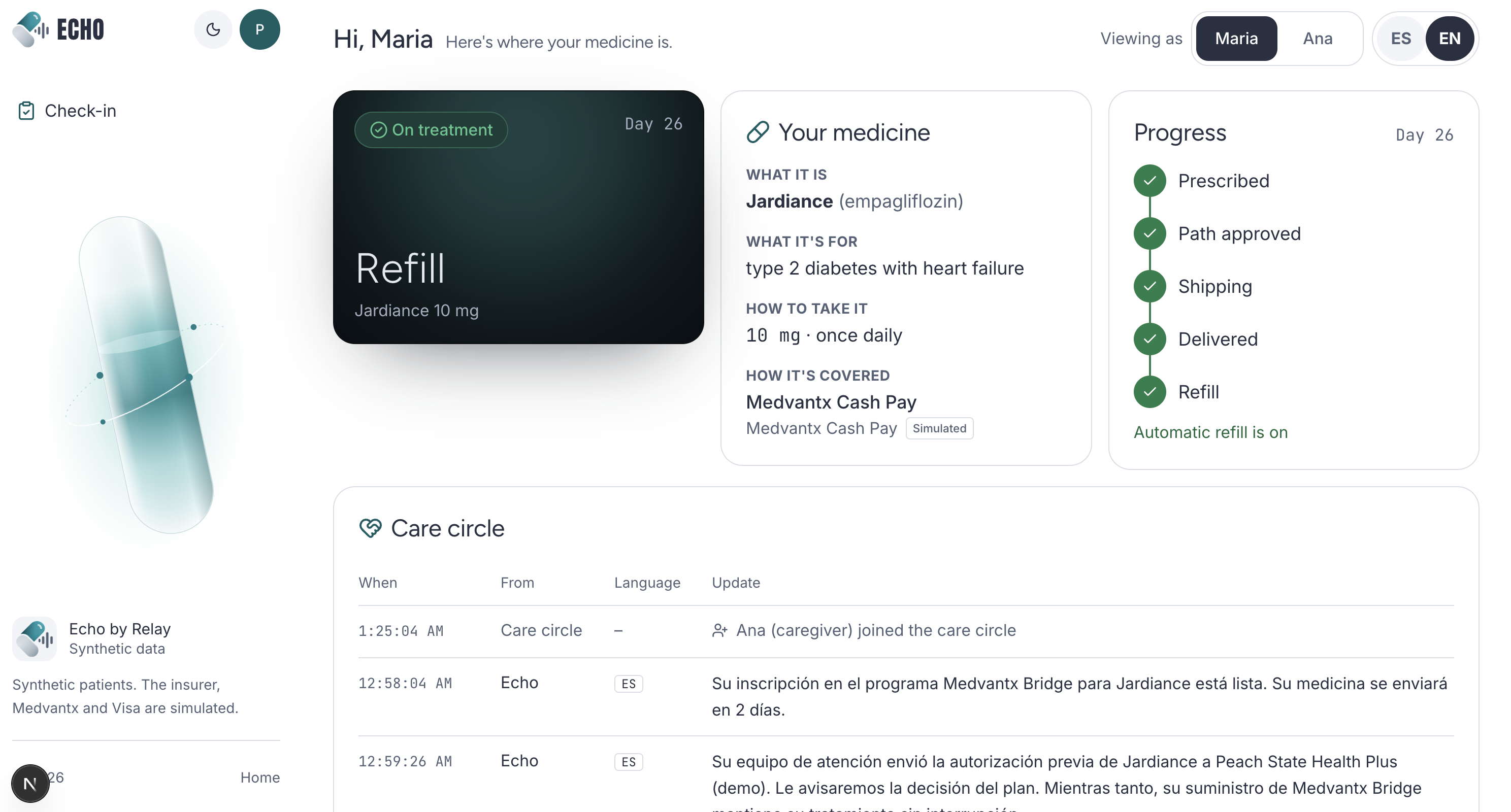
Patient Dashboard
-
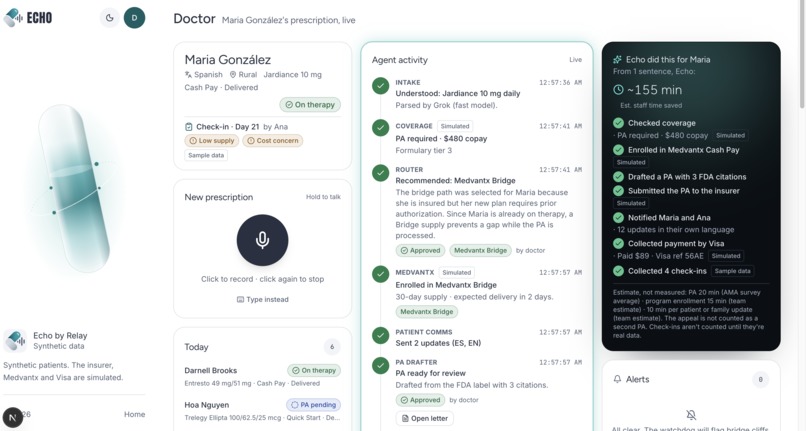
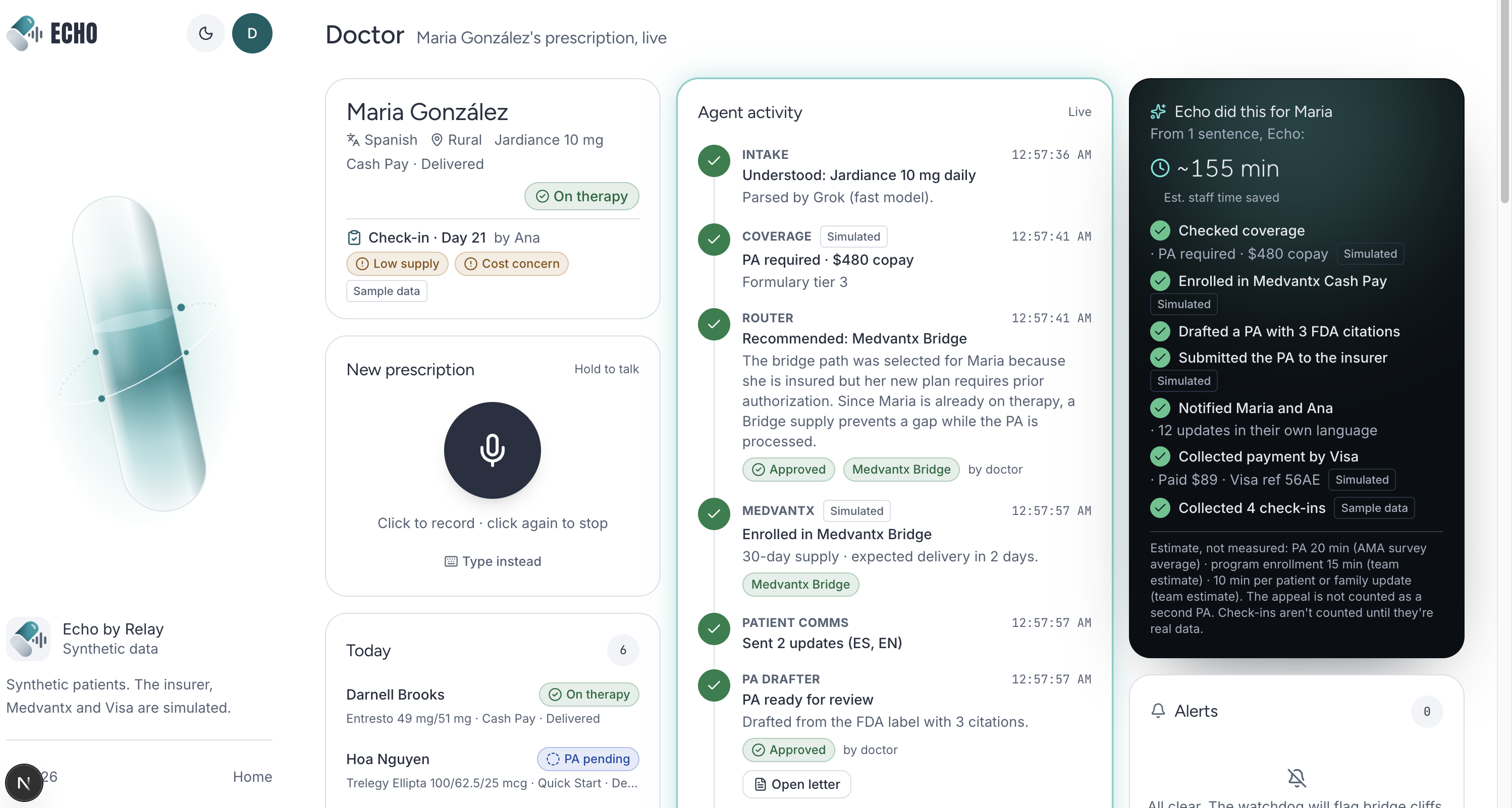
Doctor Dashboard
-
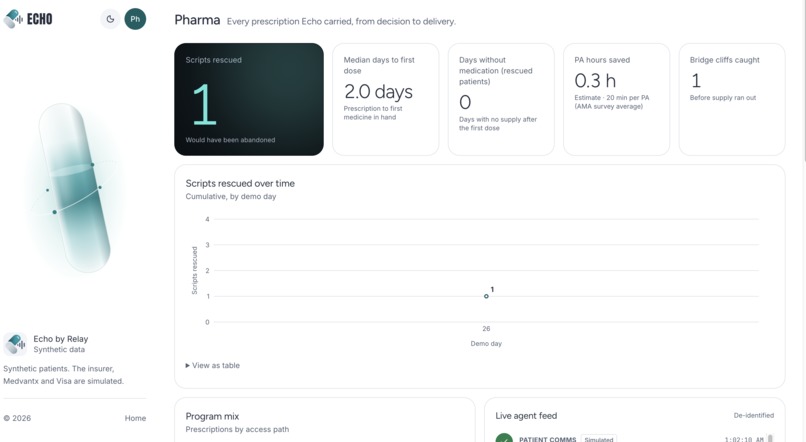
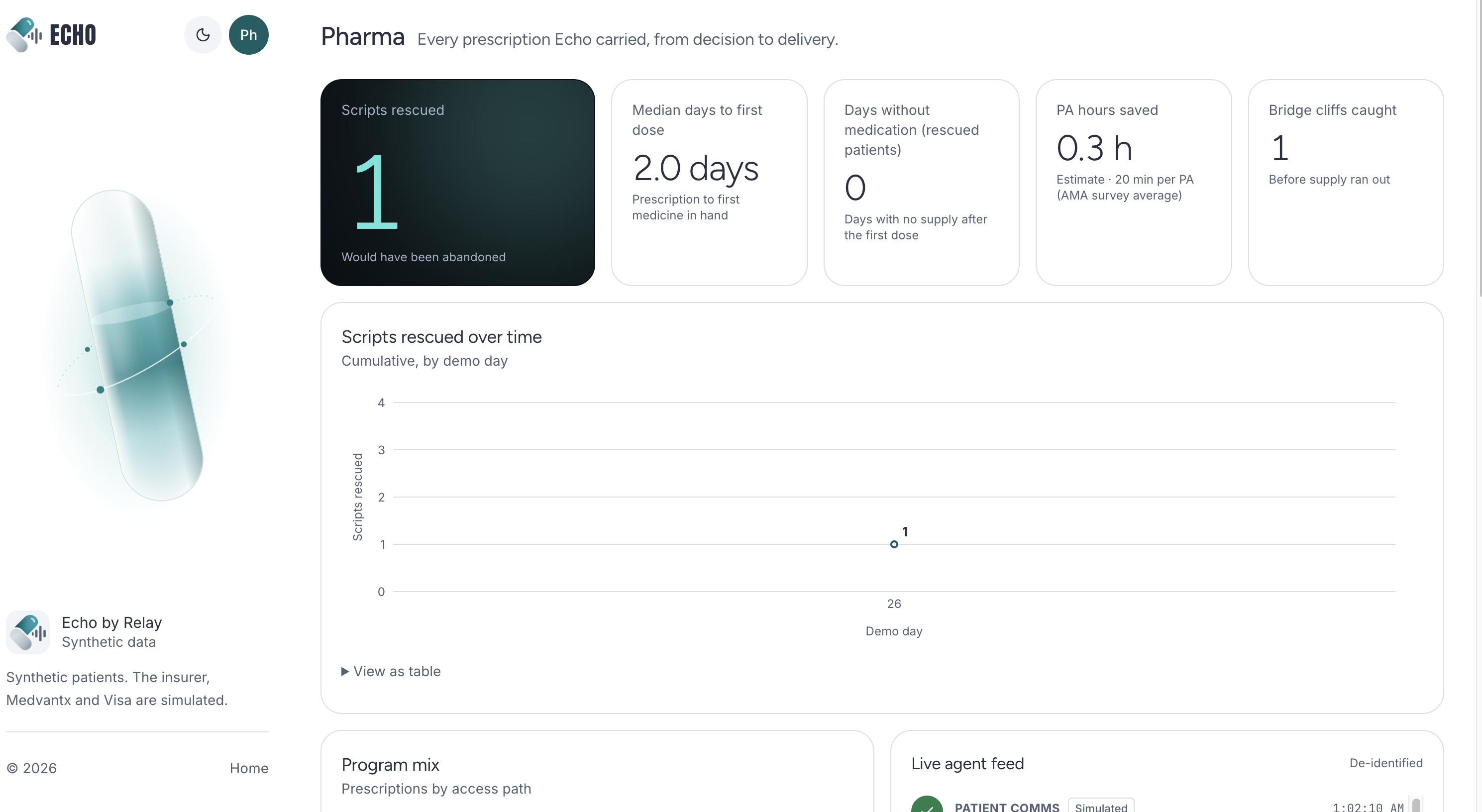
Pharma Company Dashboard
Inspiration
Almost a third of new branded prescriptions never reach the patient - insurers reject them, or patients quietly give up because of cost or paperwork. A doctor can prescribe the right treatment in thirty seconds, and it can still take weeks of insurance back-and-forth before the patient actually holds the medication. We wanted to build something that doesn't stop at the prescription - it carries the patient the rest of the way, automatically, in the background, while the doctor keeps seeing patients.
What it does
Echo by Relay is a voice-first assistant that makes sure patients actually get the medicine their doctor prescribes. A physician says a single sentence ("Starting [patient] on [drug], 10 mg daily") and Echo takes it from there:
- Checks coverage and determines whether prior authorization is required
- Routes the patient down the right path: a free Medvantx Bridge supply, a Patient Assistance Program, Quick Start, or cash pay, whichever fits their insurance and income
- Drafts the prior authorization letter, citing exact sentences from the drug's FDA label so every clinical claim is traceable. It also draws on the patient's history (conditions, labs, prior treatment) and their regular check-ins (is the medicine arriving, are they taking it, any side effects), so the request reaches the insurer complete and well supported, which makes a denial less likely
- Explains the plan to the patient in their own language (Spanish or English), in plain words
- Keeps caregivers in the loop, safely. Before a caregiver can join a patient's care circle, they must sign a consent and privacy agreement on the website. Until they've signed and logged in, no patient information is shared with them
- Lets a caregiver pay for cash-pay medication through a Visa agent, within a spending cap they set themselves
- Watches every prescription in the background and alerts the doctor before a patient silently falls off therapy, for example when a bridge supply is about to run out and the insurance approval still hasn't arrived
Three portals make this real: a Doctor app (voice intake, live prescription status, one-tap approvals, cited PA letters), a Patient app (plain-language plan, check-ins, delivery status, care circle with caregivers), and a Pharma dashboard (scripts rescued, time to therapy, and patients reached in underserved ZIP codes, all de-identified).
How we built it
EchoByRelay is a Next.js application backed by Supabase (Postgres + real-time subscriptions), deployed on Vercel. A three-person team split the work into three parallel tracks: engine (orchestration, AI agents, insurance/payment logic), experience (all three portals, the live demo), and integration (data, testing, deployment, sponsor coordination).
The core intelligence runs on Grok 4.3 (xAI), toggled between reasoning and non-reasoning modes depending on the task - reasoning mode for tasks like drafting a defensible PA letter with citations, and a faster mode for real-time voice intake parsing. The PA drafter performs retrieval against the real openFDA label for our demo drug (Jardiance/empagliflozin, an actual FDA-approved medication for both type 2 diabetes and heart failure) so every citation in the generated letter is a real, exact sentence from the label - not a hallucinated claim.
Patient data is fully synthetic - six seed patients, one per Medvantx program (bridge, PAP, cash pay, quick start, and covered/retail), each with realistic conditions and a full clinical history (vitals, lab trends, encounter timeline). To make that synthetic history clinically believable, we referenced value ranges and trend patterns from the openly-available MIMIC-IV Clinical Database Demo (a real, de-identified 100-patient ICU/ED dataset) - used strictly as a pattern reference to ground realism, never copied directly, so every record in our own database remains fully invented.
Insurance and payment systems (the insurer, Medvantx, and the Visa agent) are simulated with data shapes that mirror the real systems, since integrating actual regulated third-party APIs wasn't realistic in a 36-hour build - a fact we say plainly on stage and in this write-up rather than implying otherwise.
The team coordinated through three git branches (engine, experience, integration) merged into main every 2-3 hours, with a shared types file and event schema as the contract between them, and an end-to-end Playwright test that exercises the full patient journey - voice intake through to the pharma dashboard incrementing - to make sure the "Maria" demo never silently broke as pieces landed.
Challenges we ran into
Coordinating three people editing a shared schema in real time was the hardest part. More than once we had to pause and explicitly confirm ownership before touching a file outside our own lane - for example, deciding together whether five additional demo patients belonged in the actual seed database or only as UI-side fixtures, and confirming who owned a shared constant that appeared, inconsistently, on two different screens (a "staff time saved" figure that needed one clear, sourced number instead of two contradicting placeholders).
We also had to get genuinely disciplined about citations. Our validation layer rejects any PA-letter citation that isn't an exact, verbatim 8+ word sentence copied from the real FDA label - which meant we couldn't fake or approximate a single quote; every citation had to be generated from the real live chain against real label text.
On the data side, we made a deliberate call not to include an "at-risk" patient status among our seed data until the watchdog system that monitors prescriptions actually existed - an amber-status seed row with no live monitoring behind it risked being silently wrong on stage, so we chose accuracy over visual variety.
Accomplishments that we're proud of
Getting the full Maria journey - voice sentence in, medicine to the patient out - running end-to-end, with every clinical citation in the PA letter traceable to a real FDA label sentence, not an invented one. We're also proud of grounding our "staff time saved" metric in an actual cited source (the AMA's 2024 Prior Authorization Physician Survey) rather than a made-up number, and being upfront, in the product and on stage, about exactly which parts of the system are real versus realistically simulated.
What we learned
How much of the real burden in healthcare technology isn't the AI itself — it's the surrounding trust infrastructure: citation validation, synthetic-data discipline, and clear ownership boundaries across a shared codebase. We also learned firsthand why prior authorization is such a documented burden on physicians — building even a simplified version of the PA drafting process made the AMA's 13-hours-a-week statistic feel very real.
What's next for EchoByRelay
Real integrations with insurance eligibility systems and Medvantx's actual APIs, replacing our honest simulations with production connections. Expanded language support beyond Spanish and English. A production-grade watchdog with configurable risk scoring across a full patient population. And deeper partnership conversations with Visa (for real Intelligent Commerce agent payments) and Impiricus (for real HCP-network distribution).
Why Echo fits each track
🧠 Oracle of the Deep (ML/AI)
Echo uses AI where it matters and constrains it where it's risky. Grok 4.3 runs in two modes: a fast mode parses a doctor's spoken sentence into a structured prescription in seconds, and a reasoning mode drafts the prior authorization letter. That letter is grounded by retrieval against the real openFDA label for Jardiance, and a validation layer rejects any citation that isn't a verbatim 8+ word sentence from the label, so the model can't invent clinical claims. Every LLM output that drives logic is schema-validated JSON with a retry and a deterministic fallback, and eligibility decisions stay in deterministic code; the model only writes the explanation. The result is AI a clinician can actually trust: fast, cited, auditable, and honest about what's simulated.
🩺 Impiricus: Invent the next way we engage HCPs
Reaching a physician today means another email, rep visit, or portal they'll never open. Echo engages HCPs inside the one moment that matters: the prescribing decision. The doctor says one sentence; Echo handles coverage, program enrollment and a cited prior authorization, then returns a single one-tap approval. It's engagement that gives physicians time back instead of taking it (the AMA reports physicians spend ~13 hours a week on prior authorization). For life-sciences teams, every rescued prescription flows into a de-identified pharma dashboard (scripts rescued, time to therapy, patients reached in underserved ZIP codes), turning HCP engagement into measurable patient outcomes instead of impressions.
🌊 Aramco: A Marina's Mission (Social Good)
Almost a third of new branded prescriptions never reach the patient, and the people most likely to fall through are the ones with the fewest resources: rural patients far from a pharmacy, patients who don't speak English, and families who can't absorb a surprise $480 copay. Echo is built for them. Maria, our demo patient, is a Spanish-speaking woman in rural South Georgia. Echo finds her a free bridge supply so she starts treatment today, explains her plan in her own language, and lets a caregiver she trusts help, only after that caregiver signs a consent agreement. Its watchdog catches her before she silently runs out of medicine. The pharma dashboard even tracks patients reached in underserved ZIP codes, so success is measured by who gets care, not just how many. Echo's goal is simple: no patient left without their medicine because of cost, language, distance or paperwork.
✨ Best use of Gemini API
Echo treats reliability as a clinical requirement, and Gemini is our resilience layer. If the primary model fails or times out, Gemini takes over prescription parsing and patient-facing explanations before Echo ever falls back to cached responses. A patient's path to their medicine never stalls on one provider's outage.
🎙️ Best use of ElevenLabs
Echo is voice-first because doctors don't have time to type. ElevenLabs Scribe turns the physician's spoken sentence into accurate text, including drug names and dosages that generic browser speech often mangles, and our intake agent parses it into a structured prescription. Approvals work by voice too: saying "approve" signs off on a bridge enrollment or a prior authorization. If the network drops, it degrades gracefully to browser speech and then typing, so the doctor is never blocked.
💬 Best use of Backboard
Patients and caregivers have questions long after the appointment ends: "When does my medicine arrive?" or "What will this cost me?" Echo's Ask box, powered by Backboard, answers them in plain language inside the patient portal, grounded in that patient's own plan and delivery status. When it can't answer safely, it says the care team will follow up instead of guessing, so no patient is left alone with a question.
Built With
- grok
- nextjs
- supabase
- tailwindcs
- typescript
- vercel
- xai


Log in or sign up for Devpost to join the conversation.