-
-
RESULT
EchoAid AI — The Commitment Guardian
The problem
People don't just forget tasks. They lose track of commitments that depend on other people, unfinished work, and decisions that change the next steps. A normal reminder can tell you when to do something, but it may not explain what is blocking you, what needs to happen first, or how a delay affects the rest of your plan.
Our solution
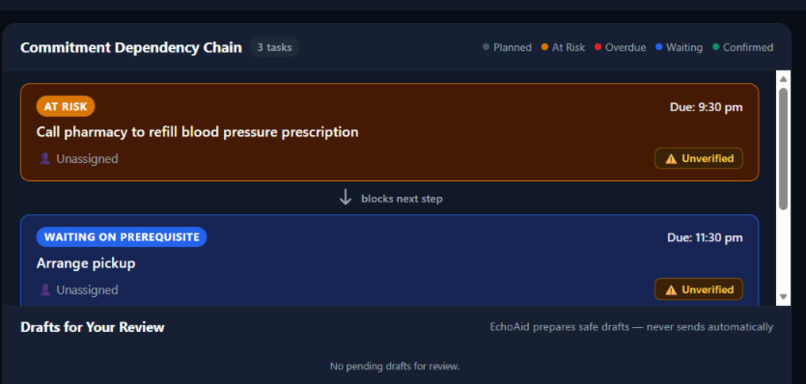
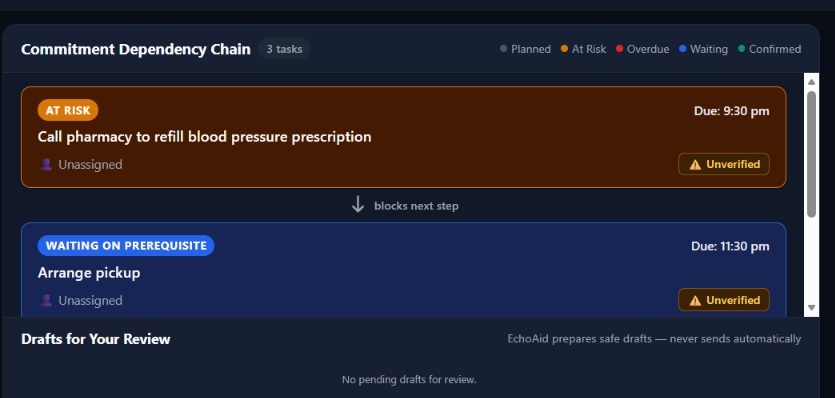
EchoAid AI is a dependency-aware coordination agent that turns everyday conversations into trackable workflows. It identifies commitments, organizes tasks and dependencies, tracks what is still unverified, and recommends the next useful action when something gets blocked.
For example, if a student needs a teammate to review a project report before submission, EchoAid can create a workflow with the review as a dependency. If the review is still pending, it highlights the blocker and prepares a follow-up message for the user's approval. When the user confirms an update, EchoAid adjusts the workflow accordingly.
What makes it different?
EchoAid is designed around the state of a commitment, not just its deadline. It distinguishes between open, blocked, and completed tasks; tracks dependencies between steps; preserves workflow context across refreshes; and avoids claiming that an action happened unless the user confirms it. Follow-up messages are drafts for review, not automatically sent messages.
How we built it
We are developing EchoAid with a web interface for viewing workflows and interacting with the agent, a backend for task and dependency management, persistent storage, and an agent-tool integration based on the Model Context Protocol (MCP), where implemented. The intended architecture separates the conversation layer from the workflow state so that tasks can be updated consistently.
What we learned
Building EchoAid challenged us to think beyond generating AI responses. A useful agent needs structured state, clear dependencies, reliable persistence, and safeguards against assuming that something has been completed. We also learned that a polished demo must show the underlying workflow changes—not just a chatbot conversation.
Current status and next steps
Our focus is to demonstrate a complete workflow: capture a commitment, identify its dependencies, preserve it across a page refresh, detect an unresolved blocker, prepare a follow-up draft, and update the state after explicit confirmation. We will distinguish implemented features from planned features in the demo.
EchoAid's goal is simple: help people follow through on commitments by making blockers and next actions visible.

