Inspiration
Last Year, nearly 33,000 emergency calls in Florida went unanswered. That’s not just a number , these were lives at risk. With studies showing that each minute of delay increases mortality by 17%, we asked ourselves: What if someone could step in when the line goes silent?
That’s why we created Echo, an AI-powered emergency call assistant that listens, understands, and responds when humans can’t.
What it does
Echo activates automatically when a 911 call goes unanswered for 10 seconds. It connects the caller to our fine-tuned AI call agent, trained to:
- Listen actively and collect critical details (location, issue, age, injuries, etc.)
- Generate a complete incident report
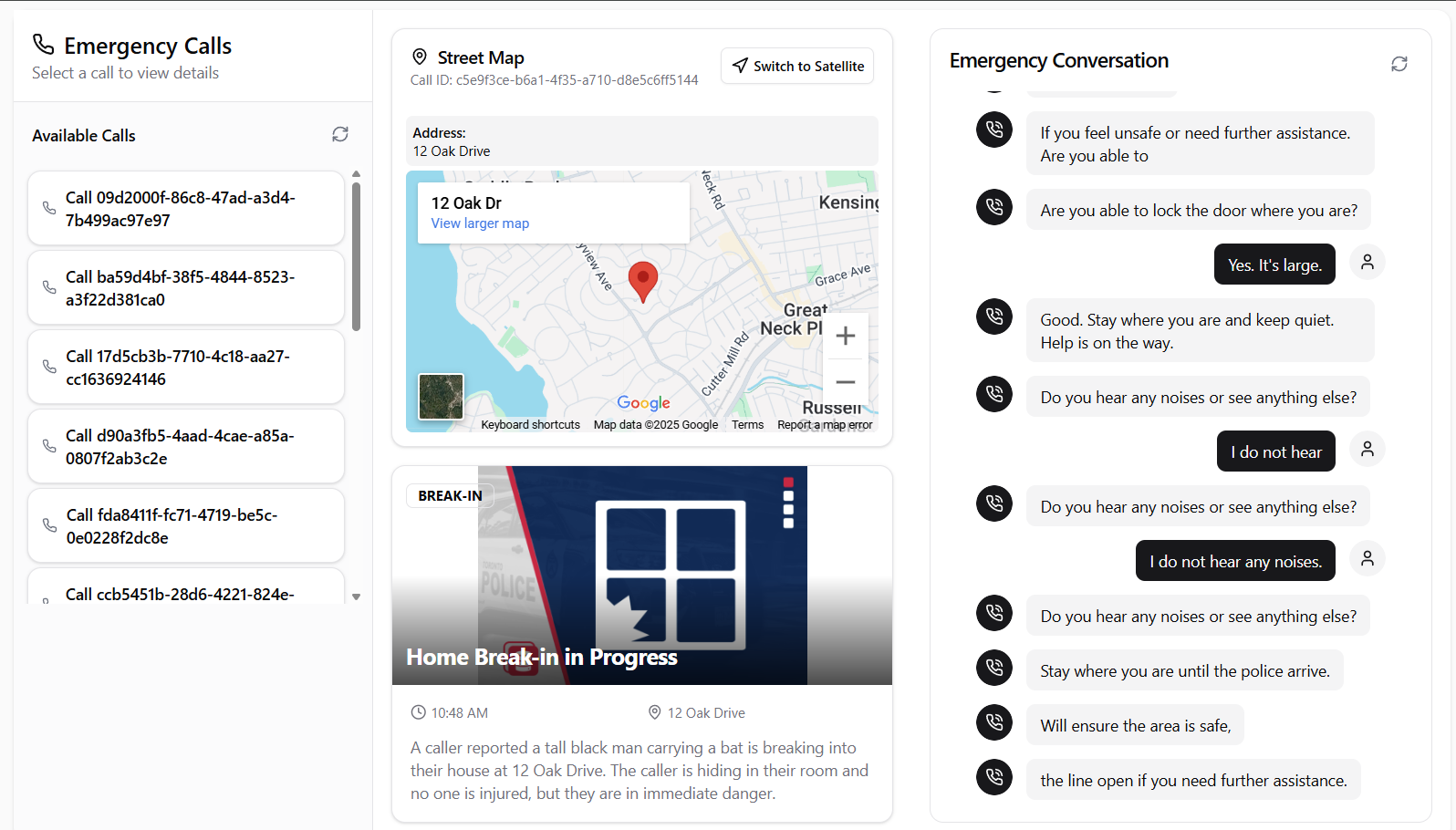
- Pinpoint the caller on a map
- Sketch a visual description of any person mentioned (e.g. missing individuals, suspects)
- Forward all data instantly to the appropriate emergency responders (police, EMTs, firefighters)
Remember, Echo doesn't replace 911. It acts as a backup when the emergency call center is backed up.
How we built it
Echo is powered by Vapi, a voice API that helps us handle emergency calls seamlessly. Here’s how it works:
- When someone calls our number, Vapi records the conversation and transcribes it in real-time.
- We then pull out the important details — like the caller’s location, the nature of the emergency, their age, and any other critical info.
- This information is sent straight to the frontend, where it’s displayed on a clean, easy-to-read emergency report.
- The frontend, designed with React.js and styled with Tailwind CSS, shows everything from the caller's details to a map of their location and even a sketch of any person described during the call.
Echo turns the chaos of an emergency call into clear, actionable information for responders, ensuring help gets there faster when it’s needed most.
Challenges we ran into
One of our biggest challenges was capturing the transcript from the call in real-time. Since Vapi uses webhooks to send call data, we had to carefully handle timing issues and make sure we were consistently receiving the full transcript without losing any part of the conversation. It took a lot of trial and error to get everything flowing smoothly between the voice data, our backend, and the frontend.
Accomplishments that we're proud of
- This was our first time working with webhooks, and getting real-time data flowing from a live phone call into our app was a huge milestone for us.
- We also integrated AI into an actual phone conversation for the first time — something we weren’t sure we could pull off in just a weekend.
- Most importantly, we built something that tackles a real-world, life-saving problem, and we’re proud of how far we pushed ourselves to make it work.
What we learned
We learned how to work with webhooks to handle real-time call data, which was new territory for us.
- We discovered how important prompt design is when using AI for serious, time-sensitive tasks.
- We also gained insight into real emergency protocols, helping us shape a more realistic and effective call experience.
- Most of all, we learned how to build under pressure and stay focused on solving a real-world problem.
What's next for Echo
These are features we would like to bring to echo:
- Multi-language support to help non-English speakers in emergencies.
- Faster location detection using device GPS and network data.
- Continue training our AI with real emergency scripts to improve accuracy and empathy.


Log in or sign up for Devpost to join the conversation.