-
-
Project Main Image
-
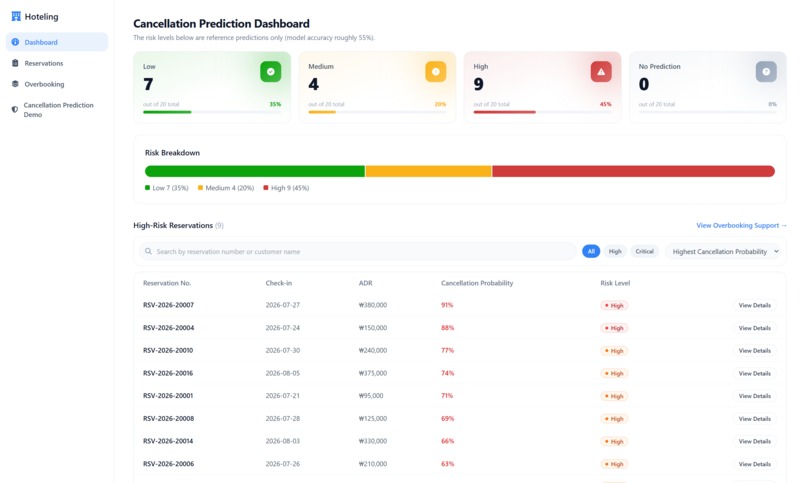
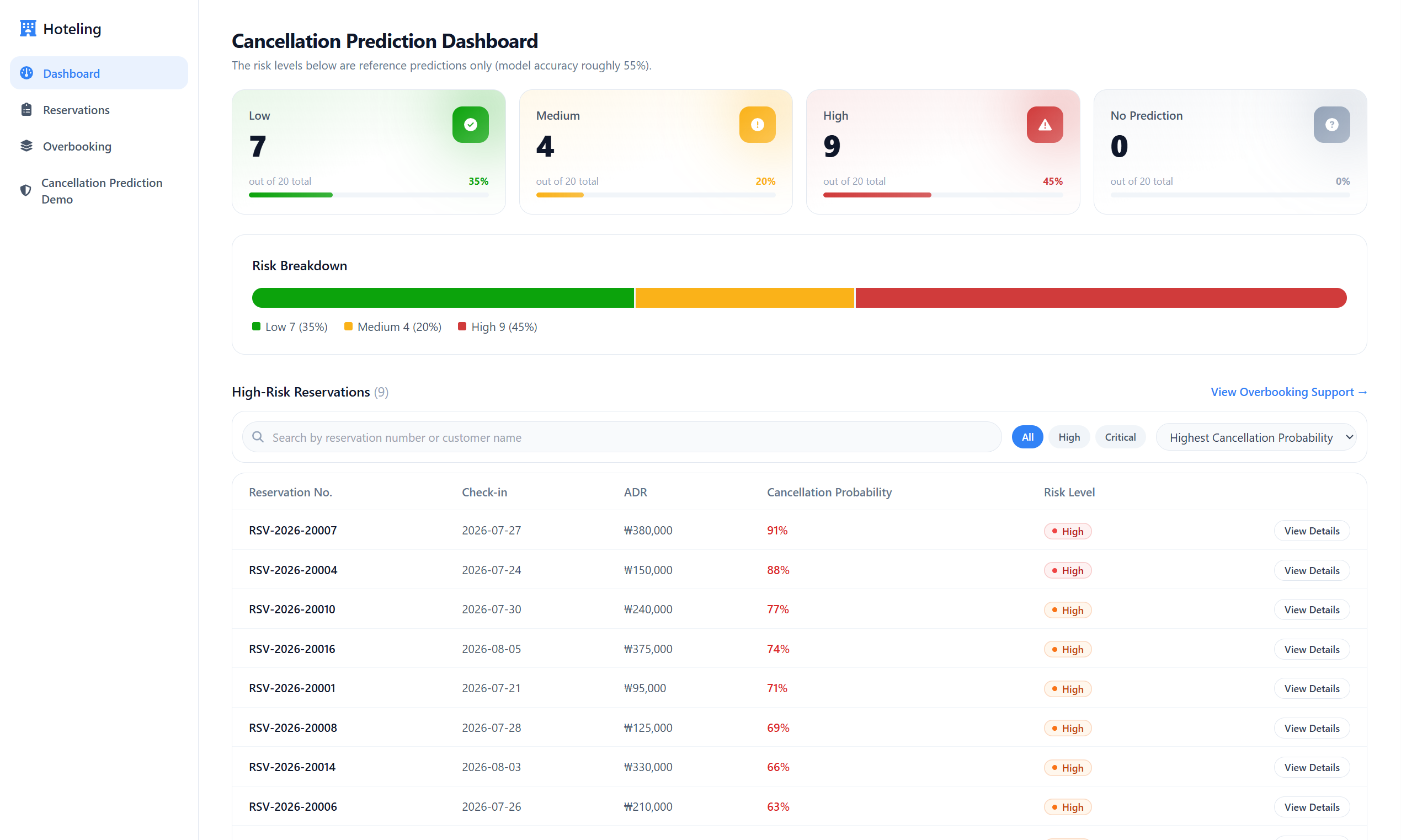
Dashboard
-
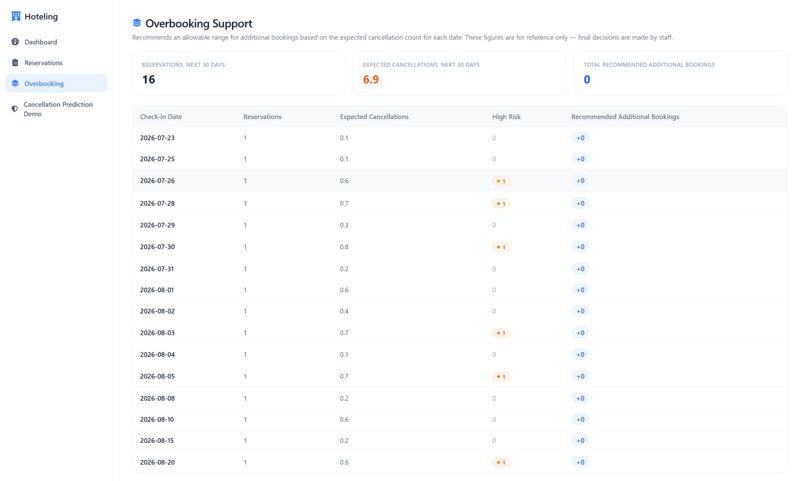
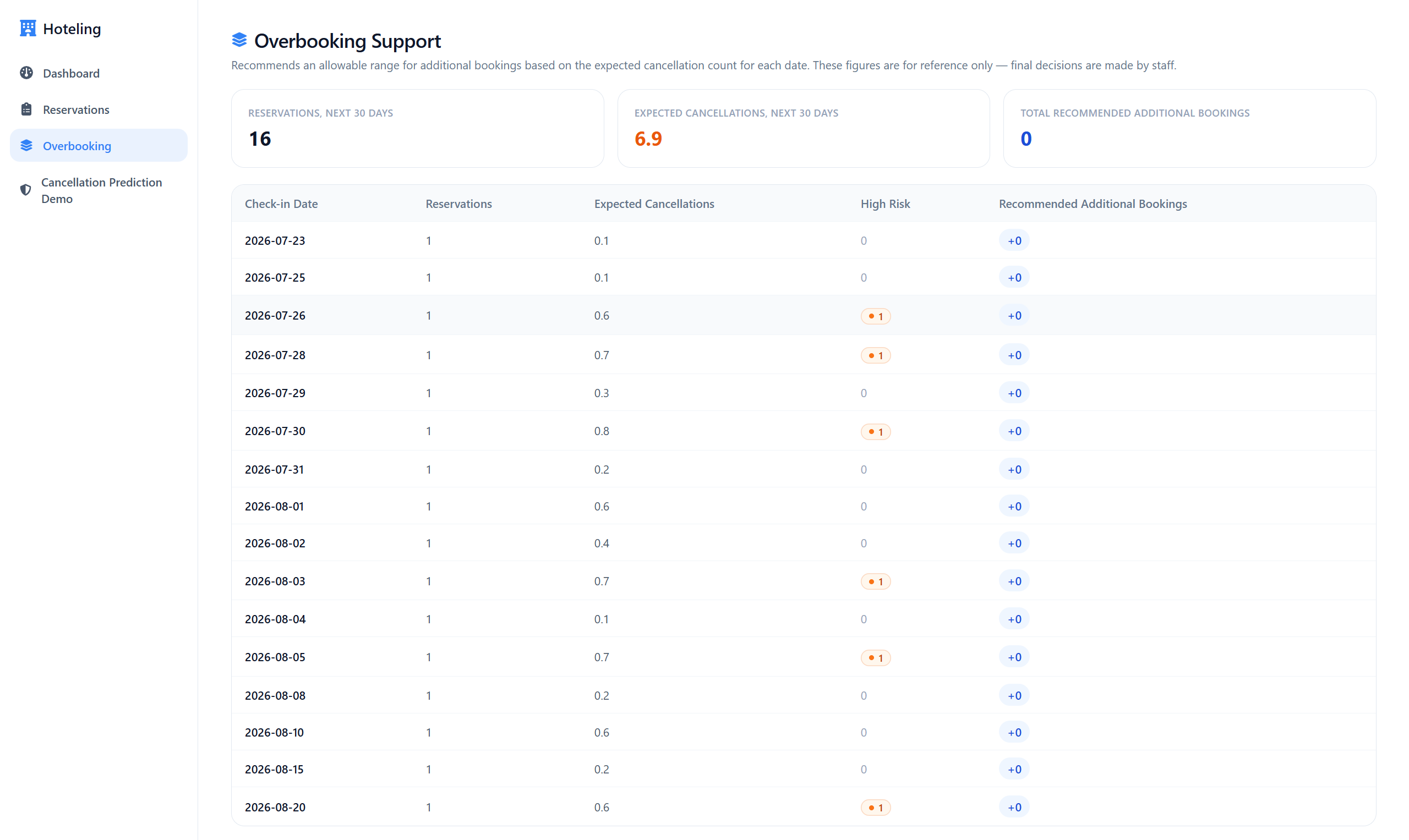
overbooking
-
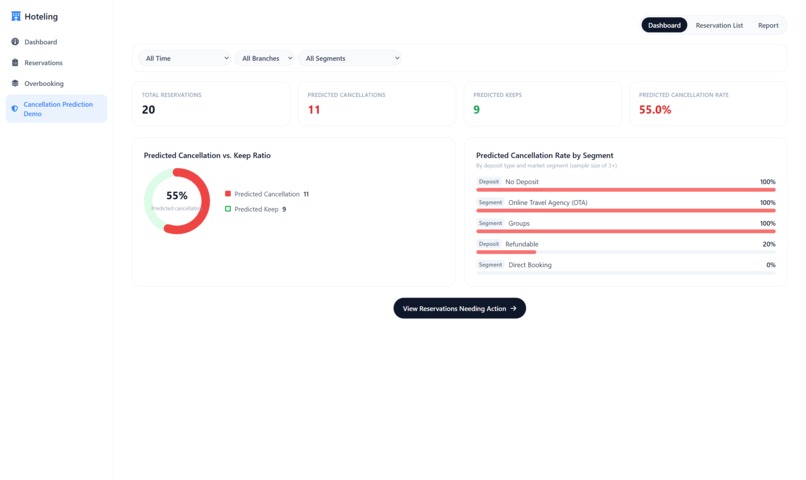
Cancellation Prediction Demo
-
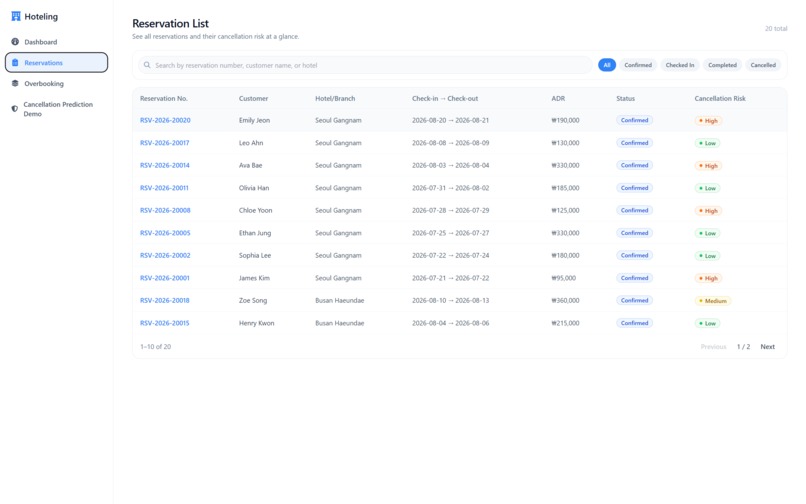
Reservations
Problem Statement
Hotel booking cancellations create uncertainty in room inventory management, customer service, room resale planning, and expected revenue. When hotel staff manage many reservations at the same time, it can be difficult to consistently determine which bookings require attention first.
If a possible cancellation is identified too late, staff have less time to confirm the reservation with the guest or prepare the room for resale. Manually reviewing every reservation also takes considerable time and can lead to inconsistent decisions among staff members.
Solution Overview
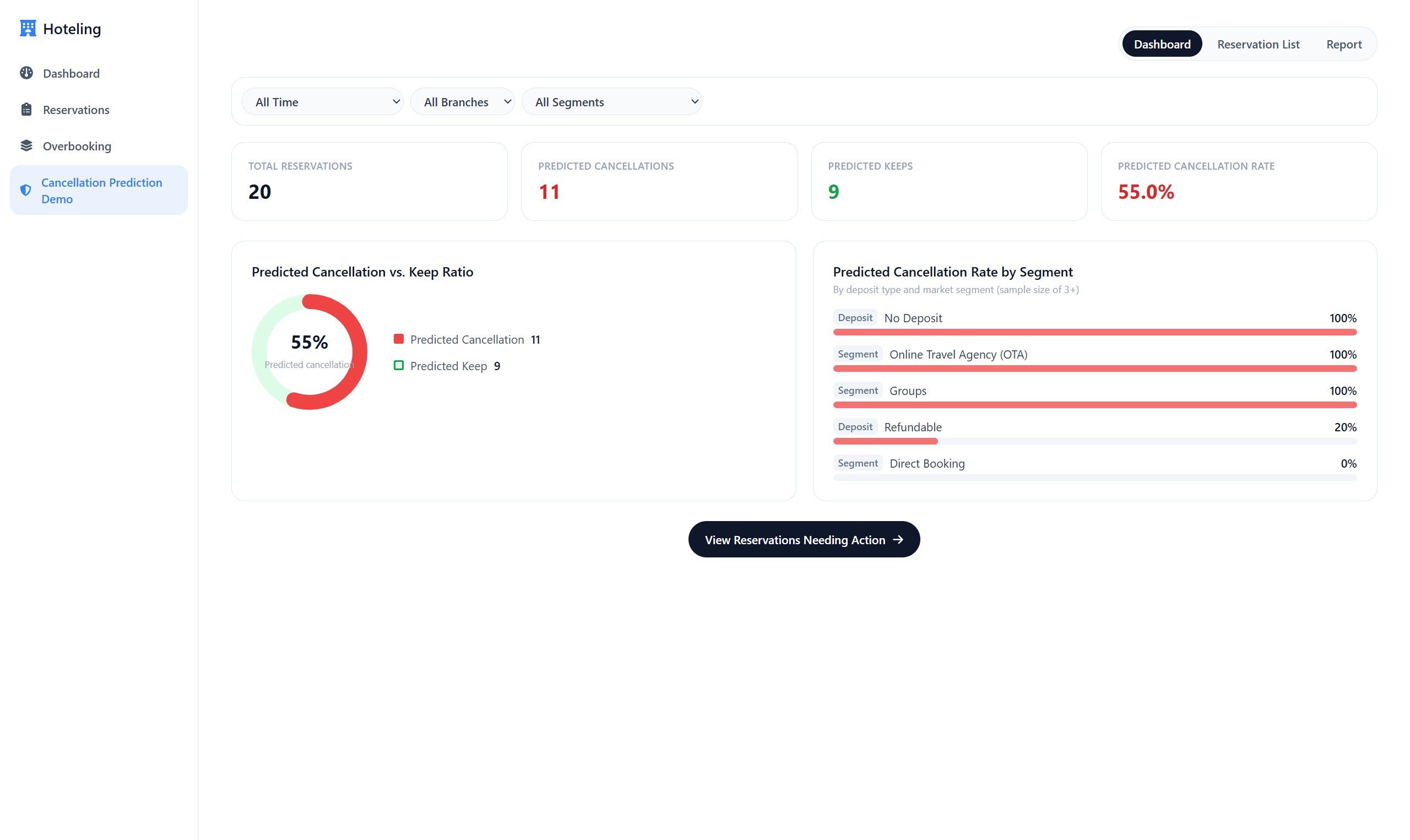
Hoteling is an AI-powered decision-support service that predicts the cancellation probability of hotel reservations. A final model trained with Google Cloud AutoML analyzes 10 reservation features and provides a cancellation probability and predicted class for each booking.
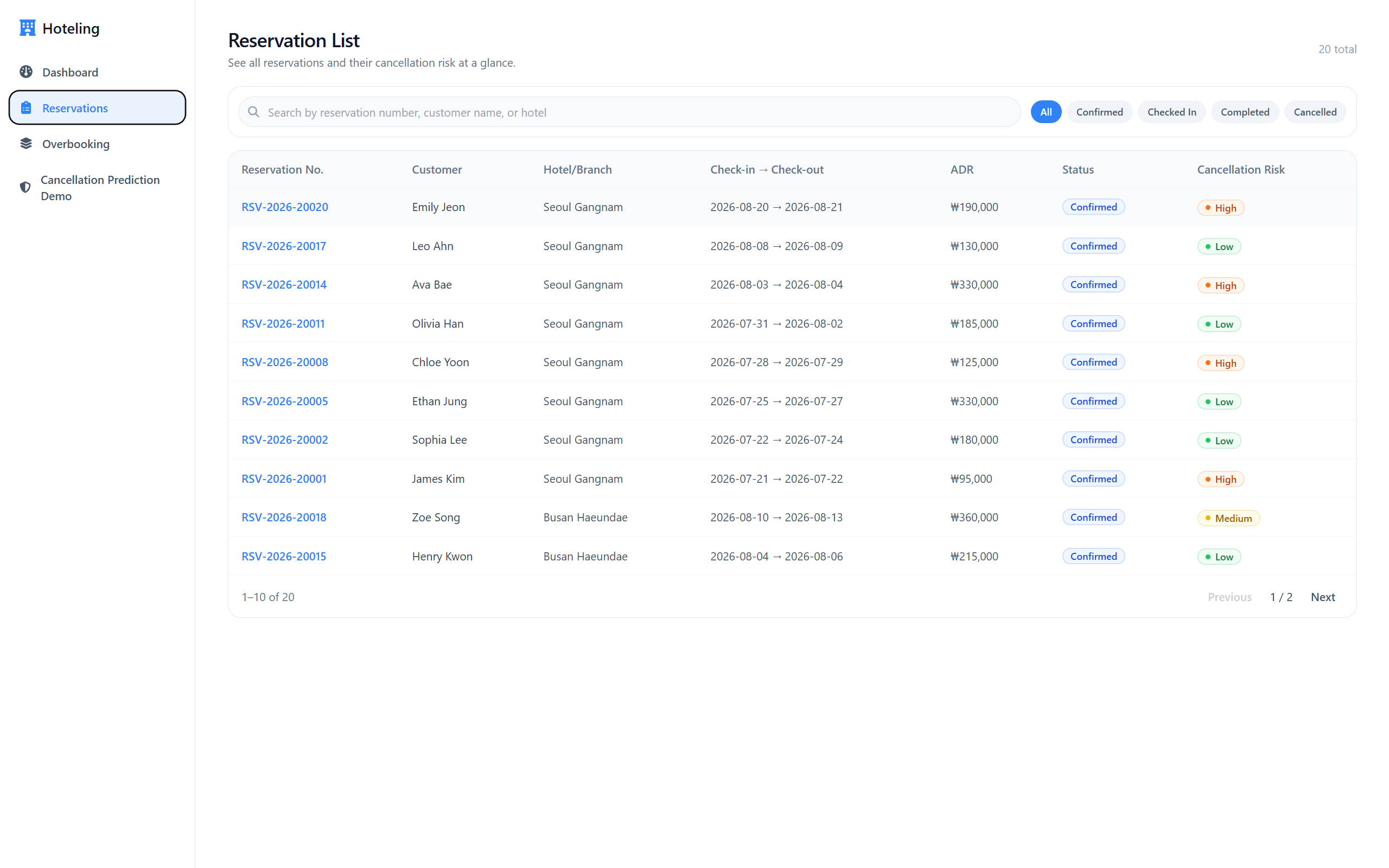
The service organizes bookings based on their predicted cancellation probability, helping hotel staff identify reservations that may require earlier attention. Staff can review the prediction together with the reservation details before deciding whether customer confirmation or room resale preparation is appropriate.
Hoteling supports human judgment rather than replacing it. It does not automatically cancel reservations, contact guests, or change room prices.
Key Features
- Booking cancellation prediction: Uses 10 reservation features to provide a cancellation probability and predicted class.
- Prioritized reservation list: Sorts bookings by cancellation probability so staff can review relevant reservations first.
- Reservation details: Displays the prediction together with the reservation information used by the model.
- Input data validation: Verifies that uploaded reservation data contains the required fields and valid data formats.
- Prediction history: Stores prediction results, model versions, timestamps, and staff actions.
- CSV workflow: Supports structured reservation data uploads and prediction-result exports.
- Human-in-the-loop design: Keeps final decisions and customer communication under the control of hotel staff.
Technologies Used
- AI/ML: Google Cloud AutoML
- Frontend: React
- Backend: Python and FastAPI
- Database: PostgreSQL
- Data processing and analysis: SAS, Microsoft Excel, and CSV
- Deployment platform: Render
- Hosted on Render: React frontend, FastAPI backend web server, and PostgreSQL database server
- Development tools: IntelliJ IDEA, PyCharm, and Claude Code
Target Users
Hoteling is designed for:
- Hotel operations teams
- Revenue management teams
- Reservation and customer service teams
- Hotel managers responsible for room inventory and cancellation planning
These users can use Hoteling to prioritize reservation reviews more consistently and prepare earlier responses for bookings with a higher predicted cancellation probability.
Inspiration
Hotel cancellations create uncertainty in room availability, operational planning, and expected revenue. Hotel staff often manage many reservations at once, making it difficult to identify which bookings are more likely to be canceled before the cancellation actually occurs.
Team ECHO created Hoteling to help hotel operators, reservation teams, and revenue managers use booking data more effectively. Our goal was to provide an AI-based prediction that can support earlier reservation reviews, room inventory planning, and informed overbooking decisions.
What it does
Hoteling is an AI-powered hotel cancellation prediction service. A user enters 10 pieces of reservation information, and the system analyzes the booking using a prediction workflow developed with Google Cloud AutoML. It then provides a cancellation prediction that helps hotel staff determine which reservations may require closer attention.
The service is designed for hotel operators, reservation teams, and revenue managers. Predictions are intended to support human decisions, not automatically cancel reservations or change prices.
How we built it
We prepared the data using hotel reservation records from the public Hotel Booking Demand dataset, focusing on City Hotel data. The team cleaned, organized, and explored the dataset using SAS and Excel, then prepared the 10 input features required by the service.
We trained and evaluated two models using Google Cloud AutoML. The web application was built with React for the frontend, FastAPI for the backend, and PostgreSQL for data storage. The frontend, backend web server, and PostgreSQL database are hosted on Render, and the prediction workflow is integrated with the web service.
Challenges we ran into
One major challenge was keeping the data format consistent between model training and the live service. The frontend, backend, and model needed to use the same 10 input fields and handle numerical and categorical values consistently.
We also had to connect the AutoML prediction workflow to the FastAPI backend and React interface while deploying the frontend, backend, and database as separate components. Coordinating these components required repeated integration and deployment testing.
Accomplishments that we're proud of
We completed an end-to-end web service that accepts hotel reservation information and returns an AI-based cancellation prediction. We also trained and evaluated two Google Cloud AutoML models and connected the prediction workflow to the deployed application.
The project brought together data preparation, machine learning, frontend development, backend development, database management, and cloud-based deployment in one working prototype.
What we learned
We learned that reliable AI services depend heavily on data quality and consistent preprocessing. Even when a model performs well during evaluation, the live service must use the same input structure and data rules used during training.
We also learned how to connect an AutoML prediction workflow with a React frontend, a FastAPI backend, and a PostgreSQL database. Most importantly, we learned that an AI prediction becomes useful only when it is presented clearly enough to support a real user decision.
What's next for Hoteling
We plan to improve Hoteling by using more recent and diverse hotel reservation data, validating the models with data from different hotels, and providing clearer explanations of the factors associated with each prediction.
Future development may include hotel property management system integration, model performance monitoring, retraining workflows, and usability testing with hotel staff. These improvements would help us evaluate how Hoteling can support real reservation and room inventory operations.
Built With
- automl
- claude
- fastapi
- github
- intellij-idea
- postgresql
- pycharm
- python
- render
- sas

Log in or sign up for Devpost to join the conversation.