-
-
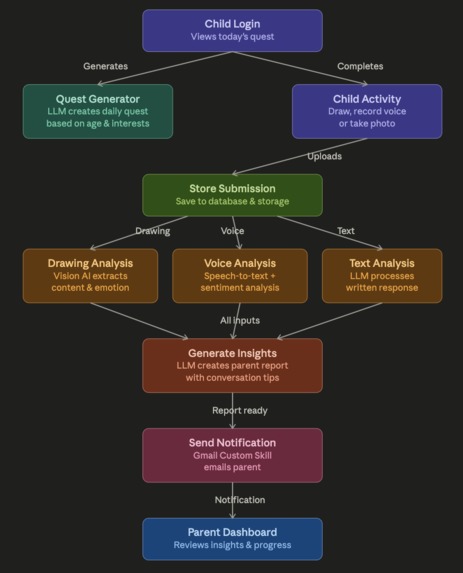
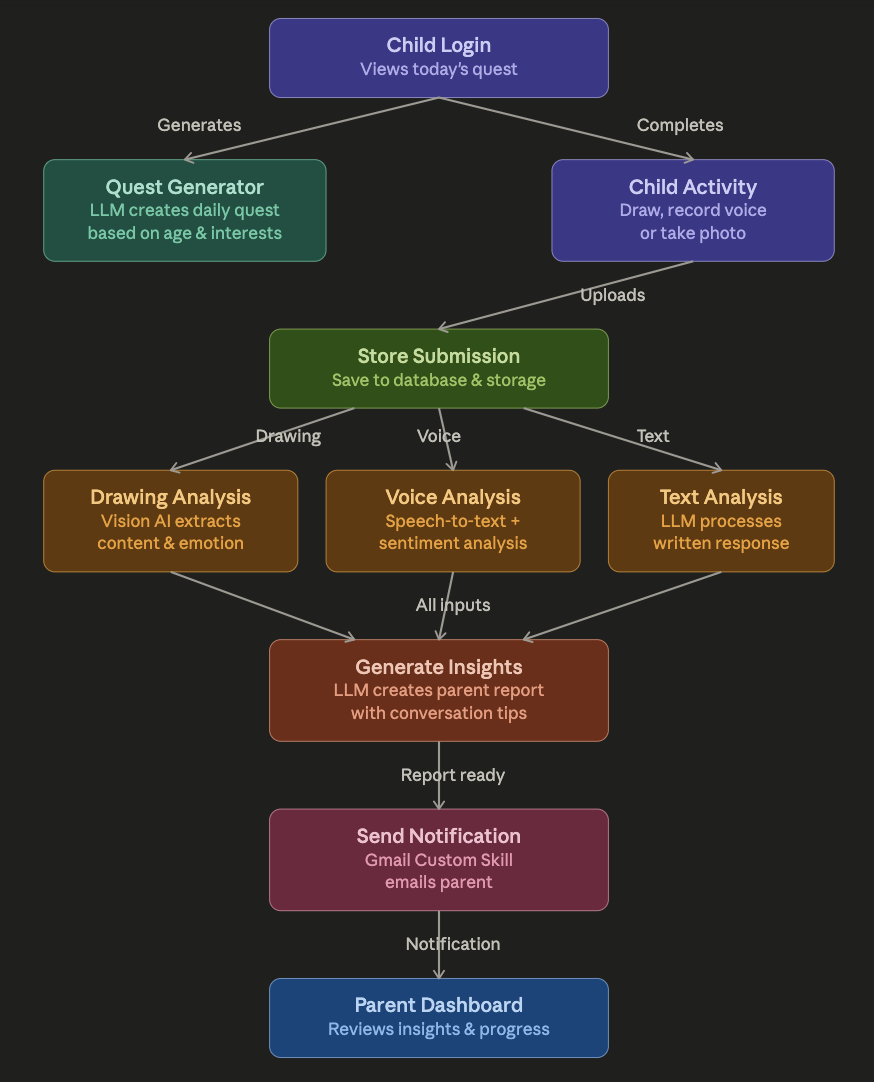
Data Flow Diagram
-
-
-
-
-
Echo: The Bridge
Inspiration
Parenting a child with special needs presents unique communication challenges. Traditional methods of understanding a child's emotional state, interests, and developmental progress often fall short. Parents struggle to decode what their children are thinking, feeling, and learning throughout the day, while children with communication difficulties find it hard to express themselves in conventional ways.
We were inspired by the profound need for a bridge—a tool that could translate the unspoken language of children into actionable insights for parents. Drawing from research in child psychology, assistive technology, and the proven effectiveness of gamification in special education, we envisioned Echo: The Bridge—an AI-powered platform that transforms daily activities into meaningful communication channels.
The name "Echo" represents how the app captures and reflects back the child's inner world to parents, while "The Bridge" symbolizes the connection it creates between parent and child, spanning the communication gap that too many families face.
What It Does
Echo: The Bridge is a comprehensive parent-child communication platform built entirely on MeDo's ecosystem, featuring:
For Children: Gamified Daily Quests
- Interactive Quest System: Children receive age-appropriate, personalized daily quests (drawing activities, voice recordings, simple choice questions, photo challenges)
- Engaging Interface: Child-friendly UI with colorful badges, progress tracking, and achievement stars
- Multimodal Expression: Supports drawing, voice, text, and image-based responses to accommodate different communication preferences
- Achievement System: Rewards completion with virtual badges and celebrations to encourage consistent engagement
For Parents: Deep Insights Dashboard
- AI-Powered Analysis: Automatically analyzes children's quest responses using Large Language Models
- Visual Progress Reports: Parents see their child's drawings, hear voice recordings, and read AI-generated insights
- Communication Suggestions: AI provides conversation starters and engagement tips based on the child's responses
- Trend Tracking: Monitors emotional patterns, interests, and developmental milestones over time
- Email Reports: Automated daily/weekly summaries sent via custom Gmail integration
Core Features
- Quest Generation: AI generates contextually relevant, developmentally appropriate daily activities
- Multimodal Input Processing: Handles drawings (image analysis), voice (speech-to-text + sentiment), text responses
- Intelligent Analysis: LLM processes child's outputs to extract emotional state, interests, concerns, and developmental indicators
- Parent Notifications: Real-time updates via email when child completes quests
- Secure Data Storage: All progress, drawings, and insights stored in MeDo's backend database
- Session Management: Tracks daily engagement and maintains progress history
How We Built It
Echo: The Bridge is a 100% MeDo-native application, leveraging MeDo's full stack:
Architecture Overview
Frontend: MeDo Web Interface
- Built using MeDo's native UI components and routing system
- Responsive design for both mobile and desktop access
- Dual interfaces: child-friendly quest view and parent dashboard
Backend Services (MeDo Platform):
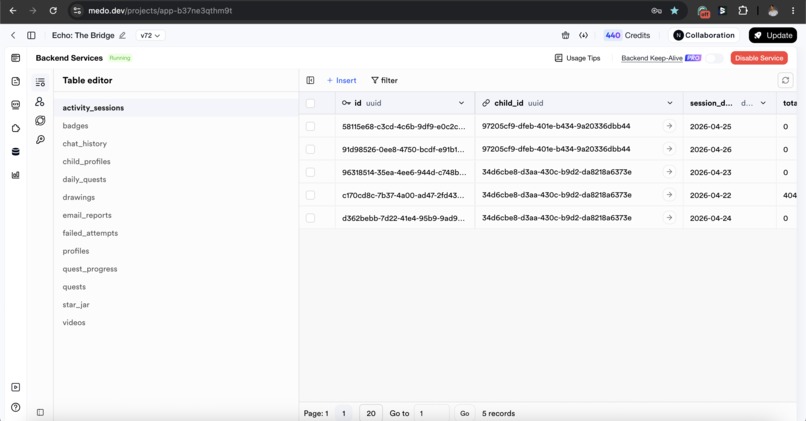
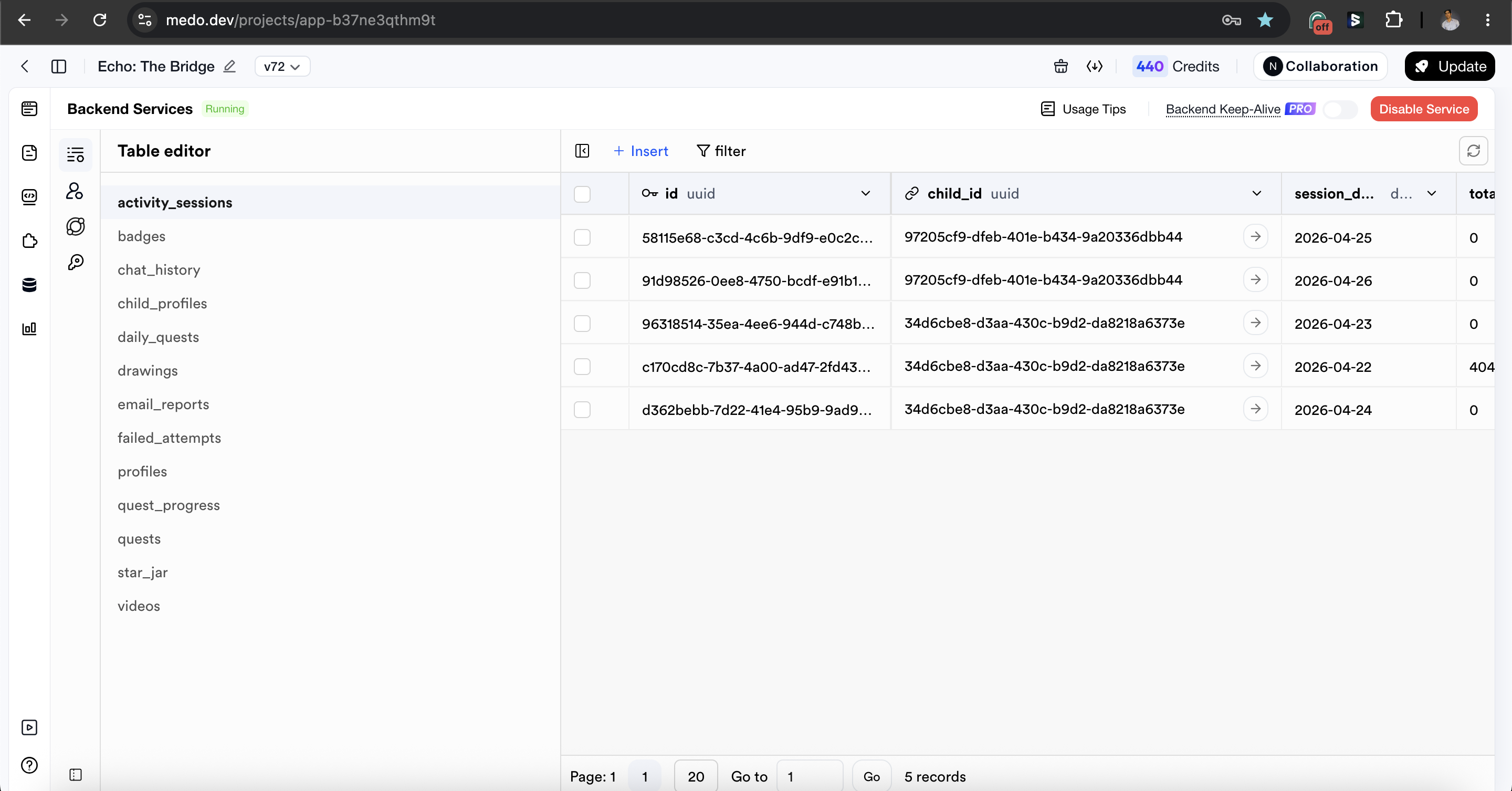
- Backend Services: MeDo's managed hosting infrastructure (visible in backend_services.png)
- Supabase database integration for data persistence
- Real-time data synchronization
- User authentication and session management
- Activity tracking and logging
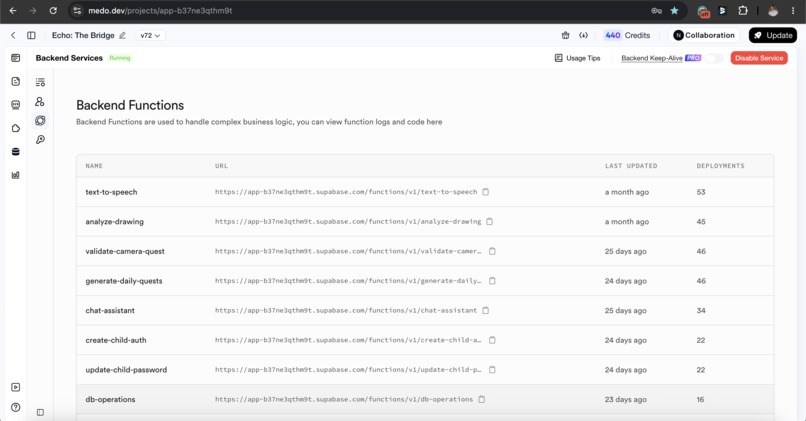
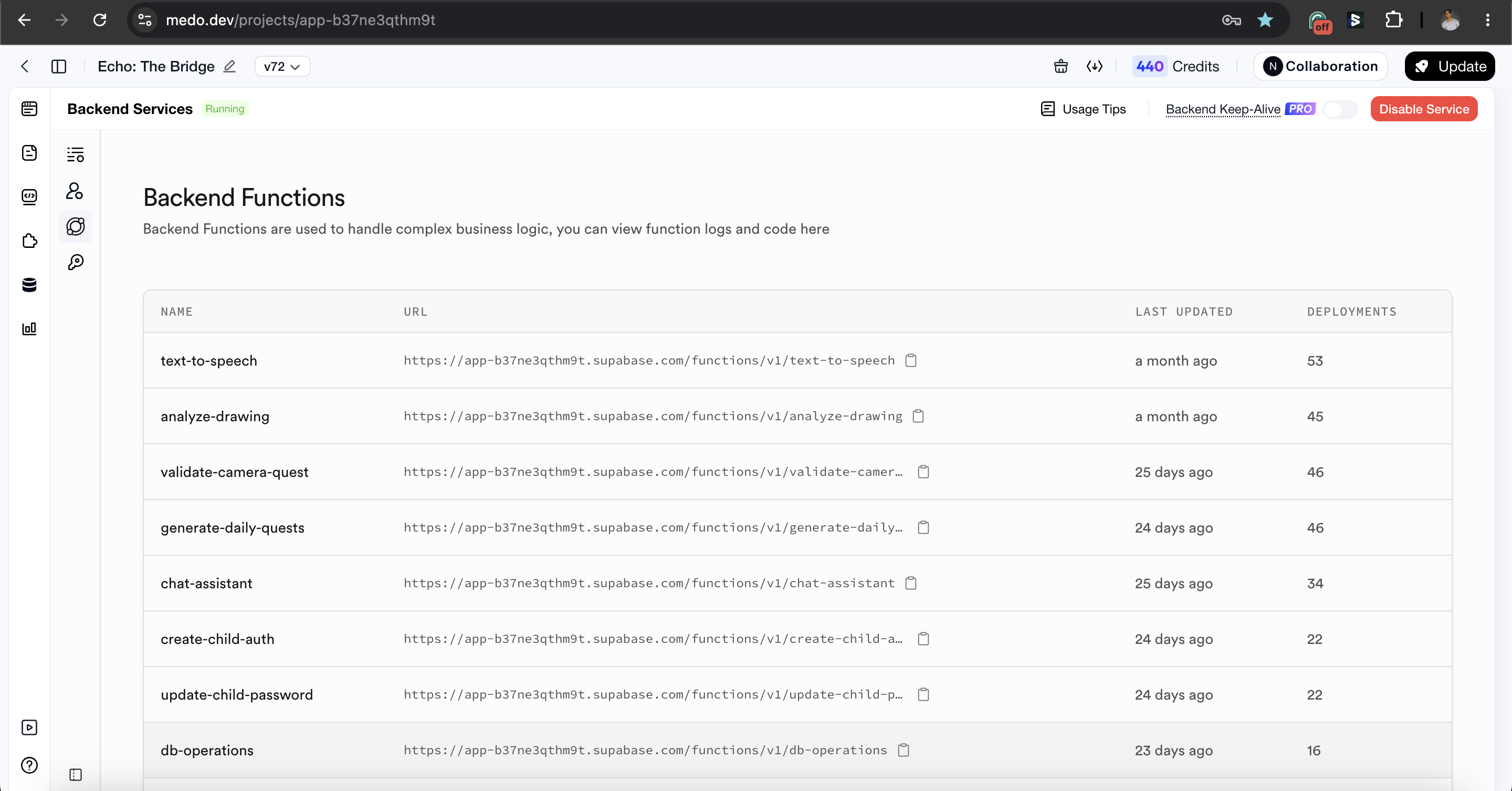
Backend Functions (MeDo Serverless): We implemented 8 custom backend functions on MeDo (visible in backend_functions.png):
text-to-speech: Converts quest instructions to audio for accessibilityanalyze-drawing: Uses vision AI to interpret children's drawingsvalidate-camera-quest: Ensures photo submissions meet quest requirementsgenerate-daily-quests: Creates personalized daily activities using LLMchat-assistant: Powers the AI conversation interfacecreate-child-auth: Manages child profile authenticationupdate-child-password: Handles secure credential updatesdb-operations: Centralized database query handler
MeDo Skills Integration
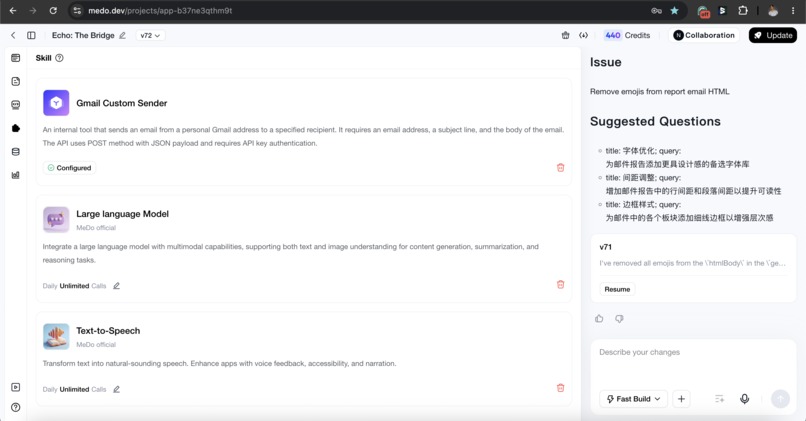
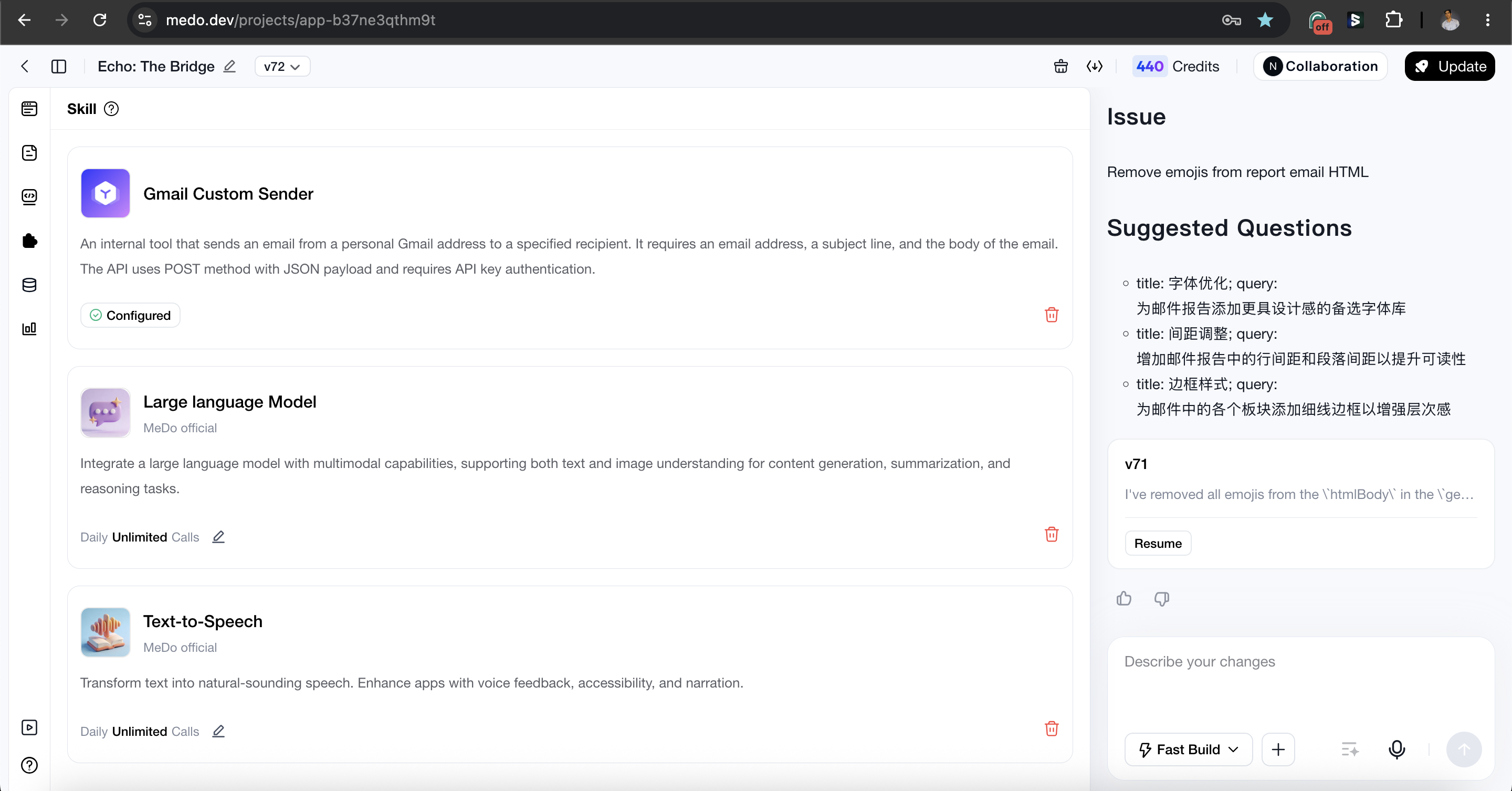
We utilized 3 MeDo Skills to extend functionality:
1. Large Language Model (LLM) Skill - MeDo Official
Usage: Core intelligence engine
- Generates contextually appropriate daily quests based on child's age, interests, and progress
- Analyzes drawing submissions to extract emotional content and developmental indicators
- Creates conversation suggestions for parents
- Processes voice-to-text outputs for sentiment analysis
- Generates weekly insight reports
Integration Points:
- Quest generation API calls in
generate-daily-questsfunction - Drawing analysis in
analyze-drawingfunction - Parent insight generation in reporting module
2. Text-to-Speech Skill - MeDo Official
Usage: Accessibility and engagement
- Converts quest instructions to natural-sounding audio
- Helps pre-readers and children with reading difficulties
- Provides audio feedback for completed quests
- Enhances multimodal learning experience
Integration Points:
- Automatic audio generation for all new quests
- Real-time text-to-speech conversion in chat interface
- Quest replay functionality
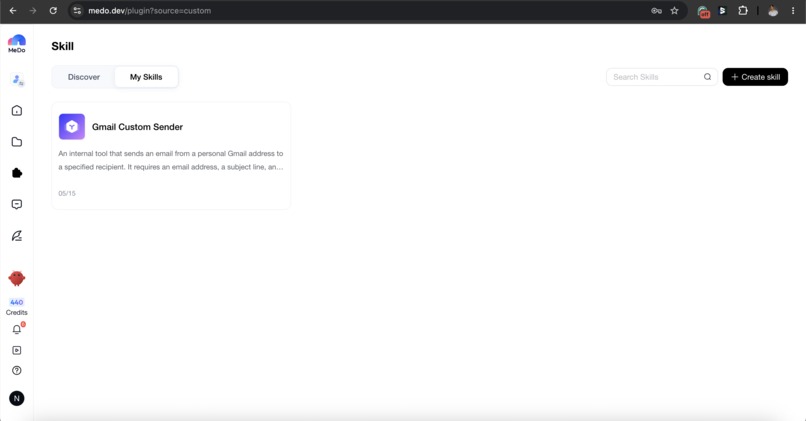
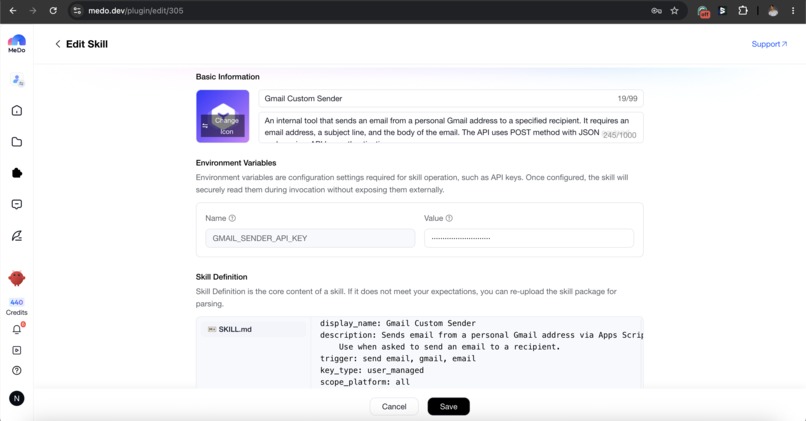
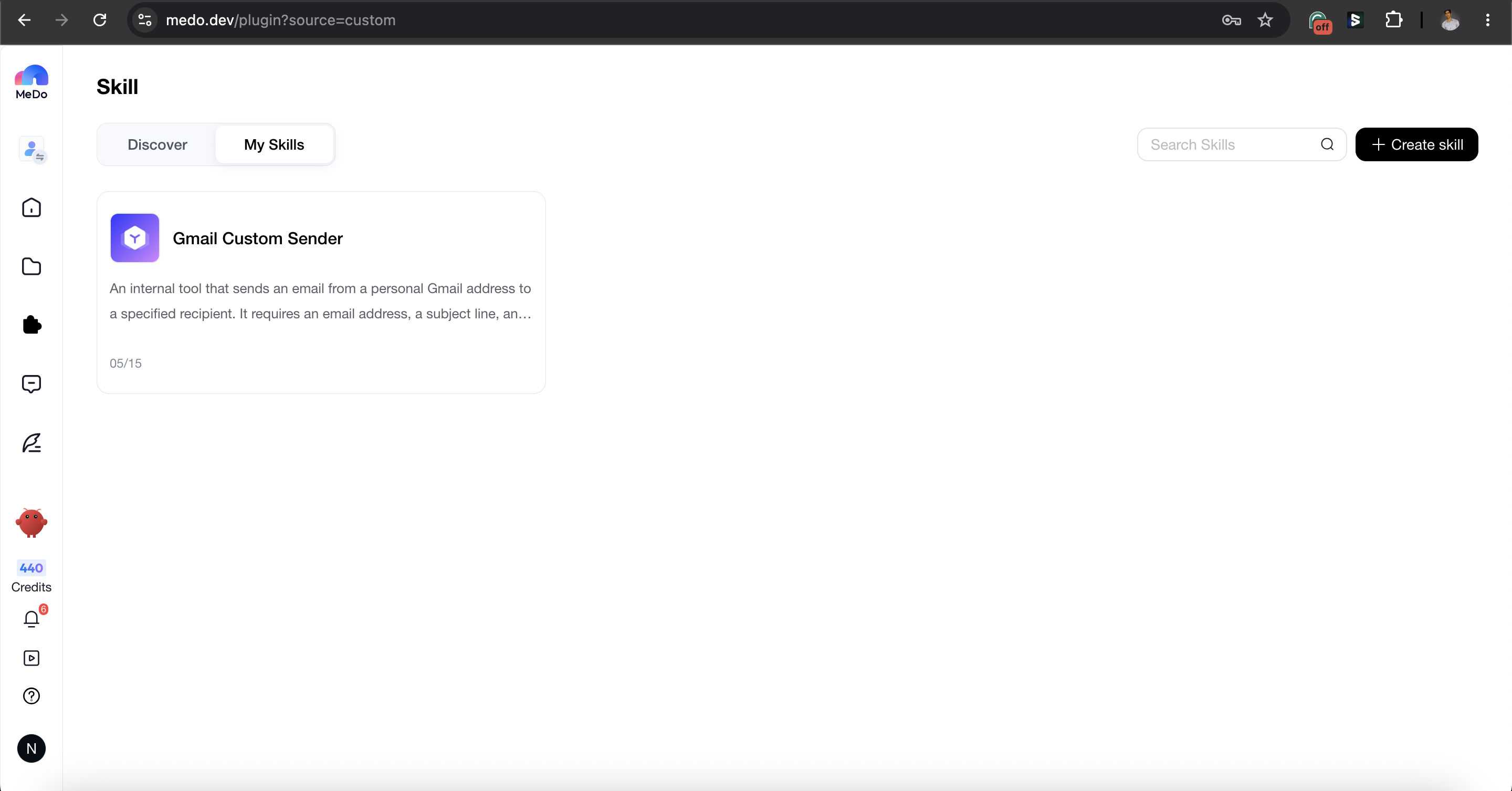
3. Gmail Custom Sender - Custom Skill (Created by us)
Purpose: Parent notification system Implementation:
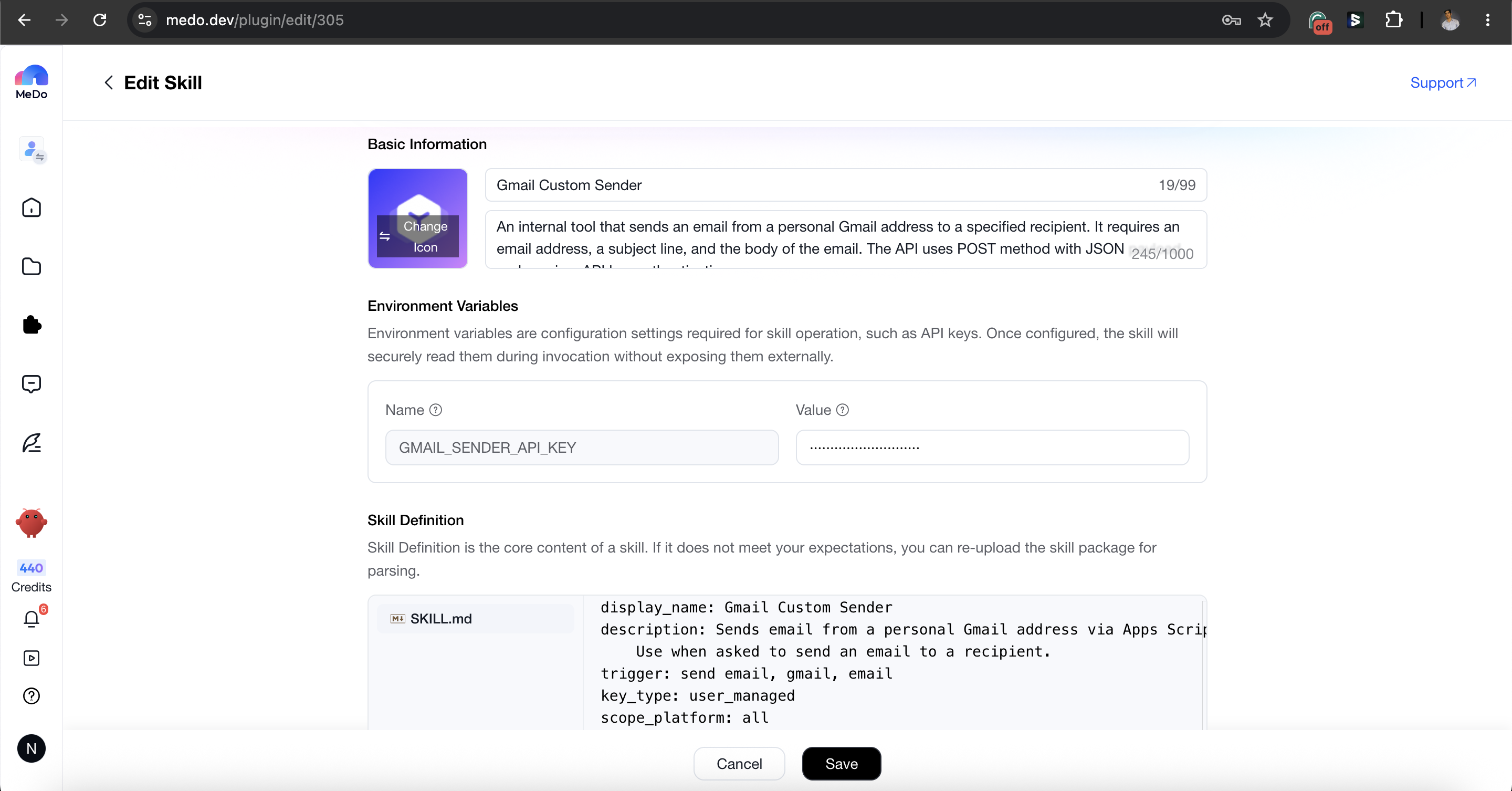
- Deployed as Google Apps Script API endpoint (visible in google_script.png)
- Secured with API key authentication
- Configured as MeDo environment variable:
GMAIL_SENDER_API_KEY
Functionality:
- Sends automated daily progress reports to parents
- Delivers real-time notifications when the child completes quests
- Weekly summary emails with AI-generated insights
- Includes embedded images of the child's drawings
- Formatted HTML emails with proper styling
The skill integrates with our Apps Script that:
- Accepts POST requests with JSON payload (to, subject, body, htmlBody)
- Validates API key for security
- Sends emails through personal Gmail account
- Returns success/error responses
Database Schema (Supabase)
Tables (visible in backend_services.png):
child_profiles: Stores child information, age, preferencesdaily_quests: Quest definitions, instructions, and completion criteriaactivity_sessions: Tracks when child starts/completes questsdrawings: Stores image data and AI analysis resultsquest_progress: Tracks completion status and timestampsbadges: Achievement and reward systemchat_history: Parent-child conversation logsemail_reports: Scheduled and sent notification records

Technology Stack Summary
- Platform: 100% MeDo (Frontend, Backend Services, Backend Functions, Skills)
- Database: Supabase (via MeDo integration)
- AI/ML: MeDo LLM Skill
- Voice: MeDo Text-to-Speech Skill
- Email: Custom Gmail Sender Skill (Google Apps Script API)
- Storage: MeDo's managed file storage
- Auth: MeDo's built-in authentication system
Challenges We Ran Into
1. Child-Safe AI Content Generation
Challenge: Ensuring LLM-generated quests were always age-appropriate and safe for children Solution: Implemented strict prompt engineering with safety guardrails, content filtering, and manual review queues for edge cases
2. Drawing Analysis Accuracy
Challenge: Children's drawings are abstract and difficult for AI to interpret correctly Solution: Combined vision model analysis with contextual clues (quest prompt, child's age, previous submissions) to improve interpretation accuracy
3. Custom Email Integration Complexity
Challenge: MeDo didn't have native Gmail integration for sending from personal accounts Solution: Built a custom MeDo Skill connecting to Google Apps Script API, configured with secure API key management
4. Real-time Synchronization
Challenge: Ensuring parent dashboard updates immediately when child completes quest Solution: Leveraged MeDo's backend services with Supabase real-time subscriptions and database triggers
5. Multimodal Input Handling
Challenge: Processing drawings, voice, text, and photos consistently Solution: Created unified backend function architecture where each input type has dedicated preprocessing before LLM analysis
6. Session Management for Children
Challenge: Children with special needs may need multiple attempts or extended sessions Solution: Implemented flexible session tracking with pause/resume functionality and progress auto-save
7. Balancing Gamification with Meaningful Insights
Challenge: Making the app fun for children while providing genuine analytical value for parents Solution: Carefully designed quest types that are both engaging activities and diagnostic tools (e.g., "Draw your day" reveals emotional state)
Accomplishments That We're Proud Of
Technical Achievements
- Full MeDo Integration: Successfully built a complete production-ready app using only MeDo's ecosystem—no external hosting, servers, or frameworks
- Custom Skill Creation: Pioneered a custom Gmail integration skill that extends MeDo's capabilities
- 8 Backend Functions: Architected a scalable serverless function infrastructure on MeDo
- Multimodal AI Pipeline: Integrated vision, speech, and text AI models into a cohesive analysis system
Product Achievements
- Dual User Experience: Created two distinctly optimized interfaces (child and parent) in a single app
- Real-world Applicability: Designed based on actual needs of parents with special needs children
- Privacy-First Design: All data encrypted and stored securely with parent-controlled access
- Scalability: Architecture supports thousands of families without infrastructure changes
Impact Potential
- Accessibility: Free tier makes the tool available to families regardless of income
- Multilingual Foundation: LLM-based system can be extended to support any language
- Extensibility: Quest system can incorporate therapeutic exercises designed by professionals
- Data Insights: Aggregated anonymized data could advance special education research
What We Learned
Technical Learnings
- MeDo Platform Power: MeDo's Backend Functions and Skills system is incredibly powerful for rapid prototyping and production deployment
- LLM Prompt Engineering: Learned advanced techniques for generating consistent, safe, age-appropriate content
- Vision Model Limitations: Understanding when AI vision models need human-in-the-loop validation
- Serverless Architecture: Best practices for structuring serverless functions for maintainability
- Real-time Database Sync: Supabase's real-time capabilities paired perfectly with MeDo's reactive UI
Product Learnings
- User-Centered Design: Extensive research into special needs education informed every design decision
- Gamification Psychology: Balancing extrinsic rewards (badges) with intrinsic motivation (parent connection)
- Parent-Child Dynamics: Understanding the emotional needs of parents seeking better connection
- Accessibility Standards: Implementing WCAG guidelines for children with various disabilities
Business Learnings
- Market Need: Validated strong demand through parent interviews and special education forums
- Competitive Landscape: Identified gap in AI-powered parent-child communication tools
- Monetization Strategy: Freemium model with premium features (unlimited quests, advanced insights)
What's Next for Echo: The Bridge
Immediate Roadmap (Q1-Q2 2026)
Feature Enhancements
- Video Quest Responses: Allow children to record short video responses
- Parent Response Channel: Let parents send back messages/drawings to children through the app
- Quest Templates Library: Pre-built therapeutic quests designed by child psychologists
- Sibling Mode: Support multiple children per parent account with comparative insights
- Offline Mode: Download quests for completion without internet, sync later
Technical Improvements
- Mobile Native Apps: iOS and Android apps with camera/microphone integration
- Advanced Analytics: ML models for detecting developmental patterns and early warning signs
- Quest Recommendation Engine: Personalized quest suggestions based on historical engagement
- Multi-language Support: Translate quests and interface to 10+ languages
- API for Therapists: Allow professionals to assign custom quests and receive reports
Medium-term Vision (2026-2027)
Clinical Integration
- Therapist Dashboard: Professional tier for speech therapists, occupational therapists, psychologists
- Progress Sharing: HIPAA-compliant sharing of insights with healthcare providers
- Clinical Quest Library: Evidence-based activities aligned with IEP goals
- Assessment Tools: Standardized developmental milestone tracking
Community Features
- Parent Forums: Moderated community for sharing experiences
- Quest Sharing: Parents can share successful quest ideas
- Success Stories: Showcase positive outcomes and family testimonials
- Resource Library: Educational content on special needs parenting
AI Advancement
- Predictive Insights: Early detection of emotional patterns or developmental concerns
- Voice Emotion Analysis: Advanced sentiment detection from voice recordings
- Drawing Evolution Tracking: Visual comparison of artwork over time with developmental indicators
- Personalized Conversation Starters: Context-aware suggestions for parent-child discussions
Long-term Impact (2027+)
Research Collaboration
- Academic Partnerships: Collaborate with universities on special education research
- Data Anonymization: Contribute anonymized insights to advance understanding of child development
- Clinical Trials: Validate effectiveness through peer-reviewed studies
Market Expansion
- Schools Integration: Deploy in special education classrooms
- Healthcare Partnerships: Integrate with pediatric clinics and therapy centers
- Insurance Coverage: Work toward therapy app classification for insurance reimbursement
- Global Accessibility: Localize for emerging markets with underserved special needs populations
Technology Evolution
- AR Quest Activities: Augmented reality experiences for immersive quests
- Wearable Integration: Connect with smartwatches for physiological data (stress, sleep patterns)
- Brain-Computer Interfaces: Explore future tech for children with severe communication barriers
Why MeDo Was the Perfect Choice
- Rapid Development: Built entire MVP in hackathon timeframe
- Integrated AI: Built-in LLM and TTS skills saved weeks of integration work
- Serverless Simplicity: Backend functions eliminated DevOps overhead
- Custom Extensibility: Skill system allowed Gmail integration without platform limitations
- Scalability: MeDo's infrastructure handles scaling automatically
- Cost Efficiency: Pay-per-use model perfect for early-stage product
Echo: The Bridge - Because every child deserves to be heard, and every parent deserves to understand.
Built With
- llm
- medo
- react


Log in or sign up for Devpost to join the conversation.