-
-
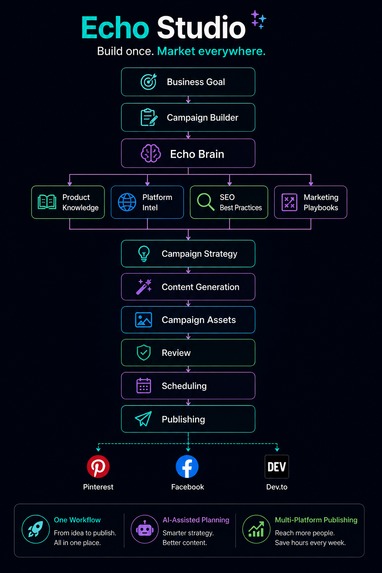
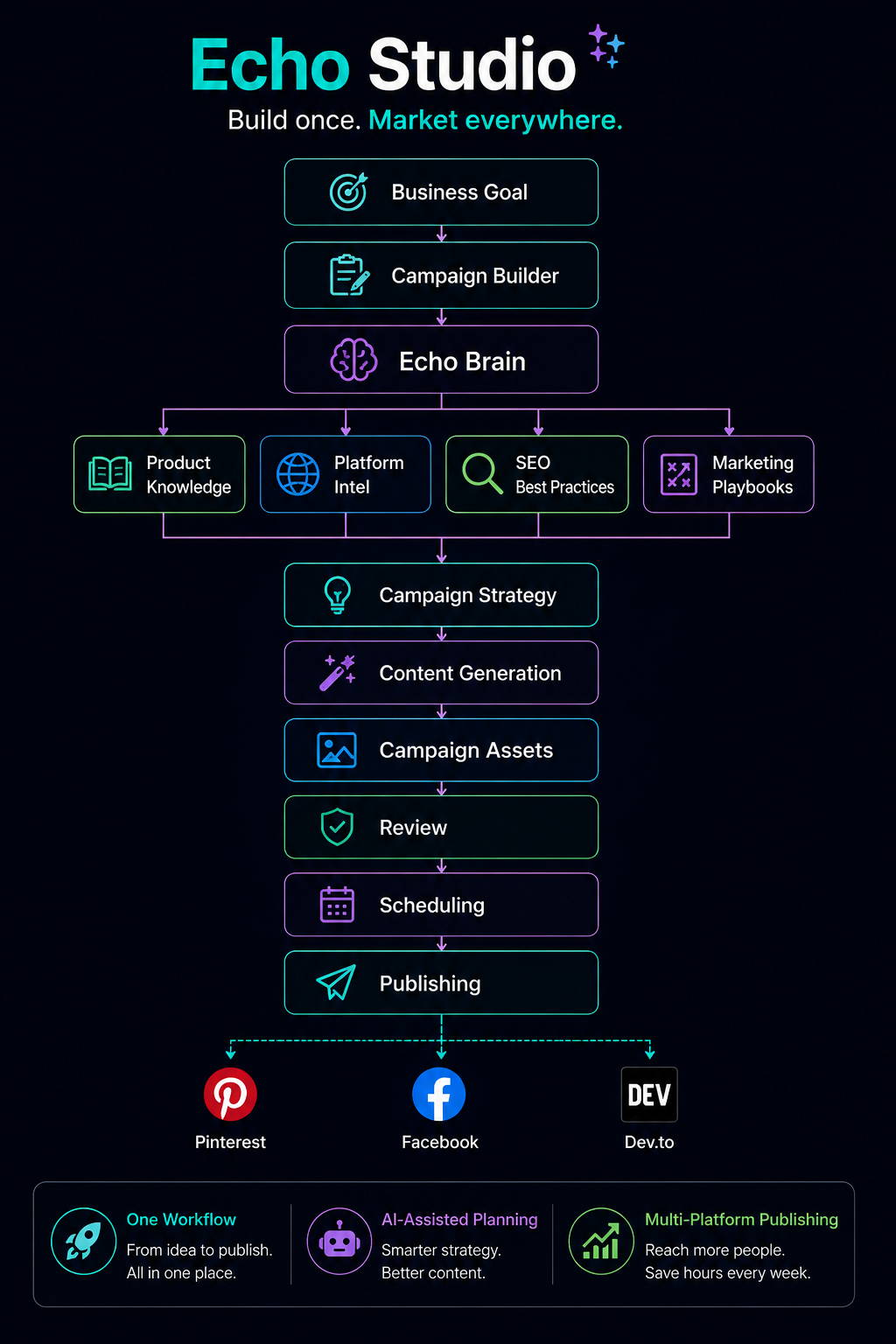
Echo Brain combines product knowledge, platform intelligence, SEO, and marketing playbooks before building campaign content.
-
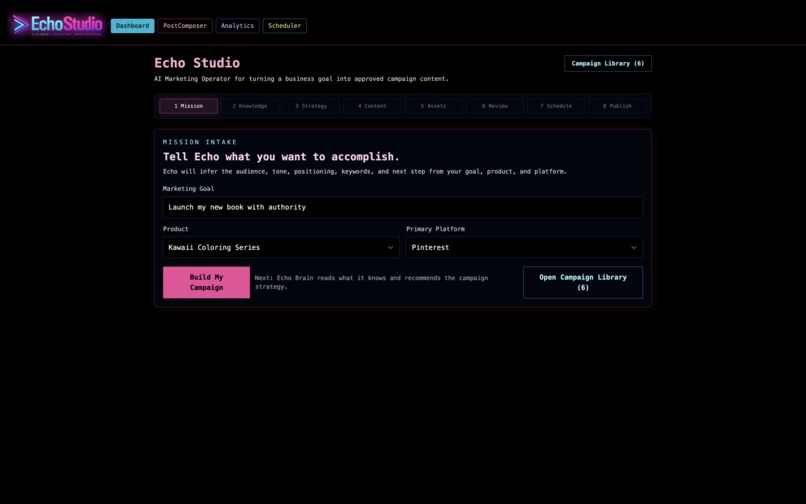
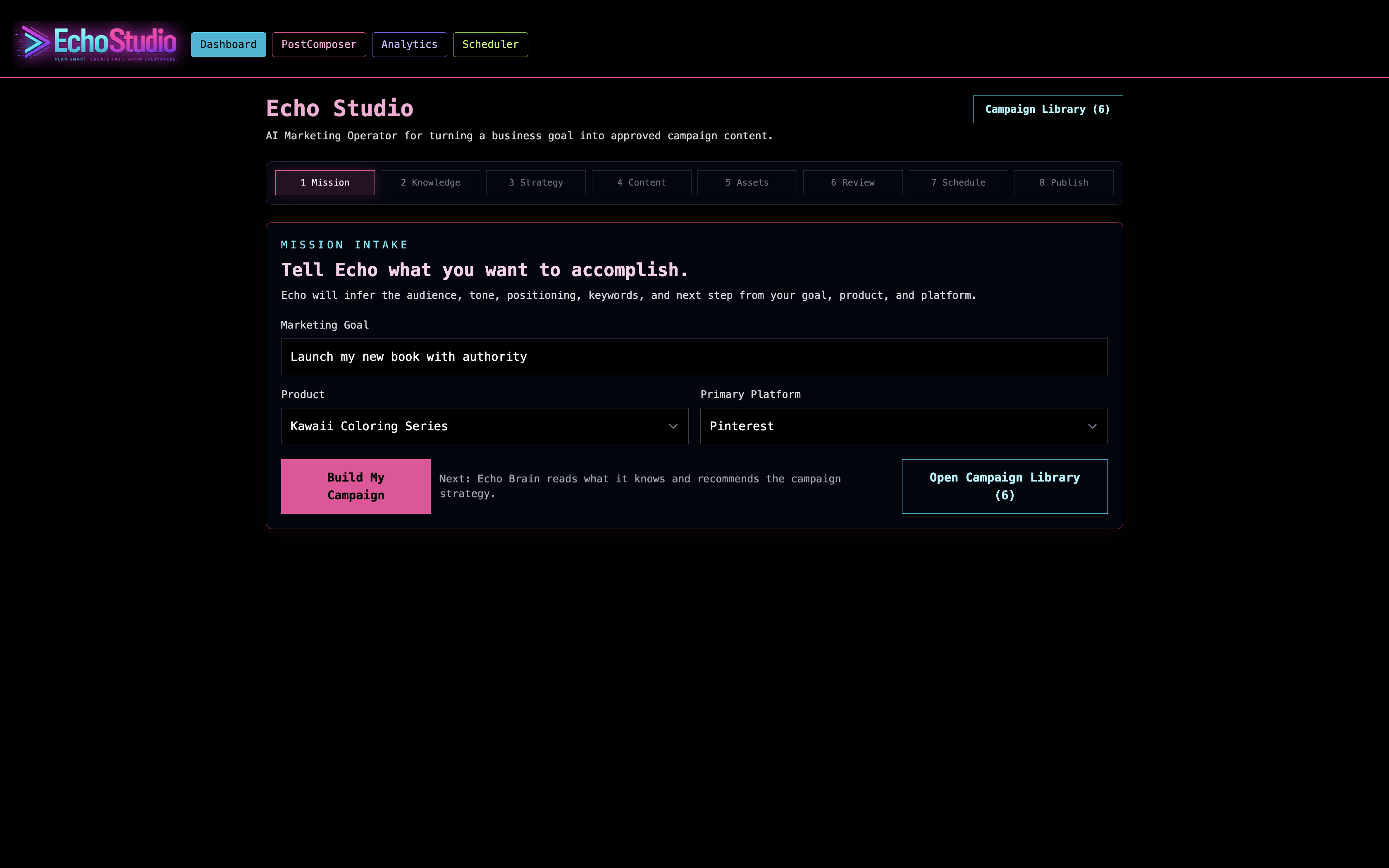
Start with a business goal, product, and primary platform. Echo Studio turns the mission into a structured campaign workflow.
-
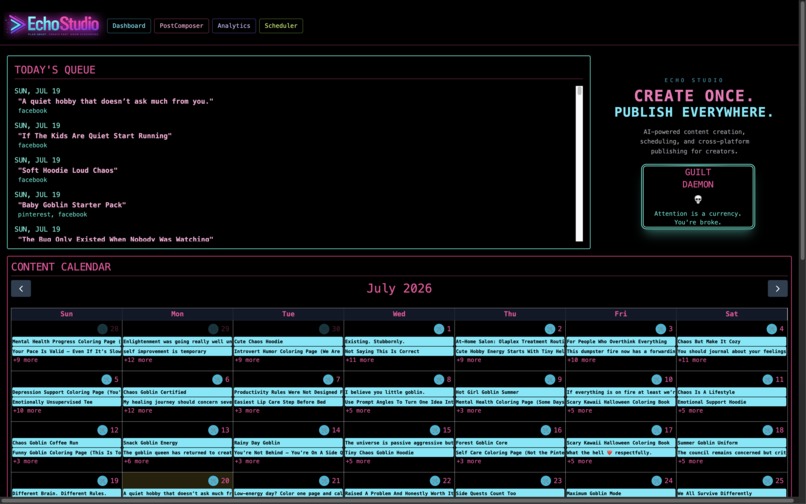
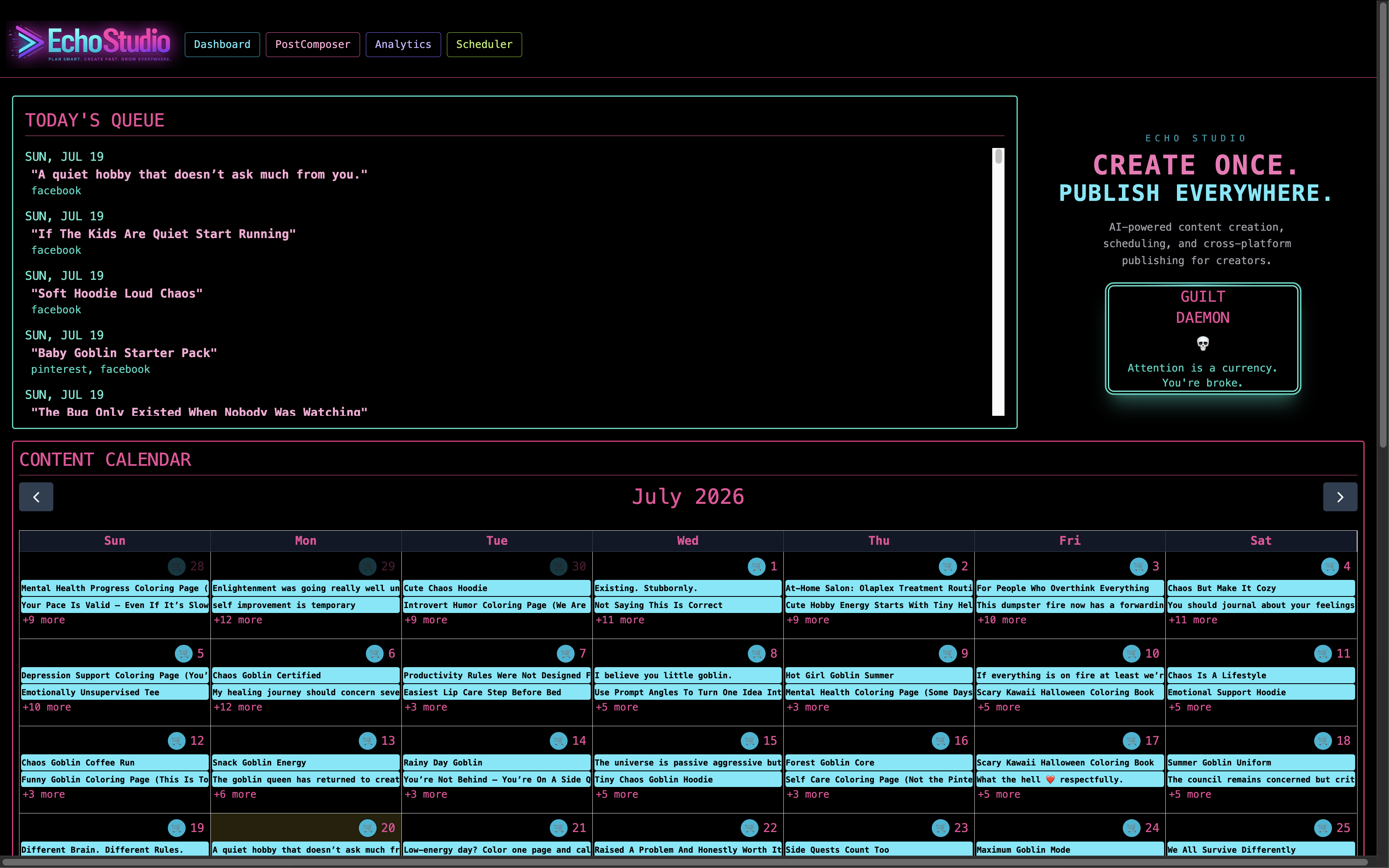
The dashboard brings today’s queue and the cross-platform publishing calendar together in one operational view.
-
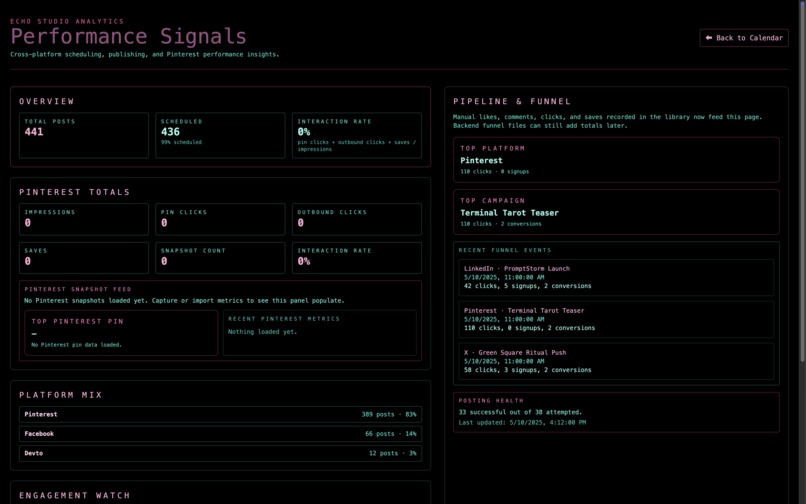
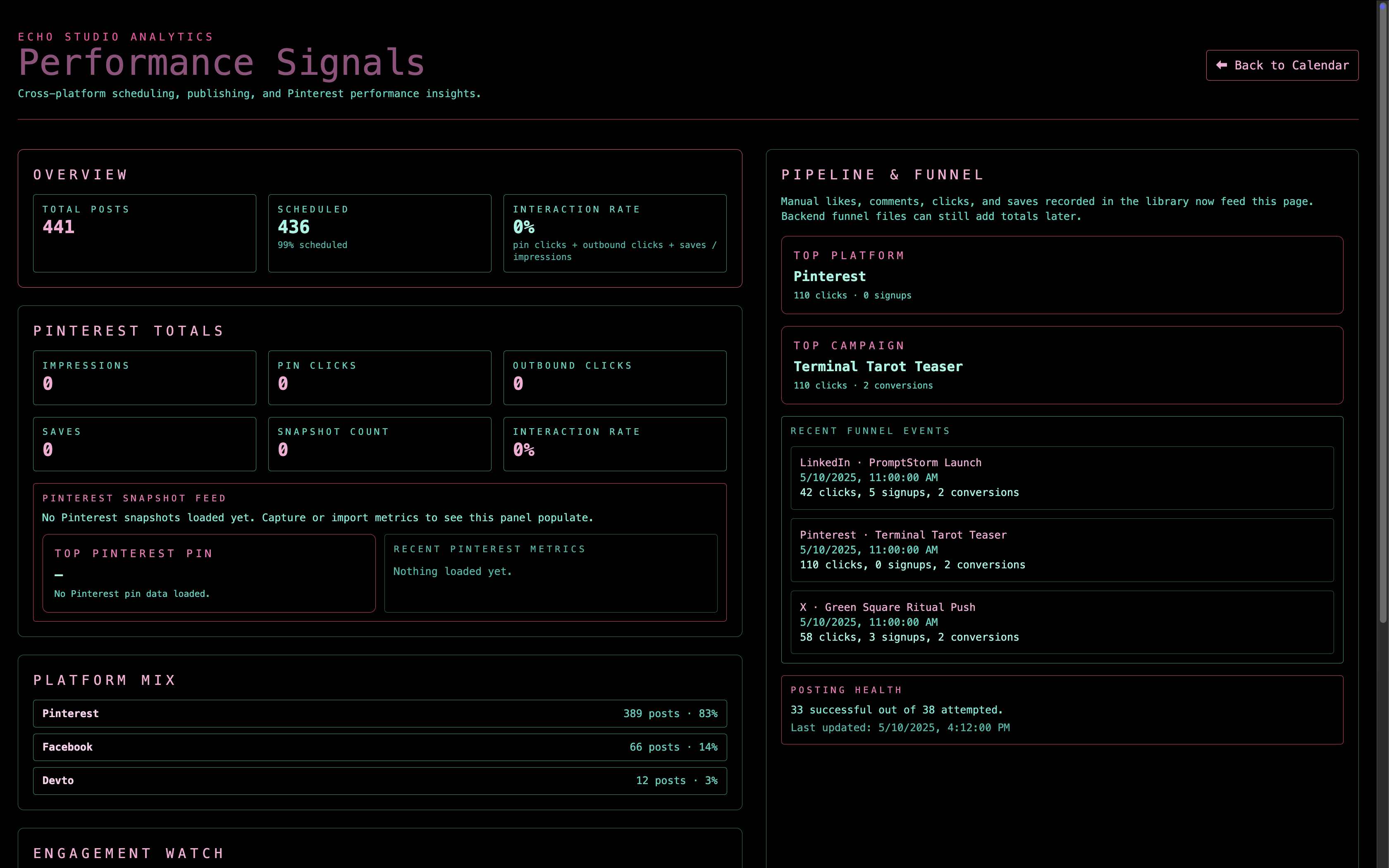
Performance Signals shows publishing health, platform mix, funnel activity, and available Pinterest campaign metrics.
-
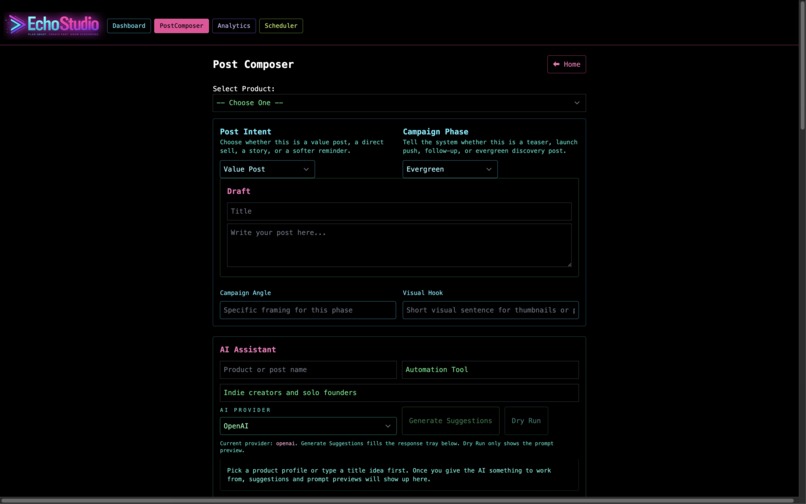
Performance Signals shows publishing health, platform mix, funnel activity, and available Pinterest campaign metrics.
-
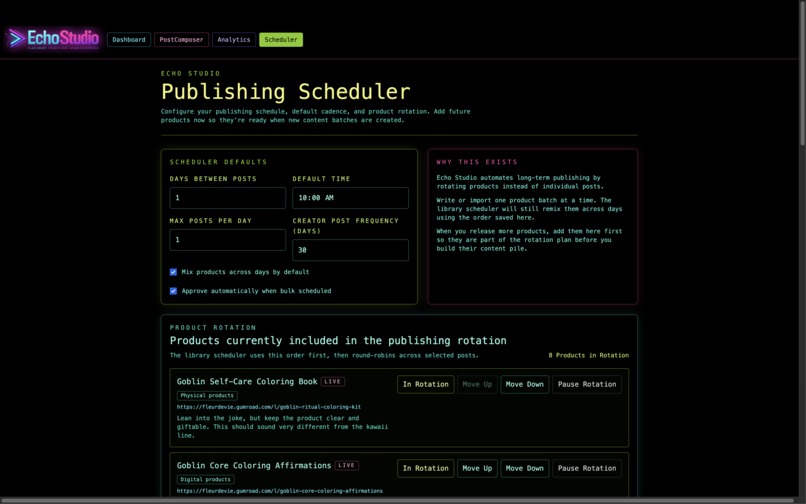
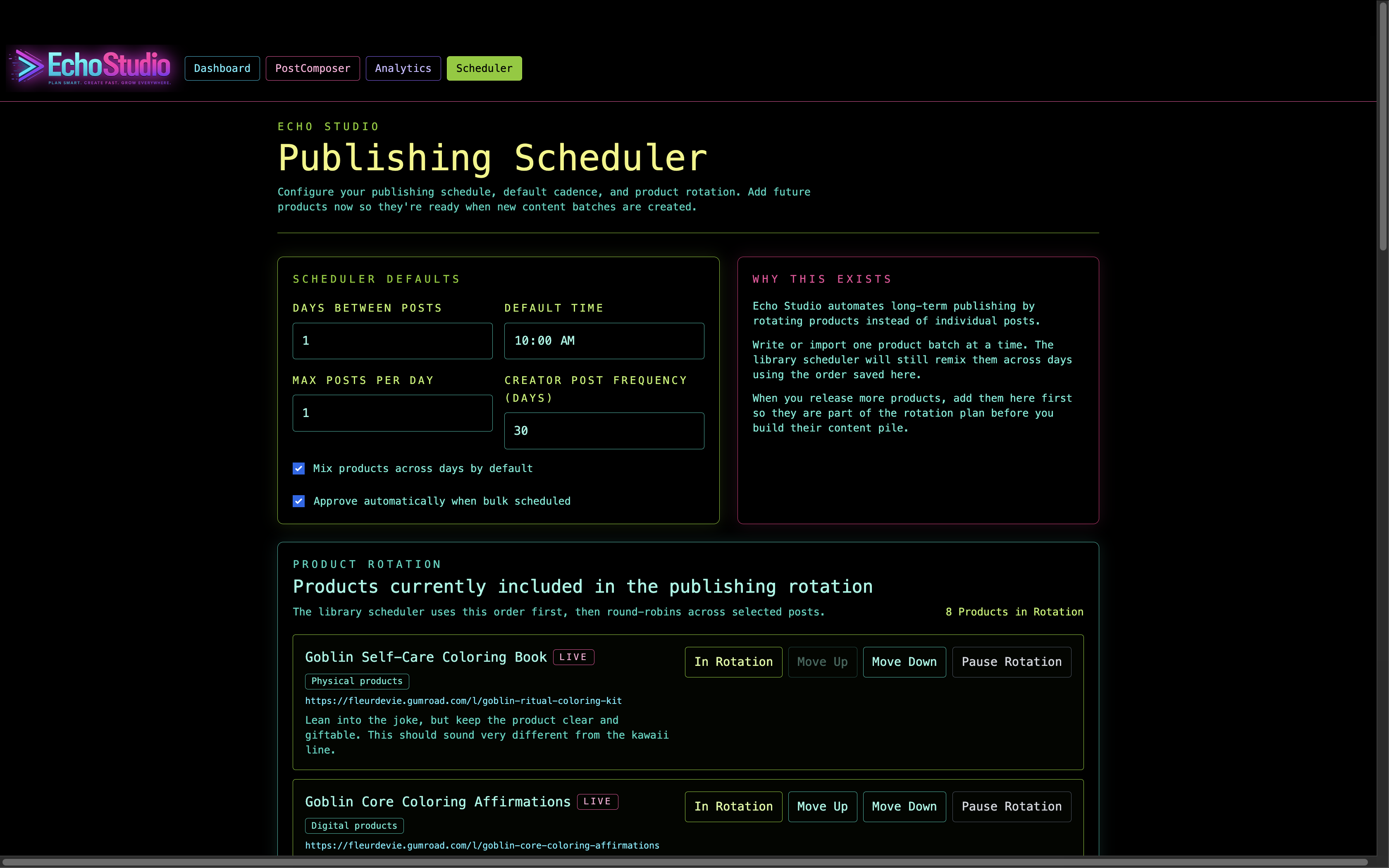
Configure cadence, daily limits, approval defaults, and product rotation so campaigns remain mixed across the publishing schedule.
Inspiration
I build a lot of things: software, books, coloring books, and digital products.
The problem was never making the product. The problem was getting people to see it.
Marketing each product meant jumping between AI tools, spreadsheets, image folders, social platforms, calendars, and notes. Even after creating the content, I still had to organize it, adapt it for each platform, schedule it, and remember what had already been published.
I did not need another chatbot that could write one caption.
I needed a system that could turn one business goal into an organized marketing campaign.
That became Echo Studio.
Build Once. Market Everywhere.
Echo Studio is designed to help creators spend less time managing disconnected tools and more time building and sharing their work.
What it does
Echo Studio turns a single business objective into a structured, multi-platform marketing workflow.
The user begins by selecting a product, choosing supported platforms, and describing the campaign goal. Echo Studio then guides the campaign through:
- Mission and business goal
- Knowledge assembly
- Campaign strategy
- Content generation
- Asset organization
- Human review
- Scheduling
- Publishing
The current prototype supports:
- Dev.to
Each platform receives content adapted to how that platform works.
Pinterest content emphasizes search intent, keywords, visual clarity, and save-worthy outcomes. Facebook content is more conversational and story-driven. Dev.to content prioritizes practical value, transparency, and technical usefulness.
Echo Brain
Echo Studio includes a strategy layer called Echo Brain.
Before generating content, Echo Brain assembles relevant context from:
- Product knowledge
- Brand voice
- Platform intelligence
- Marketing playbooks
- Previous campaign information
- SEO and discoverability guidance
This allows Echo Studio to generate coordinated campaign content instead of isolated, generic posts.
The public demo includes a curated database containing four campaigns and 45 posts based on real campaign work, including:
- Buzzing Adventures Coloring Book
- Goblin-themed affirmation and coloring products
- When You’re Not Sure If It Was Bad Enough
- Developer and build-in-public content
The smaller public database keeps the demo focused while excluding private production data, credentials, account connections, and the full PostPunk content archive.
How I built it
I built Echo Studio with a React and Vite frontend, a Node.js and Express backend, and a structured AI generation pipeline.
The frontend includes:
- Campaign planning
- Campaign library
- Product selection
- Echo Brain visualization
- Platform-specific content views
- Asset organization
- Post review
- Publishing calendar
- Scheduling controls
- Performance signals
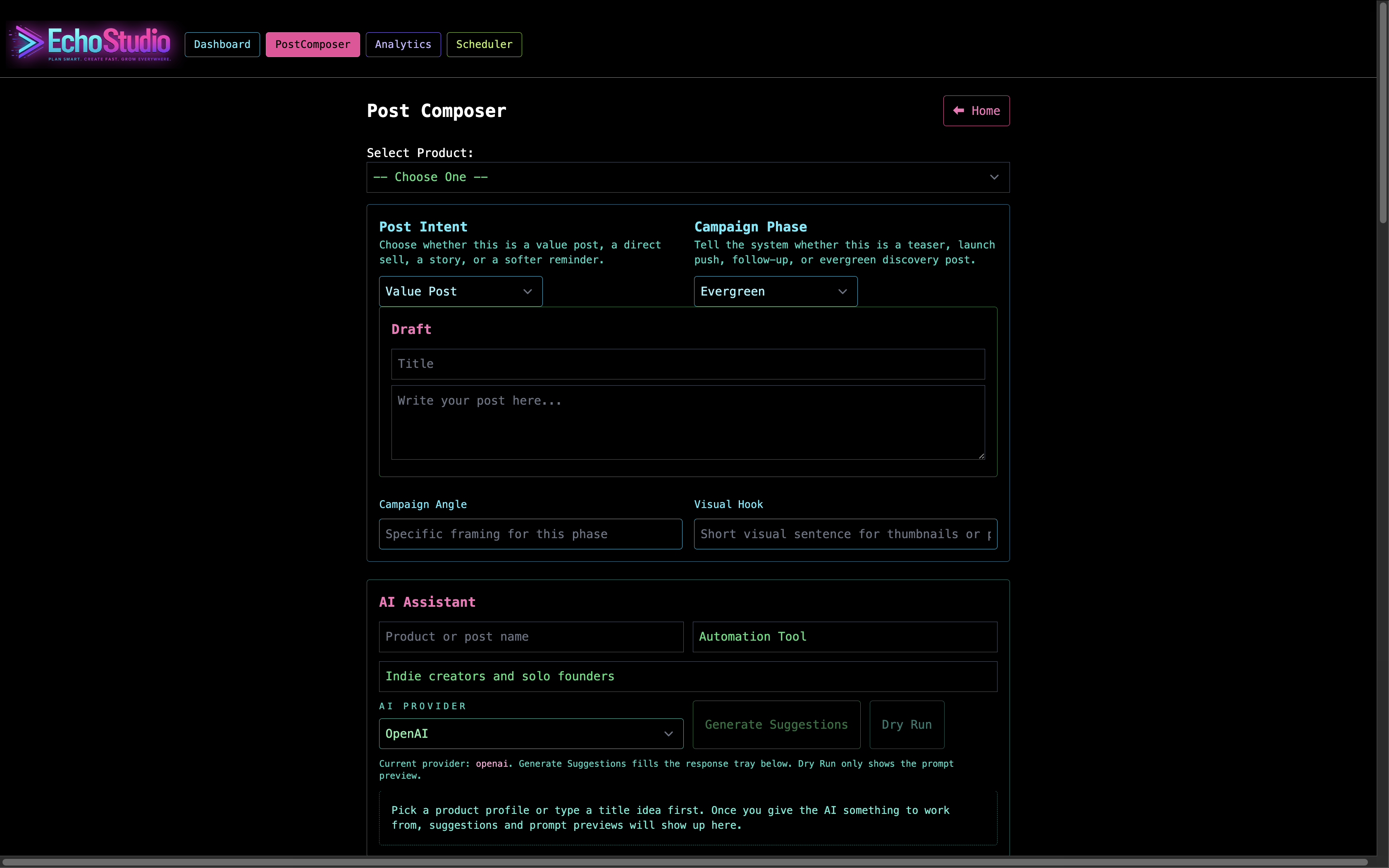
- Post composition tools
The backend provides REST endpoints for campaign data, posts, scheduling, product profiles, knowledge sources, and generation workflows.
The AI layer supports OpenAI models and an optional local Ollama provider through a shared configuration layer.
I deployed the public frontend and backend separately on Vercel.
I adapted Echo Studio from an earlier internal project called PostPunk. PostPunk already contained content queues, scheduling, platform integrations, and publishing automation. During OpenAI Build Week, I substantially redesigned and expanded that foundation into a campaign-first product.
My Build Week work included:
- Creating the Echo Studio campaign workflow
- Building the Mission Intake experience
- Creating Echo Brain
- Adding campaign strategy generation
- Redesigning navigation and the user interface
- Building the campaign library
- Adding product profile selection
- Creating scheduling and product rotation controls
- Building performance and publishing views
- Adapting real PostPunk data into a focused demo database
- Deploying the frontend and backend
- Writing project and architecture documentation
I used Codex as an implementation partner for frontend development, backend integration, routing, debugging, refactoring, and documentation.
I used ChatGPT to help refine product strategy, prompts, marketing logic, documentation, and submission content.
I remained responsible for the product vision, architecture, campaign workflow, marketing logic, interface decisions, and feature prioritization.
Challenges I ran into
Turning an internal system into a clear product
PostPunk had grown into a large internal automation system with many routes, scripts, platform adapters, queue tools, and experimental features.
The biggest product challenge was not adding more functionality. It was creating a clear user journey.
I reorganized the experience around one understandable sequence:
Business Goal → Strategy → Content → Assets → Review → Schedule → Publish
Adapting platform-specific content
Generating one generic caption and copying it everywhere would have been easier, but it would not solve the real problem.
Pinterest, Facebook, and Dev.to have different audiences, formats, search behavior, and trust expectations. Echo Studio needed to preserve one campaign strategy while adapting the execution for each platform.
Deploying an automation system to Vercel
The original PostPunk system was designed to use persistent workers, local files, private credentials, and connected publishing accounts.
Vercel uses a serverless architecture, so the public deployment could not safely run the full private production system.
I separated the public demonstration layer from the private automation layer. The deployed demo shows campaigns, generated posts, assets, scheduling data, and publishing workflows without exposing credentials or running background publishing workers.
API usage limits
I implemented and used the OpenAI generation pipeline during development.
Live generation is currently unavailable in the public demo because additional OpenAI API calls would require purchasing more API credits. Instead, the public demo includes pre-generated campaigns and posts so reviewers can inspect the actual results of the generation pipeline and continue through the rest of the workflow.
The interface demonstrates how generation connects to strategy, review, scheduling, and publishing, but reviewers should not expect new live AI generations from the hosted version.
Accomplishments I’m proud of
- I built a complete campaign-first marketing workflow.
- I deployed both the React frontend and Express backend.
- I created a focused public demo with four campaigns and 45 real posts.
- I built Echo Brain to assemble marketing context before generation.
- I adapted content for Pinterest, Facebook, and Dev.to.
- I connected campaign strategy, content, assets, review, scheduling, and publishing.
- I reused and meaningfully transformed a working automation foundation.
- I preserved private data and credentials while still demonstrating the workflow.
- I built something based on a problem I repeatedly face as a creator.
The project is more than an AI text box.
It shows what happens before and after content generation.
What I learned
The biggest lesson was that content generation is only one part of marketing.
Creators still need to:
- Decide what they are trying to accomplish
- Understand the audience
- Position the product
- Adapt content for each platform
- Organize images and supporting assets
- Review the content
- Schedule it
- Publish it
- Track what already happened
AI is useful for execution, but it does not remove the need for product judgment or workflow design.
I also learned that adapting an existing project can require significant new work. Echo Studio shares infrastructure with PostPunk, but I substantially redesigned the product structure, user experience, campaign workflow, strategy layer, and public demonstration during Build Week.
Finally, I learned that honest limitations make a demo stronger. The public version does not pretend to run private workers or unlimited API calls. It demonstrates the real workflow while clearly separating hosted capabilities from private production infrastructure.
What’s next for Echo Studio
My next goal is to turn the prototype into a secure multi-user product.
Planned improvements include:
- User accounts and workspaces
- Product and brand onboarding
- OAuth connections for publishing platforms
- Secure user-provided AI credentials
- Persistent production scheduling workers
- Live publishing status updates
- Campaign analytics
- Content performance comparisons
- Additional publishing platforms
- AI image generation
- Reusable campaign templates
- Team collaboration
- Shared knowledge libraries
- Expanded accessibility and mobile support
The long-term goal is simple:
A creator enters one business goal, reviews the resulting campaign, and manages the entire cross-platform workflow from one place.
Build Once. Market Everywhere.
Live publishing proof
The public demo does not run the private publishing workers, but the underlying system has been used to publish real content.
Reviewers can visit my connected creator profiles to see posts created and distributed through the broader Echo Studio and PostPunk workflow:
These profiles show that the project is not only a static interface or design concept. The workflow has been used to create, schedule, and publish real content across the supported platforms.
Built With
- api
- codex
- css
- express.js
- github
- javascript
- node.js
- openai
- playwright
- prisma
- react
- rest
- sqlite
- tailwind
- vercel
- vite

Log in or sign up for Devpost to join the conversation.