-
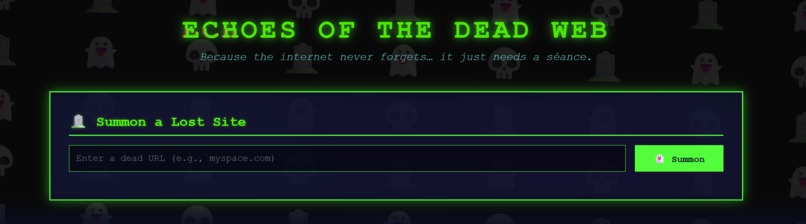
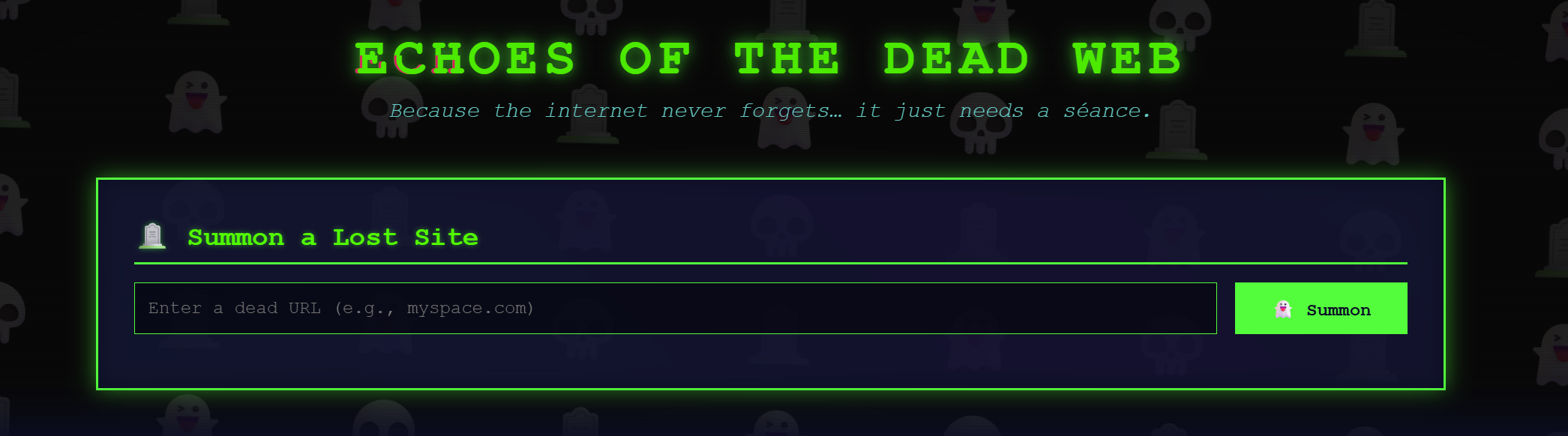
Echos of the Dead Web
Inspiration
I was deep into research one night, following a trail of references about early web design, when half the links just... died. 404 after 404. I knew these pages existed somewhere in the Wayback Machine, but manually copying URLs and hunting through snapshots felt like digital archaeology with a toothbrush.
That frustration sparked a question: what if dead links could resurrect themselves? What if we could make the web remember its own history, automatically and beautifully? The internet has ghosts - billions of dead pages floating in archives. We just needed to give them a way back.
What it does
Echoes of the Dead Web is a Chrome extension that automatically detects and resurrects dead links using archived snapshots from the Wayback Machine. But it's more than just a link fixer - it's a complete digital séance experience.
When you encounter a 404, our extension summons the archived version and displays it as a "ghost" overlay with gothic aesthetics. The interface speaks in the voice of a Gothic Archaeologist, treating lost websites with reverence ("The spirits are silent..." instead of boring error messages).
Every resurrection is tracked and analyzed by AI. We built a real-time "Monster Visualization" that shows resurrection events happening across the web globally - a living map of digital archaeology in action. AWS Bedrock analyzes each resurrected site, learning patterns about web mortality and building a knowledge base of internet history.
How we built it
Frontend: Chrome Extension (Manifest V3) with content scripts that monitor every link on pages you visit. React + Vite powers the Monster visualization dashboard with real-time WebSocket updates.
Backend: AWS serverless architecture using CDK for infrastructure as code:
Lambda functions handle snapshot fetching from Wayback Machine API Another Lambda analyzes content using AWS Bedrock (Claude) DynamoDB stores resurrection events and lineage data API Gateway with WebSocket support broadcasts events in real-time The Flow: Content script detects dead links → Lambda fetches archived snapshot → AI analyzes the content → Event stored in DynamoDB → WebSocket broadcasts to all connected clients → Monster visualization updates globally.
We wrapped everything in gothic aesthetics - phosphor green terminals, CRT scanlines, ghost cursors, and mystical language that makes digital archaeology feel like actual archaeology.
Challenges we ran into
Chrome Extension Architecture: Manifest V3's service worker model was brutal. Background scripts that sleep, message passing between isolated contexts, and CSP restrictions that block everything. We spent hours debugging why WebSockets wouldn't connect (service workers can't maintain persistent connections - had to use a hybrid REST/WebSocket approach).
CORS Nightmares: Fetching archived pages directly from archive.org? Blocked by CORS. We had to proxy everything through Lambda, adding latency but maintaining security.
iframe Chaos: Archived pages often have broken JavaScript, missing CSS, or security policies that prevent embedding. We inject custom styles and scripts, but some sites just refuse to cooperate gracefully.
Real-time Synchronization: Getting WebSocket connections working across Chrome extension contexts, AWS API Gateway, and Lambda was complex. We ended up with extensions posting to REST API, Lambda broadcasting to WebSocket, and the visualization subscribing to updates.
Cost Management: Every resurrection triggers a Bedrock API call. At scale, costs could spiral. We implemented intelligent caching and rate limiting to keep it sustainable for a hackathon project.
Accomplishments that we're proud of
It Actually Works: Clicking a dead link and watching it resurrect with a gothic animation never gets old. The core functionality is solid and genuinely useful.
The Aesthetic: We didn't just build a tool - we built an experience. The Gothic Archaeologist persona transforms mundane error messages into something atmospheric and memorable.
Real-time Global Visualization: Watching the Monster update as resurrections happen worldwide feels magical. It's not just your data - it's a collective view of the web's memory being accessed.
AI Integration That Matters: Bedrock isn't just a checkbox feature. It's identifying real patterns - which types of sites die most, what content gets lost, temporal patterns in web decay. The insights are genuinely interesting.
Full AWS Stack: We went deep on AWS services - Lambda, DynamoDB, Bedrock, API Gateway, WebSockets, CDK for IaC. This is a production-ready architecture, not a hackathon hack.
What we learned
Manifest V3 is a Different Beast: Chrome extensions have evolved. The security model is stricter, the architecture is more complex, but it forces you to build better, more secure extensions.
The Wayback Machine is Incredible: 866 billion archived pages. The Internet Archive is doing heroic work preserving web history. Their API is robust, though CDN performance varies.
AI Adds Unexpected Depth: We initially added Bedrock as a "cool feature." But the pattern recognition - startup acquisition correlations, CMS mortality rates, content type survival - turned into genuine research value.
Real-time is Hard But Worth It: WebSocket architecture across distributed systems is complex, but seeing live updates makes the experience feel alive and connected.
Aesthetics Transform Utility: The same functionality with boring UI would be forgettable. The gothic theme makes people want to encounter dead links just to see the resurrection animation.
What's next for Echo's of the Dead Web
Predictive Resurrection: Train AI to predict which links are likely to die based on domain age, hosting patterns, and content type. Pre-cache them before they vanish.
Collaborative Curation: Let users annotate resurrected sites, add context, and build a collective memory layer on top of archived content.
Distributed Preservation: Don't rely solely on Wayback Machine. Integrate multiple archives (Archive.today, Perma.cc) and even enable peer-to-peer caching.
Browser Integration: Partner with browser vendors to make this a native feature. Every browser should have digital archaeology built in.
Academic Research Tools: Build specialized features for researchers - citation preservation, temporal analysis, content evolution tracking.
Mobile Support: Bring the séance to mobile browsers where dead links are even more frustrating.
The web is ephemeral. 50% of links in Supreme Court opinions are dead. Academic papers reference URLs that no longer exist. Our digital history is evaporating faster than we're preserving it. This project is a small step toward making web preservation automatic, beautiful, and accessible to everyone.
The internet has ghosts. We're just giving them a voice.
Built With
- amplify
- apprunner
- bedrock
- css3
- dynamodb
- frontend)-python-3.11-(lambda-functions
- javascript
- lambda
- python
- react18
- vite
- websocket

Log in or sign up for Devpost to join the conversation.