-
-
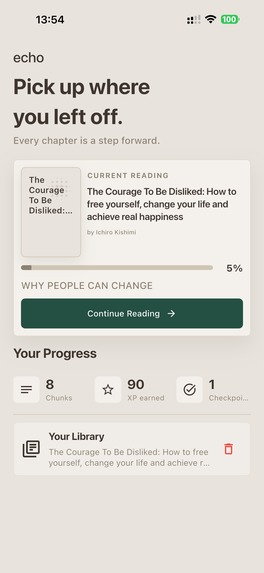
Dashboard with book uploaded and progress tracker
Inspiration
I build software to solve problems I face myself.
Reading is one of my favourite things to do, but it's also one of the things I struggle with the most. I have ADHD, and staying focused long enough to finish a chapter—or remembering what I read a few pages ago—is often harder than it should be. Too many books end up forgotten, not because I don't enjoy them, but because my brain has already moved on.
I tried reading apps and AI summaries. They helped me finish books, but they didn't help me truly learn from them. I wasn't looking for something to replace reading—I wanted something that I could read alongside me, to help me stay in the moment.
That's why I built Echo.
Echo isn't designed to read books for you. It's designed to become your companion while you read. It understands the kind of book you're reading and adapts how it teaches. A programming book becomes an interactive coding mentor. A self-improvement book becomes a coach that encourages reflection and action. A novel becomes an immersive adventure.
For me, Echo transforms reading from a task my brain eventually gives up on into an adventure I want to continue.
My hope is that it can do the same for anyone who has ever loved learning but struggled to stay engaged long enough to enjoy it.
Tagline
Turn reading into an adventure.
Vision
Echo helps people stay engaged while reading by transforming books into interactive learning journeys. Instead of passively reading page after page, readers progress through quests, make decisions, answer challenges, and build understanding as they go. Echo is designed for people who struggle with traditional reading experiences, especially those who lose focus, forget what they have read, or find it difficult to stay engaged with long-form content.
The goal is not to replace books. The goal is to help readers finish them.
What it does
Instead of treating every book the same, Echo first understands what you're reading and adapts how it teaches. A programming book becomes an interactive coding mentor with practical challenges. A self-improvement book encourages reflection and helps turn ideas into habits. A novel becomes an immersive reading adventure that keeps you engaged with characters, themes, and predictions.
Rather than replacing reading with summaries, Echo works alongside the reader. It explains difficult concepts, answers questions, creates quizzes, encourages reflection, and remembers previous reading sessions to build long-term understanding.
The goal isn't simply to finish books. The goal is to understand, remember, and enjoy them.
My next goal is to add AI so that the adventure becomes even more fulfilling. AI will help checkpoints make sense, depending on the book that was uploaded.
How I built it
Echo uses Flutter, so the same product experience can run on iOS and Android.
The EPUB parser reads the package manifest and spine, extracts readable XHTML, preserves semantic headings and code blocks, and falls back to structural code detection when an EPUB has flattened its formatting.
Memory sparks are generated locally from the chapter title. They do not claim to grade comprehension and never require the reader to type an answer. The reader is a continuous vertical flow. Tapping reveals the next reading beat, gently fades completed text, and keeps the newest passage at full emphasis. Challenges and feedback appear in that same flow rather than opening separate screens.
Codex was used as a development partner for architecture, implementation, testing, and iterative UI refinement.
Throughout development, Codex became an invaluable development partner. It helped me iterate on ideas, review architecture, refactor code, and explore different approaches, allowing me to spend more time refining the learning experience.
Challenges I ran into
One of the biggest challenges wasn't technical—it was deciding what Echo shouldn't do.
It was tempting to build another AI chatbot that could answer questions about books, but that wasn't the vision. I wanted Echo to become a learning companion rather than simply another interface to an LLM.
Designing prompts that adapt to different genres, keeping enough context for meaningful conversations, and balancing guidance without overwhelming the reader were all interesting challenges.
I also had to constantly ask myself a simple question:
"Does this feature really help me, and can it help someone learn better, or is it just another AI feature?"
That question shaped almost every decision we made. Having ADHD, choosing the design, colours and behaviour has been tough for me. Anything that makes me lose interest means the app needs changing, which happened a lot.
Accomplishments that I am proud of
I am really proud that Echo isn't another summarisation tool.
Instead, I've built the foundations of a companion that adapts to different books, different readers, and different ways of learning.
I am also proud that the project grew from a personal challenge into something that has the potential to help many others who struggle with focus, retention, or simply finding the motivation to keep reading.
Most importantly, I am proud that Echo encourages people to learn alongside AI instead of letting AI do the learning for them.
What I learned
Building Echo reinforced an important lesson:
AI is most powerful when it teaches instead of replacing the learning process.
I also learned that good AI experiences are rarely about writing better prompts alone. They're about understanding the user's intent, maintaining context, designing thoughtful interactions, and knowing when AI should guide rather than answer.
Finally, I learned that building from a personal problem leads to better products. Solving my own frustrations forced me to stay focused on creating something genuinely useful instead of adding features for the sake of novelty.
What's next for Echo
This hackathon is only the beginning.
I want Echo to become a true AI learning companion that supports many different ways of learning, from books and PDFs to technical documentation, lectures, and educational videos. All as a big adventure.
Future versions will introduce richer long-term memory, adaptive teaching personalities, spaced repetition, hardware integrations through Echo Desk, and deeper personalisation so every learning journey feels unique.
My long-term vision is simple:
To build the companion I wish I'd always had—one that helps people keep learning, stay curious, and never give up on the things they love.
Built With
- codex
- flutter

Log in or sign up for Devpost to join the conversation.