-
-

Demo capture
-
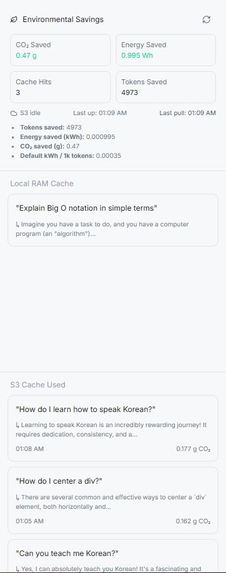
Demo capture; cache/sustainability pane


Internal Track:
- Sustainability
Sponsor Tracks:
- Redbull Basement - Most Likely to be a Startup
- Peraton - Best UI/UX
MLH Tracks:
- Best Use of Google Gemini API
Echo: The Carbon-Aware Hive Mind
Inspiration
Every time a user types "Hello" or asks a common question like "How do I center a div?", massive GPU clusters in data centers burn kilowatt-hours of energy to generate the exact same answer they generated five seconds ago. We realized that while LLMs are brilliant creators, they are terribly inefficient storage devices.
Why burn a forest to answer a question we already know?
I wanted to build a system that treats intelligence as a shared, sustainable resource. A green hive mind if you will. It gets faster, cheaper, and cleaner the more people use it.
What it does
Echo is a carbon-aware conversational AI that moves the heavy lifting of understanding to the edge.
Instead of sending every token to a cloud GPU, Echo uses the user's browser to generate vector embeddings. It then checks a distributed semantic cache, which is synchronized via AWS S3.
- If the community has asked it before: The answer is returned instantly from memory.
- If it's new: We call Google Gemini, generate the knowledge, and then save it to the cache storage as a new vector, for everyone else.
How I built it
1. Frontend
I built the frontend using SvelteKit, Tailwind, and borrowed couple of Shadcn UI components. Crucially, inference implemented using @xenova/transformers.
- We run the
all-MiniLM-L6-v2model directly in the user's browser. - This converts user text into a 384-dimensional vector locally, meaning we don't even need to wake up the server to understand the user's intent.
2. Backend
I chose golang for its raw speed, lightweight and concurrency primitives. The backend manages an in-memory MockVectorDB protected by sync.RWMutex for thread safety.
When a query arrives, it performs a cosine similarity search against our knowledge base. The similarity score between the user's query vector and a cached vector is calculated here. If similarity score is >0.9, we consider it a semantic match and serve the cached response.
3. AWS S3
To make the system collaborative, I chose AWS S3 as a global synchronization layer.
- On startup and periodic intervals, the server downloads the latest
cache.jsondump from S3. - When new response is generated by Gemini, it is batched and uploaded to S3 every 300 seconds.
- This architecture allows multiple instances of Echo to share knowledge asynchronously without the overhead of a heavy database cluster.
Challenges
- Initially, in-memory cache was empty every time we restarted the server. Implementing the cache sync with S3 was tricky. I had to handle race conditions where the backend tries to read from S3 while simultaneously writing new cache entries. I solved this using Go's channels and batched uploads.
- Implementing raw matrix math in Go was a fun challenge. I had to ensure the dot product calculations were optimized to keep latency under 5ms, even as the cache grew.
Accomplishments that I am proud of
I built a mathematical model to estimate energy savings that resulted from applying caching method to chat apps.
Successfully ran a transformer model in the browser. It proves that the future of AI software is hybrid: +cloud.
The difference between waiting 5 seconds for Gemini and 50ms for the cache is significant. It transforms the chat experience.
What I learned
- I learned that intelligence doesn't always mean generation. Sometimes, intelligence is just memory.
- The transition from Java/.NET to Go gave me a massive performance boost, especially for the vector search loops. Such a lightweight too.
- Green software isn't about planting trees; it's about writing efficient code that prevents hardware from waking up unnecessarily.
What's next
The current version is obviously an MVP, but the architecture is ready to scale.
- Replacing the in-memory JSON slice with a proper Vector Database (PostgreSQL + pgvector) for scale.
- Currently, our similarity threshold is fixed at 0.90. We want to use AI to dynamically adjust this based on the complexity of the topic.
- Adding a session layer so the cache can be distinguished between public and private context.
- Privacy. User should be able to choose if they want to share the response to cache it, or not. If user forgot to opt out, a method to recognize personal information and scrap the cache must be implemented.

Log in or sign up for Devpost to join the conversation.