Inspiration
Film production involves shooting the same scene multiple times, often with small changes in dialogue. A single improvised word can seem harmless on set but create a continuity problem when an editor tries to intercut different takes. We wanted to solve this problem at the moment it happens, rather than weeks later in post-production.
What it does
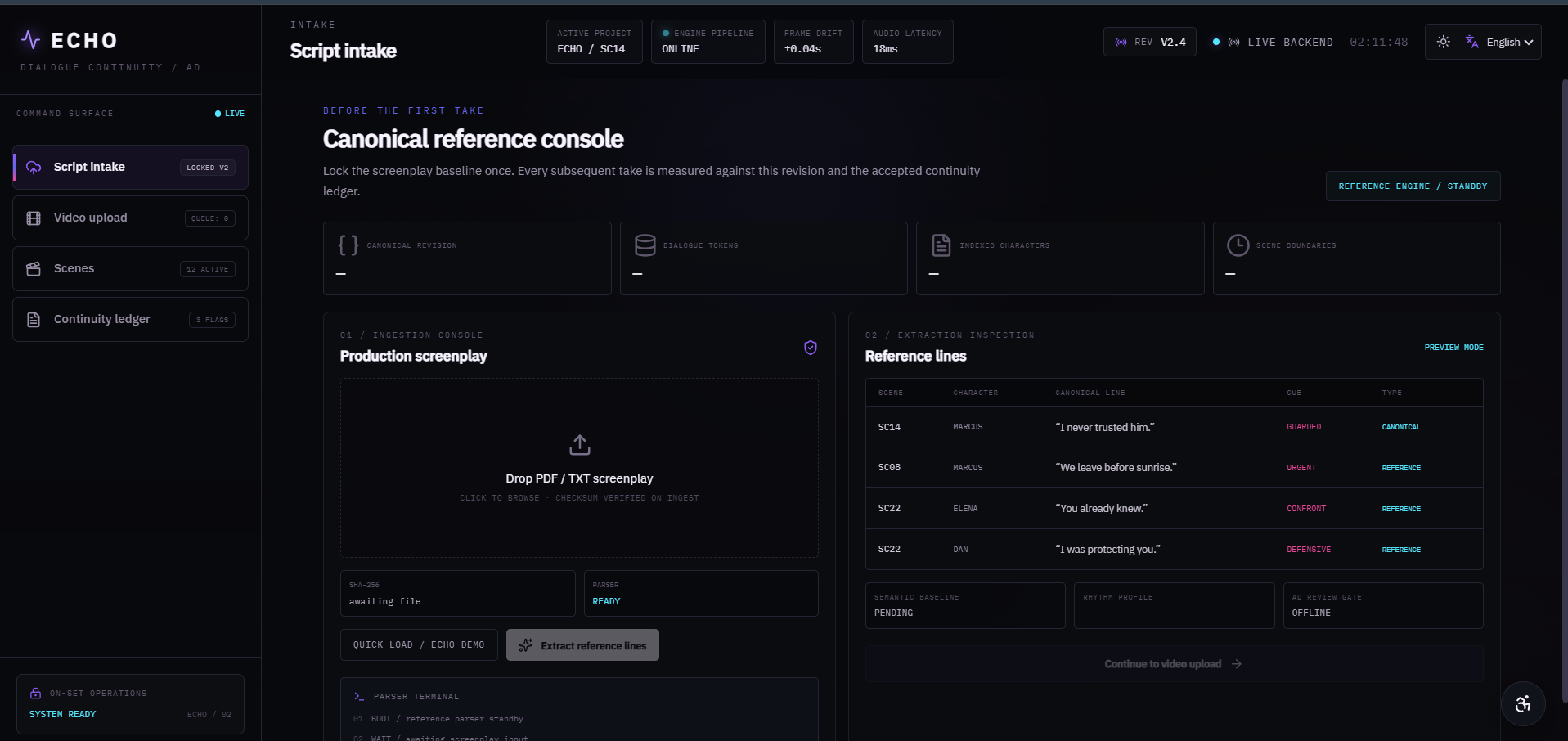
ECHO is a real-time dialogue continuity agent for film production. It compares each take against the canonical script and previously recorded takes, identifies meaningful dialogue variations, and classifies them as MATCH, ACCEPTABLE_ADLIB, or DRIFT.
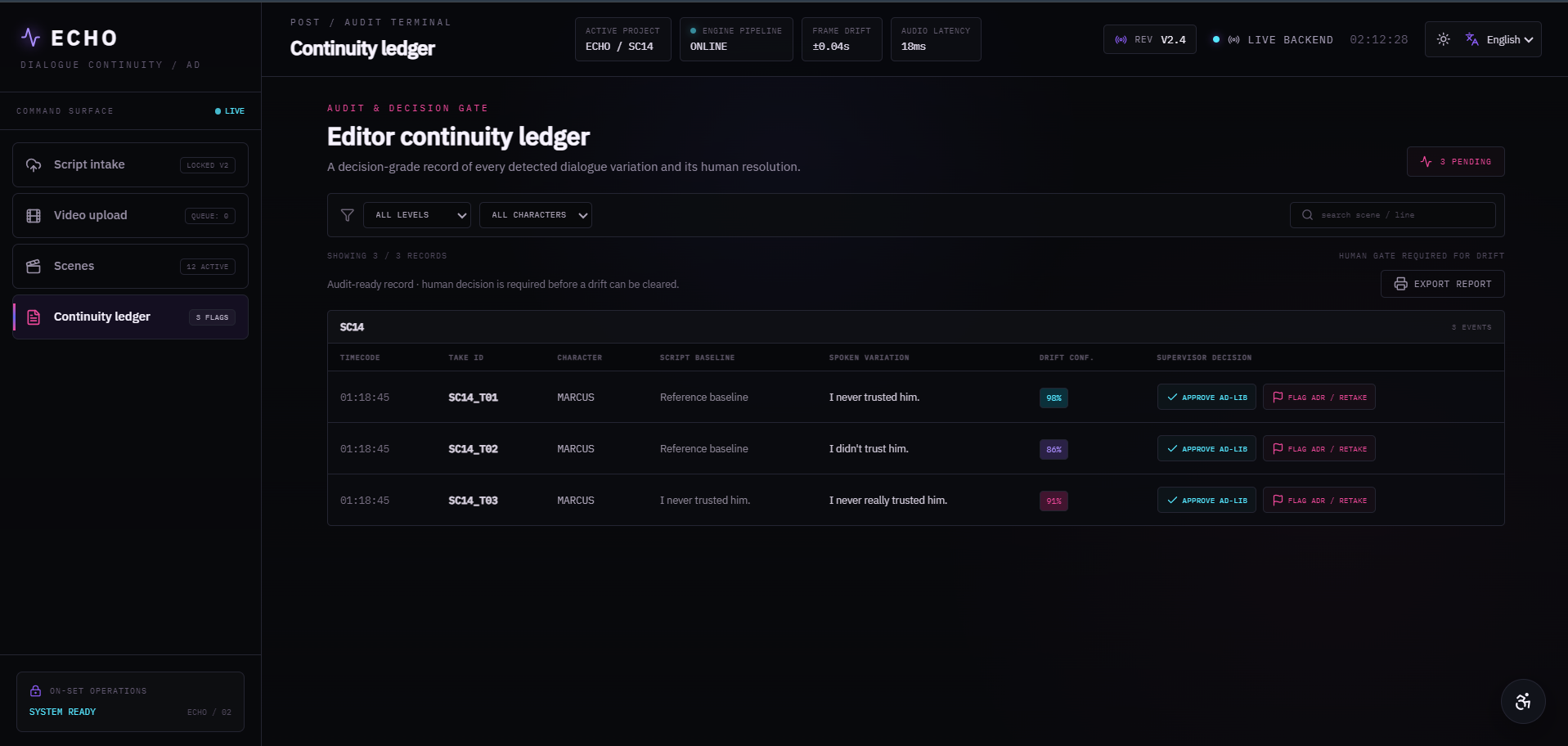
When drift is detected, ECHO highlights the diverging phrase, explains why it may affect continuity, and sends it to a human approval gate. The production team can accept the variation or flag it for a reshoot.
How we built it
ECHO uses a streaming architecture connecting the production workflow to an AI analysis pipeline.
The screenplay is first converted into canonical reference lines. Recorded takes are streamed through Kafka, where the dialogue analysis pipeline compares each take with the script and prior takes. The backend stores scene and take state and exposes it through an API to the production dashboard.
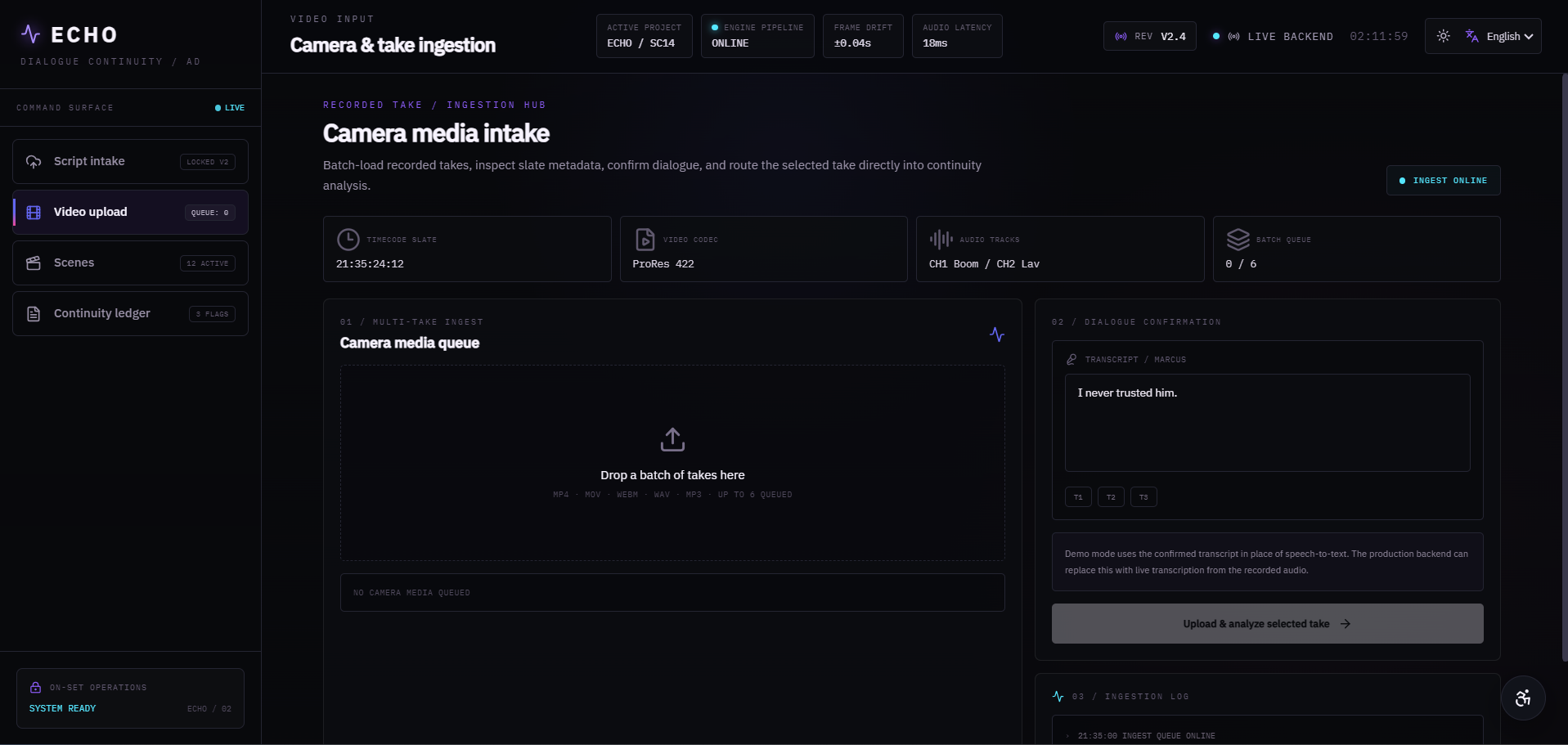
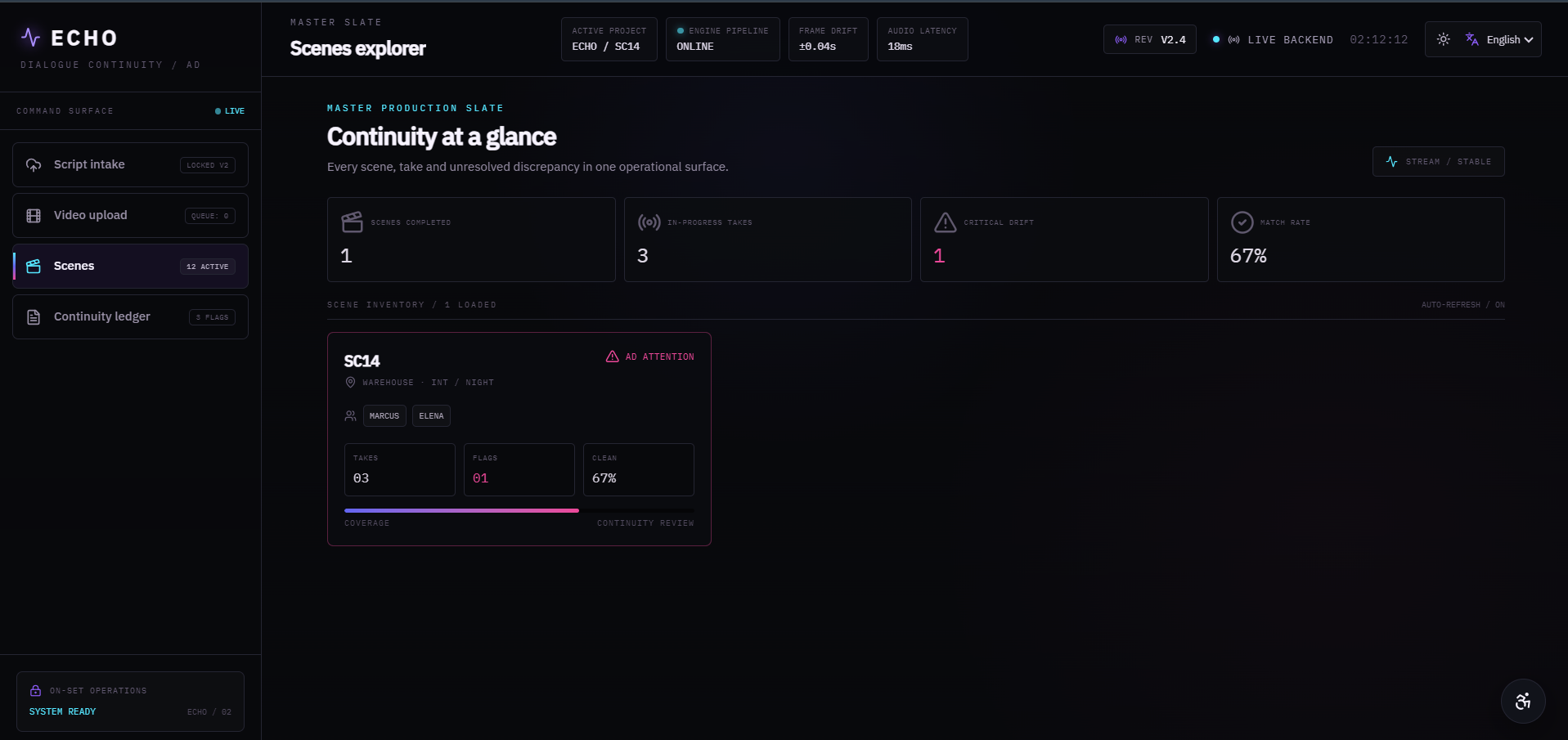
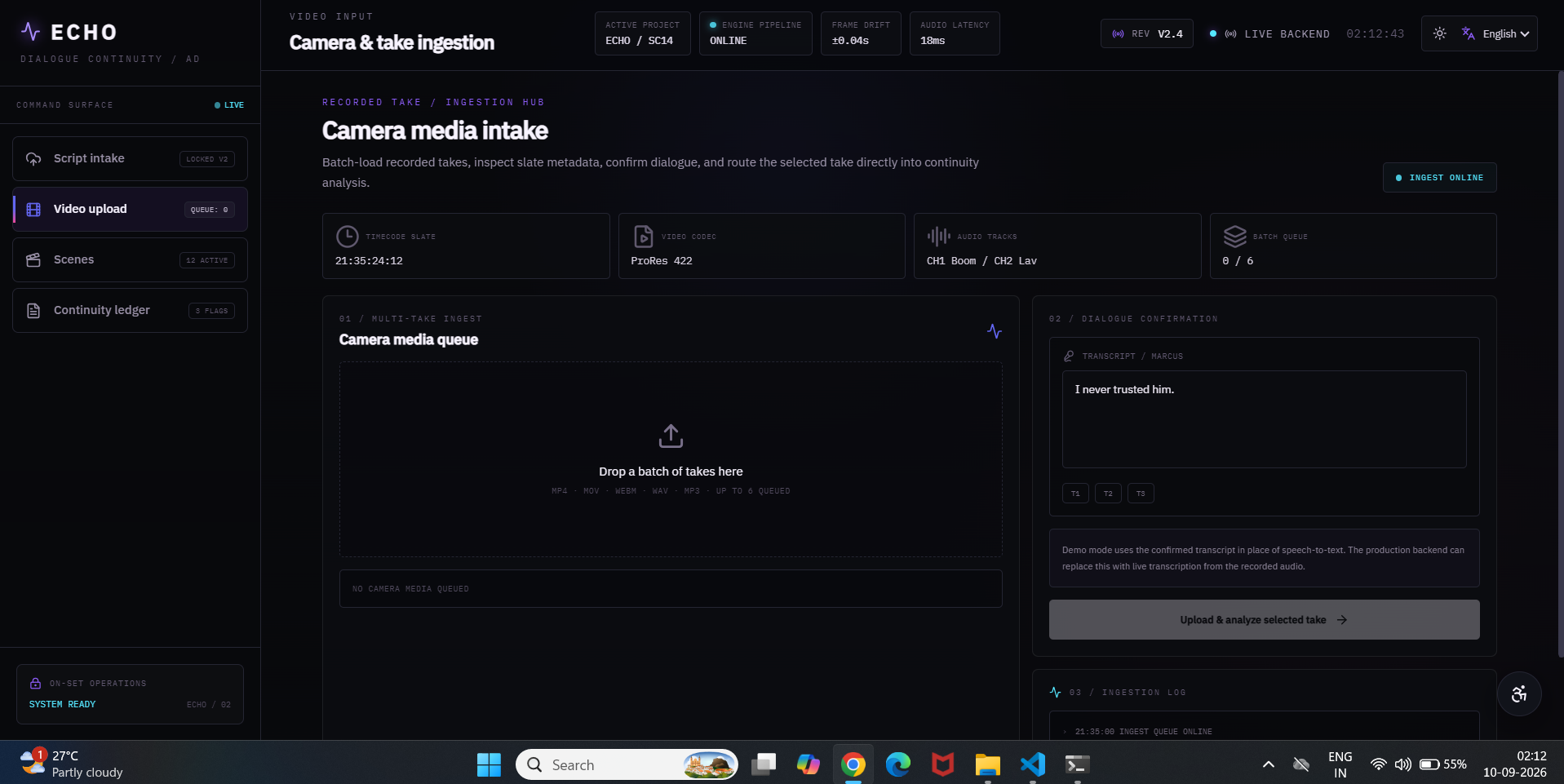
The frontend provides a command-center interface for script intake, camera/take ingestion, scene monitoring, comparison, and the continuity ledger. The system also maintains idempotency so duplicate events do not create duplicate take records.
For our working demo, we use a controlled SC14 sequence to demonstrate the complete flow from reference dialogue to classification and human decision.
Challenges we ran into
The biggest challenge was making dialogue comparison useful for real production rather than treating every wording difference as an error. Actors naturally improvise, so the system needs to distinguish harmless variations from changes that could make takes difficult to intercut.
We also had to connect asynchronous streaming analysis with a live production interface while keeping the human approval step explicit. Another challenge was creating a reliable local demonstration environment across the streaming, backend, and frontend components.
Accomplishments that we're proud of
We built an end-to-end working prototype rather than only an AI classifier.
In our SC14 demonstration, ECHO correctly identifies:
MATCH— "I never trusted him."ACCEPTABLE_ADLIB— "I didn't trust him."DRIFT— "I never really trusted him."
For the drift case, ECHO identifies the word "really", reports high confidence, explains the continuity risk, and routes the decision to a human.
We are especially proud that the system does not replace the production supervisor. AI detects and explains the issue, while the human makes the final decision.
What we learned
We learned that production AI needs to be explainable and workflow-aware, not simply accurate. A useful system must understand context, preserve previous decisions, handle uncertainty, and know when to involve a human.
We also learned how streaming events, AI analysis, APIs, persistent state, and a real-time interface can work together as one production workflow.
What's next for ECHO
The next step is to move from the controlled demo into a production-ready pipeline with live speech-to-text, stronger script extraction, richer scene and character context, persistent human decisions, and cloud deployment.
We envision ECHO becoming an always-on continuity assistant for the set: quietly monitoring takes, catching dialogue drift as it happens, and giving editors and production teams a reliable continuity record before problems reach post-production.


Log in or sign up for Devpost to join the conversation.